
UK Smart Toilet Market Size and Forecast 2025–2033
How Smart Bathrooms Are Redefining Hygiene, Sustainability, and Home Comfort in the United Kingdom

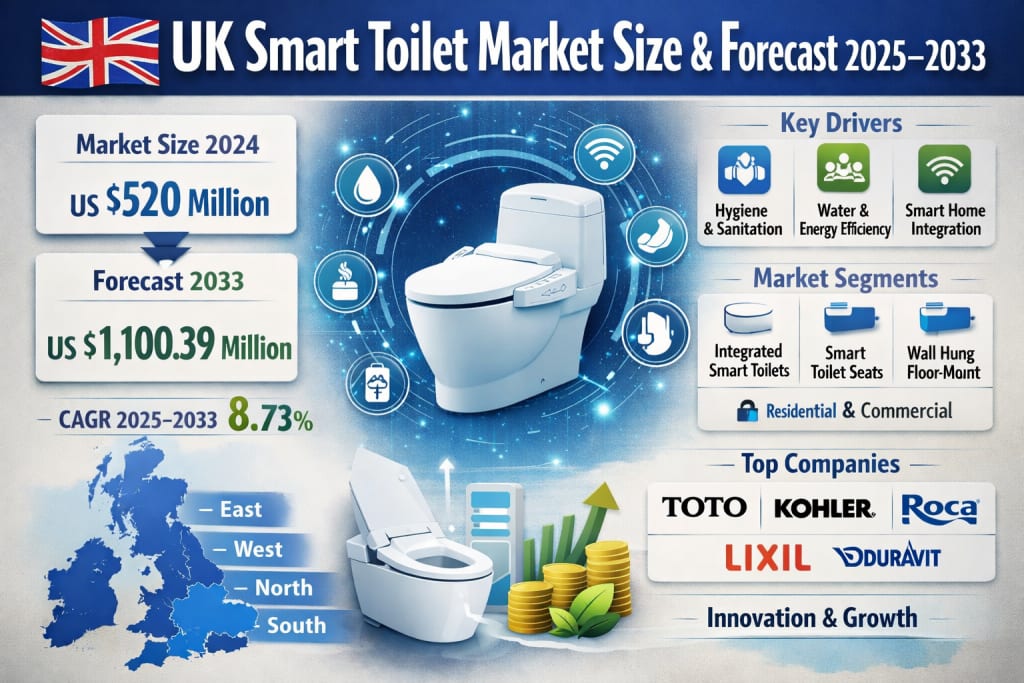
The United Kingdom smart toilet market is entering a phase of steady and transformative growth, reflecting broader changes in how consumers think about hygiene, comfort, and sustainable living. According to Renub Research, the UK smart toilet market is expected to reach US$ 1,100.39 million by 2033, rising from US$ 520 million in 2024. This expansion represents a compound annual growth rate (CAGR) of 8.73% from 2025 to 2033, highlighting how quickly advanced bathroom technologies are moving from luxury niches into more mainstream adoption.
The momentum behind this growth is not accidental. Rising awareness of hygiene, increasing pressure to conserve water and energy, and the rapid spread of smart home ecosystems are all reshaping consumer expectations. Bathrooms, once purely functional spaces, are now becoming integrated parts of the connected home—places where technology, comfort, and sustainability meet.
The UK Smart Toilet Market Forecast covers segmentation by Product (Integrated Smart Toilet, Smart Toilet Seats), Toilet Type (Floor-Mount, Wall Hung), End User (Residential, Commercial), Distribution Channel (Store-Based Sales, Supermarkets/Hypermarkets, Specialty Stores/Showrooms, Others, Online/E-Commerce), Region (East, West, North, South), and Company Analysis for 2025–2033. Together, these segments paint a detailed picture of a market that is evolving in both scope and sophistication.
UK Smart Toilet Market Overview
A smart toilet is a technologically advanced bathroom fixture equipped with features such as automatic flushing, heated seats, water-saving systems, self-cleaning functions, deodorizers, and integrated bidet technology. Many models also include motion sensors, touchless operation, air purification, and customizable user settings, making them more hygienic, comfortable, and efficient than traditional toilets.
In the UK, smart toilets are gaining popularity as awareness of hygiene, sustainability, and convenience continues to rise. These products are increasingly being installed in modern homes, luxury hotels, commercial buildings, and healthcare facilities, where cleanliness and user comfort are high priorities. Their water-saving capabilities align well with the UK’s environmental goals, while touch-free operation reduces the spread of germs—an especially important consideration in public and healthcare environments.
Another important driver is the expansion of smart home ecosystems. As more households adopt connected lighting, heating, and security systems, the bathroom is no longer left behind. Smart toilets now integrate seamlessly with home automation platforms, offering app-based controls, personalized settings, and even voice activation in some premium models. This shift is turning the bathroom into a more intelligent, efficient, and user-focused space.
Growth Drivers for the UK Smart Toilet Market
Increasing Awareness of Hygiene and Sanitation
One of the most powerful forces driving demand for smart toilets in the UK is the growing emphasis on hygiene and sanitation. Consumers are becoming more conscious of the health risks associated with traditional bathroom fixtures and are increasingly drawn to touchless, self-cleaning, and bidet-equipped solutions.
The COVID-19 pandemic significantly accelerated this shift, reinforcing the importance of minimizing contact with high-touch surfaces and improving overall cleanliness in both homes and public spaces. Households, hotels, offices, and healthcare facilities have all shown greater interest in technologies that help reduce the spread of germs.
In April 2022, the UK’s “Support to Improved Water and Sanitation in Rural Areas” program (worth £50.6 million over 2012–2021) demonstrated the country’s broader commitment to hygiene and sanitation. The initiative provided hygiene kits to over 47,000 families, installed handwashing stations in public facilities, supported WASH services in schools, and supplied water treatment chemicals to municipalities. While this program focused on essential infrastructure, it reflects a wider cultural and policy-level focus on sanitation—an environment that naturally supports the adoption of advanced bathroom technologies like smart toilets.
Water and Energy Efficiency Regulations
Sustainability is no longer a niche concern in the UK—it is a central policy and consumer priority. The government has been actively encouraging water conservation and energy efficiency through regulations and incentives, and smart toilets fit neatly into this agenda.
Most smart toilets use dual-flush systems and optimized water flow technologies, significantly reducing water consumption compared to conventional toilets. Many models also feature energy-efficient heating systems, automatic power-saving modes, and intelligent sensors that minimize unnecessary energy use.
The UK’s engagement with global WASH (Water, Sanitation, and Hygiene) initiatives further underlines this focus. In recent years, parliamentary inquiries and reports have highlighted the link between poor sanitation and issues such as antimicrobial resistance (AMR). On World Water Day 2024, the UK released its “Manifesto for Water,” outlining key actions for future governments. While these initiatives are not limited to smart toilets, they create a regulatory and cultural climate that favors innovative, resource-efficient bathroom solutions.
Growth in Smart Home Integration
The rapid expansion of smart home technologies in the UK is another major catalyst for the smart toilet market. Consumers who already use smart thermostats, lighting systems, and security devices are increasingly interested in extending this convenience and connectivity to their bathrooms.
Modern smart toilets now offer app-based controls, user profiles, programmable settings, and even voice control in some high-end models. These features appeal particularly to high-income households and luxury property developers, who view smart bathrooms as a key differentiator in modern housing projects.
In April 2023, for example, Roca unveiled the In-Wash® Insignia shower toilet, designed to deliver enhanced comfort and hygiene through advanced digital and customizable features. Product launches like this highlight how manufacturers are positioning smart toilets not just as functional upgrades, but as premium lifestyle products.
Challenges in the UK Smart Toilet Market
High Initial Cost and Installation Complexity
Despite their advantages, smart toilets still face a significant barrier in the form of high upfront costs. Compared to traditional toilets, smart models are more expensive and often require professional installation, including electrical and plumbing modifications.
This complexity can discourage price-sensitive consumers and slow adoption, particularly in older homes where retrofitting may involve additional renovation work. While long-term savings from water and energy efficiency can offset some of these costs, the initial investment remains a key hurdle for broader market penetration.
Limited Consumer Awareness and Adoption
Another challenge is limited consumer awareness. While smart TVs, speakers, and thermostats are widely understood, smart toilets are still unfamiliar to many UK consumers. A lack of knowledge about their features, benefits, and long-term value can lead to hesitation and resistance.
Cultural habits also play a role. Bathrooms are traditionally seen as purely functional spaces, and some consumers are reluctant to change long-established routines. Over time, however, as more people experience smart toilets in hotels, offices, and public spaces, familiarity and acceptance are likely to grow.
UK Smart Toilet Market by Product
Integrated Smart Toilet Market
Integrated smart toilets are all-in-one units that combine the toilet, bidet, flushing system, and self-cleaning functions into a single, seamless product. These models are particularly popular in modern homes and upscale real estate developments, where design, convenience, and performance are equally important.
The growing preference for minimalist bathroom designs has further boosted demand for integrated models, as they reduce the need for additional fixtures while offering a wide range of advanced features in one compact unit.
UK Smart Toilet Seats Market
Smart toilet seats provide a more affordable and flexible entry point into the smart toilet market. These seats can be installed on existing toilets and typically include features such as heated seating, bidet functions, and touch or remote controls.
Their DIY-friendly nature and lower cost make them especially attractive to homeowners who want to upgrade their bathrooms without replacing the entire unit. In October 2024, TOTO launched the NEOREST NX, a premium smart toilet featuring auto-flush, heated seats, air cleaning, self-cleaning functions, and the company’s signature eWater+ technology, which uses electrolyzed water to keep the bowl clean. Such innovations continue to raise consumer interest across both full-unit and seat-based solutions.
UK Smart Toilet Market by Toilet Type
Wall-Hung Smart Toilet Market
Wall-hung smart toilets are gaining traction in the UK thanks to their sleek, space-saving design and ease of cleaning. Mounted directly on the wall, these models create a modern aesthetic and are particularly popular in urban apartments and contemporary commercial spaces where space efficiency matters.
Their compatibility with smart home systems and premium bathroom designs makes them a strong choice for high-end residential and commercial projects.
UK Smart Toilet Market by End User
Commercial Smart Toilet Market
Commercial spaces such as hotels, offices, airports, shopping centers, and healthcare facilities are increasingly adopting smart toilets to enhance user experience, improve hygiene standards, and reduce maintenance costs.
Features like touchless flushing, automatic seat sanitization, and water-efficient operation are especially valuable in high-traffic environments. In September 2021, Geberit launched the AquaClean Mera, a premium smart toilet designed for both residential and commercial use, featuring WhirlSpray shower technology, odor removal, and easy-to-use remote controls.
UK Smart Toilet Market by Distribution Channel
Store-Based Sales
Traditional bathroom showrooms and home improvement stores remain a dominant sales channel. Many consumers prefer to see and experience smart toilets in person, compare models, and receive expert advice before making a purchase. Leading brands often showcase their premium ranges in dedicated in-store displays.
Supermarkets and Hypermarkets
Large retail chains are increasingly offering mid-range smart toilet seats and models in their home improvement sections. Their broad reach, competitive pricing, and financing options make them an attractive channel for budget-conscious consumers seeking accessible upgrades.
Regional Insights
West UK Smart Toilet Market
The western regions of the UK, including cities like Bristol and Cardiff, are witnessing strong growth driven by high-income households, luxury housing projects, and green urban development initiatives. Investments in smart infrastructure and new residential construction continue to support market expansion here.
East UK Smart Toilet Market
In areas such as Cambridge and Norwich, adoption is being fueled by home automation trends and environmentally conscious consumer behavior. The presence of research institutions and a highly educated population further supports the uptake of advanced, water-efficient bathroom technologies.
United Kingdom Smart Toilet Market Segmentation
By Product:
Integrated Smart Toilet
Smart Toilet Seats
By Toilet Type:
Floor-Mount
Wall Hung
By End User:
Residential
Commercial
By Distribution Channel:
Store-Based Sales
Supermarkets/Hypermarkets
Specialty Stores/Showrooms
Others
Online/E-Commerce
By Region:
East
West
North
South
All key players are analyzed from four viewpoints: Overview, Key Person, Recent Developments, and Revenue.
Key Players in the UK Smart Toilet Market
Kohler Co.
TOTO Ltd.
Xiaomi
Roca Sanitario S.A.U.
LIXIL Corporation
Duravit AG
Masco Corporation
Wellis Inc.
Villeroy & Boch Group
JOMOO KITCHEN & BATH CO. LTD.
These companies continue to invest in innovation, design, and sustainability, shaping the future of smart bathroom solutions in the UK.
Final Thoughts
The UK smart toilet market is no longer just about luxury—it is increasingly about health, sustainability, and smarter living. With the market projected to grow from US$ 520 million in 2024 to US$ 1,100.39 million by 2033 at a CAGR of 8.73%, smart toilets are set to become a much more common feature in British homes and commercial spaces.
As awareness grows, costs gradually come down, and smart home ecosystems continue to expand, smart toilets will move from being a premium upgrade to a practical, forward-looking investment. For the UK, this market represents not just a technological trend, but a broader shift toward cleaner, more efficient, and more comfortable living environments.
About the Creator
Tom Shane
Tom Shane is a content writer specializing in SEO-driven blogs, product descriptions, and thought leadership. He crafts engaging, research-backed content that connects with audiences and drives results.
North America Powder Dietary Supplements Market Size and Forecast 2025
Market Snapshot The North America powder dietary supplements market is estimated to be around USD 9.33 billion in 2024 and is anticipated to grow to USD 23.35 billion by 2033, expanding at a CAGR of 10.78% between 2025 and 2033. This impressive growth is being driven by rising health awareness, increasing demand for vitamin and protein supplementation, and a strong consumer preference for convenient, nutrient-dense powdered formats.
By shibansh kumarabout 5 hours ago in Trader
📢 Raise Your Voice Thread: 02/05/2026
Our “Raise Your Voice Threads” are hosted most alternating Thursdays at 12PM ET to offer creators more avenues to uncover exceptional stories on Vocal. As we are continuously searching for fresh creators and inspiring stories, this thread provides an opportunity to exchange and discuss the stories that have moved and motivated us on Vocal.
By Raise Your Voice by Vocal4 days ago in Resources


Comments
There are no comments for this story
Be the first to respond and start the conversation.