
India Frozen Food Market Size & Forecast 2026–2034
Rising Convenience Culture, Expanding Cold Chains, and QSR Growth Are Reshaping India’s Food Habits

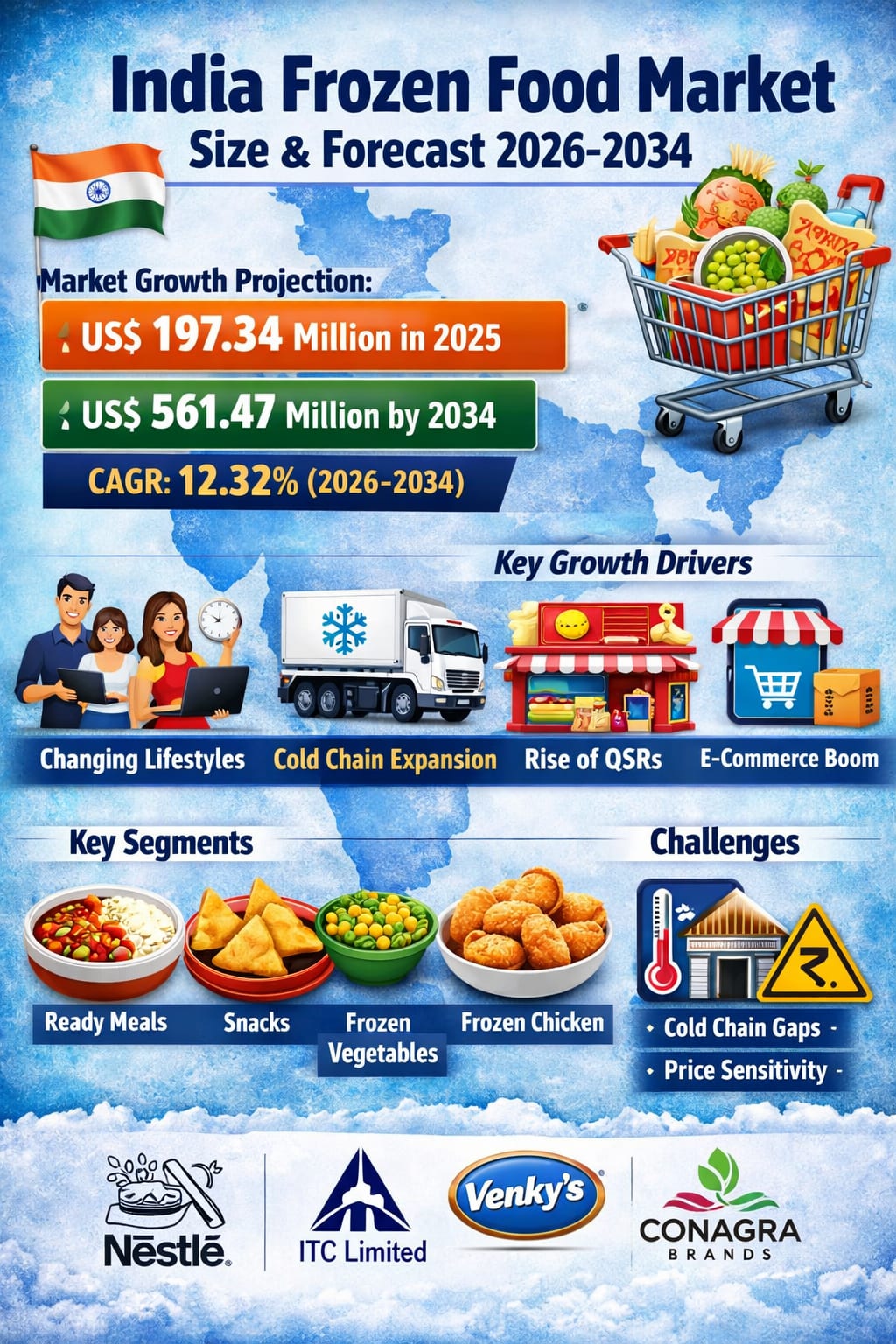
India Frozen Food Market: Big Shift in How India Eats
The India Frozen Food Market is entering a decisive growth phase, reflecting a broader transformation in how Indian consumers shop, cook, and eat. According to Renub Research, the market is expected to expand from US$ 197.34 million in 2025 to US$ 561.47 million by 2034, registering a strong CAGR of 12.32% during 2026–2034. This growth is being powered by changing lifestyles, rising demand for ready-to-cook and ready-to-eat foods, steady improvements in cold chain infrastructure, and the rapid expansion of modern retail and e-commerce platforms.
Frozen food refers to food products preserved through freezing to maintain freshness, taste, texture, and nutritional value over extended periods. The freezing process slows microbial growth and enzymatic reactions, enabling long-term storage without the need for heavy chemical preservatives. In India, the category now spans frozen vegetables, fruits, meat, seafood, snacks, ready meals, and ready-to-cook staples such as parathas, fries, nuggets, dumplings, and regional snacks.
Traditionally, Indian households have preferred fresh and home-cooked food. However, rapid urbanization, longer working hours, smaller family sizes, and a growing base of working professionals are steadily changing consumption patterns. Today, convenience, consistency, hygiene, and time efficiency are becoming just as important as taste and tradition. Frozen food, once limited largely to hotels and select urban supermarkets, is now increasingly finding space in home freezers across metro and Tier I cities—and gradually in Tier II and Tier III cities as well.
The expansion of quick-commerce, food delivery platforms, and organized retail has also made frozen food more visible and accessible. At the same time, investments in cold storage, refrigerated transport, and last-mile delivery are improving product quality and availability. Together, these factors are pushing frozen food from a niche category toward a more mainstream role in India’s evolving food ecosystem.
Key Growth Drivers of the India Frozen Food Market
Changing Lifestyles and the Demand for Convenience
One of the strongest growth drivers is India’s rapidly changing lifestyle. Urbanization, longer workdays, and the rise of nuclear families have reduced the time available for traditional cooking. Consumers are increasingly looking for meal solutions that are quick to prepare, easy to store, and consistent in quality.
Frozen foods such as ready-to-cook snacks, frozen vegetables, parathas, and QSR-style items fit neatly into this new lifestyle. Dual-income households, students, and young professionals—especially in metro and Tier I cities—are leading this shift. Portion control, standardized taste, and reduced preparation time make frozen products especially appealing for weekday meals and quick snacks.
Product launches in recent years reflect this trend. In May 2025, Gujarat-based HyFun Foods expanded its portfolio by introducing ready-to-cook frozen snack products such as Mumbai Aloo Vada, targeting the growing demand for Indianized frozen snacks. Such launches highlight how companies are localizing products to better match Indian tastes while still delivering convenience.
Expansion of Cold Chain Infrastructure and Retail Channels
A reliable cold chain is the backbone of the frozen food industry, and India has made notable progress in this area over the past decade. Investments in cold storage facilities, refrigerated transport, and temperature-controlled last-mile delivery are gradually reducing spoilage and improving product availability.
Modern retail formats such as supermarkets and hypermarkets have played a key role by providing freezer space, better product visibility, and consumer trust. At the same time, e-grocery platforms and quick-commerce services equipped with cold storage are extending the reach of frozen foods beyond traditional retail catchments.
As infrastructure gaps narrow, manufacturers can distribute products more efficiently across wider geographies. This not only lowers wastage and operating costs but also helps build consumer confidence in the quality and safety of frozen products. A notable example is BigBasket’s collaboration with chef Sanjeev Kapoor in March 2024 to launch the frozen foods brand Precia, offering frozen vegetables, appetizers, and traditional sweets. Such initiatives show how retail and branding strategies are evolving alongside infrastructure improvements.
Growth of QSRs, Foodservice, and Product Innovation
The rapid expansion of quick-service restaurants (QSRs), cafés, and food delivery platforms has significantly boosted demand for frozen ingredients and ready-to-cook products. For foodservice operators, frozen foods offer consistency, scalability, and cost efficiency—critical factors in a competitive, high-volume business.
On the consumer side, innovation is reshaping perceptions. Companies are increasingly offering Indianized frozen products such as samosas, kebabs, idlis, momos, and regional snacks tailored to local tastes. There is also growing interest in cleaner-label products that emphasize fewer preservatives and lighter processing.
In February 2025, ITC announced an agreement to acquire Prasuma, a leading player in the Indian frozen and chilled foods segment specializing in oriental cuisine. This strategic move is expected to strengthen ITC’s presence in high-growth frozen food categories and reflects how large FMCG players are betting on this segment’s long-term potential.
Challenges Facing the India Frozen Food Market
Cold Chain Gaps and Storage Constraints
Despite improvements, India’s cold chain infrastructure remains uneven, especially in Tier II, Tier III, and rural regions. Limited access to reliable refrigeration, inconsistent power supply, and high logistics costs can affect product quality and availability. Many small retailers also lack sufficient freezer space, which restricts product display and consumer choice.
These constraints increase operational costs for manufacturers and distributors and slow down geographic expansion. Until cold chain penetration becomes more uniform, market growth outside major urban centers will remain gradual.
Price Sensitivity and Consumer Perception
India is a highly price-sensitive market, and frozen foods are often perceived as more expensive than fresh alternatives. Additionally, some consumers still associate frozen food with preservatives, reduced freshness, or lower nutritional value—despite technological advances in freezing and packaging.
Overcoming these perceptions requires sustained consumer education, transparent labeling, and competitive pricing strategies. Building trust around quality, safety, and nutritional integrity remains a key task for brands operating in this space.
Segment Insights: How the Market Is Shaping Up
India Frozen Staple Food Market
Frozen staples in India include frozen vegetables, frozen grains, frozen rotis and parathas, and other ready-to-cook daily essentials. Demand is driven mainly by urban consumers seeking time-efficient alternatives that retain taste and nutritional value. The rise of working professionals and nuclear families supports this trend, as does the growing presence of freezers in Indian households.
While fresh staples continue to dominate overall consumption, frozen staples are gaining traction in metro and Tier I cities, especially for weekday meals and quick preparation needs. Localized products such as frozen chapatis and regional bread varieties further strengthen acceptance.
India Frozen Dairy Products and Alternatives Market
This segment includes ice cream, frozen desserts, butter, cheese, and plant-based alternatives. Ice cream remains the largest and most established category, supported by strong seasonal demand and wide brand recognition. Frozen cheese and dairy ingredients used in cooking are also seeing steady growth, particularly with the rise of home cooking and baking trends.
At the same time, increasing awareness of lactose intolerance and vegan lifestyles is driving interest in dairy alternatives. However, cold chain requirements and cost considerations still limit wider penetration beyond major urban centers. Overall, this is a value- and innovation-driven segment closely tied to lifestyle and indulgence trends.
India Frozen Chicken Market
Frozen chicken is one of the fastest-growing non-vegetarian segments, supported by rising protein consumption and increasing concern for food safety and hygiene. Products such as frozen chicken cuts, nuggets, sausages, and marinated items are gaining popularity, especially in urban markets.
Organized retail, specialized meat delivery platforms, and improved cold chain services have made frozen chicken more accessible. The QSR and foodservice sectors also rely heavily on frozen chicken for standardization and scalability. Although many consumers still prefer fresh meat from wet markets, acceptance of frozen chicken is steadily rising in metro and Tier I cities.
India Frozen French Fries Market
Frozen French fries are a high-growth segment, largely driven by the expansion of QSRs, cafés, and food delivery services. Fries are a staple menu item across both international and Indian food chains, making consistent quality and reliable supply essential—conditions that frozen products fulfill well.
Retail demand is also increasing as consumers prepare restaurant-style snacks at home, supported by the growing popularity of air fryers. While imports and domestic production coexist, localization is increasing due to cost and supply chain considerations. This segment is volume-driven in foodservice and price-sensitive in retail.
India Frozen Ready Meals Market
Frozen ready meals include complete meal solutions such as curries, rice-based dishes, and regional cuisines that require minimal preparation. Growing acceptance of convenience foods, especially among working couples and young professionals, is driving this segment.
To appeal to local tastes, brands are introducing Indianized options such as paneer meals, biryani, idli meals, and regional snack platters. Improvements in packaging, better positioning around “preservative-free” claims, and stronger online distribution are helping build consumer trust. Although price sensitivity and freshness perceptions remain hurdles, this segment is steadily expanding in metro and Tier I cities.
Distribution Channel: The Role of Supermarkets and Hypermarkets
Supermarkets and hypermarkets continue to play a crucial role in the development of India’s frozen food category. They offer the necessary freezer infrastructure, a wide choice of brands, and a controlled environment that builds consumer confidence in product quality.
These formats allow consumers to explore multiple frozen categories—staples, snacks, meats, and ready meals—under one roof, supporting both trial and premiumization. While their reach is still largely urban, organized retail will remain a key driver of awareness, trust, and category growth in the years ahead, alongside online and quick-commerce platforms.
Regional Spotlight: State-Level Market Dynamics
Gujarat Frozen Food Market
Gujarat’s frozen food market is shaped by a strong vegetarian consumer base and high acceptance of ready-to-cook products. Frozen snacks such as samosas, patra, dhokla, thepla, parathas, and frozen vegetables see steady demand, particularly in cities like Ahmedabad, Surat, and Vadodara.
A well-developed food processing ecosystem, good retail penetration, and the growth of quick-commerce platforms support category expansion. While fresh food still dominates, frozen products are increasingly viewed as hygienic, time-saving, and reliable options in urban households.
West Bengal Frozen Food Market
In West Bengal, the frozen food market is still in an evolving stage, with most demand concentrated in urban areas like Kolkata. Traditionally, consumers here have favored fresh and home-cooked food, which has slowed adoption. However, urbanization, rising numbers of working families, and exposure to modern retail are gradually changing consumption behavior.
Frozen snacks, fish, chicken products, and ready-to-cook items are gaining popularity among younger consumers and nuclear families. The growth of supermarkets, hypermarkets, e-grocery, and foodservice outlets is improving accessibility. While penetration remains lower than in western states, the long-term outlook is promising as infrastructure and awareness improve.
Maharashtra Frozen Food Market
Maharashtra is one of the largest and fastest-growing frozen food markets in India. High urbanization, a large working population, and a strong presence of QSRs, cafés, and food delivery platforms are key growth drivers.
Consumers here are increasingly adopting frozen snacks, meals, chicken, and French fries as part of their regular food routines. The state also benefits from well-developed modern retail, quick-commerce, and e-commerce networks, which ensure strong product visibility and accessibility. Health-conscious consumers are additionally showing interest in higher-quality and better-positioned frozen products.
Competitive Landscape: Key Companies
The Indian frozen food market features a mix of multinational giants and strong domestic players. Key companies covered in the market include:
Nestlé
ITC Limited
Arla Foods
Hershey’s
Apex Frozen Foods Ltd.
Godrej Agrovet Ltd.
Venky’s (India) Ltd.
Conagra Brands
These companies compete across product quality, distribution reach, brand trust, innovation, and pricing. Most are focusing on expanding portfolios, strengthening cold chain partnerships, and introducing products tailored to Indian tastes.
Market Segmentation Overview
By Category:
Staple Foods
Dairy Products and Alternatives
Snacks
Cooking Ingredients and Meals
By Product Type:
Fruits & Vegetables (peas, mushrooms, carrots, beans, corn, others)
Non-Veg (chicken, fish, mutton, beef, pork, others)
Potatoes (French fries, tikki, wedges, bites, smileys, others)
Frozen Bakery Products (biscuits & cookies, bread & pizza dough, rolls & pastry, others)
Ready Meals (soup, others)
By Age Group:
Under 18
18–30
30–45
45 & Above
By Distribution Channel:
Supermarkets/Hypermarkets
Online Retail
Convenience Stores
Other Channels
By Top States:
Maharashtra, Tamil Nadu, Karnataka, Gujarat, Uttar Pradesh, West Bengal, Rajasthan, Telangana, Andhra Pradesh, Madhya Pradesh
Final Thoughts: A Market Moving from Niche to Mainstream
The India Frozen Food Market is no longer just a niche urban category—it is steadily becoming a meaningful part of the country’s modern food ecosystem. With the market projected to grow from US$ 197.34 million in 2025 to US$ 561.47 million by 2034 at a 12.32% CAGR, the long-term outlook remains strongly positive.
Changing lifestyles, expanding cold chain infrastructure, the rise of QSRs and food delivery, and continuous product innovation are all reshaping consumer habits. While challenges such as infrastructure gaps, price sensitivity, and perception issues remain, steady progress on these fronts is likely to unlock even broader adoption.
In the years ahead, brands that combine affordability, trust, local taste preferences, and strong distribution will be best positioned to win in India’s rapidly evolving frozen food landscape.
About the Creator
US and India reach trade deal, Trump says after Modi call
US and India Reach Trade Deal, Trump Says After Modi Call The United States and India have reached a new trade agreement following a high-level phone call between former U.S. President Donald Trump and Indian Prime Minister Narendra Modi, according to Trump’s public statement. The announcement has drawn global attention, signaling a potential shift in economic cooperation between the world’s largest and fifth-largest economies at a time when global trade dynamics remain under pressure.
By muhmmed mairaj2 days ago in Trader



Comments
There are no comments for this story
Be the first to respond and start the conversation.