
Allergy Relieving Eye Drops Market Size & Forecast 2026–2034
Rising allergy burden, OTC accessibility, and product innovation reshape the future of ocular allergy care worldwide

Introduction
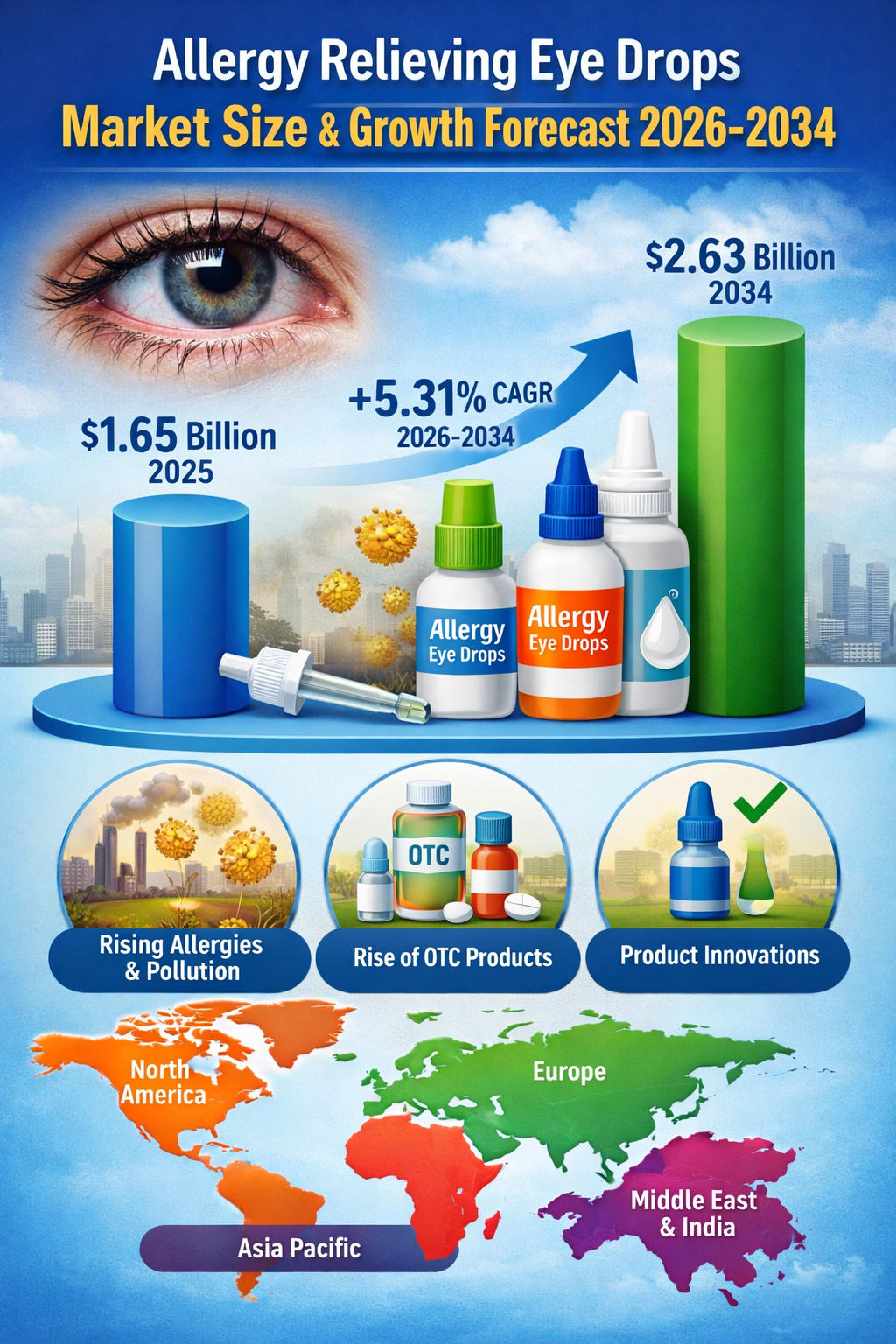
The global Allergy Relieving Eye Drops Market is entering a phase of steady and sustained growth, driven by rising allergy prevalence, increasing air pollution, and growing consumer awareness about eye health. According to Renub Research, the market is projected to grow from US$ 1.65 billion in 2025 to US$ 2.63 billion by 2034, registering a compound annual growth rate (CAGR) of 5.31% during the forecast period 2026–2034.
Eye allergies, once considered a seasonal inconvenience, are now recognized as a widespread and persistent public health issue. Urbanization, climate change, longer pollen seasons, and rising exposure to dust, smoke, and industrial pollutants have significantly increased the incidence of allergic conjunctivitis and related ocular conditions. As a result, demand for fast-acting, easy-to-use, and affordable allergy-relieving eye drops has surged across both developed and emerging markets.
In parallel, the healthcare industry has seen a shift toward self-care and over-the-counter (OTC) solutions. Consumers increasingly prefer non-invasive treatments that offer quick symptom relief without the need for frequent doctor visits. This trend has positioned allergy relieving eye drops as a staple product in pharmacies, supermarkets, and online health platforms worldwide.
Allergy Relieving Eye Drops Market Outlook
Allergy relieving eye drops are specially formulated ophthalmic solutions designed to reduce symptoms associated with allergic reactions in the eyes, such as itching, redness, burning, swelling, and watery discharge. These symptoms are commonly triggered by allergens including pollen, dust mites, pet dander, molds, and airborne pollutants.
Depending on their composition, these eye drops work through different mechanisms. Antihistamine drops block histamine receptors to prevent allergic reactions, mast cell stabilizers reduce the release of inflammatory mediators, vasoconstrictors help minimize redness, and lubricating drops soothe irritated ocular surfaces. Many modern formulations combine multiple mechanisms to provide both immediate relief and longer-term prevention.
A notable trend in recent years is the increasing preference for preservative-free formulations, especially among contact lens users and patients requiring frequent or long-term use. Improved packaging technologies and single-dose units have made preservative-free products more accessible and convenient, further boosting their adoption.
Globally, the growing burden of allergic eye diseases, combined with better awareness of eye care and easier access to OTC products, continues to support robust demand. Since eye allergies affect people across all age groups, these products have become a routine part of personal healthcare for millions worldwide.
Growth Drivers of the Allergy Relieving Eye Drops Market
Rising Prevalence of Allergic Eye Conditions Worldwide
One of the most significant growth drivers for this market is the increasing prevalence of allergic eye diseases. Estimates suggest that 15% to 20% of the global population experiences some form of allergic conjunctivitis, although many cases remain untreated or self-managed. Conditions such as seasonal allergic conjunctivitis, perennial allergic conjunctivitis, vernal keratoconjunctivitis, and atopic keratoconjunctivitis are becoming more common due to environmental and lifestyle changes.
Air pollution, climate change, urban crowding, and longer pollen seasons have dramatically increased exposure to allergens. As a result, symptoms like itching, redness, tearing, and irritation have become more frequent and persistent, creating a constant demand for fast-acting ocular treatments.
In the United States alone, data indicates that more than 100 million people suffer from at least one allergic disease, with a significant portion experiencing seasonal allergies often accompanied by eye symptoms. Since ocular discomfort is often one of the first noticeable signs of an allergic reaction, many patients turn to eye drops as their first line of defense, reinforcing consistent market demand.
Increasing Availability of Over-the-Counter and Self-Care Products
The growing availability of OTC allergy relieving eye drops has played a crucial role in expanding the market. Consumers today are more inclined toward self-care solutions for mild to moderate symptoms, seeking quick relief without the time and cost associated with medical consultations.
Pharmacies, supermarkets, and e-commerce platforms have made these products widely accessible, improving market penetration across urban and semi-urban regions. Clear labeling, better consumer education, and pharmacist recommendations have also made it easier for individuals to choose appropriate products for their needs.
Scientific advancements have led to the development of faster-acting and longer-lasting formulations, enhancing both convenience and treatment outcomes. For instance, in January 2026, Dr. Reddy’s Laboratories introduced an OTC Olopatadine Hydrochloride Ophthalmic Solution in the U.S., a generic version of “Extra Strength Pataday Once-Daily Relief,” following approval from the USFDA. Such launches highlight the growing momentum in the OTC segment and its impact on market expansion.
Product Innovation and Improved Formulations
Continuous innovation remains a cornerstone of market growth. Manufacturers are increasingly focusing on multi-action formulations that combine antihistamines with mast cell stabilizers, offering both immediate symptom relief and preventive benefits.
In addition, the shift toward preservative-free products has improved tolerability, especially for contact lens users and patients with sensitive eyes. Innovations in dropper design, packaging, and dosing mechanisms have further enhanced ease of use and safety.
In August 2024, OCuSOFT Inc. launched OCuSOFT Retaine Allergy, a prescription-strength antihistamine eye drop aimed at relieving itchiness due to eye allergies. Such developments reflect the industry’s commitment to addressing unmet patient needs and expanding treatment options beyond traditional formulations.
Challenges of the Allergy Relieving Eye Drops Market
Risk of Misuse and Side Effects from Prolonged Use
Despite their benefits, allergy relieving eye drops are not without challenges. One major concern is the risk of misuse, particularly with OTC products. Overuse of decongestant drops can lead to rebound redness and worsening symptoms, while improper self-diagnosis may delay treatment of more serious eye conditions such as infections or chronic inflammatory diseases.
Healthcare professionals often emphasize the importance of correct usage, but ensuring widespread adherence remains a persistent challenge. These safety concerns can sometimes lead to regulatory scrutiny and cautious consumer behavior, potentially limiting the growth of certain product categories.
Intense Competition and Price Sensitivity
The market is highly competitive, with numerous branded and generic products available across regions. Price sensitivity, especially in emerging markets, puts pressure on profit margins. Store brands and low-cost generics make it difficult for manufacturers to differentiate their offerings purely on price.
As a result, companies must balance innovation, regulatory compliance, and cost efficiency while still delivering value to consumers. This competitive environment encourages continuous product improvement but also creates challenges in maintaining brand loyalty and premium pricing strategies.
Segment Insights
Antihistamines Allergy Relieving Eye Drops Market
Antihistamine eye drops represent the largest and most widely used segment of the market. These products provide rapid relief from itching, redness, and watering by directly blocking histamine receptors at the site of the allergic reaction.
Modern formulations often combine antihistamines with mast cell stabilizers, offering both immediate and long-term benefits. Their widespread OTC availability, strong physician endorsement, and high patient familiarity continue to drive strong demand. Seasonal peaks are common, but in highly polluted regions, demand remains consistent throughout the year. The growing preference for preservative-free and long-acting options further strengthens this segment’s outlook.
Vernal Keratoconjunctivitis Market
Vernal keratoconjunctivitis (VKC) is a chronic and more severe form of allergic eye disease, primarily affecting children and adolescents. It is characterized by intense itching, light sensitivity, mucus discharge, and potential corneal involvement.
Although the patient population is smaller compared to seasonal allergies, the chronic nature of VKC ensures steady demand for prescription-based treatments, including mast cell stabilizers, antihistamines, and, in some cases, corticosteroids. Increased awareness and earlier diagnosis have contributed to gradual growth in this segment, with a strong emphasis on long-term safety and sustained efficacy.
Atopic Keratoconjunctivitis Market
Atopic keratoconjunctivitis (AKC) is a chronic, potentially vision-threatening condition often associated with atopic dermatitis in adults. Long-term management is essential due to persistent inflammation and the risk of corneal complications.
Treatment typically involves a combination of anti-allergic eye drops and, in severe cases, short-term immunosuppressive therapies. The rising prevalence of atopic diseases and better recognition of their ocular manifestations are driving growth in this specialized segment. Unlike seasonal allergies, AKC requires ongoing medical management, positioning this segment closer to chronic disease care than episodic treatment.
Regional Market Highlights
United States
The U.S. remains one of the largest markets for allergy relieving eye drops, supported by high allergy prevalence, strong consumer awareness, and easy access to both OTC and prescription products. Innovation in preservative-free and long-acting formulations continues to stimulate demand. In January 2026, LENZ Therapeutics launched the “Make it VIZZable” consumer campaign, reflecting the country’s active focus on eye health awareness and product adoption.
Germany
Germany’s market is strongly physician-driven, with a high preference for clinically proven and preservative-free formulations. Seasonal pollen exposure and environmental allergies contribute to consistent demand. The country’s regulated healthcare system supports structured allergy management, ensuring steady use of both prescription and OTC products.
India
India’s market is expanding rapidly due to rising air pollution, urbanization, and widespread exposure to environmental allergens. OTC availability and self-medication play a major role, especially in urban areas. Although price sensitivity is high, increasing awareness and expanding pharmacy networks make India a high-volume, long-term growth market. In January 2024, Lupin Limited received FDA approval for its generic loteprednol etabonate ophthalmic suspension, highlighting India’s growing role in ophthalmic pharmaceuticals.
Saudi Arabia
In Saudi Arabia, arid climate conditions, dust exposure, and urban pollution contribute to a steady rise in allergic eye conditions. Improved healthcare access and growing awareness of eye health have increased demand for both OTC and prescription products. In January 2026, LENZ Therapeutics entered an exclusive distribution agreement for VIZZ in the Middle East, underscoring the region’s growing commercial potential.
Market Segmentation
By Drug Class:
Antihistamines
Non-steroidal Anti-inflammatory Drugs
Vasoconstrictors
Others
By Type:
Seasonal and Perennial Allergic Conjunctivitis
Vernal Keratoconjunctivitis
Atopic Keratoconjunctivitis
Giant Papillary Conjunctivitis
Others
By Geography:
North America: United States, Canada
Europe: France, Germany, Italy, Spain, United Kingdom, Belgium, Netherlands, Turkey
Asia Pacific: China, Japan, India, Australia, South Korea, Thailand, Malaysia, Indonesia, New Zealand
Latin America: Brazil, Mexico, Argentina
Middle East & Africa: South Africa, Saudi Arabia, United Arab Emirates
Competitive Landscape
The market features several global pharmaceutical leaders, each analyzed across five viewpoints: Overview, Key Persons, Recent Developments & Strategies, Product Portfolio, and Financial Insights. Key players include:
AbbVie Inc. (Allergan Plc)
Johnson & Johnson
Pfizer Inc.
F. Hoffmann-La Roche Ltd
Novartis AG
Bausch Health Companies Inc.
Regeneron Pharmaceuticals
Santen Pharmaceutical Co.
These companies continue to invest in research, product innovation, and geographic expansion to strengthen their market positions.
Final Thoughts
With Renub Research projecting growth from US$ 1.65 billion in 2025 to US$ 2.63 billion by 2034 at a CAGR of 5.31%, the Allergy Relieving Eye Drops Market is set for a stable and promising decade ahead. Rising allergy prevalence, expanding OTC access, and continuous product innovation are reshaping how consumers manage ocular allergies worldwide.
While challenges such as misuse risks and price competition persist, the overall outlook remains positive. As awareness of eye health continues to grow and manufacturers introduce safer, more effective, and more convenient formulations, allergy relieving eye drops will remain an essential part of global eye care—offering comfort, clarity, and relief to millions every day.
About the Creator
Tom Shane
Tom Shane is a content writer specializing in SEO-driven blogs, product descriptions, and thought leadership. He crafts engaging, research-backed content that connects with audiences and drives results.
Carbon Removal Credits (CRC): Driving Net-Zero Futures
Abstract As global efforts to mitigate climate change intensify, achieving carbon neutrality has become a central objective for governments, corporations, and financial institutions. While emissions reduction remains the primary pathway, it is increasingly recognized that emission abatement alone is insufficient to meet mid-century net-zero targets. Carbon Removal Credits (CRC), which represent the verified removal of carbon dioxide from the atmosphere, have emerged as a critical complementary mechanism. This research report examines the concept, mechanisms, market development, and policy relevance of Carbon Removal Credits, analyzing their role in supporting carbon neutrality and fostering the transition toward a green economy. The report also evaluates key challenges and future prospects, offering insights into how CRC can be effectively integrated into climate strategies.
By Carbon Removal Credit(CRC)5 days ago in Trader



Comments
There are no comments for this story
Be the first to respond and start the conversation.