
GPS Tracking Device Market Size and Forecast 2025–2033
AI-powered tracking, fleet digitization, and regulatory mandates are reshaping the global GPS tracking device industry

Global GPS Tracking Device Market: An Industry in Motion
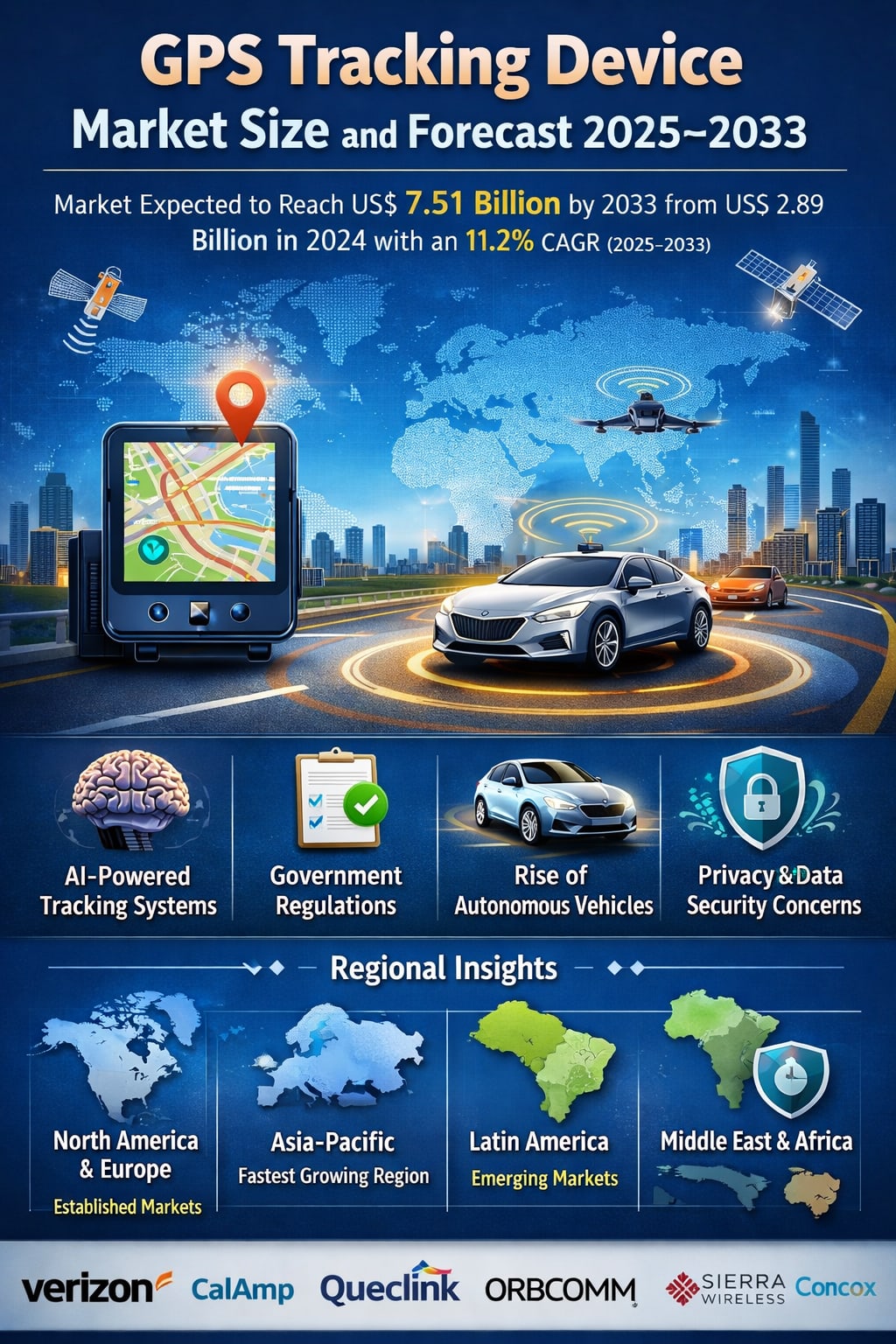
The global GPS tracking device market is entering a decisive growth phase as industries across transportation, logistics, healthcare, and personal security increasingly rely on real-time location intelligence. According to Renub Research, the GPS Tracking Device Market is expected to reach US$ 7.51 billion by 2033, up from US$ 2.89 billion in 2024, registering a strong compound annual growth rate (CAGR) of 11.2% from 2025 to 2033.
This expansion reflects a broader transformation in how organizations and individuals manage assets, vehicles, and personal safety. What began as a niche technology for navigation has evolved into a critical digital infrastructure layer supporting fleet optimization, asset monitoring, compliance management, and even autonomous mobility systems.
At its core, a GPS tracking device is an electronic gadget that uses signals from multiple satellites in the Global Positioning System to calculate precise geographic coordinates. These devices transmit location data to centralized platforms or user interfaces, enabling real-time tracking of vehicles, assets, or people. Compact, increasingly affordable, and easy to install, GPS trackers have found applications in fleet management, logistics, asset tracking, personal safety, and security services.
The GPS tracking device market today encompasses a wide range of solutions, including vehicle trackers, asset trackers, personal trackers, and wearable tracking devices. Each category addresses a specific use case, but all share a common value proposition: visibility, control, and data-driven decision-making. As businesses prioritize operational efficiency and governments tighten compliance requirements, the role of GPS tracking systems is becoming more strategic than ever.
Market Outlook: From Navigation Tool to Intelligent Platform
The modern GPS tracking device is no longer just a location pin on a map. Today’s solutions integrate cloud platforms, mobile applications, Internet of Things (IoT) connectivity, and artificial intelligence (AI) to deliver predictive insights and automation. Fleet operators use GPS data to optimize routes, reduce fuel consumption, monitor driver behavior, and improve customer service. Logistics companies depend on real-time tracking to ensure timely deliveries and manage complex supply chains. Even consumers are embracing GPS trackers for personal safety, pet tracking, and vehicle security.
This shift from basic tracking to intelligent telematics platforms is a major reason behind the market’s robust growth outlook. As enterprises continue their digital transformation journeys, GPS tracking devices are increasingly viewed as essential tools rather than optional add-ons.
Key Factors Driving the GPS Tracking Device Market
Adoption of AI-Powered GPS Tracking Systems
One of the most important growth drivers is the rising adoption of AI-powered GPS tracking solutions. According to the International Organization of Motor Vehicle Manufacturers (OICA), road traffic accidents cause around 50 million injuries and 1.35 million fatalities each year worldwide, with nearly 90% of these incidents occurring in developing countries. This alarming statistic has intensified the focus on road safety, driver behavior monitoring, and predictive risk management.
AI-enabled GPS systems can analyze parameters such as speed, acceleration, braking patterns, and route choices in real time. By identifying risky driving behavior and unusual patterns, these systems allow fleet managers and authorities to intervene proactively. Some advanced platforms also assess the relative positions and movements of nearby vehicles, pedestrians, and obstacles, helping to reduce accident risks and improve overall road safety.
Beyond safety, AI-driven analytics enhance operational efficiency by predicting maintenance needs, optimizing routes based on traffic conditions, and improving asset utilization. As AI capabilities become more accessible and affordable, their integration with GPS tracking systems is expected to accelerate, further boosting market demand.
Government Mandates and Compliance Requirements
Regulatory support is another powerful catalyst for market growth. In many countries, governments have made GPS tracking mandatory for specific vehicle categories, especially in commercial transportation and public transit. In India, for example, the government introduced Automotive Industry Standard 140 (AIS-140), which requires GPS-based vehicle tracking systems in commercial fleets. These regulations aim to improve passenger safety, enhance vehicle efficiency, and support Intelligent Transportation System (ITS) initiatives.
Beyond transportation, GPS tracking devices are increasingly used in government-mandated asset tracking and surveillance programs to monitor vehicles, critical infrastructure, and, in some cases, high-value goods. Environmental regulations focused on reducing carbon emissions and promoting sustainable practices are also encouraging the adoption of GPS-based route optimization and fuel management solutions.
As regulatory frameworks continue to evolve, compliance-driven adoption is likely to remain a stable and long-term growth driver for the GPS tracking device market.
Rising Use of Unmanned and Autonomous Vehicles
The rapid development of unmanned and autonomous vehicles is creating new opportunities for GPS tracking technology. These vehicles depend heavily on precise location data, real-time monitoring, and continuous connectivity to operate safely and efficiently. GPS tracking systems play a critical role in enabling control, navigation, and security for drones, autonomous delivery vehicles, and robotaxis.
For instance, companies like Pony.ai have received approval to operate fully autonomous ride-hailing services in cities such as Guangzhou, China, and have already completed hundreds of thousands of paid robotaxi rides. Such developments highlight the growing need for reliable, high-precision GPS tracking solutions to support autonomous mobility ecosystems.
As advancements in AI, machine learning, sensor technology, and processing power continue, the number of unmanned and autonomous vehicles worldwide is expected to rise, further strengthening demand for advanced GPS tracking systems.
Challenges Facing the GPS Tracking Device Market
Privacy and Data Security Concerns
Despite strong growth prospects, the industry faces significant challenges related to privacy and data security. GPS tracking devices continuously collect and transmit sensitive location data, raising concerns about unauthorized tracking, data breaches, and misuse of personal information. Consumers and enterprises alike are increasingly cautious about how their data is stored, shared, and protected.
Strict data protection regulations such as the General Data Protection Regulation (GDPR) in Europe and the California Consumer Privacy Act (CCPA) in the United States require companies to implement robust data governance practices. Compliance involves encryption, secure data storage, transparent user consent mechanisms, and regular audits—all of which increase operational complexity and costs. Failure to comply can result in legal penalties and loss of customer trust, making data security a critical strategic priority for GPS tracking solution providers.
Integration with Existing Enterprise Systems
Another notable challenge is the integration of GPS tracking devices with existing enterprise platforms such as fleet management systems, ERP, and CRM software. Many organizations seek seamless data flow across multiple systems to improve visibility and decision-making. However, differences in software architectures, lack of standardized APIs, and compatibility issues often complicate integration efforts.
These technical hurdles can lead to higher implementation costs and longer deployment timelines, particularly for organizations with legacy infrastructure. To overcome this barrier, GPS solution providers are increasingly focusing on developing flexible, well-documented APIs and improving interoperability with widely used enterprise applications.
Regional Overview: A Market with Global Momentum
North America and Europe
North America and Europe currently lead the GPS tracking device market, supported by advanced digital infrastructure, high adoption of telematics solutions, and strong regulatory frameworks. These regions benefit from mature fleet management ecosystems and widespread use of GPS tracking in logistics, transportation, and public safety.
Asia-Pacific
Asia-Pacific is witnessing the fastest growth, driven by rapid industrialization, expanding logistics networks, and government initiatives promoting smart transportation. Countries like China and India are investing heavily in digital infrastructure, creating a fertile environment for GPS tracking adoption across commercial and public sectors.
Latin America, Middle East, and Africa
Latin America and Africa are emerging markets with growing penetration of GPS tracking solutions, particularly in logistics, security, and fleet management. The Middle East, especially countries like the United Arab Emirates, is adopting GPS tracking as part of broader smart city and smart mobility initiatives.
Country-Level Market Highlights
United States
The U.S. GPS tracking device market is well-established and continues to grow due to strong demand from logistics, transportation, law enforcement, and personal safety segments. Businesses increasingly rely on GPS for route optimization, real-time asset tracking, and cost reduction. Consumer adoption for vehicle security, pet tracking, and personal safety is also on the rise. However, data privacy regulations and integration challenges remain key considerations for market participants.
United Kingdom
In the UK, GPS tracking devices are gaining traction across transportation, logistics, and personal safety applications. The integration of IoT and advanced connectivity technologies such as 5G is enhancing real-time monitoring and data analytics capabilities. Regulatory requirements and safety standards continue to influence adoption patterns, supporting steady market growth.
India
India represents one of the most dynamic markets, fueled by government mandates like AIS-140 and the rapid expansion of the logistics and transportation sectors. Companies are adopting GPS technology to improve fleet efficiency, reduce costs, and enhance safety. The integration of AI and IoT is further strengthening the value proposition of GPS tracking solutions in the country.
United Arab Emirates
The UAE market is benefiting from strong investments in smart city initiatives, logistics infrastructure, and digital transformation. Businesses are using GPS tracking to optimize operations, while regulatory requirements and safety standards are encouraging broader adoption across sectors.
Market Segmentation Overview
By Type:
Standalone GPS
Advanced Tracker
OBD Device
By Application:
Vehicle Tracking
Asset Tracking
Personal Tracking
By End Use:
Automotive
Aerospace and Defense
Healthcare
Transportation
Others
By Region:
North America (United States, Canada)
Europe (France, Germany, Italy, Spain, United Kingdom, Belgium, Netherlands, Turkey)
Asia Pacific (China, Japan, India, Australia, South Korea, Thailand, Malaysia, Indonesia, New Zealand)
Latin America (Brazil, Mexico, Argentina)
Middle East & Africa (South Africa, Saudi Arabia, United Arab Emirates)
Competitive Landscape and Key Players
The GPS tracking device market is moderately fragmented, with a mix of global technology providers and specialized tracking solution companies. Key players covered in the market include:
Verizon Wireless
Concox Information Technology Co. Ltd.
Calamp Corp.
Orbocomm Inc.
Sierra Wireless Inc.
Atrack Technology Inc.
Spytec Inc.
Queclink Wireless Solutions Co. Ltd.
These companies compete on the basis of product innovation, connectivity capabilities, software platforms, and service offerings. Strategic partnerships, new product launches, and investments in AI and IoT integration are common strategies used to strengthen market position and expand customer reach.
Final Thoughts: A Market Positioned for Smart Growth
The global GPS tracking device market is clearly on a strong upward trajectory. With Renub Research projecting growth from US$ 2.89 billion in 2024 to US$ 7.51 billion by 2033 at a CAGR of 11.2%, the industry is set to play an increasingly vital role in the digital economy.
Driven by AI-powered analytics, regulatory mandates, the rise of autonomous vehicles, and the need for real-time visibility across industries, GPS tracking devices are evolving from simple location tools into intelligent, data-driven platforms. While challenges related to privacy, security, and system integration remain, ongoing technological innovation and supportive policy environments are expected to keep the market moving forward.
In an era where data, efficiency, and safety define competitiveness, GPS tracking technology is no longer just about knowing where something is—it is about understanding how it moves, how it performs, and how it can be optimized for a smarter, safer, and more connected world.
About the Creator
Tom Shane
Tom Shane is a content writer specializing in SEO-driven blogs, product descriptions, and thought leadership. He crafts engaging, research-backed content that connects with audiences and drives results.
Australia Concrete Reinforcement Market: Doubling Demand Amid Major Infrastructure and Urban Growth 2026-2034
The Australia concrete reinforcement market is poised for significant expansion, more than doubling in value over the next decade as construction activity across infrastructure, urban development, industrial facilities, and renewable energy projects accelerates. According to the latest market analysis by IMARC Group, the market reached USD 158.3 Million in 2025 and is projected to expand to USD 326.0 Million by 2034, exhibiting a strong Compound Annual Growth Rate (CAGR) of 8.80% during 2025–2033.
By Rashi Sharma3 days ago in Trader
Unofficial Challenge: What would you do if you were rich?
I love the kind of work I get to do in my career, but as I job search and browse apartments again due to another understaffed and unsustainable work environment that I did not intend to get into, my daydreams of better days consistently lean into the same question: What would I do if I didn't have to worry about my basic needs being met?
By Kay Husnicka day ago in Writers



Comments
There are no comments for this story
Be the first to respond and start the conversation.