
Radio Frequency Components Market Size and Forecast 2025–2033
How 5G, IoT, and Next-Generation Wireless Are Powering a US$ 113 Billion Opportunity

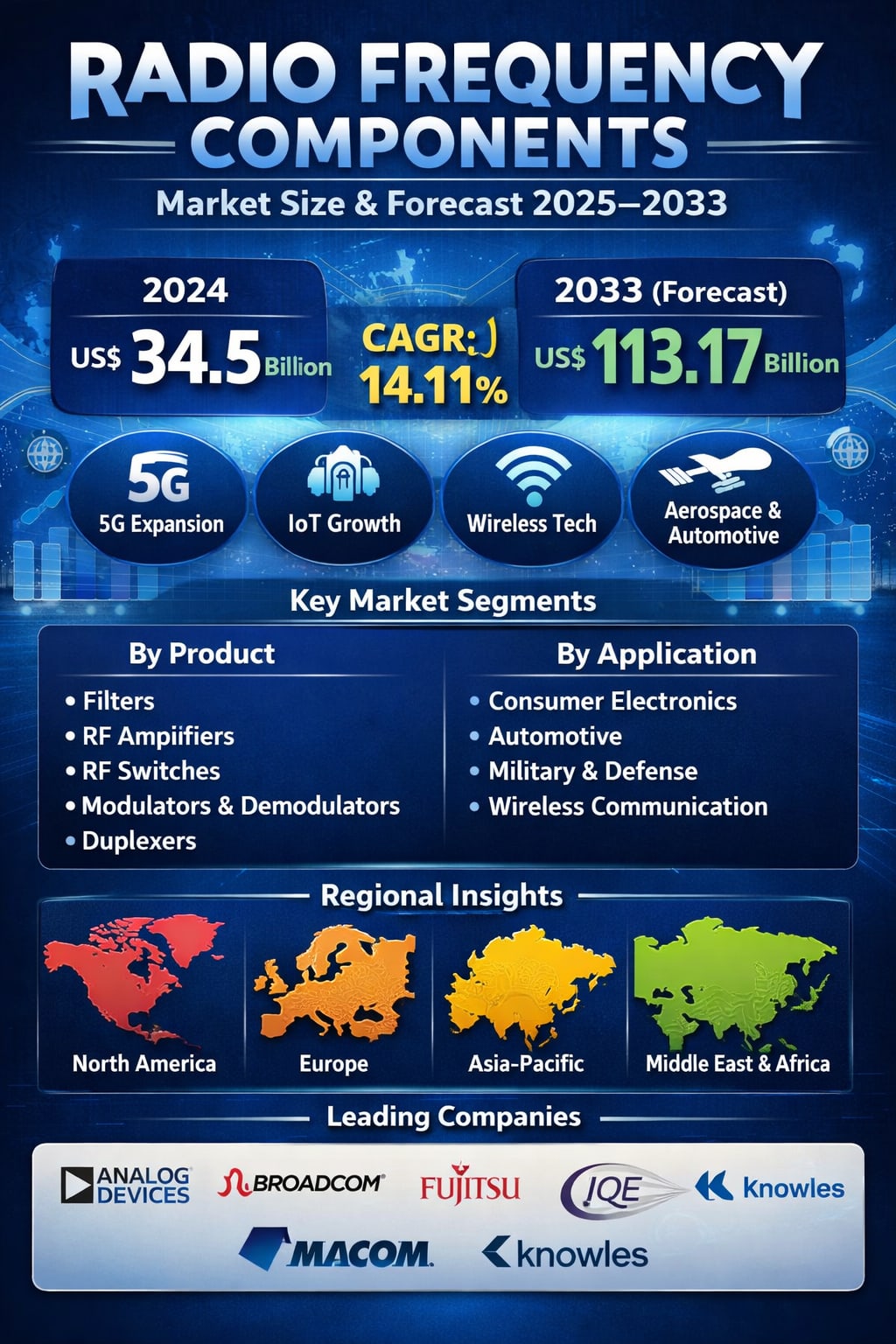
Global Radio Frequency Components Market: A Connected World’s Silent Backbone
The global Radio Frequency (RF) Components Market is entering a powerful growth phase as the world becomes increasingly dependent on fast, reliable, and always-on wireless connectivity. According to Renub Research, the market was valued at US$ 34.5 billion in 2024 and is expected to reach US$ 113.17 billion by 2033, expanding at a strong CAGR of 14.11% from 2025 to 2033.
This remarkable growth story is being written by the rapid rollout of 5G networks, continuous advancements in RF technologies, the explosive adoption of wireless communication systems, and the expanding use of RF components across industries such as automotive, aerospace, defense, consumer electronics, and telecommunications.
At the heart of modern digital life—smartphones, base stations, satellites, connected vehicles, smart homes, and industrial IoT systems—RF components quietly perform the essential task of transmitting, receiving, filtering, and amplifying signals. Components such as amplifiers, filters, switches, antennas, mixers, oscillators, and duplexers form the invisible infrastructure that keeps the connected world running smoothly.
As data consumption rises, networks become more complex, and devices become more compact and powerful, the importance of high-performance, efficient, and reliable RF components continues to grow. What was once a niche segment of the electronics industry has now become a strategic pillar of the global digital economy.
Industry Overview: From Smartphones to Satellites
The global RF components industry sits at the crossroads of electronics, telecommunications, and digital infrastructure. These components are critical for signal transmission and reception in devices ranging from everyday smartphones and Wi-Fi routers to advanced radar systems, satellites, and 5G base stations.
The expansion of mobile networks, the commercial deployment of 5G, the surge in connected devices, and the rapid spread of IoT applications are reshaping demand patterns across the market. At the same time, continuous innovation in miniaturization, power efficiency, and performance optimization is pushing manufacturers to develop more sophisticated RF solutions.
One of the most ambitious examples of RF technology adoption is the rapid growth of satellite communications (SATCOM). Projects such as SpaceX’s global satellite internet initiative—designed to deploy tens of thousands of satellites—highlight the rising need for advanced RF engineering. These satellites operate across Ku and Ka bands (10–30 GHz), requiring highly specialized RF components capable of handling high frequencies, harsh environments, and strict performance standards.
On the terrestrial side, telecom operators are increasingly deploying RF front-end modules to support high-speed mobile networks. According to Ericsson estimates, global 5G subscriptions have been rising sharply, creating a massive need for high-end RF front-end modules, power amplifiers, RF switches, and advanced filters in both base stations and smartphones. Compared to 4G devices, 5G smartphones require a significantly higher number of RF components, especially in mmWave variants, which also drive demand for Antenna-in-Package (AiP) technologies to manage signal integrity and interference.
Key Factors Driving the Radio Frequency Components Market
1. Explosive Growth of Smart Devices and IoT
The rise of the Internet of Things (IoT) is one of the strongest structural drivers of the RF components market. According to industry estimates, billions of IoT devices are already connected globally, and this number is expected to grow steadily in the coming years. Smart lighting systems, industrial sensors, connected appliances, wearables, smart meters, and home automation devices all rely heavily on RF components for wireless communication and data exchange.
Smart cities, Industry 4.0 initiatives, and connected infrastructure projects are accelerating this trend. These applications demand RF components that are compact, energy-efficient, durable, and capable of reliable performance in diverse environments. As device ecosystems expand, so does the need for robust RF solutions that ensure seamless connectivity and interoperability.
2. Rising Need for Connectivity and Data Transmission
Global demand for data is increasing at an unprecedented pace. With billions of mobile users, widespread adoption of cloud services, video streaming, online gaming, remote work, and digital services, networks are under constant pressure to deliver higher speeds, lower latency, and greater reliability.
Smartphones alone are consuming more data every year, and the average monthly data usage per device continues to climb. This surge directly translates into higher performance requirements for RF components, which must support higher frequencies, wider bandwidths, and more complex modulation schemes.
To meet these expectations, manufacturers are investing heavily in next-generation RF technologies that can handle increased data loads while maintaining signal quality and energy efficiency. As a result, RF components are becoming more advanced, more integrated, and more critical to overall network performance.
3. Expanding Adoption of Wireless Communication Technologies
Wireless communication is now the default mode of connectivity across consumer, industrial, and enterprise environments. Smartphones, tablets, laptops, smart TVs, connected vehicles, and home automation systems all depend on RF components to maintain stable and high-quality wireless links.
The global transition toward 5G and the early research into 6G are further intensifying this trend. New standards demand components that can operate at higher frequencies, support massive device connectivity, and deliver ultra-low latency. Test and measurement platforms, such as those introduced to support advanced Wi-Fi and 5G technologies, highlight how the ecosystem is evolving to accommodate more complex wireless environments.
As consumers and enterprises expect faster, more reliable, and more responsive wireless experiences, the demand for high-performance RF components will continue to grow.
Challenges Facing the RF Components Market
Thermal Management Issues
As RF devices operate at higher frequencies and power levels, thermal management has become a critical engineering challenge. Components such as power amplifiers, transceivers, and filters can generate significant heat during operation. If not managed properly, this heat can lead to performance degradation, reduced lifespan, or even device failure.
The challenge is even greater in compact and densely packed devices, where space for cooling solutions is limited. Manufacturers must invest in advanced thermal materials, heat sinks, integrated cooling designs, and innovative packaging technologies to address these issues. While these solutions improve reliability, they can also increase product complexity and cost.
Technological Obsolescence
The RF components industry operates in a fast-moving technological environment. The transition from 4G to 5G and the ongoing research into 6G mean that performance standards are constantly evolving. Components that are cutting-edge today can become outdated in a relatively short time.
This puts continuous pressure on manufacturers to invest in research and development, shorten product development cycles, and adapt quickly to new standards. Companies that fail to keep pace with innovation risk losing competitiveness in a market where time-to-market and technological relevance are critical success factors.
Regional Outlook: A Global Market with Local Strengths
United States
The United States remains one of the most important markets for RF components, driven by rapid adoption of 5G, strong R&D ecosystems, and advanced telecom infrastructure. Key industries such as consumer electronics, automotive, aerospace, and defense rely heavily on RF technologies for performance and innovation.
With sustained investments in next-generation networks, semiconductor research, and digital infrastructure, the U.S. continues to shape global trends in RF component development and deployment.
United Kingdom
The UK RF components market is benefiting from the expansion of 5G networks and the growing adoption of IoT applications across healthcare, automotive, and consumer electronics. The country’s strong aerospace and defense sectors also create steady demand for advanced RF solutions used in radar, satellite communications, and electronic warfare systems.
Government support for technological innovation and infrastructure development further strengthens the UK’s position in the global RF ecosystem.
India
India represents one of the fastest-growing opportunities in the RF components market. The rapid rollout of 5G, increasing smartphone penetration, expanding consumer electronics manufacturing, and strong government support for local production are key growth drivers.
RF components such as filters, switches, and amplifiers are becoming increasingly important for improving network performance and device efficiency. While challenges such as spectrum management and skills development remain, the long-term growth outlook for India’s RF market is highly promising.
United Arab Emirates
The UAE is emerging as a technology hub in the Middle East, with strong investments in 5G, smart cities, satellite communications, and digital infrastructure. These initiatives are driving demand for high-performance RF components used in telecom networks, defense systems, and advanced consumer electronics.
As the country continues to position itself at the forefront of digital transformation, the RF components market is expected to remain dynamic and competitive.
Market Segmentation Snapshot
By Product:
Filters
RF Amplifiers
RF Switches
Modulators & Demodulators
Duplexers
Mixers & Synthesizers
Others
By Application:
Consumer Electronics
Automotive
Military
Wireless Communication
Others
By Region:
North America (United States, Canada)
Europe (France, Germany, Italy, Spain, United Kingdom, Belgium, Netherlands, Turkey)
Asia Pacific (China, Japan, India, Australia, South Korea, Thailand, Malaysia, Indonesia, New Zealand)
Latin America (Brazil, Mexico, Argentina)
Middle East & Africa (South Africa, Saudi Arabia, United Arab Emirates)
Competitive Landscape: Key Industry Players
The global RF components market is characterized by strong competition, continuous innovation, and strategic partnerships. Major players covered in the market include:
Analog Devices, Inc.
Broadcom, Inc.
Fujitsu Limited
Gotmic AB
IQE plc
Knowles Corporation
MACOM Technology Solutions Holdings, Inc.
Marki Microwave, Inc.
These companies focus on product innovation, capacity expansion, strategic collaborations, and advanced manufacturing technologies to strengthen their market positions and address evolving customer needs.
Final Thoughts: The Future Is Wireless—and RF Is at the Core
The global Radio Frequency Components Market is no longer just a supporting segment of the electronics industry—it is a strategic enabler of the digital economy. With the market projected to grow from US$ 34.5 billion in 2024 to US$ 113.17 billion by 2033, the scale of opportunity is both impressive and transformative.
Driven by 5G expansion, IoT proliferation, rising data consumption, and continuous innovation in wireless technologies, RF components will remain at the heart of global connectivity. While challenges such as thermal management and rapid technological change persist, the industry’s strong focus on R&D and advanced engineering positions it well for long-term growth.
About the Creator
Tom Shane
Tom Shane is a content writer specializing in SEO-driven blogs, product descriptions, and thought leadership. He crafts engaging, research-backed content that connects with audiences and drives results.
Zhipu AI Model GLM-5 Tops Benchmarks, Shares Jump 34%
Shares of Zhipu AI surged by an impressive 34% after the company announced that its latest artificial intelligence model, GLM-5, had topped several major industry benchmarks. The strong market reaction highlights growing investor enthusiasm around next-generation AI technologies and reflects confidence in Zhipu AI’s ability to compete with global leaders in the rapidly evolving artificial intelligence space.
By Hammad Nawaz7 days ago in Trader
Goodbye, Mr. Duvall
It is turning out to be an interesting year. I was in the middle of teaching a class when a pop-up appeared on the screen announcing the death of Mr. Robert Seldon Duvall (yes, that was his full name). I was in the middle of a discussion on the obsession we have with winning when it comes to sports (the Winter Olympics was a theme), and I felt as though things were coming full circle. We had already lost Gene Hackman last year, and along with that titan, it feels though one particular golden age has closed off to be replaced by...?
By Kendall Defoe 2 days ago in Geeks




Comments
There are no comments for this story
Be the first to respond and start the conversation.