
Global Water Purifier Market Size and Forecast 2025–2033: Clean Water Becomes a Global Priority
Rising health awareness, urbanization, and advanced purification technologies are driving the global water purifier market toward a US$ 113.19 billion future.

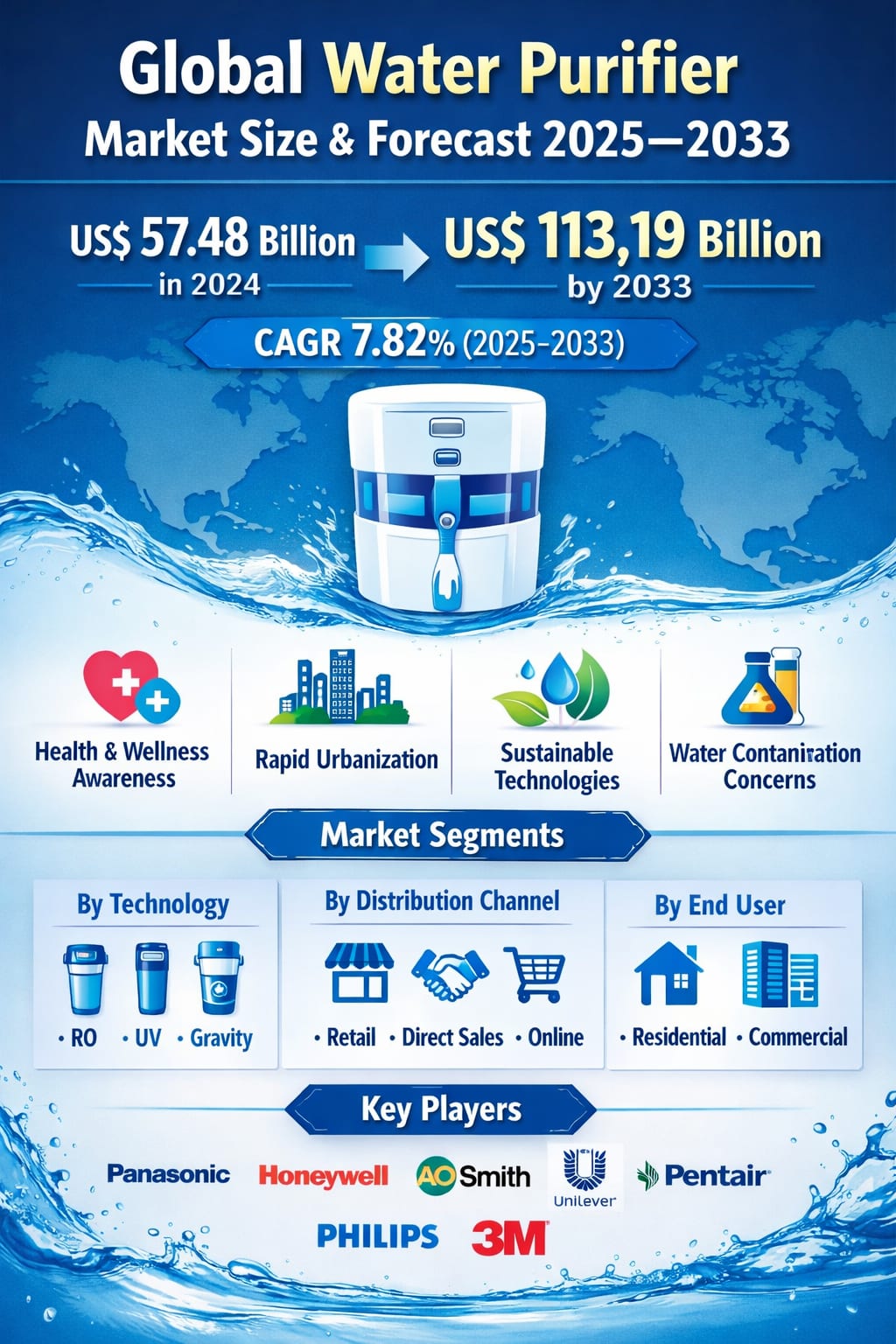
Global Water Purifier Market Size and Forecast 2025–2033
The global water purifier market is entering a phase of strong and sustained growth as access to clean and safe drinking water becomes one of the most critical priorities worldwide. According to Renub Research, the Water Purifier Market is expected to reach US$ 113.19 billion by 2033, up from US$ 57.48 billion in 2024, registering a CAGR of 7.82% from 2025 to 2033. This impressive expansion reflects a global shift in consumer behavior, government policy, and technological innovation aimed at improving water quality and public health.
Water purifiers are no longer considered a luxury product limited to urban households. They are rapidly becoming an essential appliance across residential, commercial, and institutional settings. Rising awareness about waterborne diseases, increasing industrial pollution, shrinking freshwater resources, and a growing focus on preventive healthcare are all contributing to the widespread adoption of water purification systems.
At the same time, rapid urbanization—especially in emerging economies—is placing immense pressure on existing water infrastructure. While many cities have improved water supply systems, concerns about taste, odor, chemical contaminants, heavy metals, and microbial impurities continue to push consumers toward point-of-use and point-of-entry purification solutions. As a result, the global water purifier market is evolving into a technology-driven, innovation-focused industry with strong long-term growth potential.
Introduction to the Water Purifier Market
Water purifiers are designed to remove suspended particles, harmful chemicals, biological contaminants such as bacteria and viruses, excess minerals, and unpleasant taste or odor from water. Their primary goal is to improve water quality for drinking and other daily uses such as cooking, bathing, and cleaning.
Broadly, water purifiers are categorized into point-of-use (POU) systems and point-of-entry (POE) or whole-house systems. Point-of-use systems are installed at the location where water is consumed, such as kitchen taps or water dispensers. Point-of-entry systems, on the other hand, are installed where water enters a building and treat all water used throughout the household or facility.
Modern water purification solutions often combine multiple technologies—such as reverse osmosis (RO), ultraviolet (UV) purification, and activated carbon filtration—to deliver comprehensive water treatment. This multi-layered approach ensures the removal of pathogens, dissolved salts, heavy metals, and organic pollutants, making water safer and more palatable.
The growing focus on health, hygiene, and quality of life is turning water purifiers into a standard household appliance in many parts of the world. In commercial spaces such as offices, hotels, hospitals, and restaurants, safe drinking water is not just a convenience but a necessity, further strengthening market demand.
Key Growth Drivers of the Water Purifier Market
Growing Awareness of Health and Wellness
One of the most powerful drivers of the water purifier market is the rising global awareness of health and wellness. Consumers today are far more conscious about what they eat and drink, and water quality has become a central part of that conversation. The presence of contaminants such as heavy metals, pesticides, industrial chemicals, and harmful microorganisms in untreated water has raised serious health concerns.
People increasingly understand that clean, filtered water can help prevent waterborne diseases, improve digestion, support immunity, and contribute to overall well-being. This shift in mindset is pushing households to invest in reliable in-home water purification systems rather than relying on bottled water or unfiltered municipal supplies.
Additionally, environmental awareness is playing a role. Many consumers are moving away from bottled water due to concerns about plastic waste and sustainability. Water purifiers offer a more eco-friendly and cost-effective long-term solution, reinforcing their appeal across both developed and developing markets.
Rapid Urbanization and Infrastructure Development
Urbanization is another major force shaping the global water purifier market. As cities expand and populations grow, existing water supply systems face increasing strain. Even in regions with relatively advanced infrastructure, maintaining consistent water quality across vast urban populations is a challenge.
Industrialization often accompanies urban growth, and with it comes the risk of water contamination from industrial discharge and environmental pollution. While municipal water treatment facilities do their best to meet safety standards, many consumers remain concerned about residual contaminants, aging pipelines, and inconsistent water quality.
These concerns are driving strong demand for additional layers of filtration at the household and commercial levels. In emerging economies, where urban infrastructure is still developing, water purifiers are increasingly seen as a necessary safeguard rather than an optional upgrade.
Rising Concerns About Water Contamination
Water contamination has become a global issue, affecting both developed and developing regions. Pollution, agricultural runoff, industrial waste, and natural contaminants are putting pressure on freshwater sources worldwide. High-profile cases of contaminated water supplies have further increased public awareness and concern.
As a result, consumers are prioritizing access to safe and clean drinking water like never before. Technologies such as reverse osmosis, UV purification, and activated carbon filtration are being widely adopted to address these concerns. With stricter regulations and growing public scrutiny around water quality, the demand for effective purification solutions is expected to remain strong throughout the forecast period.
Challenges in the Water Purifier Market
High Maintenance and Replacement Costs
Despite strong demand, the market faces certain challenges—one of the most significant being the high maintenance cost of filters and components. Most water purification systems require periodic replacement of filters, RO membranes, and UV lamps to maintain performance and safety.
Point-of-use filters often need replacement every six to twelve months, while commercial systems may require even more frequent maintenance. Point-of-entry systems typically need servicing every two to three years. These recurring costs can discourage price-sensitive consumers, particularly in developing markets, and may slow adoption in some segments.
Limited Awareness in Rural and Remote Areas
Another major challenge is the lack of awareness in rural and remote regions. In many such areas, people still rely on traditional water sources and may not fully understand the health risks associated with contaminated water. Limited access to information, lower income levels, and infrastructure constraints further restrict market penetration.
While urban markets are growing rapidly, expanding awareness and affordability in rural areas remains essential for truly global market growth.
Water Purifier Market Overview by Region
The global water purifier market shows strong regional diversity in terms of adoption and growth patterns.
North America and Europe exhibit high levels of awareness and adoption, supported by strong regulatory frameworks and consumer focus on health and safety. Asia-Pacific holds the largest market share, driven by rapid urbanization, rising disposable incomes, and widespread concerns about water quality. The Middle East and Africa are seeing growing demand due to water scarcity and dependence on desalination and treated water sources. Latin America is also expanding, though at a comparatively moderate pace due to economic and infrastructure challenges.
United States Water Purifier Market
The United States represents a mature but steadily growing market, driven by strict water safety regulations, rising health awareness, and ongoing concerns about water quality in certain regions. Urban and industrial areas, in particular, show strong demand for advanced filtration systems.
In June 2022, A.O. Smith Corporation acquired Florida-based Atlantic Filter to strengthen its regional presence and expand its water treatment capabilities. This move highlights the competitive and consolidation-driven nature of the U.S. market.
In December 2021, Culligan and Waterlogic Group Holdings formed a strategic partnership aimed at developing sustainable water filtration solutions and expanding their distribution networks, especially in the U.S. market. Such strategic initiatives underline the long-term growth potential and innovation focus of the sector.
Germany Water Purifier Market
Germany’s water purifier market is driven by strong environmental awareness, strict water quality standards, and a high level of technological adoption. Consumers and businesses alike are increasingly investing in efficient and sustainable filtration systems. Smart devices, advanced filtration technologies, and energy-efficient solutions are gaining popularity, supported by Germany’s strong emphasis on public health and environmental protection.
India Water Purifier Market
India is one of the fastest-growing markets for water purifiers due to rapid urbanization, rising middle-class incomes, and widespread concerns about water contamination. Many urban and semi-urban regions face serious water quality issues, making reliable purification systems a necessity rather than a luxury.
Technological innovation in RO, UV, and alkaline purification systems is driving product adoption. Government initiatives to improve access to clean drinking water and raise public awareness are further supporting market growth.
In January 2022, Whirlpool Corporation relocated its Global Technologies & Engineering Center (GTEC) to Pune, India, reinforcing the country’s role as a major innovation hub for advanced technologies such as IoT and Industry 4.0 in consumer appliances, including water purification systems.
Saudi Arabia Water Purifier Market
Saudi Arabia’s market is shaped by water scarcity, high consumption rates, and heavy reliance on desalinated water. Concerns about water quality and the need for additional purification at the point of use are driving demand across both residential and commercial sectors. Government initiatives focused on sustainability and water security, along with rising awareness of waterborne diseases, continue to support market expansion.
Water Purifier Market Segmentation
By Technology
RO Purifier
UV Purifier
Gravity Purifier
Others
By Distribution Channel
Retail Stores
Direct Sales
Online
By End User
Commercial
Residential
Regional Coverage
North America: United States, Canada
Europe: France, Germany, Italy, Spain, United Kingdom, Belgium, Netherlands, Turkey
Asia-Pacific: China, Japan, India, South Korea, Thailand, Malaysia, Indonesia, Australia, New Zealand
Latin America: Brazil, Mexico, Argentina
Middle East & Africa: Saudi Arabia, UAE, South Africa
Key Players in the Water Purifier Market
Panasonic Corporation
Honeywell International Inc.
AO Smith Corporation
Unilever Plc
Pentair
Helen of Troy Limited
Koninklijke Philips N.V
3M Corporation
All key players are analyzed from four viewpoints: Overview, Key Persons, Recent Developments & Strategies, and Revenue Analysis, highlighting the competitive and innovation-driven nature of the industry.
Final Thoughts
The global water purifier market is on a powerful growth trajectory, driven by rising health awareness, urbanization, technological advancement, and increasing concerns about water quality. With the market projected by Renub Research to grow from US$ 57.48 billion in 2024 to US$ 113.19 billion by 2033, the industry is set to play a critical role in shaping the future of public health and sustainable living.
As clean water becomes a top global priority, water purifiers will continue to evolve from optional appliances into essential household and commercial infrastructure. Companies that focus on innovation, affordability, sustainability, and accessibility—especially in emerging and rural markets—will be best positioned to lead the next phase of this rapidly expanding global industry.
About the Creator
Philippines Warehousing Market 2026: Set to Surge to USD 706.8 Million by 2034 on E-Commerce & Logistics Growth
Philippines Warehousing Market Overview The Philippines warehousing market growth is gearing up for sustained growth over the next decade as logistics, e-commerce, and supply chain modernization take center stage in the country’s economic expansion. According to IMARC Group, the market was valued at USD 441.7 million in 2025 and is projected to reach USD 706.8 million by 2034, growing at a compound annual growth rate (CAGR) of 5.20 % during 2026–2034. This steady trajectory underscores the rising strategic importance of warehousing infrastructure in supporting trade, distribution, and industrial activities across the Philippines.
By Manisha Dixit4 days ago in Trader
The Saddest Thing - The Billionaires Who Rule America Aren't Even Enjoying Themselves
This single post says more about our ruling class than a thousand policy papers. The saddest thing about today's system is that the men robbing the rest of us - sabotaging our economic prospects, our pensions, our access to affordable healthcare - are not even happy.
By Scott Christenson🌴7 days ago in The Swamp



Comments
There are no comments for this story
Be the first to respond and start the conversation.