
Global 4K Medical Imaging Market Size and Forecast 2025–2033
Ultra-High-Definition Technology Reshaping Diagnostics and Surgical Precision Worldwide

Introduction: The Rise of 4K in Modern Medicine
Ultra-high-definition (UHD) imaging has moved far beyond consumer electronics and entertainment and is now transforming modern healthcare. The term 4K medical imaging refers to the use of imaging systems with a resolution of 3840 × 2160 pixels, delivering four times the detail of conventional full HD systems. This dramatic increase in clarity allows clinicians to visualize tissues, organs, and anatomical structures with exceptional precision, improving both diagnostic accuracy and surgical outcomes.
In fields such as radiology, endoscopy, laparoscopy, neurosurgery, and minimally invasive procedures, image quality can directly influence clinical decisions. With 4K imaging, surgeons can identify fine details such as tiny blood vessels, subtle tissue differences, and small lesions that might be difficult to detect with lower-resolution systems. This not only enhances procedural confidence but also reduces the risk of complications and repeat interventions.
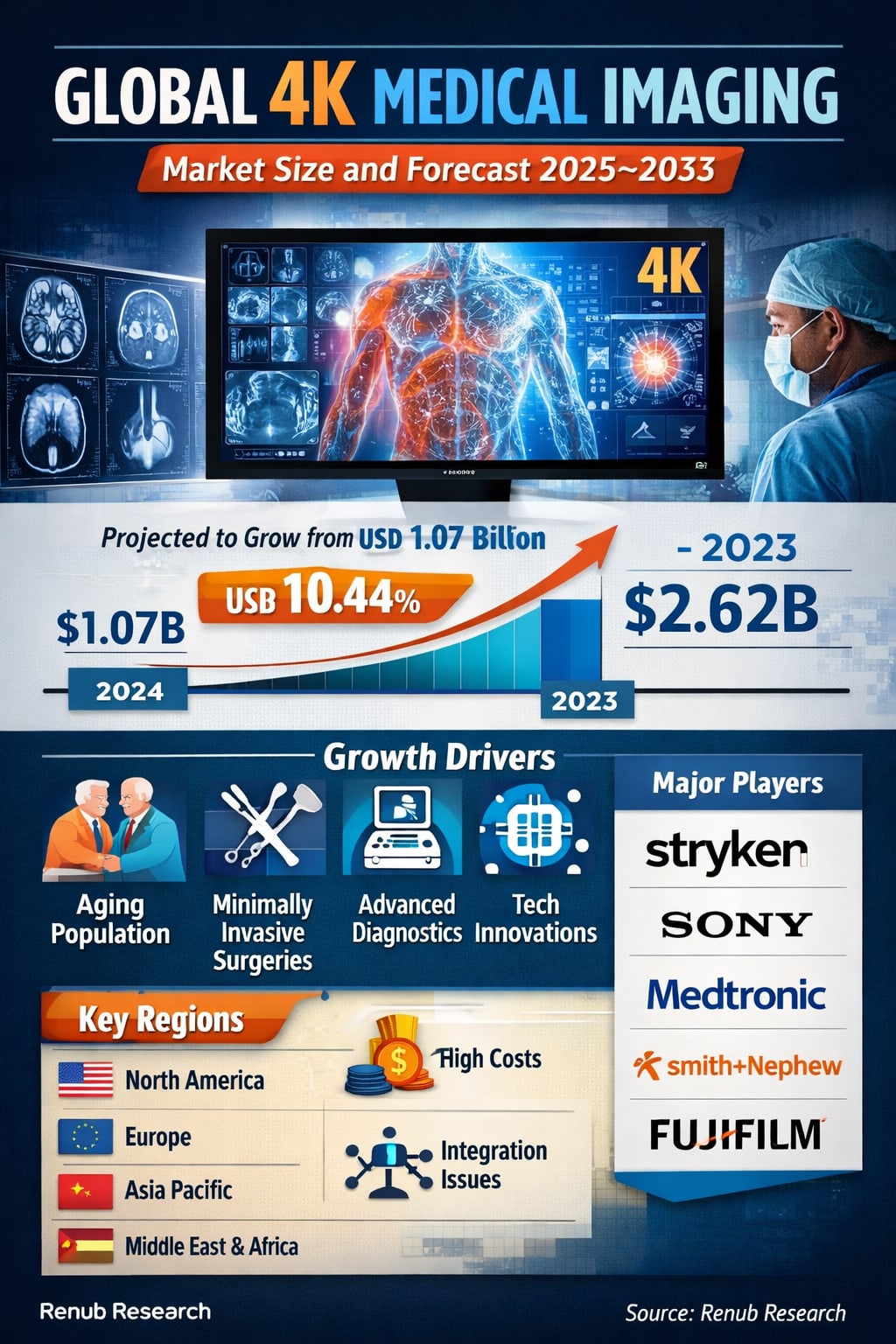
According to Renub Research, the global 4K medical imaging market is expected to reach US$ 2.62 billion by 2033, up from US$ 1.07 billion in 2024, registering a CAGR of 10.44% from 2025 to 2033. This robust growth reflects the healthcare sector’s increasing reliance on high-resolution visualization, rising healthcare expenditures, rapid technological progress, and the expanding use of minimally invasive surgical techniques worldwide.
Market Overview: Why 4K Imaging Is Gaining Momentum
The demand for 4K medical imaging is being driven by a combination of clinical needs and technological innovation. Healthcare providers today are under constant pressure to improve patient outcomes, reduce procedural risks, and enhance operational efficiency. High-resolution imaging plays a critical role in achieving these goals.
4K systems offer superior contrast, color accuracy, and depth perception, which are particularly valuable during complex procedures. In endoscopic and laparoscopic surgeries, for example, better visualization translates into more precise instrument handling and improved surgical confidence. In diagnostics, radiologists benefit from sharper images that help in the early detection of abnormalities.
At the same time, global healthcare systems are modernizing. Investments in hospital infrastructure, digital operating rooms, and advanced diagnostic centers are creating a favorable environment for the adoption of next-generation imaging technologies. The growing burden of chronic diseases, coupled with an aging global population, is further increasing the need for accurate and reliable diagnostic tools—another factor strengthening the case for 4K imaging solutions.
Key Growth Drivers of the 4K Medical Imaging Market
1. Growing Need for Improved Visualization in Healthcare
One of the most powerful drivers of the 4K medical imaging market is the rising demand for better visualization in both diagnosis and treatment. Modern medicine increasingly depends on precision, and high-resolution imaging provides clinicians with the visual detail required to make more informed decisions.
A notable example is Stryker’s advanced 1788 imaging platform, launched in India in September 2024. This system offers 4K high-resolution imaging, enhanced fluorescence-guided surgery, OLED display technology, high dynamic range, and a wider color gamut. Such innovations allow surgeons to visualize critical anatomy and tissue perfusion more clearly, reinforcing the value of 4K imaging in complex procedures. As more healthcare providers experience these benefits firsthand, adoption is expected to accelerate across specialties.
2. Advances in Video Recording Systems and Data Management
Modern healthcare facilities are not only focused on image quality but also on workflow efficiency and data management. Today’s 4K imaging systems increasingly come with advanced video recording capabilities, secure storage, and seamless integration with hospital information systems.
In July 2024, MediCapture introduced the MVR 4K, a compact 4Kp60 surgical recording system designed for digital operating rooms. With features such as dual 4K input, multi-input recording, 1TB storage, and advanced data management, the system improves workflow flexibility and enhances data security. These types of innovations make 4K systems more attractive to hospitals and clinics that are aiming to streamline operations while maintaining high clinical standards.
3. Increasing Use of 4K Imaging in Precision Surgery
As surgical procedures become more sophisticated, the need for extreme visual clarity becomes even more critical. 4K imaging enables surgeons to see fine anatomical structures in greater detail, improving accuracy during complex interventions.
In September 2024, Olympus launched the 4K CH-S700-08-LB camera head for gynecological and urological procedures. By combining 4K white light, 4K narrow band imaging (NBI), and blue light imaging, this technology enhances visibility during endoscopic procedures, particularly in the detection and resection of bladder cancer. Such advancements highlight how 4K imaging is becoming a standard tool in high-precision surgical environments.
Challenges Facing the 4K Medical Imaging Market
High Maintenance and Ownership Costs
Despite its clear advantages, the high cost of maintenance remains a significant barrier to wider adoption. 4K medical imaging systems require regular calibration, software updates, and specialized technical support. Over time, these ongoing expenses can place a financial strain on healthcare providers, especially smaller hospitals and clinics with limited budgets. Additionally, as technology evolves, facilities may need to upgrade or replace existing systems to remain compatible with new standards, further increasing long-term costs.
Integration Issues with Existing Infrastructure
Another major challenge is system integration. Many healthcare facilities still operate with legacy IT and imaging infrastructure that may not be fully compatible with the latest 4K technologies. Integrating new 4K systems with existing electronic health records (EHRs), picture archiving and communication systems (PACS), and diagnostic tools can be complex, time-consuming, and expensive. These hurdles can delay adoption, particularly in cost-sensitive or resource-constrained healthcare environments.
Regional Overview: A Global Market with Uneven Adoption
The 4K medical imaging market is expanding across all major regions, although adoption rates vary depending on healthcare infrastructure, investment capacity, and technological readiness.
North America leads the market, supported by advanced healthcare systems, high technology adoption, and strong investment in medical innovation.
Europe follows closely, driven by increasing healthcare spending and a strong focus on diagnostic accuracy and surgical precision.
Asia Pacific is the fastest-growing region, fueled by improving healthcare infrastructure, rising awareness, and growing demand for advanced medical technologies.
Latin America and the Middle East & Africa are emerging markets, where growth is supported by healthcare modernization efforts, although adoption is slower due to cost and infrastructure constraints.
Country Spotlight
United States
The United States remains a key market for 4K medical imaging, driven by high healthcare spending, rapid technology adoption, and strong demand for precision in surgery and diagnostics. In August 2023, Viseon Inc. commercialized the 4K MaxView System, marking the first clinical application of this visualization technology for minimally invasive spine surgery. Such innovations underline the country’s leadership in adopting cutting-edge imaging solutions and are expected to support continued market growth.
Germany
Germany’s 4K medical imaging market benefits from a strong healthcare infrastructure, an aging population, and a robust medical device industry. The country is steadily integrating 4K technologies into radiology, endoscopy, and minimally invasive surgery, enhancing diagnostic accuracy and procedural outcomes. Consistent investment in healthcare and technology positions Germany as a major player in the European market.
India
India represents one of the most promising growth markets in Asia Pacific. Rising healthcare expenditure, increasing patient awareness, and rapid expansion of private hospitals are driving demand for high-resolution imaging. The growing prevalence of chronic diseases and the need for accurate diagnostics are further accelerating the adoption of 4K medical imaging systems across the country.
Saudi Arabia
Saudi Arabia’s market is being shaped by significant government investment in healthcare modernization under initiatives such as Vision 2030. The focus on advanced medical technologies, precision medicine, and improved patient care is boosting demand for 4K imaging systems in radiology, surgery, and diagnostics.
Market Segmentation
By Type:
Magnetic Resonance Imaging (MRI)
Computed Tomography (CT)
X-ray
Ultrasound
Others
By End User:
Hospitals
Diagnostic Imaging Centers
Specialty Clinics
Others
Regional Coverage
North America: United States, Canada
Europe: France, Germany, Italy, Spain, United Kingdom, Belgium, Netherlands, Turkey
Asia Pacific: China, Japan, India, South Korea, Thailand, Malaysia, Indonesia, Australia, New Zealand
Latin America: Brazil, Mexico, Argentina
Middle East & Africa: Saudi Arabia, UAE, South Africa
Competitive Landscape
The global 4K medical imaging market is moderately competitive, with leading players focusing on product innovation, strategic partnerships, and geographic expansion. Key companies covered in the market from five viewpoints—overview, key persons, product portfolio, recent developments and strategies, and revenue analysis—include:
Stryker Corporation
Zimmer Biomet Holdings, Inc.
Smith & Nephew Plc
Conmed Corporation
Medtronic plc
Sony Group Corporation
Fujifilm Holdings Corporation
Hitachi Ltd.
These companies are investing heavily in R&D to enhance image quality, improve workflow integration, and expand the clinical applications of 4K imaging technologies.
Final Thoughts
The global 4K medical imaging market is entering a decisive growth phase. With the market projected to rise from US$ 1.07 billion in 2024 to US$ 2.62 billion by 2033, the role of ultra-high-definition imaging in healthcare is becoming increasingly central. While challenges such as high costs and integration issues remain, the benefits of superior visualization, improved surgical precision, and enhanced diagnostic confidence are too significant to ignore.
As healthcare systems worldwide continue to prioritize quality, safety, and efficiency, 4K medical imaging is set to move from being a premium option to a mainstream standard in modern medical practice. The coming decade will likely see this technology reshape not only how clinicians see the human body—but also how effectively they can treat it.
About the Creator
Global Multiple Myeloma Market Size and Forecast 2025–2033
Introduction: A Market at the Crossroads of Innovation and Urgency The global healthcare landscape is undergoing a profound transformation, and nowhere is this more visible than in the field of oncology. Among the many cancers that continue to challenge healthcare systems worldwide, multiple myeloma stands out as both a clinical and commercial focal point. This complex blood cancer, which affects plasma cells in the bone marrow, has historically been difficult to treat. However, rapid advances in medical science are now reshaping patient outcomes—and the market that supports these therapies.
By Sakshi Sharma2 days ago in Trader
The Saddest Thing - The Billionaires Who Rule America Aren't Even Enjoying Themselves
This single post says more about our ruling class than a thousand policy papers. The saddest thing about today's system is that the men robbing the rest of us - sabotaging our economic prospects, our pensions, our access to affordable healthcare - are not even happy.
By Scott Christenson🌴7 days ago in The Swamp


Comments
There are no comments for this story
Be the first to respond and start the conversation.