
Global Vegetable Oil Market Size and Forecast 2025–2033
Rising Health Awareness, Industrial Demand, and Agricultural Innovation Drive the Next Decade of Growth

Introduction: A Market That Touches Every Kitchen and Industry
Vegetable oil is one of the most essential commodities in the modern global economy. Extracted primarily from seeds and fruits such as soybeans, palm, sunflower, rapeseed, and olives, vegetable oils play a critical role not only in everyday cooking but also across a wide range of industries, including food processing, cosmetics, pharmaceuticals, and biofuels. Their versatility, nutritional profile, and wide availability have made them a cornerstone of both household consumption and industrial production worldwide.
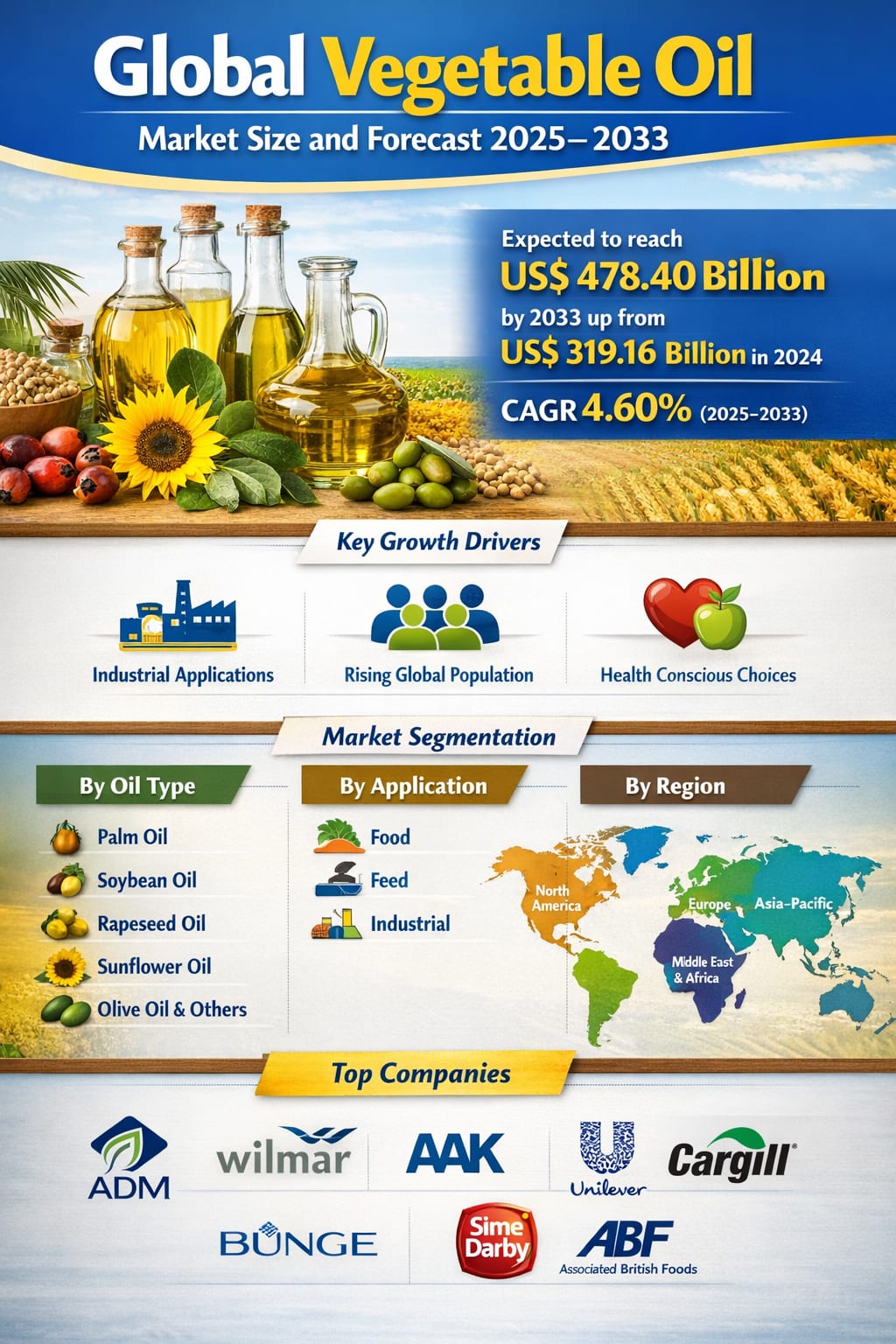
According to Renub Research, the Global Vegetable Oil Market is expected to reach US$ 478.40 billion by 2033, up from US$ 319.16 billion in 2024, growing at a CAGR of 4.60% from 2025 to 2033. This steady expansion reflects a combination of powerful forces: the global shift toward healthier eating habits, rising population and urbanization, expanding industrial applications, improvements in agricultural productivity, and increasing disposable incomes, particularly in emerging economies.
Vegetable oils are valued not only for their culinary functions—such as frying, baking, and flavor enhancement—but also for their nutritional benefits. Many vegetable oils are rich in unsaturated fats and essential fatty acids, which are widely considered beneficial for heart health when consumed in moderation. At the same time, non-food uses such as biodiesel production, personal care products, soaps, and detergents are becoming increasingly important demand drivers.
As consumer awareness grows and industries diversify their raw material needs, the vegetable oil market is evolving from a basic food commodity sector into a strategically important global industry with deep links to health, sustainability, trade policy, and energy security.
Global Market Outlook: Growth Fueled by Multiple Demand Engines
The projected growth of the vegetable oil market over the next decade is not driven by a single factor, but by a convergence of long-term structural trends. On the consumption side, rising global population and changing dietary patterns are increasing the demand for edible oils. On the production side, advances in farming techniques, better crop yields, and improved processing technologies are making vegetable oil production more efficient and scalable.
In addition, the industrial use of vegetable oils is expanding rapidly. Beyond food, these oils are now widely used in the manufacture of cosmetics, soaps, lubricants, and especially biofuels such as biodiesel. As countries seek to reduce their dependence on fossil fuels and lower carbon emissions, vegetable oils are increasingly being positioned as renewable and more sustainable alternatives in certain applications.
Trade policies, government regulations, and sustainability initiatives also play a significant role in shaping the market. Import-export dynamics, tariffs, and environmental standards can influence both pricing and production patterns. Meanwhile, the rise of e-commerce and modern retail channels is making a wider variety of oils more accessible to consumers across both developed and developing markets.
Key Drivers of the Global Vegetable Oil Market
1. Expanding Industrial Applications
One of the strongest growth drivers for the vegetable oil market is its increasing use beyond the kitchen. Vegetable oils are now essential raw materials in industries such as personal care, pharmaceuticals, chemicals, and energy. In the cosmetics and personal care sector, they are used in creams, lotions, soaps, and hair products due to their moisturizing and emollient properties.
Perhaps the most significant industrial growth area is biofuels, particularly biodiesel. As governments and corporations push for cleaner energy solutions, vegetable oils—especially soybean oil, palm oil, and rapeseed oil—are being increasingly used as feedstocks for biodiesel production. This trend is expected to continue over the next decade, providing a strong and stable source of demand for the vegetable oil industry.
2. Growing Global Population
According to the United Nations, the world’s population is expected to grow from around 8 billion today to approximately 9.7 billion by 2050, potentially peaking at about 10.4 billion in the mid-2080s. This population growth naturally translates into higher demand for food, including cooking oils and processed foods that rely heavily on vegetable oils as key ingredients.
The impact is particularly strong in emerging economies, where rising incomes are enabling consumers to diversify their diets and increase their consumption of packaged and processed foods. As urbanization continues, the demand for convenient, ready-to-cook, and ready-to-eat food products—many of which use vegetable oils extensively—is also rising.
3. Shift Toward Healthier Dietary Choices
Health consciousness is reshaping consumer preferences worldwide. There is a growing shift away from fats high in saturated content toward oils rich in unsaturated fats, such as olive, canola, sunflower, and avocado oils. These oils are often promoted for their potential benefits in supporting heart health and managing cholesterol levels.
Public health campaigns, improved food labeling, and a steady stream of nutritional research are encouraging consumers to make more informed choices. As a result, premium and “health-positioned” vegetable oils are seeing stronger demand, especially in North America and Europe, while similar trends are gradually gaining momentum in Asia-Pacific, Latin America, and the Middle East.
Challenges Facing the Vegetable Oil Market
1. Volatile Raw Material Prices
One of the biggest challenges for the vegetable oil industry is the volatility of raw material prices. Crops such as soybeans, sunflower seeds, and oil palm are highly sensitive to weather conditions, climate change, geopolitical tensions, and supply chain disruptions. Droughts, floods, or disease outbreaks can significantly impact yields, leading to sharp price fluctuations.
This volatility affects not only producers but also food manufacturers and end consumers. Unpredictable pricing makes long-term planning more difficult for companies and can result in higher retail prices, potentially dampening demand in price-sensitive markets.
2. Labor and Fair Trade Concerns
Ethical and sustainability issues, particularly in palm oil production, have drawn increasing global attention. In some regions, concerns have been raised about labor exploitation, poor working conditions, and environmental damage such as deforestation. These issues have prompted pressure from governments, NGOs, and consumers for greater transparency and responsible sourcing.
While certification schemes and sustainability initiatives are helping to address these concerns, they can also increase operational costs for producers. Balancing profitability with ethical and environmental responsibility remains a key challenge for the industry.
Regional Overview: A Truly Global Market
The vegetable oil market is global in both production and consumption, with different regions specializing in different oil types based on climate, agriculture, and dietary habits.
Asia-Pacific dominates global production, especially for palm oil, with major contributions from Indonesia and Malaysia. The region is also a major consumer due to its large population and rapidly growing food processing sector.
North America and Europe primarily consume soybean, canola (rapeseed), sunflower, and olive oils, with strong emphasis on health, quality, and sustainability.
Latin America, particularly Brazil and Argentina, plays a major role in soybean oil production and exports.
Middle East & Africa are largely import-dependent but are witnessing steady growth in consumption driven by urbanization, population growth, and changing diets.
Country-Level Insights
United States Vegetable Oil Market
The United States is one of the largest vegetable oil markets in the world, with soybean oil being the most widely produced and consumed. It is extensively used in frying, food processing, and packaged foods. Health trends are influencing consumption patterns, with rising demand for oils such as olive and avocado oil.
At the same time, the U.S. market faces challenges such as raw material price volatility, competition from alternative fats, and increasing scrutiny over sustainability and non-GMO sourcing. The growing use of soybean oil in biodiesel production is also reshaping demand dynamics.
Germany Vegetable Oil Market
Germany’s vegetable oil market is strongly influenced by health-conscious consumers and sustainability-focused policies. Oils such as olive, sunflower, and rapeseed are particularly popular. The rise of plant-based diets and demand for non-GMO and organic products are supporting the growth of premium oil segments.
Strict food safety regulations and sustainability standards encourage ethical sourcing and transparent supply chains, making Germany a key market for high-quality and responsibly produced vegetable oils.
India Vegetable Oil Market
India is one of the world’s largest and fastest-growing vegetable oil markets, driven by population growth, urbanization, and changing dietary habits. Palm, sunflower, and soybean oils dominate consumption, with sunflower oil gaining popularity due to its perceived health benefits.
The market has seen significant corporate activity in recent years. For instance, Freedom Refined Sunflower Oil, part of Gemini Edibles & Fats India, announced plans in June 2022 to expand into Tamil Nadu and Kerala, highlighting regional growth opportunities. Similarly, Cargill’s acquisition of an edible oil refinery in Nellore in November 2021, followed by a USD 35 million investment to upgrade the facility, underscores the increasing competitiveness and consolidation in the Indian market.
Despite strong growth prospects, the Indian market is affected by price fluctuations, import dependence, trade policies, and sustainability concerns, pushing companies to strengthen sourcing strategies and expand their distribution networks.
Saudi Arabia Vegetable Oil Market
Saudi Arabia’s vegetable oil market is driven by the food processing industry, urbanization, and rising consumption of packaged foods. The country relies heavily on imports due to limited domestic agricultural production. Palm, soybean, and sunflower oils are among the most commonly used.
Government initiatives aimed at improving food security and promoting sustainable practices, along with growing demand for premium and non-GMO oils, are shaping the future of the market.
Market Segmentation
By Oil Type:
Palm Oil
Soybean Oil
Rapeseed Oil
Sunflower Oil
Olive Oil
Others
By Application:
Food
Feed
Others
By Distribution Channel:
B2B
B2C
By Region:
North America: United States, Canada
Europe: France, Germany, Italy, Spain, United Kingdom, Belgium, Netherlands, Turkey
Asia-Pacific: China, Japan, India, South Korea, Thailand, Malaysia, Indonesia, Australia, New Zealand
Latin America: Brazil, Mexico, Argentina
Middle East & Africa: Saudi Arabia, UAE, South Africa
Competitive Landscape and Key Players
The global vegetable oil market is highly competitive, with major multinational companies operating across sourcing, processing, refining, and distribution. Key players include:
Archer Daniels Midland (ADM)
Wilmar International
AAK (AarhusKarlshamn)
Unilever Plc
Bunge
Cargill
Sime Darby
Associated British Foods
These companies compete on multiple fronts, including product quality, pricing, supply chain efficiency, sustainability initiatives, and geographic expansion. Strategic investments, acquisitions, and partnerships are common as firms seek to strengthen their market positions and secure reliable raw material supplies.
Final Thoughts: A Market Poised for Steady, Sustainable Growth
The global vegetable oil market is entering a decade of steady and resilient growth. With the market projected to expand from US$ 319.16 billion in 2024 to US$ 478.40 billion by 2033, the industry stands at the intersection of some of the world’s most important trends: population growth, health awareness, industrial diversification, and the transition toward more sustainable resources.
While challenges such as price volatility, ethical concerns, and environmental pressures remain, they are also driving innovation, better governance, and more responsible business practices. Companies that can balance efficiency, sustainability, and consumer trust will be best positioned to succeed in this evolving landscape.
In short, vegetable oil is no longer just a kitchen staple—it is a strategic global commodity shaping the future of food, industry, and energy alike.
About the Creator
Non-Invasive Prenatal Testing Market Size and Forecast 2025–2033
Global Non-Invasive Prenatal Testing Market Overview Non-Invasive Prenatal Testing (NIPT) has rapidly emerged as one of the most transformative innovations in modern prenatal care. Designed to detect the risk of specific chromosomal abnormalities in a fetus using a simple maternal blood sample, NIPT offers a safer, more accurate alternative to traditional invasive procedures such as amniocentesis and chorionic villus sampling (CVS). By analyzing cell-free fetal DNA (cfDNA) circulating in the mother’s bloodstream, clinicians can assess the likelihood of conditions such as Down syndrome (trisomy 21), Edwards syndrome (trisomy 18), Patau syndrome (trisomy 13), Turner syndrome, and other chromosomal anomalies early in pregnancy.
By shibansh kumar3 days ago in Trader
Asia Pacific Pediatric Interventional Cardiology Market Size and Forecast 2025–2033
Introduction The Asia Pacific Pediatric Interventional Cardiology Market is entering a period of sustained and meaningful growth as healthcare systems across the region place increasing emphasis on advanced, child-focused cardiac care. According to Renub Research, the market is expected to reach US$ 1,525.53 million by 2033, rising from US$ 829.09 million in 2024, at a compound annual growth rate (CAGR) of 7.01% from 2025 to 2033.
By shibansh kumarabout 12 hours ago in Trader
The Pride Flag and the Diversion
For nearly a decade, the LGBTQIA Pride Flag rippled in the wind at Christopher Park, a kaleidoscope of color staked into the soil of America’s first national monument to LGBTQIA+ liberation. That flag came down this week. Federal officials, citing new guidance from the Trump Administration, silently lowered the rainbow flag from its pole across the street from the Stonewall Inn. The birthplace of the modern gay rights movement now flies only the United States flag.
By Tim Carmichael3 days ago in Pride




Comments
There are no comments for this story
Be the first to respond and start the conversation.