
Non-Invasive Prenatal Testing Market Size and Forecast 2025–2033
How advanced genetic screening, rising awareness, and precision medicine are reshaping prenatal care worldwide

Global Non-Invasive Prenatal Testing Market Overview
Non-Invasive Prenatal Testing (NIPT) has rapidly emerged as one of the most transformative innovations in modern prenatal care. Designed to detect the risk of specific chromosomal abnormalities in a fetus using a simple maternal blood sample, NIPT offers a safer, more accurate alternative to traditional invasive procedures such as amniocentesis and chorionic villus sampling (CVS). By analyzing cell-free fetal DNA (cfDNA) circulating in the mother’s bloodstream, clinicians can assess the likelihood of conditions such as Down syndrome (trisomy 21), Edwards syndrome (trisomy 18), Patau syndrome (trisomy 13), Turner syndrome, and other chromosomal anomalies early in pregnancy.
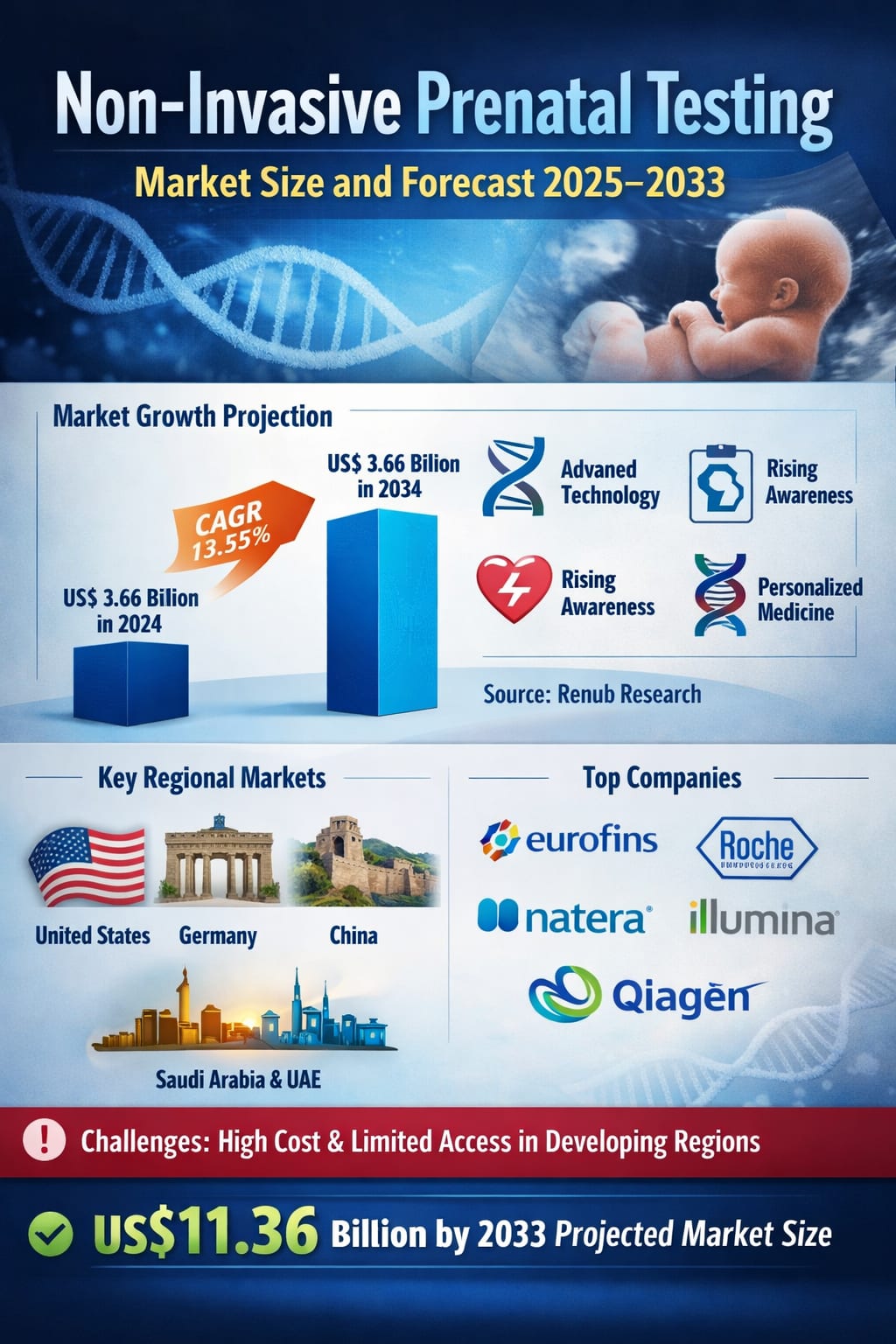
According to Renub Research, the Global Non-Invasive Prenatal Testing Market is expected to reach US$ 11.36 billion by 2033, growing from US$ 3.62 billion in 2024, at a robust compound annual growth rate (CAGR) of 13.55% from 2025 to 2033. This strong growth trajectory reflects not only technological advancements in genetic sequencing but also a broader shift in healthcare toward preventive, personalized, and precision-based diagnostics.
What makes NIPT particularly compelling is its combination of high accuracy and low risk. Traditional invasive diagnostic methods, while definitive, carry a small but real risk of miscarriage and other complications. NIPT, by contrast, requires only a blood draw from the expectant mother, significantly reducing physical risk while still delivering highly reliable screening results. As a result, both clinicians and parents are increasingly embracing this method as a first-line screening tool in prenatal care.
In recent years, the integration of next-generation sequencing (NGS) technologies and advanced bioinformatics has further improved the sensitivity and specificity of NIPT. These improvements have expanded its clinical applications beyond the most common trisomies to include sex chromosome abnormalities, microdeletions, and copy number variations (CNVs). This expanding clinical scope is one of the key reasons why the market is gaining momentum across both developed and emerging economies.
For instance, a January 2024 article published in the Heliyon Journal highlighted that NIPT screening can improve the detection of copy number variations, fetal sex chromosome abnormalities, and other chromosomal issues while also reducing false-positive rates. The study also noted that pregnant women over the age of 35 showed significantly higher detection rates of chromosomal abnormalities, reinforcing the clinical importance of NIPT, particularly in cases of advanced maternal age.
Government policies and healthcare system support are also playing a crucial role in accelerating adoption. In April 2023, the Dutch government announced that all expectant mothers could access NIPT without participating in a research trial, effectively making it a standard part of prenatal screening. Similarly, in January 2023, Myriad Genetics, Inc. expressed support for updated guidelines from the American College of Medical Genetics and Genomics (ACMG), which emphasized the clinical value of non-invasive prenatal screening in detecting a wide range of chromosomal abnormalities. Such policy-level endorsements are helping normalize NIPT as a routine component of prenatal care worldwide.
Growth Drivers for the Non-Invasive Prenatal Testing Market
Advancements in Technology
Technological progress has been the single most important catalyst behind the rapid rise of NIPT. The development and refinement of next-generation sequencing and high-throughput genetic analysis tools have dramatically improved the accuracy, reliability, and clinical utility of these tests. By examining cell-free DNA fragments from the placenta that circulate in maternal blood, NIPT can identify chromosomal abnormalities with remarkable precision, often as early as the first trimester.
These technological advancements have not only improved detection rates for common trisomies but have also expanded the scope of screening to include sex chromosome aneuploidies and other genetic variations. As sequencing costs continue to decline and analytical algorithms become more sophisticated, NIPT is becoming both more accessible and more informative. This steady improvement in performance and affordability is reinforcing the test’s position as a preferred screening option in prenatal care.
Rising Awareness and Adoption
Another powerful driver of market growth is the increasing awareness of NIPT among both healthcare providers and expectant parents. Over the past decade, education campaigns, clinical guidelines, and word-of-mouth experiences have helped build trust in the accuracy and safety of non-invasive screening methods.
Parents today are more informed and proactive about prenatal health than ever before. The knowledge that NIPT can provide early, reliable insights into fetal health without the risks associated with invasive procedures makes it an attractive choice, particularly for those with high-risk pregnancies or advanced maternal age. As more hospitals and diagnostic laboratories integrate NIPT into routine prenatal care pathways, adoption rates continue to rise across diverse demographic groups.
Growing Demand for Personalized Medicine
The broader shift toward personalized medicine is also fueling the expansion of the NIPT market. Modern healthcare is increasingly focused on tailoring medical decisions to the individual characteristics of each patient, including genetic risk factors. NIPT fits perfectly into this paradigm by offering customized, risk-based screening that goes beyond one-size-fits-all approaches.
Instead of relying solely on age-based or population-level risk assessments, clinicians can use NIPT results to provide more precise, individualized counseling and care plans. This personalized approach not only improves clinical decision-making but also empowers parents with clearer, more relevant information about their pregnancy. As precision medicine continues to gain ground across healthcare systems, the role of NIPT in prenatal care is expected to become even more central.
Challenges in the Non-Invasive Prenatal Testing Market
High Cost of Testing
Despite its many advantages, the high cost of NIPT remains a significant barrier to widespread adoption. Compared to traditional screening methods, NIPT is still relatively expensive, particularly in regions where healthcare budgets are constrained or insurance coverage is limited. For many families, the out-of-pocket cost can be prohibitive, forcing them to choose between NIPT and other essential healthcare needs.
This cost challenge is especially pronounced in low- and middle-income countries, where advanced genetic testing infrastructure may be scarce and healthcare spending per capita is lower. While technological advancements are gradually reducing costs, achieving truly universal access will require further price reductions, broader insurance reimbursement, and supportive public health policies.
Limited Availability in Developing Regions
Access to NIPT remains uneven across the globe. While the test is widely available in North America, Europe, and parts of Asia-Pacific, many developing regions still lack the necessary laboratory infrastructure, trained personnel, and logistical systems required to offer NIPT at scale.
The shortage of skilled genetic counselors and laboratory technicians further complicates adoption, as accurate interpretation of results is just as important as the test itself. Bridging this gap will require sustained investment in healthcare infrastructure, workforce training, and international collaboration to ensure that the benefits of non-invasive prenatal screening are not limited to wealthier nations alone.
United States Non-Invasive Prenatal Testing Market
The United States represents one of the largest and most dynamic markets for non-invasive prenatal testing. Driven by high awareness, advanced healthcare infrastructure, and a strong focus on early diagnosis, NIPT has become increasingly integrated into routine prenatal care across the country.
Expectant parents in the U.S. are particularly receptive to NIPT because it offers high accuracy in detecting conditions such as Down syndrome, trisomy 18, and trisomy 13 without the risks associated with invasive procedures. Adoption is especially high among older mothers and those with high-risk pregnancies. Expanding insurance coverage and the growing availability of testing services in hospitals and diagnostic labs have further supported market growth.
For example, a March 2023 report from the Minnesota Department of Health noted that Trisomy 18 affects approximately 1 in every 2,000 to 6,000 live births in the United States, and its prevalence increases with maternal age. Similarly, the Centers for Disease Control and Prevention (CDC) reported in June 2023 that Down syndrome occurs in about 1 in 707 births in the U.S. These statistics underscore the ongoing need for reliable prenatal screening tools, reinforcing the importance of NIPT in the American healthcare landscape.
Germany Non-Invasive Prenatal Testing Market
Germany’s NIPT market is growing steadily, supported by a strong healthcare system, high awareness of genetic screening, and increasing acceptance of advanced diagnostic technologies. Pregnant parents, particularly those in higher-risk categories, are increasingly opting for NIPT due to its accuracy and safety profile.
Coverage by many private insurance plans has helped improve accessibility, while ongoing advancements in genetic testing technologies continue to enhance test performance. However, variations in regulations across European countries and the relatively high cost of testing still influence market dynamics. Despite these challenges, Germany remains a key contributor to the overall growth of the European NIPT market.
China Non-Invasive Prenatal Testing Market
China is emerging as one of the fastest-growing markets for non-invasive prenatal testing, driven by rising healthcare awareness, improving medical infrastructure, and increasing demand for safer prenatal screening options. As the country continues to modernize its healthcare system, access to advanced genetic testing is expanding in both urban and, gradually, rural areas.
The growing number of high-risk pregnancies, coupled with a rising focus on early diagnosis and preventive care, is boosting demand for NIPT. While cost remains a barrier for some families, increasing awareness and wider availability are expected to support sustained market growth in the coming years.
Saudi Arabia and United Arab Emirates Non-Invasive Prenatal Testing Market
In Saudi Arabia and the United Arab Emirates, the NIPT market is gaining traction as healthcare systems continue to invest in advanced diagnostic technologies. The growing prevalence of high-risk pregnancies and the shift toward more personalized healthcare are encouraging adoption among expectant parents.
Improved healthcare infrastructure and greater awareness of the benefits of non-invasive screening are supporting market expansion. However, high testing costs and limited insurance coverage still pose challenges to broader adoption. Even so, the long-term outlook remains positive as these countries continue to prioritize modernization of their healthcare services.
Non-Invasive Prenatal Testing Market Segmentation
By Component
Instruments
Kits and Reagents
Services
By Application
Down Syndrome (Trisomy 21)
Edwards Syndrome (Trisomy 18)
Patau Syndrome (Trisomy 13)
Turner Syndrome
Other Applications
By End User
Hospitals
Diagnostic Laboratories
By Geography
North America:
United States
Canada
Europe:
France, Germany, Italy, Spain, United Kingdom, Belgium, Netherlands, Turkey
Asia Pacific:
China, Japan, India, Australia, South Korea, Thailand, Malaysia, Indonesia, New Zealand
Latin America:
Brazil, Mexico, Argentina
Middle East & Africa:
South Africa, Saudi Arabia, United Arab Emirates
Company Insights and Competitive Landscape
Key players in the global Non-Invasive Prenatal Testing market include:
Eurofins Scientific
F. Hoffmann-La Roche Ltd
Invitae Corporation
Illumina Inc.
Natera Inc.
Centogene NV
Qiagen
These companies are активно investing in research and development, expanding their testing portfolios, and forming strategic partnerships to strengthen their market positions. Innovations in sequencing technologies, data analytics, and service delivery models are expected to intensify competition and drive further improvements in test accuracy, speed, and affordability.
Final Thoughts
The global Non-Invasive Prenatal Testing market is on a strong growth path, supported by rapid technological advancements, rising awareness, and the global shift toward personalized and preventive healthcare. With the market projected to grow from US$ 3.62 billion in 2024 to US$ 11.36 billion by 2033 at a CAGR of 13.55%, NIPT is set to become an increasingly integral part of prenatal care worldwide.
While challenges such as high costs and limited access in developing regions remain, ongoing innovation, supportive policies, and expanding healthcare infrastructure are expected to gradually overcome these barriers. In the years ahead, non-invasive prenatal testing will not only reshape how genetic screening is performed but also play a crucial role in improving maternal and fetal health outcomes across the globe.
About the Creator
Keep reading
More stories from shibansh kumar and writers in Trader and other communities.
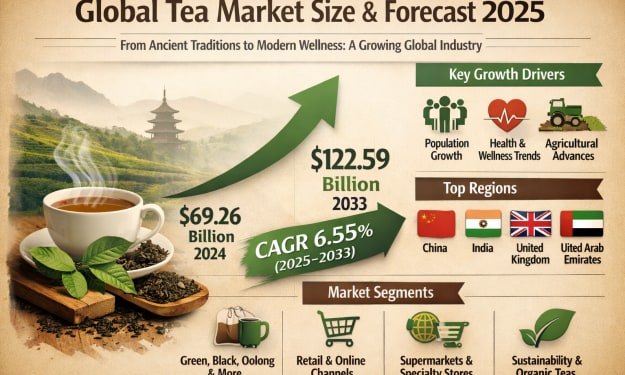
Global Tea Market Size and Forecast 2025: Tradition Meets Innovation in a $122 Billion Industry
Global Tea Market Overview One of the oldest and most culturally significant beverage industries in the world, the global tea market continues to evolve while staying rooted in centuries-old traditions. Tea is consumed across Asia, Europe, the Americas, the Middle East, and Africa in countless forms—black, green, oolong, white, herbal, and specialty blends—making it one of the most universal daily beverages on the planet.
By shibansh kumar3 days ago in Trader
Nifty 50 & Sensex: Little-Known Market Insights Every Investor Must Know
Nifty 50 & Sensex are the heartbeat of India’s stock market. Every time these indexes move, investors feel the impact. Understanding their patterns can help you make better investment decisions. If you know how Nifty 50 & Sensex behave, you can avoid common mistakes and spot opportunities early. Even beginners can benefit. Tracking Nifty 50 & Sensex gives insights into the economy and investor sentiment. In this article, we reveal little-known secrets of these indexes that most people overlook.
By John.doe798about 19 hours ago in Trader
No Other Choice (2025)
It is only February, so other films may well surpass “No Other Choice”, but I think this is the best film I’ve seen so far this year. And that surprises me, because, it is a subtitled film and while I am pretentious enough to choose to watch foreign-language films, I was also very tired and that was an extra commitment from me. But more importantly, let me warn you, this film is gruesome and violent. There were times I had to turn away from the screen to avoid the worst of it (including some self-inflicted dentistry).
By Rachel Robbinsa day ago in Geeks



Comments
There are no comments for this story
Be the first to respond and start the conversation.