
Japan Hotel Market Size and Forecast 2025–2033: Steady Growth Powered by Tourism Revival and Experience-Driven Stays
Rising international arrivals, smart hospitality technologies, and themed accommodations reshape Japan’s hotel industry outlook through 2033

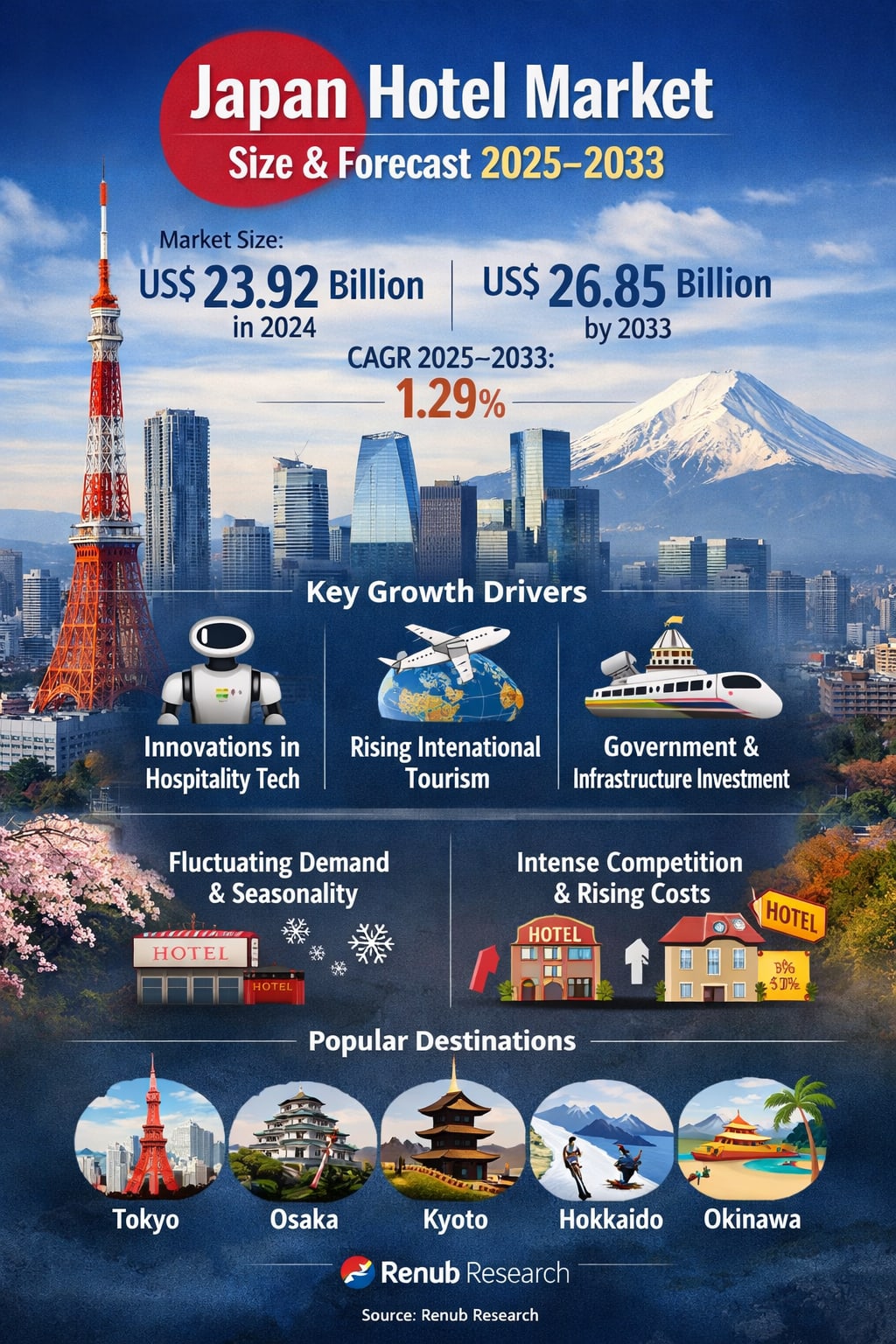
Japan Hotel Market Overview
The Japan Hotel Market is expected to reach US$ 26.85 billion by 2033, growing from US$ 23.92 billion in 2024, at a CAGR of 1.29% from 2025 to 2033. This steady expansion reflects Japan’s strong recovery in tourism, the consistent flow of business travel, and the increasing demand for unique, experience-focused accommodations. While the growth rate is moderate compared to some emerging markets, Japan’s hotel industry benefits from a mature tourism ecosystem, world-class infrastructure, and a globally admired cultural brand.
Japan’s hospitality sector is one of the most diverse in Asia. From ultra-luxury international chains in Tokyo and Osaka to traditional ryokan inns, capsule hotels, and budget-friendly business hotels, the country offers accommodation options for nearly every type of traveler. This diversity has become one of Japan’s biggest competitive advantages, allowing the market to cater to luxury tourists, business travelers, backpackers, and experience-seekers alike.
Tourism, business travel, and cultural exploration continue to form the backbone of hotel demand. Cities such as Tokyo, Kyoto, Osaka, Fukuoka, and Sapporo attract millions of visitors every year, drawn by Japan’s blend of modern urban life, historical heritage, natural beauty, and globally celebrated cuisine. As travel patterns normalize after recent global disruptions, Japan is once again positioning itself as one of the most desirable destinations in the Asia-Pacific region.
Industry Landscape: Tradition Meets Modern Hospitality
Japan’s hotel industry is unique in how it balances tradition and innovation. On one end of the spectrum are centuries-old ryokan offering tatami rooms, hot spring baths, and traditional kaiseki meals. On the other are high-tech hotels with automated check-ins, robot assistants, and AI-powered concierge services. Between these extremes lies a wide range of business hotels, boutique properties, themed accommodations, and international chain hotels.
This mix allows Japan to attract not just first-time visitors but also repeat travelers looking for new experiences. In recent years, themed hotels, lifestyle hotels, and experience-driven stays have gained popularity, especially among younger travelers who value uniqueness and social media-friendly environments. At the same time, business hotels continue to perform strongly due to Japan’s role as a major economic and corporate hub in Asia.
The country’s strong transportation network—anchored by the Shinkansen bullet train system and well-connected international airports—further supports hotel demand by making both major cities and regional destinations easily accessible.
Key Growth Drivers
1. Innovations in Hospitality Technology
Technology is becoming a core differentiator in Japan’s hotel market. Many hotels are adopting AI-driven services, digital concierge platforms, mobile check-ins, and contactless payment systems to improve guest experience and operational efficiency. These innovations not only reduce staffing pressure but also appeal strongly to tech-savvy travelers who expect seamless digital interactions.
Robot assistants, smart rooms, and personalized digital services are no longer novelties in Japan—they are increasingly part of the standard hospitality offering. Virtual tours and immersive digital experiences are also playing a role in destination marketing. For example, in March 2024, a VR360 virtual tour event launched by a Japanese virtual travel platform developer reported that 95% of participants felt more interested in visiting the featured destination, showing how digital tools can directly influence travel intent.
As competition intensifies, hotels that invest in smart technologies and data-driven personalization are likely to gain a clear edge in customer satisfaction and repeat bookings.
2. Rising International Tourism
The revival of international tourism is one of the strongest pillars supporting Japan’s hotel market growth. According to the Japan National Tourism Organization (JNTO), 25,066,100 foreign visitors visited Japan in 2023, reaching nearly 80% of the 2019 pre-pandemic level of 31,882,049. This represented an increase of more than 20 million visitors compared to 2022, signaling a powerful rebound in inbound travel.
Japan’s appeal lies in its rare combination of ancient traditions, modern cities, scenic landscapes, pop culture, and world-class food. Travelers from neighboring countries such as China, South Korea, and Taiwan continue to form a significant portion of inbound tourists, while visitors from Europe and North America are also steadily returning.
This surge in international arrivals directly boosts demand across all hotel categories—from luxury and upscale hotels in major cities to budget and midscale properties near transport hubs and tourist attractions. The growing diversity of visitors also encourages hotels to tailor services to different cultural expectations and travel styles.
3. Government Support and Infrastructure Investment
The Japanese government plays an active role in supporting tourism and hospitality growth. Continuous investments in airport upgrades, rail networks, urban redevelopment, and digital tourism platforms have made travel within Japan faster, more convenient, and more visitor-friendly.
In addition to improving infrastructure, government initiatives also promote regional tourism, encouraging travelers to explore destinations beyond Tokyo, Kyoto, and Osaka. This strategy helps distribute tourism revenue more evenly across the country and creates new opportunities for hotels in secondary cities and rural areas.
By strengthening both physical and digital infrastructure, Japan is enhancing its long-term competitiveness as a global tourism destination—an approach that supports sustained, if gradual, growth in the hotel market through 2033.
Challenges Facing the Japan Hotel Market
1. Fluctuating Demand and Seasonality
Seasonality remains a major challenge for hotel operators in Japan. Peak seasons such as cherry blossom season (spring) and autumn foliage season often see near-full occupancy and higher room rates. In contrast, off-peak periods—particularly parts of summer and winter—can result in lower occupancy and weaker revenues.
This uneven demand makes revenue management and staffing more complex. Hotels must balance pricing strategies, promotional campaigns, and cost controls to remain profitable throughout the year. External factors such as natural disasters or global travel disruptions can further amplify demand volatility, adding another layer of uncertainty to long-term planning.
2. Intense Competition and Rising Operating Costs
Japan’s hotel market is highly competitive, especially in major cities. The presence of global hotel chains, strong domestic brands, boutique hotels, and alternative accommodations puts pressure on pricing and margins. At the same time, rising costs for labor, utilities, maintenance, and real estate continue to squeeze profitability, particularly for smaller and independent operators.
To survive and grow in this environment, hotels must either differentiate through unique experiences and superior service or improve efficiency through technology and smarter operations. Those that fail to adapt risk being caught between rising costs and limited pricing power.
Regional Outlook: Diverse Demand Centers
Japan’s hotel market is geographically diverse, with each region offering a distinct value proposition:
Tokyo and Osaka serve as major business and tourism hubs.
Kyoto attracts visitors seeking cultural and historical experiences.
Hokkaido is known for winter sports and natural landscapes.
Okinawa is famous for beach tourism and resort stays.
Fukuoka, Hiroshima, and other regional cities blend history, modern attractions, and growing business activity.
This regional diversity helps stabilize the overall market by spreading demand across multiple travel segments and seasons.
Tokyo Hotel Market
Tokyo remains the heart of Japan’s hotel industry. As one of the world’s leading financial, cultural, and transportation hubs, the city attracts a constant flow of both leisure and business travelers. Accommodation options range from luxury hotels in areas like Shinjuku, Shibuya, and Marunouchi to more affordable business hotels and hostels in districts such as Asakusa and Ueno.
The rise of boutique and themed hotels has added a new layer of diversity to Tokyo’s hospitality landscape. These properties appeal especially to younger travelers and international visitors seeking distinctive, experience-driven stays. Ongoing urban development, improved transport links, and strong inbound tourism continue to support high occupancy levels and steady investment in new hotel projects.
Osaka Hotel Market
Osaka’s hotel market benefits from a strong mix of tourism, business travel, and entertainment-driven demand. The city is renowned for its food culture, shopping districts, and proximity to major attractions such as Osaka Castle and Universal Studios Japan. Hotels in Osaka range from budget-friendly options near transport hubs to upscale properties in areas like Namba and Umeda.
The growth of the MICE (Meetings, Incentives, Conferences, and Exhibitions) segment further strengthens demand, positioning Osaka as a key destination for international events and corporate gatherings. With excellent air and rail connectivity, including Shinkansen links, Osaka continues to enjoy stable visitor traffic and ongoing hotel development.
Market Segmentation Insights
The Japan Hotel Market is segmented across multiple dimensions, reflecting the industry’s diversity and broad customer base.
By Type:
Economy
Midscale
Upscale
Luxury
By Business Model:
Chain
Independent
By Sales Channel:
Offline
Online
By Age Group:
18–24 years
25–34 years
35–44 years
45–54 years
55–64 years
By Gender:
Male
Female
By Star Rating:
1 Star
2 Star
3 Star
4 Star
5 Star
By Region:
Tokyo
Osaka
Fukuoka
Hokkaido
Kyoto
Kanagawa
Okinawa
Other Regions
Each segment plays a role in shaping overall market performance. For example, economy and midscale hotels benefit from budget travelers and business trips, while luxury and upscale hotels gain from premium tourism and high-spending international visitors. The continued growth of online booking channels is also transforming how travelers discover and reserve accommodations.
Competitive Landscape and Company Analysis
The Japanese hotel market features a mix of global brands and strong domestic players. Companies are typically evaluated across four key dimensions: Company Overview, Key Persons, Recent Developments, and Sales Analysis.
Major players include:
Marriott International Inc.
Hoshino Resorts REIT Inc.
APA Hotels & Resorts
JR Hotel Group
MYSTAYS Hotel Group
Okura Nikko Hotel Management Co. Ltd.
Prince Hotels & Resorts
Route Inn Japan Co. Ltd.
These companies compete on location, brand reputation, service quality, pricing strategies, and increasingly, technological innovation and sustainability practices. Strategic partnerships, property upgrades, and portfolio expansions remain common tactics to strengthen market position.
Sustainability and the Future of Japanese Hospitality
Sustainability is becoming an increasingly important theme in Japan’s hotel industry. Many operators are adopting energy-efficient systems, waste reduction programs, and eco-friendly building designs to align with global environmental goals and changing traveler expectations. Eco-conscious travelers are more likely to choose hotels that demonstrate genuine commitment to responsible tourism, making sustainability not just an ethical choice but also a competitive advantage.
At the same time, experiential travel is reshaping what guests expect from hotels. Rather than simply providing a place to sleep, hotels are being asked to offer cultural immersion, local experiences, and personalized services. This trend is particularly strong in Japan, where regional culture, cuisine, and traditions provide rich material for experience-driven hospitality concepts.
Final Thoughts
The Japan Hotel Market is on a path of steady, sustainable growth, projected to expand from US$ 23.92 billion in 2024 to US$ 26.85 billion by 2033, at a CAGR of 1.29%. While the pace of growth is moderate, the market’s strength lies in its resilience, diversity, and global appeal.
Rising international tourism, continuous infrastructure investment, and rapid adoption of hospitality technologies are reshaping the industry. At the same time, challenges such as seasonal demand fluctuations, intense competition, and rising costs are pushing hotel operators to innovate, differentiate, and operate more efficiently.
Looking ahead, hotels that successfully combine technology, sustainability, and authentic experiences will be best positioned to thrive in Japan’s evolving hospitality landscape. As global travel continues to normalize and traveler expectations evolve, Japan’s hotel industry remains well-placed to maintain its reputation as one of the world’s most distinctive and high-quality hospitality markets.
About the Creator
Philippines Data Center Construction Market 2026: Set for Strong Long-Term Growth as Digital Demand and AI Infrastructure Drive Expansion
Philippines Data Center Construction Market Overview The Philippines data center construction market growth is experiencing significant momentum as digital transformation, cloud computing adoption, and enterprise demand for resilient infrastructure drive the need for modern facilities across the archipelago. According to IMARC Group, the market reached USD 525.2 million in 2025 and is expected to grow to USD 1,611.5 million by 2034, reflecting a strong compound annual growth rate (CAGR) of 13.27% during 2026–2034.
By Manisha Dixit5 days ago in Trader
The Rule of 72 Explained - and Why You Need to Lock In Now
There's a reason wealthy people stay calm about money while everyone else panics. It's not confidence. It's math. Specifically, it's one rule most people never learn - or learn too late to benefit from fully.
By Destiny S. Harris7 days ago in Trader




Comments
There are no comments for this story
Be the first to respond and start the conversation.