
Asia Pacific Pediatric Interventional Cardiology Market Size and Forecast 2025–2033
Minimally invasive heart care for children is transforming outcomes across Asia Pacific as technology, infrastructure, and awareness drive steady market growth.

Introduction
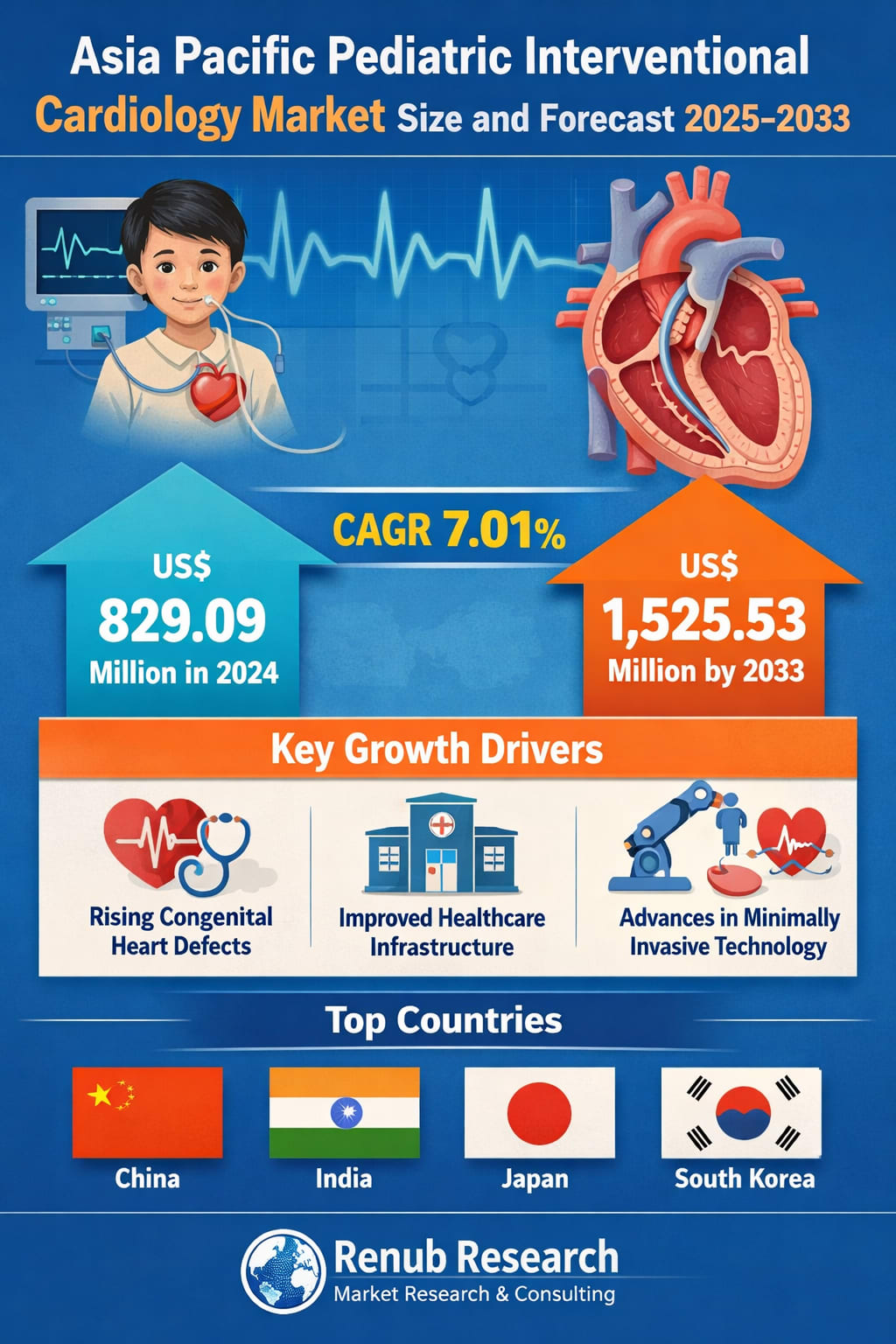
The Asia Pacific Pediatric Interventional Cardiology Market is entering a period of sustained and meaningful growth as healthcare systems across the region place increasing emphasis on advanced, child-focused cardiac care. According to Renub Research, the market is expected to reach US$ 1,525.53 million by 2033, rising from US$ 829.09 million in 2024, at a compound annual growth rate (CAGR) of 7.01% from 2025 to 2033.
This growth is not happening in isolation. It reflects deeper structural changes in how pediatric heart diseases are diagnosed, treated, and managed across Asia Pacific. Rising cases of congenital heart defects, rapid improvements in healthcare infrastructure, increasing public awareness, and continuous innovation in minimally invasive technologies are all reshaping the pediatric cardiology landscape. Countries such as China and India, with their large and growing child populations, are playing a particularly important role in driving demand for pediatric interventional procedures.
At the same time, governments and private healthcare providers are investing heavily in modern hospitals, specialist cardiac centers, and advanced medical devices. Together, these trends are pushing pediatric interventional cardiology from a niche specialty into a core component of child healthcare across the region.
Market Overview: Asia Pacific Pediatric Interventional Cardiology
Pediatric interventional cardiology is a specialized branch of cardiology focused on the minimally invasive diagnosis and treatment of heart conditions in neonates, children, and adolescents. Instead of relying solely on open-heart surgery, interventional cardiologists use catheter-based techniques to correct congenital heart defects, open narrowed valves or arteries, and close septal defects. These procedures are typically guided by imaging technologies such as echocardiography and fluoroscopy, allowing for high precision and improved safety.
Compared to traditional surgery, interventional approaches offer several important benefits: shorter hospital stays, faster recovery times, reduced risk of complications, and less physical trauma for young patients. For families, this often means lower emotional stress and reduced long-term healthcare burdens. For healthcare systems, it translates into more efficient use of resources and better patient outcomes.
In the Asia Pacific region, pediatric interventional cardiology is becoming increasingly essential as both congenital and acquired heart conditions in children receive greater clinical attention. The combination of better diagnostics, improved access to care, and growing acceptance of minimally invasive procedures is helping this specialty become a standard part of pediatric cardiac treatment.
Key Growth Drivers of the Market
Rising Incidence of Congenital Heart Defects
One of the strongest forces behind the growth of the Asia Pacific Pediatric Interventional Cardiology Market is the increasing incidence and detection of congenital heart defects (CHDs). In highly populated countries such as China and India, the absolute number of children born with heart abnormalities is naturally high due to large birth rates. With advances in prenatal screening, fetal echocardiography, and newborn screening programs, these conditions are now being identified earlier and more accurately than ever before.
Early diagnosis means more children are being referred for timely intervention, often before complications become severe. Pediatric interventional cardiology offers an effective alternative to open-heart surgery for many of these cases, making treatment safer and more accessible. As awareness grows among parents and healthcare professionals, the demand for minimally invasive cardiac procedures continues to rise across the region.
Improved Healthcare Infrastructure
Another major driver is the rapid improvement in healthcare infrastructure throughout Asia Pacific. Economic growth, urbanization, and healthcare reforms have led to large-scale investments in hospitals, specialized cardiac centers, and advanced diagnostic and treatment equipment. Countries such as China, India, Japan, and several Southeast Asian nations are expanding their networks of tertiary care hospitals and pediatric specialty centers.
Public-private partnerships and international collaborations are also helping to raise standards of care, improve training for pediatric cardiologists, and introduce globally accepted treatment protocols. In parallel, the growth of digital health platforms and telemedicine is helping bridge the gap between urban centers and remote or underserved regions, enabling earlier diagnosis and referral. As healthcare systems mature, more children gain access to high-quality interventional cardiac care, directly supporting market growth.
Advancements in Minimally Invasive Technologies
Technological innovation lies at the heart of the pediatric interventional cardiology market’s expansion. Significant progress has been made in imaging systems, catheter-based techniques, and the miniaturization of medical devices. These advances have made it possible to perform complex procedures with greater accuracy, safety, and efficiency—even in very young patients.
The development of child-specific devices such as smaller balloons, stents, occluders, and transcatheter valves has dramatically improved treatment outcomes for neonates and infants. These tools reduce procedural risks, shorten recovery times, and improve long-term quality of life for pediatric patients. As these technologies become more widely available and affordable across Asia Pacific, their adoption is expected to accelerate, further fueling market growth.
Challenges Facing the Market
High Treatment Costs
Despite strong growth prospects, high treatment costs remain a significant barrier in the Asia Pacific Pediatric Interventional Cardiology Market. Advanced procedures require specialized equipment, highly trained medical professionals, and well-equipped hospitals, all of which contribute to higher overall costs. For many families—especially in lower-income or developing regions—these expenses can be difficult to afford.
Although health insurance coverage is expanding in several countries, it often does not fully cover the cost of complex pediatric cardiac interventions. As a result, financial constraints can delay or prevent access to life-saving treatments, limiting the overall reach and impact of interventional cardiology in the region.
Limited Access to Specialized Care
Access to specialized pediatric cardiac care is still uneven across Asia Pacific. While major cities may have advanced cardiac centers, many rural and remote areas lack the necessary infrastructure and trained specialists. Families in these regions often have to travel long distances to receive treatment, which can lead to delays in diagnosis and intervention.
This disparity in access remains a serious challenge for achieving equitable healthcare outcomes. Addressing it will require continued investment in regional healthcare facilities, training programs for specialists, and stronger referral networks that can connect patients to appropriate care in a timely manner.
Country-Level Market Insights
China Pediatric Interventional Cardiology Market
China represents one of the largest and fastest-growing markets in the region, driven by its massive population and rising number of children diagnosed with congenital heart conditions. The adoption of minimally invasive, catheter-based therapies has significantly improved treatment outcomes and reduced recovery times for pediatric patients.
Government initiatives aimed at expanding healthcare access and strengthening specialized medical services are further supporting market growth. In addition, ongoing investments in hospital infrastructure and medical technology are enhancing the country’s capacity to deliver advanced pediatric cardiac care. With increasing awareness and demand, China is expected to remain a key contributor to regional market expansion.
India Pediatric Interventional Cardiology Market
India’s pediatric interventional cardiology market is growing rapidly due to a combination of high disease burden and improving healthcare access. The prevalence of congenital heart defects in children has created strong demand for specialized treatments. Technological advancements, including the availability of child-specific devices and modern catheter-based procedures, have improved clinical outcomes and reduced hospital stays.
Government programs such as the Rashtriya Bal Swasthya Karyakram (RBSK) and various state-level health schemes are helping make treatment more affordable for low-income families. Alongside this, the expansion of pediatric cardiac centers and better training for specialists are strengthening India’s overall care capacity, supporting steady market growth.
Japan Pediatric Interventional Cardiology Market
Japan’s market is characterized by steady growth driven by technological sophistication and strong government support for child healthcare. The country has made significant progress in developing specialized pediatric cardiac facilities and training highly skilled cardiologists.
The widespread adoption of minimally invasive procedures has improved recovery times and treatment outcomes for children with congenital heart conditions. Ongoing healthcare reforms and public health initiatives aimed at early diagnosis and timely intervention are expected to sustain demand for pediatric interventional cardiology services in the years ahead.
Market Segmentation
By Device Type
Transcatheter Heart Valves
Atherectomy Devices
Catheters
Closure Devices
Balloons
Stents
Others
By Procedure
Catheter-Based Valve Implantation
Congenital Heart Defect Correction
Angioplasty
Coronary Thrombectomy
Others
By End Use
Hospitals
Ambulatory Surgical Centers
Specialty Clinics and Others
Country-Wise Coverage and Forecast
The market analysis covers key Asia Pacific countries including:
China, Japan, India, South Korea, Thailand, Malaysia, Indonesia, Australia, New Zealand, and the Rest of Asia Pacific.
Each company in the competitive landscape is analyzed from four perspectives:
Overview
Key Persons
Recent Developments
Financial Insights
Competitive Landscape and Key Players
The Asia Pacific Pediatric Interventional Cardiology Market is moderately competitive, with several global and regional players focusing on innovation, partnerships, and geographic expansion. Key companies operating in this space include:
Abbott Laboratories Inc.
Boston Scientific Corporation
Medtronic Plc.
B. Braun
Biosensors International Group, Ltd.
Siemens AG
Cardinal Health Inc.
Terumo Medical Corporation
These companies are investing in research and development, expanding their pediatric-focused product portfolios, and working closely with healthcare providers to improve access to advanced interventional solutions across the region.
Final Thoughts
The Asia Pacific Pediatric Interventional Cardiology Market is on a strong growth trajectory, supported by rising awareness of congenital heart diseases, expanding healthcare infrastructure, and continuous technological innovation. With the market projected to grow from US$ 829.09 million in 2024 to US$ 1,525.53 million by 2033 at a CAGR of 7.01%, the coming years will likely see even wider adoption of minimally invasive cardiac treatments for children.
While challenges such as high costs and unequal access to specialized care remain, ongoing government initiatives, private sector investments, and medical advancements are steadily improving the outlook. Ultimately, the expansion of pediatric interventional cardiology across Asia Pacific is not just a market story—it is a powerful indicator of how modern medicine is transforming child healthcare and giving millions of young patients a better chance at a healthier future.
About the Creator
Keep reading
More stories from shibansh kumar and writers in Trader and other communities.
Vietnam Organic Food Market Size and Forecast 2025–2033
Vietnam Organic Food Market Overview The Vietnam Organic Food Market is entering a decisive growth phase, driven by changing consumer lifestyles, rising health awareness, and stronger focus on environmental sustainability. According to industry estimates, the Vietnam Organic Food Market is expected to reach US$ 2.68 billion by 2033, up from US$ 1.04 billion in 2024, expanding at a robust CAGR of 11.16% from 2025 to 2033. This impressive growth trajectory reflects a deep transformation in how Vietnamese consumers think about food quality, safety, and long-term wellbeing.
By shibansh kumarabout 11 hours ago in Trader
Super Bowl LX Recap: A Team Called Hawks
Sixty. The Super Bowl turned 60! Still amazes me that this was the sixtieth Super Bowl played in NFL history. It seems like yesterday that I watched Super Bowl XXVII, the first SB I ever watched. The QB who won Super Bowl XXVII has since called a few SBs, and will call next year's game, but that's another story. Super Bowl LX took place at Levi's Stadium in Santa Clara, California, the home stadium of the San Francisco 49ers. However, it was one of their division foes who represented the NFC, as the Seattle Seahawks faced off against the New England Patriots.
By Clyde E. Dawkins5 days ago in Unbalanced




Comments
There are no comments for this story
Be the first to respond and start the conversation.