
Global Smart Textile Market Size & Forecast 2026–2034
How intelligent fabrics are reshaping healthcare, defense, sports, fashion, and smart infrastructure worldwide

Introduction: When Fabrics Start Thinking
Textiles have always been a silent companion to human progress. From simple cotton garments to high-performance synthetic fibers, fabrics have evolved alongside civilization. Today, however, textiles are stepping into an entirely new role—not just as materials we wear or use, but as intelligent systems that can sense, react, and even adapt to their environment. This is the era of smart textiles.
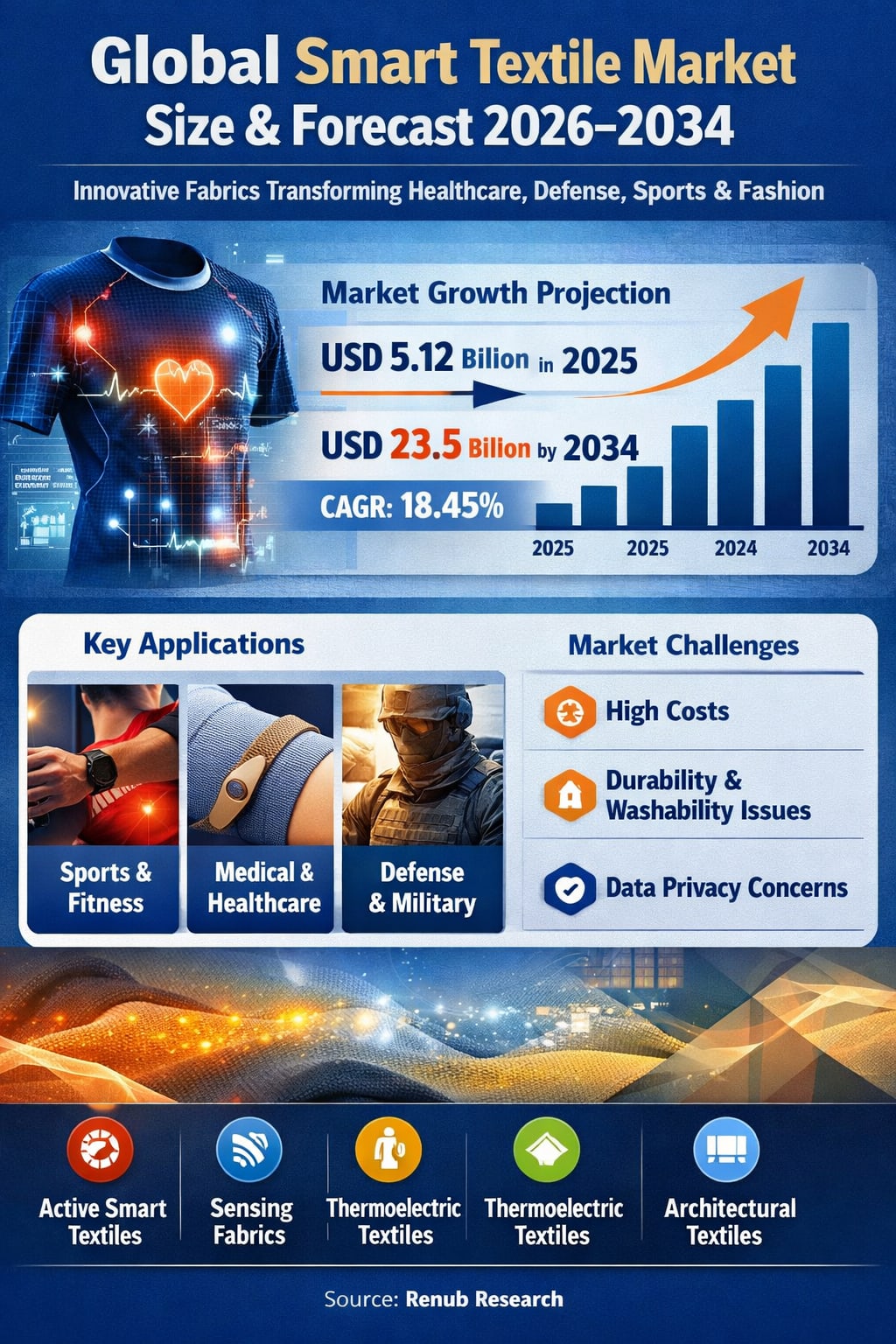
According to Renub Research, the Global Smart Textiles Market is projected to expand dramatically from USD 5.12 billion in 2025 to USD 23.5 billion by 2034, registering a robust CAGR of 18.45% during the forecast period 2026–2034. This rapid growth reflects a broader technological shift where fabrics are no longer passive materials but active participants in health monitoring, performance optimization, safety enhancement, and interactive design.
Smart textiles—also known as intelligent fabrics or e-textiles—integrate technologies such as sensors, conductive fibers, microelectronics, and connectivity modules directly into fabric structures. These materials can monitor physiological parameters like heart rate, body temperature, movement, and moisture, while also responding to environmental changes. As industries increasingly prioritize real-time data, personalization, and automation, smart textiles are emerging as a powerful bridge between the physical and digital worlds.
Global Smart Textile Market Outlook
Smart fabrics are typically classified into passive, active, and ultra-smart textiles. Passive smart textiles can sense environmental or bodily changes, active smart textiles can sense and respond, while ultra-smart textiles go a step further by adapting their behavior based on conditions and stimuli.
What makes smart textiles particularly attractive is their ability to maintain comfort, flexibility, and wearability while embedding advanced functionalities. Unlike conventional wearable devices that are often rigid or bulky, smart textiles allow technology to blend seamlessly into everyday clothing, medical garments, sports gear, military uniforms, and even architectural fabrics.
Globally, adoption is accelerating due to several converging trends: the rise of wearable technology, increasing demand for continuous health monitoring, advancements in conductive fibers and flexible electronics, and growing interest in smart lifestyles. Healthcare, sports, defense, and fashion are currently among the most active application areas, but transportation, architecture, and industrial safety are also quickly catching up.
As material science and electronics continue to evolve together, smart textiles are expected to move from niche applications into mainstream markets, transforming how people interact with clothing, interiors, and functional fabrics.
Key Growth Drivers of the Global Smart Textile Market
Rising Adoption of Wearable and Health-Monitoring Technologies
One of the strongest drivers behind the smart textile market is the explosive growth of wearable and health-monitoring technologies. Both consumers and healthcare providers are increasingly seeking continuous, non-invasive monitoring solutions for parameters such as heart rate, respiration, posture, temperature, and physical activity.
Smart textiles offer a major advantage here: instead of relying on external devices like smartwatches or chest straps, sensors can be embedded directly into garments, bedding, bandages, and medical textiles. This enables long-term, comfortable, and unobtrusive data collection, which is particularly valuable for elderly care, chronic disease management, rehabilitation, and preventive healthcare.
In June 2025, Samsung Electronics announced plans to create a digital health hub that would allow users to transmit health data directly to physicians, highlighting how integrated health ecosystems are becoming a reality. Smart textiles fit naturally into this vision, acting as continuous data sources that can support early diagnosis, personalized treatment, and remote patient monitoring.
As healthcare systems worldwide shift toward preventive and home-based care models, demand for smart garments, medical textiles, and monitoring fabrics is expected to rise sharply.
Technological Advancements in Materials and Electronics
The smart textile industry is deeply influenced by rapid progress in material science, flexible electronics, and microfabrication. Recent innovations in conductive fibers, stretchable sensors, miniaturized microelectronics, and energy-harvesting technologies have significantly improved the durability, washability, and comfort of smart fabrics.
Miniaturization plays a crucial role. Smaller, lighter components can now be integrated into textiles without compromising their look, feel, or flexibility. At the same time, advancements in wireless communication and data accuracy have made real-time monitoring more reliable and practical for everyday use.
Manufacturing techniques are also evolving to support scalable production of smart textiles with better quality control and cost efficiency. These improvements are gradually reducing performance limitations and expanding application areas, including industrial safety clothing, military uniforms, automotive interiors, and smart home textiles.
In 2023, Schoeller Textil AG introduced its sustainable “Re-Source” range, featuring fabrics based on recycled materials and bio-based spandex fibers while maintaining high performance standards. Such innovations reflect how sustainability and smart functionality are increasingly being developed together, shaping the future of the textile industry.
Expanding Applications Across Defense, Sports, and Fashion
Beyond healthcare, smart textiles are gaining strong momentum in defense, sports, and lifestyle sectors. In military applications, smart fabrics are used for soldier health monitoring, fatigue detection, temperature regulation, and protection against chemical or environmental hazards. Advanced concepts even include adaptive camouflage and integrated communication systems.
In sports and fitness, athletes and training organizations use smart garments for performance analysis, injury prevention, and recovery optimization. Real-time data on muscle activity, posture, and movement patterns helps coaches and athletes make more informed decisions and improve training outcomes.
The fashion and lifestyle segment is also embracing smart textiles, blending design with interactivity. From illuminated garments to responsive fabrics that change color or texture, smart textiles are opening new creative possibilities and attracting tech-savvy consumers who value both aesthetics and functionality.
Workplace safety regulations further support adoption, as industries look for smart protective clothing that can monitor exposure, fatigue, and hazardous conditions.
In March 2022, Troop Comforts Limited (TCL) and IIT Delhi signed an agreement to develop smart protective clothing for Indian security forces, including sensor-enabled garments for high-altitude and extreme conditions. Such collaborations underline how strategic and industrial applications are becoming a major growth engine for the smart textile market.
Challenges in the Global Smart Textile Market
High Cost and Limited Commercial Scalability
Despite strong growth prospects, high development and manufacturing costs remain a significant challenge. Integrating electronics, sensors, and conductive elements into textiles is far more complex than producing traditional fabrics. This complexity increases production costs and limits large-scale commercialization.
While costs are expected to decrease over time with technological maturity and mass production, price sensitivity—especially in consumer markets—continues to be a barrier. Until economies of scale are achieved, smart textiles may remain concentrated in premium, professional, or institutional applications.
Durability, Washability, and Data Privacy Concerns
Another major hurdle is ensuring long-term durability and washability. Smart textiles must withstand repeated washing, bending, stretching, and everyday wear without losing functionality. Although progress has been made, maintaining consistent performance over time remains a technical challenge.
Data privacy and security are also critical concerns. Since many smart textiles collect personal and health-related data, ensuring secure transmission, storage, and usage of information is essential. Addressing these concerns will be key to building consumer trust and supporting widespread adoption.
Key Market Segments and Technology Trends
Active Smart Textile Market
Active smart textiles go beyond sensing—they can react and respond to detected changes. Examples include rehabilitation garments that provide feedback, posture-correcting clothing, compression wear with adaptive pressure, and temperature-regulating sports apparel. Advances in flexible electronics and actuators are making these textiles more comfortable and practical, pushing them into mainstream use.
Smart Textile Sensing Market
Sensing smart textiles embed sensors capable of monitoring heart rate, respiration, temperature, pressure, movement, and environmental factors. Their ability to provide continuous, non-invasive data makes them highly valuable in healthcare, elderly care, sports, and occupational safety. With ongoing miniaturization and better connectivity, this segment is expected to remain one of the fastest-growing areas of the market.
Smart Textile Thermoelectricity Market
Thermoelectric smart textiles can generate or regulate heat, either by harvesting body heat for power or by providing active heating and cooling. These fabrics are especially useful for outdoor clothing, military gear, and medical warming applications. As demand grows for self-powered and climate-controlling garments, thermoelectric textiles represent a promising niche within the broader smart textile market.
End-Use Industry Insights
Defense & Military
Defense remains a critical application area, driven by the need for improved soldier safety, performance, and situational awareness. Smart textiles are used for vital sign monitoring, fatigue sensing, temperature control, and hazard protection. Governments worldwide continue to invest in these technologies to enhance operational efficiency and survivability.
Transportation
In transportation, smart textiles are increasingly used in automotive interiors, including seats and cabin fabrics that can monitor occupant position, stress, and temperature. These applications support advanced human-machine interfaces and personalized in-cabin experiences, especially as electric and autonomous vehicles gain traction.
Architecture
Architectural smart textiles are being integrated into curtains, facades, shading systems, and interior furnishings that adapt to light, temperature, and environmental conditions. These solutions improve energy efficiency, comfort, and aesthetics, aligning well with the global push for smart and sustainable buildings.
Regional Market Highlights
United States
The United States remains one of the most advanced markets for smart textiles, supported by strong R&D investments and a vibrant ecosystem of tech companies, universities, and defense contractors. Applications in healthcare, defense, sports, and wearables drive growth, while favorable policies around digital health and remote monitoring further strengthen market adoption. In May 2022, IARPA announced a program to develop sensor-integrated garments with properties comparable to normal clothing, highlighting ongoing innovation in this space.
United Kingdom
The UK market benefits from strong expertise in material science, design, and wearable health technologies. Sustainability is a key focus, with growing demand for eco-friendly smart textiles. In April 2023, a research team led by the University of Cambridge unveiled next-generation smart textiles with integrated LEDs, sensors, and energy-harvesting components that can be produced using conventional garment manufacturing equipment.
India
India’s smart textile market is expanding rapidly, supported by a large textile manufacturing base, growing interest in wearable health solutions, and government initiatives focused on technical textiles. In November 2025, the Indian government approved the Tex-RAMPS scheme with an outlay of ₹305 crore (~USD 34.14 million) to boost innovation and data-driven decision-making in the textile sector, further strengthening the ecosystem for smart textiles.
Saudi Arabia
Saudi Arabia’s smart textile market is emerging within the broader context of digital transformation and economic diversification. Key drivers include defense, smart healthcare, and climate-responsive clothing for extreme conditions. Investments in smart cities and infrastructure are opening new opportunities, although local production is still in early stages, with imports and pilot projects currently leading adoption.
Competitive Landscape
Major companies active in the global smart textile market include:
Adidas AG
DuPont de Nemours, Inc.
Gentherm Incorporated
Google LLC
Texas Instruments Incorporated
Toray Industries, Inc.
Ohmatex A/S
Schoeller Textil AG
These companies are evaluated across five viewpoints: Overview, Key Persons, Recent Developments & Strategies, Product Portfolio, and Financial Insights, reflecting a competitive landscape driven by innovation, partnerships, and technology integration.
Final Thoughts: A Fabric of the Future
The global smart textile market is no longer a futuristic concept—it is rapidly becoming a practical, scalable, and commercially viable industry. With Renub Research projecting growth from USD 5.12 billion in 2025 to USD 23.5 billion by 2034, the sector is set to play a transformative role across healthcare, defense, sports, transportation, architecture, and lifestyle markets.
While challenges related to cost, durability, and data security remain, continuous advancements in materials science, electronics, and manufacturing are steadily addressing these barriers. As consumers and industries alike seek smarter, more connected, and more personalized solutions, smart textiles are uniquely positioned to meet these demands—quietly weaving technology into the very fabric of everyday life.
In the coming decade, intelligent fabrics will not just be something we wear or use—they will become an active interface between humans, data, and the environments we live in.
About the Creator
Australia Agricultural Machinery Market: Grounded in Growth, Powered by Technology
The Australia agricultural machinery market is on a steady expansion trajectory as farmers adopt advanced machinery to boost productivity and meet rising food demand. According to the latest research from IMARC Group, the market was valued at USD 4.0 billion in 2024 and is expected to reach USD 6.4 billion by 2033, growing at a CAGR of 5.18% from 2025 to 2033.
By Amélie Belle4 days ago in Trader

Comments
There are no comments for this story
Be the first to respond and start the conversation.