
Cold Chain Packaging Market Size & Forecast 2026–2034
Global demand for temperature-controlled logistics accelerates as pharmaceuticals, biologics, and fresh food supply chains go truly global

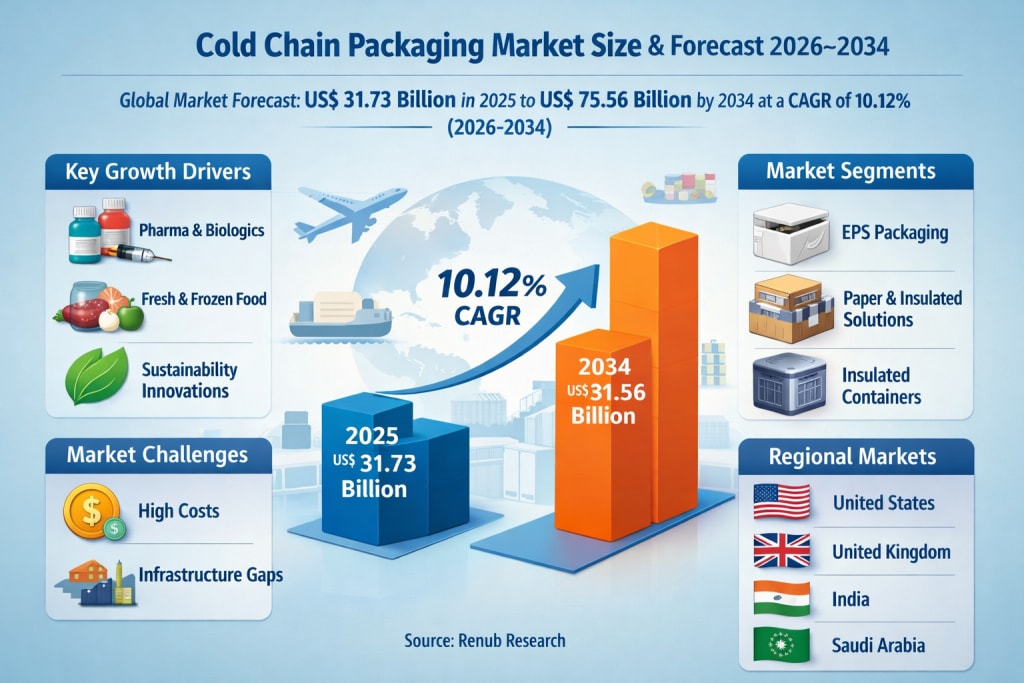
Cold Chain Packaging Market: A Market Entering Its Golden Decade
The Global Cold Chain Packaging Market is entering a decisive growth phase as temperature-sensitive products become central to modern healthcare, food supply, and international trade. According to Renub Research, the market is projected to expand from US$ 31.73 billion in 2025 to US$ 75.56 billion by 2034, registering a strong Compound Annual Growth Rate (CAGR) of 10.12% from 2026 to 2034.
This impressive growth trajectory reflects structural changes across multiple industries. Pharmaceuticals, vaccines, biologics, fresh and frozen foods, and specialty chemicals increasingly depend on reliable temperature-controlled logistics. At the same time, globalization of supply chains, expansion of e-commerce grocery delivery, and stricter regulatory oversight are making cold chain packaging not just a value-add, but a necessity.
Cold chain packaging refers to specialized solutions designed to maintain specific temperature ranges during storage and transportation. These solutions include insulated containers, thermal blankets, gel packs, dry ice systems, vacuum insulated panels, and smart temperature-monitoring technologies. Together, they ensure that sensitive products retain their quality, safety, and efficacy from the point of origin to the final destination—even across complex, multi-country supply chains.
The COVID-19 pandemic served as a powerful stress test for global cold chains, particularly during the distribution of vaccines and biologics. Since then, governments, healthcare systems, and logistics providers have accelerated investments in more resilient, efficient, and compliant cold chain infrastructure. Simultaneously, consumers’ rising demand for fresh, frozen, and ready-to-eat foods—often delivered directly to their homes—has further strengthened the case for advanced thermal packaging solutions.
Key Growth Drivers Shaping the Global Market
Expanding Pharmaceutical and Biologics Distribution
One of the most powerful engines of growth for the cold chain packaging market is the rapid expansion of pharmaceutical and biologics distribution worldwide. Products such as vaccines, insulin, monoclonal antibodies, and cell and gene therapies require extremely strict temperature control. Even minor deviations can compromise product efficacy or patient safety.
As healthcare spending rises globally and pharmaceutical pipelines become increasingly dominated by complex biologics, the demand for validated, high-performance cold chain packaging continues to surge. Regulatory authorities across major markets now enforce stringent guidelines for temperature-controlled transport and storage, pushing manufacturers and logistics providers toward more sophisticated solutions.
The globalization of clinical trials and the cross-border movement of high-value medicines have further increased the need for reliable long-distance thermal packaging. Reflecting this trend, in June 2025, Tjoapack announced the expansion of its contract packaging services and cold chain storage solutions in both the United States and the Netherlands, aiming to support rising demand from injectable and biologics manufacturers.
Rising Demand for Fresh and Frozen Food Products
Beyond healthcare, the global food industry is playing a crucial role in driving cold chain packaging adoption. Urbanization, changing lifestyles, and rising disposable incomes are boosting consumption of meat, seafood, dairy, fruits, and frozen foods. At the same time, international food trade requires temperature-controlled packaging to preserve freshness and prevent spoilage across long transit routes.
The explosive growth of online grocery platforms and meal-kit delivery services has added a new “last-mile” dimension to cold chain requirements. Packaging now needs to be not only thermally efficient, but also lightweight, cost-effective, and suitable for home delivery logistics.
Companies are increasingly investing in insulation innovations and packaging “lightweighting” to reduce logistics costs without compromising performance. In December 2025, Stonepeak launched Peregrine Cold Logistics, a new cold chain logistics platform initially targeting Asia-Pacific and GCC markets, underlining the strategic importance of temperature-controlled food supply chains in high-growth regions.
Technological Advancements and Sustainable Packaging Innovations
Technology is reshaping the cold chain packaging landscape. High-performance insulation materials, phase-change materials, and smart packaging solutions with real-time temperature tracking are becoming more common. These innovations improve reliability, reduce product loss, and enhance regulatory compliance.
At the same time, sustainability has become a central theme. Companies and regulators alike are pushing for recyclable, reusable, and lower-carbon packaging solutions. This has fueled the development of eco-friendly insulation materials and returnable packaging systems, especially for high-value pharmaceutical shipments.
In this context, Atlas, a division of Atlas Roofing Corp., announced the rollout of ReGenX Technology in December 2025, aimed at promoting innovation in sustainable cold chain and insulation solutions. Such initiatives highlight how environmental responsibility is increasingly intertwined with performance and compliance in cold chain packaging.
Challenges That Continue to Test the Market
High Cost of Cold Chain Packaging Solutions
Despite strong growth prospects, cost remains a major barrier. Advanced insulated containers, refrigerants, and monitoring technologies significantly increase packaging and logistics expenses compared to conventional solutions. For small and medium-sized enterprises, especially in price-sensitive markets, these costs can limit adoption.
Reusable systems, while more sustainable in the long run, also introduce operational complexities related to reverse logistics, cleaning, and asset tracking. In many developing regions, budget constraints and cost pressures still lead to inconsistent cold chain practices, increasing the risk of product loss and quality degradation.
Balancing performance, compliance, and affordability remains one of the industry’s most persistent challenges.
Infrastructure Gaps and Operational Complexity
Cold chain packaging does not operate in isolation—it depends heavily on supporting infrastructure such as cold storage facilities, reliable power supply, and trained personnel. In many emerging markets, gaps in this infrastructure weaken the overall effectiveness of cold chains.
Multiple handoffs during transportation increase the risk of temperature excursions, while differing regulatory standards across countries add further complexity for global shippers. Addressing these infrastructure and coordination challenges is essential for unlocking the full potential of the global cold chain packaging market.
Market Insights by Material and Product Type
Expanded Polystyrene (EPS) Cold Chain Packaging
Expanded polystyrene remains one of the most widely used materials due to its excellent insulation properties, light weight, and cost-effectiveness. EPS packaging is commonly used for pharmaceuticals, seafood, meat, and dairy products over short to medium distances. Its ability to maintain stable internal temperatures and its ease of customization make it a popular choice, despite ongoing environmental concerns about disposal and recycling.
Paper & Paperboard Cold Chain Packaging
The paper and paperboard segment is gaining momentum as sustainability becomes a priority. Often used with insulation liners or special coatings, paper-based solutions are increasingly adopted in the food and beverage sector, particularly for meal kits and fresh produce. Lightweight, recyclable, and easy to dispose of, these solutions are well-suited for last-mile delivery, and ongoing innovations in fiber-based insulation are improving their thermal performance.
Insulated Containers Cold Chain Packaging
Insulated containers represent the high-performance end of the market. Using materials such as polyurethane foam, vacuum insulated panels, and phase-change materials, these containers are designed for long-distance and high-value shipments. They are widely used in pharmaceuticals, biotechnology, chemicals, and premium food logistics. Many of these solutions are reusable, offering long-term cost and environmental benefits despite higher upfront investment.
Key Application Areas Driving Demand
Milk and Dairy Products
Milk and dairy products are extremely sensitive to temperature fluctuations. Cold chain packaging ensures safety, freshness, and shelf life for products such as milk, cheese, butter, yogurt, and ice cream. With rising consumption of packaged dairy products and growth in home delivery services, demand for reliable cold chain solutions in this segment continues to climb globally.
Pharmaceuticals and Vaccines
This is one of the fastest-growing application segments. Vaccines, biologics, and many specialty drugs require strict temperature control to maintain efficacy. Cold chain packaging solutions—ranging from insulated shippers to advanced temperature-monitoring systems—are now essential for regulatory compliance and patient safety. The increasing complexity of pharmaceutical pipelines further strengthens the strategic importance of this segment.
Regional Market Highlights
United States
The United States represents one of the most advanced cold chain packaging markets, driven by strong demand from pharmaceuticals, healthcare, and food logistics. The rise of biologics, specialty drugs, online grocery delivery, and meal kits continues to fuel demand. In July 2025, Nordic Cold Chain Solutions introduced the Nordic Express Pack, designed specifically for transporting GLP-1 medications, reflecting the market’s focus on high-value, compliance-driven applications.
United Kingdom
The UK market is growing steadily, supported by pharmaceutical distribution and rising demand for fresh and frozen foods. Sustainability plays a key role, with strong preference for recyclable and reusable packaging formats. In October 2023, Tower Cold Chain announced new initiatives for its KTEvolution small-box solution, aimed at direct-to-patient and last-mile deliveries.
India
India’s cold chain packaging market is expanding rapidly due to pharmaceutical manufacturing, vaccine exports, and growing consumption of fresh and frozen foods. Urbanization, organized retail, and food delivery platforms are boosting demand, while government initiatives to reduce food wastage and improve cold chain infrastructure are providing additional support. SIG’s fully operational aseptic carton plant in Ahmedabad underscores the country’s growing role in global packaging and food processing.
Saudi Arabia
In Saudi Arabia, demand is driven by pharmaceuticals, vaccines, and imported food products. Harsh climatic conditions make temperature-controlled packaging essential. Investments in healthcare, modern retail, and foodservice, along with the establishment of GMP-GxP compliant pharmaceutical logistics facilities in Riyadh in October 2025, are strengthening the market’s foundation.
Competitive Landscape
Key players in the global cold chain packaging market include:
Cascades Inc.
Sonoco Products Company
Pelican BioThermal LLC
Cold Chain Technologies Inc.
Cryopak Industries Inc.
Sofrigam Company
Intelsius (A DGP Company)
These companies compete through product innovation, sustainability initiatives, expanded service portfolios, and strategic partnerships, offering customers a mix of performance, compliance, and cost-efficiency.
Final Thoughts
The global cold chain packaging market is no longer a niche segment—it has become a strategic backbone of modern healthcare, food security, and international trade. With the market set to grow from US$ 31.73 billion in 2025 to US$ 75.56 billion by 2034 at a CAGR of 10.12%, the coming decade will be defined by innovation, sustainability, and operational excellence.
As pharmaceuticals become more complex, food supply chains more global, and consumers more demanding, cold chain packaging will continue to evolve from a logistical necessity into a critical competitive advantage. Companies that successfully balance performance, cost, compliance, and sustainability will be the ones shaping the future of temperature-controlled logistics worldwide.
About the Creator
Gold Price News: Market Trends and Investment Insights for 2026
Gold Price News: Current Market Overview The latest gold price news shows that gold remains one of the most important safe-haven assets globally. Over the past months, gold prices have fluctuated due to a combination of interest rate decisions, inflation data, and geopolitical tensions. Investors continue to monitor global economic developments, including central bank policies and currency movements, to assess how gold may perform in the coming months.
By Hammad Nawaz4 days ago in Trader
Stanislav Kondrashov: AI Is Quietly Rewriting the Rules for Bitcoin and XRP
Bitcoin has dropped to $74,000. XRP has slipped. Across the board, digital currencies have lost ground—at the same time that technology companies are facing renewed pressure. While headlines often point to policy changes or economic signals, another factor is emerging in the background: artificial intelligence. According to TELF AG founder Stanislav Kondrashov, the ripple effects of AI development are playing a much larger role than many realise.
By Stanislav Kondrashova day ago in Trader
Lately, I'm empty
Lately, I feel an emptiness inside of me that doesn’t make any sense. I was fine a week ago and now I’m numb to the pain that I’ve been carrying around. Numb to the idea of me existing. I wish I could go to a place where I can hear happy positive thoughts and surround myself with joy. The medication I’m on doesn’t seem to work anymore. I still feel pain from existing, why am I here anyways? Merely to exist. I don’t feel like I’m making any differences being here.
By Cerina Galvan4 days ago in Confessions


Comments
There are no comments for this story
Be the first to respond and start the conversation.