
Global Biotechnology Market Size and Forecast 2025–2033
How Genomics, Biopharma Innovation, and Sustainable Science Are Reshaping the World Economy

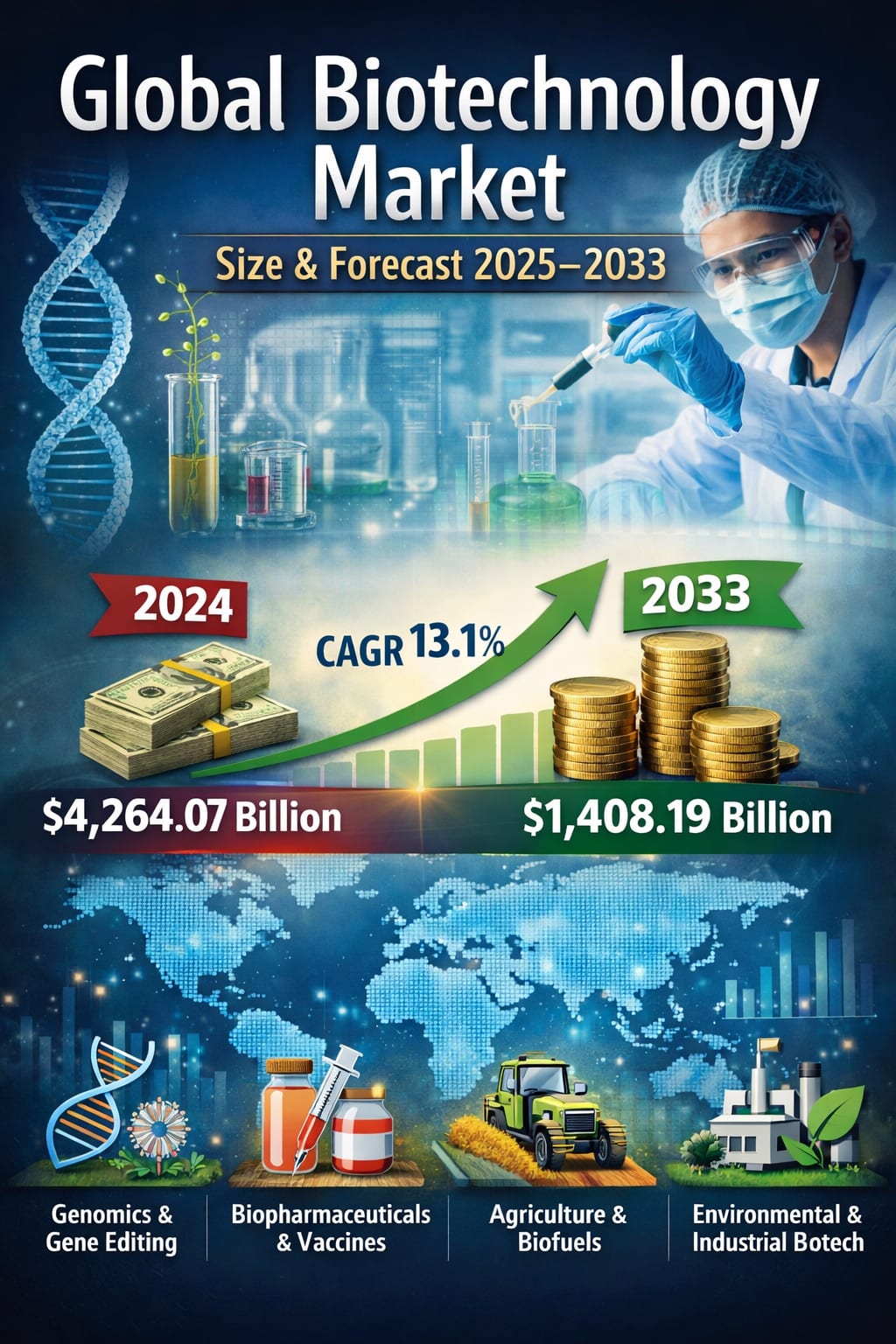
Global Biotechnology Market Outlook
Biotechnology has quietly become one of the most powerful forces shaping the modern world. From life-saving vaccines and gene therapies to climate-resilient crops and cleaner industrial processes, biotechnology sits at the crossroads of science, medicine, and sustainability. It is a field that uses living organisms, biological systems, or their derivatives to create products and technologies that solve real-world problems—often at a scale no other discipline can match.
According to Renub Research, the Global Biotechnology Market is anticipated to grow to US$ 1,408.19 billion by 2033, from US$ 4,264.07 billion in 2024, registering a CAGR of 13.1% from 2025 to 2033. While the headline numbers reflect a market recalibration in base-year valuation and segment reclassification, the underlying momentum of the sector remains strong. Rapid advances in genetic engineering, surging demand for biopharmaceuticals, rising R&D investments, and the expanding application of biotechnology across healthcare, agriculture, and industrial sectors continue to redefine the global innovation landscape.
In recent decades, breakthroughs in genomics, personalized medicine, and synthetic biology have transformed biotechnology from a niche scientific discipline into a cornerstone of the global knowledge economy. The COVID-19 pandemic further accelerated this shift, pushing biotech into the spotlight through mRNA vaccines, rapid diagnostics, and global-scale biomanufacturing. At the same time, food security challenges, environmental concerns, and sustainability goals are driving governments and corporations to invest heavily in bio-based solutions.
Today, biotechnology is not just an industry—it is an enabling platform for the future of healthcare, food systems, and industrial production.
Growth Drivers in the Global Biotechnology Market
Advances in Genomics and Personalized Medicine
One of the most powerful engines behind the biotechnology market is the revolution in genomics and personalized medicine. The cost of genome sequencing has dropped dramatically over the past decade, opening the door for large-scale genetic testing, precision diagnostics, and targeted therapies. Technologies such as CRISPR and other gene-editing tools are no longer confined to research labs; they are steadily moving into clinical and commercial applications.
Personalized medicine is changing how diseases like cancer, rare genetic disorders, and chronic illnesses are treated. Instead of a one-size-fits-all approach, therapies are increasingly tailored to a patient’s genetic profile, improving outcomes and reducing side effects. Pharmaceutical and biotech companies are rapidly building precision medicine pipelines, while regulators are evolving frameworks to accommodate these innovations.
In December 2023, India’s Department of Biotechnology (DBT) and BIRAC announced the commercialization of more than 14 cutting-edge biotechnology products across medical devices, diagnostics, agriculture, and industrial biotech—highlighting how public policy and innovation ecosystems are aligning to accelerate market growth.
Increasing Demand for Biopharmaceuticals and Vaccines
The global demand for biologics—such as monoclonal antibodies, recombinant proteins, cell and gene therapies, and vaccines—continues to rise. Aging populations, the growing burden of chronic diseases, and the persistent threat of infectious outbreaks are reshaping healthcare priorities worldwide.
The success of mRNA vaccines during the COVID-19 pandemic has created a new wave of interest in RNA-based therapies for cancer, rare diseases, and infectious conditions. This has fueled massive investment in biopharmaceutical R&D, manufacturing infrastructure, and supply chain capabilities.
In January 2025, Esphera SynBio, a pre-clinical stage synthetic biology company, launched a new project aimed at improving the effectiveness of mRNA vaccines using its patented technology to instruct patient cells to produce altered nanomedicines. Such innovations underscore how biotechnology is moving beyond traditional drug development into platform-based therapeutic ecosystems.
Environmental and Industrial Biotechnology Applications
Biotechnology’s influence extends far beyond healthcare. In agriculture, genetically improved crops and microbial biofertilizers are boosting yields while reducing environmental impact. In industry, enzyme-based processes are replacing harsh chemicals, lowering energy consumption, and cutting waste. In environmental management, bioremediation is using microorganisms to detoxify polluted soil and water.
Sustainability has become a central policy and consumer priority, and industrial biotechnology sits at the heart of this transition. Governments and corporations are increasingly investing in bio-based materials, biofuels, and circular economy solutions.
India’s National Biopharma Mission (NBM) – Innovate in India (i3), supported by the World Bank, exemplifies this approach. With a budget of US$ 250 million, the mission supports over 100 projects across more than 150 organizations, building shared testing and manufacturing facilities and strengthening the country’s biopharma ecosystem. Alongside this, the Genome India Programme aims to sequence 10,000 genomes, laying the groundwork for future healthcare policy and precision medicine strategies.
Global Biotechnology Market Challenges
Regulatory Barriers and Ethical Issues
Biotechnology operates in one of the most tightly regulated environments in the world. Concerns around patient safety, environmental impact, data privacy, and ethical boundaries mean that new products often face long and complex approval processes. Differences between regulatory systems—such as those of the FDA in the United States and the EMA in Europe—add further complexity and cost.
Ethical debates surrounding gene editing, genetically modified organisms (GMOs), and the use of personal genetic data continue to shape public opinion and policy decisions. While regulation is essential for safety and trust, inconsistent or slow-moving frameworks can delay innovation and create uncertainty for investors and developers.
High Investment Risk and R&D Costs
Developing biotech products is expensive, time-consuming, and risky. From early-stage research to late-stage clinical trials and manufacturing scale-up, costs can run into billions of dollars. Failure rates—especially in clinical development—remain high, and even promising candidates can be derailed by safety or efficacy issues.
Funding has become more selective, with investors demanding clear milestones and proof of concept before committing capital. For smaller biotech firms, a single clinical setback can threaten survival. This high-risk, high-reward environment can slow innovation and limit the number of breakthrough ideas that reach the market.
Key Segments Shaping the Biotechnology Ecosystem
Global Instruments Biotechnology Market
Biotechnology relies heavily on advanced laboratory instruments such as PCR machines, mass spectrometers, DNA sequencers, and flow cytometers. These tools are essential for research, diagnostics, and quality control across academic, industrial, and clinical settings.
Demand is being driven by growth in genomics, drug discovery, personalized medicine, and environmental testing. Automation, miniaturization, and AI integration are making instruments faster, more accurate, and easier to use. Cloud-connected platforms and built-in data analytics are further improving productivity and accelerating research outcomes worldwide.
Global Nanobiotechnology Market
Nanobiotechnology merges nanotechnology with biology to create ultra-precise drug delivery systems, biosensors, and diagnostic tools. Applications range from targeted cancer therapies to tissue engineering and advanced imaging techniques.
Nanocarriers such as liposomes, dendrimers, and quantum dots allow drugs to be delivered more efficiently and with fewer side effects. As regulatory frameworks for nanomaterials mature, commercialization is accelerating. Collaboration between pharmaceutical companies, academic institutions, and materials science firms is expanding product pipelines and attracting new investment.
Global DNA Sequencing Market
The DNA sequencing market continues to grow as costs fall, speeds increase, and clinical applications expand. Next-generation sequencing is now central to oncology, infectious disease surveillance, population genomics, and rare disease diagnosis.
Technologies such as nanopore sequencing and single-cell genomics are pushing the boundaries of resolution and real-time analysis. Cloud-based bioinformatics platforms are enabling massive genomic projects, supporting public health initiatives, and advancing personalized medicine.
Global Chromatography Market
Chromatography remains a cornerstone of analytical science in biotechnology, pharmaceuticals, food safety, and environmental testing. Techniques such as liquid chromatography (LC), gas chromatography (GC), and UHPLC are essential for separating, identifying, and quantifying complex biological substances.
As biologics become more complex, the demand for high-performance, automated, and highly sensitive separation technologies continues to rise. Coupling chromatography with mass spectrometry has further enhanced analytical precision, supporting regulatory compliance and data-driven decision-making.
Global Biotechnology Healthcare Market
This segment includes therapeutic biologics, gene and cell therapies, diagnostics, and companion diagnostics. It is one of the fastest-growing areas of the biotech industry, driven by precision medicine, rising healthcare spending, and breakthroughs in genetic and cellular engineering.
CAR-T therapies, CRISPR-based treatments, and RNA therapeutics are transforming previously untreatable conditions. Companion diagnostics are ensuring that the right patients receive the right therapies, improving outcomes and reducing costs. As healthcare systems adopt precision medicine models, biotech is becoming central to modern treatment strategies.
Regional Market Insights
United States Biotechnology Market
The United States remains the global leader in biotechnology innovation and commercialization. Major hubs such as Boston, San Francisco, and San Diego host dense clusters of startups, research institutions, and multinational companies. Strong venture capital ecosystems and supportive regulatory pathways, including accelerated approvals for breakthrough therapies, continue to fuel growth.
In September 2023, the U.S. Department of Energy launched the AlgaePrize 2023–2025 competition to encourage student-led innovation in bioenergy and the bioeconomy, highlighting the country’s commitment to long-term biotech leadership.
Germany Biotechnology Market
Germany combines strong engineering expertise with cutting-edge biotechnology, particularly in biopharmaceuticals and industrial biotech. Cities like Frankfurt and Munich serve as innovation hubs, supported by government policies, EU funding, and public–private partnerships.
In September 2023, Merck KGaA partnered with BenevolentAI and Exscientia to use artificial intelligence in drug discovery for oncology, neurology, and immunology—showcasing how digital tools are reshaping biotech R&D in Europe.
India Biotechnology Market
India has emerged as a major player in vaccines, biosimilars, bio-agriculture, and diagnostics. Cost-effective manufacturing, a skilled workforce, and strong government support through initiatives like “Make in India” and biotech parks are strengthening its global position.
In November 2023, Bharat Biotech reported successful Phase 3 trials for its chikungunya vaccine, a milestone that could significantly improve public health outcomes and reinforce India’s role in global vaccine supply.
Saudi Arabia Biotechnology Market
Under Vision 2030, Saudi Arabia is investing heavily in biotechnology to diversify its economy. Focus areas include biologics, biosimilars, and agricultural biotech to improve healthcare and food security. International partnerships and capacity-building initiatives are accelerating progress.
In March 2024, India and Saudi Arabia strengthened strategic cooperation in biotechnology, healthcare, and energy security, signaling deeper regional collaboration in life sciences.
Market Segmentation Snapshot
By Product Type:
Instruments
Reagents
Software and Services
By Technology:
Nanobiotechnology
Tissue Engineering and Regeneration
DNA Sequencing
Cell-Based Assays
Fermentation
PCR Technology
Chromatography
Others
By Application:
Healthcare
Food and Agriculture
Natural Resources and Environment
Industrial Processing
Bioinformatics
Others
By Geography:
North America (U.S., Canada)
Europe (France, Germany, Italy, Spain, U.K., Belgium, Netherlands, Turkey)
Asia Pacific (China, Japan, India, South Korea, Thailand, Malaysia, Indonesia, Australia, New Zealand)
Latin America (Brazil, Mexico, Argentina)
Middle East & Africa (Saudi Arabia, UAE, South Africa)
Key Players Analysis
Major companies shaping the global biotechnology landscape include:
Lonza Group AG
Amgen Inc.
Syngenta AG
Biocon Limited
Biogen Inc.
F. Hoffmann-La Roche AG
Novartis AG
Novo Nordisk A/S
Pfizer Inc.
Seagen Inc.
These companies are evaluated across five perspectives: company overview, key personnel, recent developments, SWOT analysis, and revenue analysis—highlighting their strategic positions in a highly competitive and innovation-driven market.
Final Thoughts
The global biotechnology market stands at a defining moment. Despite short-term recalibrations in market sizing, the long-term trajectory is unmistakably upward. Advances in genomics, biopharmaceutical innovation, and sustainable industrial applications are transforming how the world treats disease, produces food, and manages resources.
As governments, investors, and industries continue to prioritize health security, environmental sustainability, and technological sovereignty, biotechnology will remain a central pillar of the global innovation economy. The next decade will not just be about new products—it will be about reshaping entire systems through the power of life sciences.
About the Creator
Tom Shane
Tom Shane is a content writer specializing in SEO-driven blogs, product descriptions, and thought leadership. He crafts engaging, research-backed content that connects with audiences and drives results.
Probiotics Market Size, Trends & Forecast 2025–2033 | Renub Research
Introduction: The Rise of the “Good Bacteria” Economy The global probiotics market is undergoing a remarkable transformation, driven by changing consumer lifestyles, growing health awareness, and a strong shift toward preventive healthcare. According to Renub Research, the Probiotics Market is expected to grow from US$ 88.55 billion in 2024 to US$ 270.28 billion by 2033, registering an impressive CAGR of 13.20% during 2025–2033.
By Sakshi Sharma5 days ago in Trader
BYD Stock Price Analysis: Should You Buy Before the Next Surge?
The BYD stock price has caught the eye of investors worldwide. As one of the leading electric vehicle companies, BYD continues to show strong growth in sales and production. Many investors are asking: is now the right moment to invest? This article explores the factors affecting the BYD stock price, current trends, potential risks, and tips for making a smart investment decision.
By hamza mirza6 days ago in Trader



Comments
There are no comments for this story
Be the first to respond and start the conversation.