
Global Building Materials Market Size and Forecast 2025–2033
Urbanization, green construction, and infrastructure megaprojects reshape a US$ 2 trillion industry

Introduction: The Backbone of Modern Development
Building materials are the foundation of every modern structure, from residential homes and commercial towers to bridges, highways, and industrial plants. These materials include natural resources such as wood, clay, stone, and sand, as well as manufactured products like cement, concrete, steel, glass, bricks, and advanced composites. In recent years, the industry has also seen growing adoption of sustainable alternatives, including recycled metals, bamboo, insulated panels, and low-carbon concrete solutions.
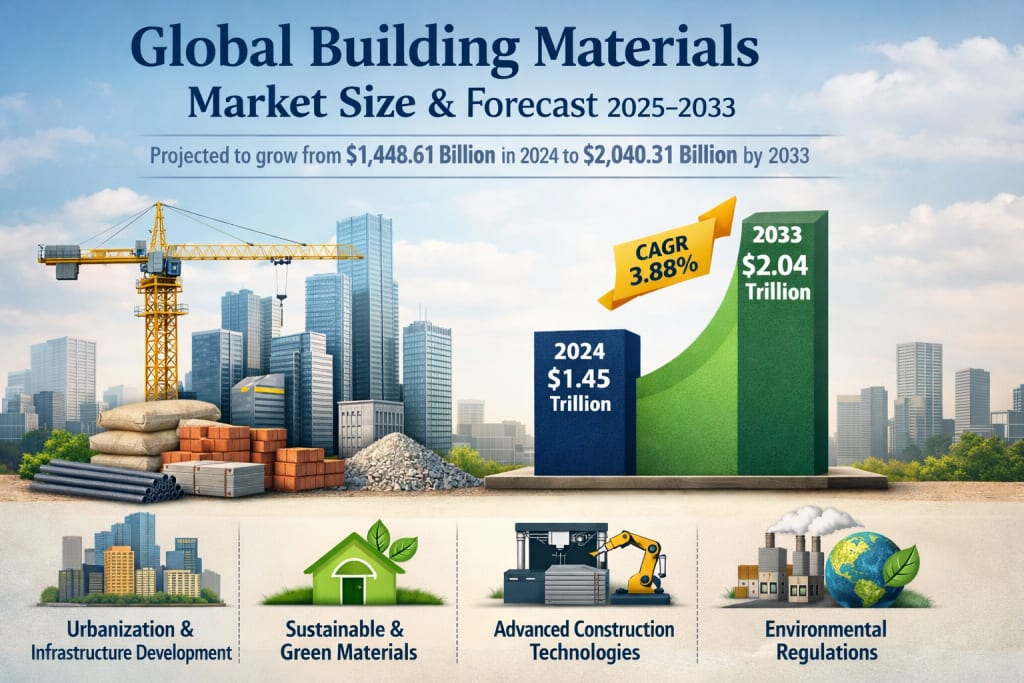
According to Renub Research, the Global Building Materials Market is anticipated to grow at a CAGR of 3.88% during 2025–2033, reaching US$ 2,040.31 billion by 2033, up from US$ 1,448.61 billion in 2024. This steady expansion is being driven by rapid urbanization, large-scale infrastructure development, increasing demand for sustainable and energy-efficient materials, and continuous advancements in construction technologies.
As cities expand and governments invest heavily in infrastructure, building materials remain a strategic sector closely tied to economic growth, employment generation, and long-term development planning across both developed and emerging economies.
Global Building Materials Market Outlook
The global building materials industry plays a critical role in shaping the world’s built environment. With more than half of the world’s population already living in urban areas, and this number expected to rise significantly by 2050, the demand for housing, transportation networks, energy infrastructure, and commercial spaces continues to surge.
At the same time, the construction industry is undergoing a transformation. Sustainability, energy efficiency, and digitalization are no longer optional—they are becoming core requirements. Green building principles, circular economy models, and smart construction practices are pushing manufacturers to innovate and deliver materials that are not only strong and durable but also environmentally responsible.
Technologies such as modular construction, prefabrication, and 3D printing are also changing how materials are produced and used. These approaches emphasize speed, precision, reduced waste, and better resource efficiency, further reshaping demand patterns across the building materials value chain.
Key Growth Drivers in the Global Building Materials Market
Urbanization and Infrastructure Development
One of the most powerful drivers of the building materials market is rapid urbanization, especially in Asia, Africa, and Latin America. Expanding cities require massive investments in housing, transportation systems, utilities, and public infrastructure. This translates directly into rising demand for cement, steel, aggregates, bricks, insulation materials, and finishing products.
Governments around the world are also promoting large-scale infrastructure projects, including highways, rail networks, airports, ports, and smart city initiatives. These projects consume enormous volumes of construction materials and create long-term, stable demand for suppliers across the sector.
With more than 4 billion people already living in urban areas and urban populations projected to continue rising, the construction and building materials industries are positioned for sustained growth over the coming decades.
Rising Demand for Sustainable and Green Materials
Environmental sustainability has become a central theme in global construction. Concerns about climate change, carbon emissions, and resource depletion are encouraging governments, developers, and architects to adopt greener building practices.
Materials such as recycled concrete, low-carbon cement, bamboo, high-performance insulation, and energy-efficient glass are gaining popularity. Green building certifications like LEED and BREEAM are further accelerating this shift by setting clear benchmarks for sustainability and energy efficiency.
In May 2025, India’s Department for Promotion of Industry and Internal Trade (DPIIT) launched CemHack for Green Infra, a national-level initiative aimed at promoting innovation in sustainable cement and infrastructure solutions. Such initiatives highlight how policy support and industry collaboration are shaping the future of building materials.
Technological Advancements in Construction Techniques
Innovation in construction methods is another major growth catalyst. Modular construction, prefabrication, and 3D printing are changing how buildings are designed and assembled. These methods often require specialized, lightweight, and high-performance materials that can be produced with greater precision and installed more quickly on-site.
Digitalization and automation in manufacturing are also improving efficiency, reducing waste, and lowering production costs. The growing adoption of smart buildings and data-driven construction management is increasing demand for advanced materials compatible with modern building systems.
In May 2024, Buildots launched its AI-powered Delay Forecast feature, designed to identify potential project delays and help construction teams take corrective action early. Such digital tools further underline how technology is becoming deeply integrated into construction workflows, indirectly influencing material selection and usage.
Challenges Facing the Global Building Materials Market
Volatility in Raw Material Prices
The building materials sector is highly sensitive to fluctuations in raw material prices, particularly for cement, steel, sand, and aggregates. Global supply chain disruptions, geopolitical tensions, and energy price volatility can significantly impact production costs.
These cost swings often squeeze manufacturer margins and increase construction expenses for developers and contractors. For large, long-term infrastructure projects, uncertainty around material pricing can complicate budgeting, planning, and contract negotiations.
Environmental Regulations and Carbon Emissions
Cement and steel production are among the largest industrial sources of carbon emissions. As governments tighten environmental regulations and set more ambitious climate targets, manufacturers face growing pressure to decarbonize their operations.
Meeting these standards often requires heavy investment in cleaner technologies, alternative fuels, and process redesign. While large corporations may have the resources to adapt, smaller and medium-sized companies can struggle with the financial and technical burden. Additionally, stricter waste management and recycling regulations are adding complexity to supply chain and production planning.
Segment Insights
Global Building Aggregates Market
Aggregates—including sand, gravel, and crushed stone—are essential components in roads, bridges, buildings, and other infrastructure projects. Demand for aggregates is closely tied to overall construction activity, particularly in urban development and transportation infrastructure.
Technological advancements in aggregate processing and the growing use of recycled aggregates are improving both product quality and environmental performance. Government policies promoting the reuse of construction and demolition waste are also supporting the growth of recycled aggregates, making this segment increasingly important in the sustainability transition.
Global Cement Market
Cement remains one of the most critical materials in the construction industry, widely used across residential, commercial, and infrastructure projects. Growth in developing economies, along with infrastructure upgrades in developed regions, continues to support strong demand.
At the same time, the industry is shifting toward low-carbon and blended cements to reduce environmental impact. Government spending on affordable housing and infrastructure modernization further strengthens the market outlook. However, long-term growth will depend heavily on how successfully the sector can address emission challenges and adopt greener production methods.
Commercial Building Materials Market
The commercial construction sector includes offices, retail spaces, hospitals, hotels, and institutional buildings. Growth in this segment is driven by urban expansion, business development, tourism, and rising demand for modern, efficient work and public spaces.
Commercial buildings increasingly require high-quality, energy-efficient, and aesthetically appealing materials. The rise of smart buildings is boosting demand for advanced insulation, high-performance glass, HVAC systems, and eco-friendly interior finishes. In the post-pandemic era, there is also growing interest in materials with health-focused features, such as antimicrobial surfaces and improved air filtration systems.
Residential Building Materials Market
Population growth, urbanization, and rising homeownership continue to fuel residential construction worldwide. This drives demand for essential materials such as bricks, concrete, wood, roofing, drywall, flooring, and plumbing fixtures.
Trends in green housing are accelerating the adoption of sustainable products like fly ash cement, insulated concrete blocks, and solar roofing tiles. In developing economies, large-scale affordable housing programs are further boosting material consumption. Meanwhile, in developed markets, home renovation and remodeling activities are sustaining strong demand for interior finishing products and energy-efficient upgrades.
Regional and Country-Level Insights
United States Building Materials Market
The United States remains one of the most developed and diversified building materials markets in the world. Strong infrastructure spending, a resilient housing sector, and ongoing renovation trends continue to support demand.
Federal and state investments in transportation, energy, and public infrastructure are key growth drivers. At the same time, increasing focus on sustainability is encouraging greater adoption of green building products. The rise of modular construction and smart home technologies is also influencing material choices across the industry.
In March 2023, Cemex announced a USD 250 million investment to expand its plant in Comal County, Texas, doubling cement production capacity to 2.4 million tons to meet rising construction demand in the state.
Germany Building Materials Market
Germany’s construction sector is characterized by strong demand for housing, energy-efficient retrofitting, and modernization of public infrastructure. The country is a leader in sustainable building practices, supported by strict building regulations and ambitious energy efficiency targets.
There is high demand for insulation materials, energy-efficient windows, and eco-friendly cement products. Germany also plays a significant role in the production of high-precision building materials and construction technologies.
In January 2024, Heidelberg Materials introduced evoBuild, a global brand for low-carbon and circular products, setting uniform sustainability criteria across its international operations and reinforcing Germany’s leadership in sustainable construction materials.
India Building Materials Market
India is experiencing rapid growth in construction activity, driven by urbanization, industrial expansion, and major government initiatives such as the Smart Cities Mission and Pradhan Mantri Awas Yojana. Demand for cement, bricks, aggregates, roofing materials, and steel is rising across both urban and rural areas.
While cost sensitivity remains a key factor, awareness of green construction is gradually increasing. Government infrastructure spending and housing programs are expected to support long-term market growth.
In February 2025, Shree Cement launched Bangur Marble Cement, a premium PSC product offering enhanced strength, brightness, and crack resistance, reflecting the industry’s move toward higher-performance materials.
Saudi Arabia Building Materials Market
Saudi Arabia’s Vision 2030 program is transforming the country’s construction landscape, with mega-projects such as NEOM and The Line driving massive demand for building materials. Cement, aggregates, glass, and prefabricated components are all seeing strong growth.
The government’s push for economic diversification is encouraging local production of materials, while sustainability and innovation are becoming increasingly important. In December 2024, Al Jouf Cement Company announced plans to build a green cement facility to support NEOM projects, highlighting the shift toward environmentally responsible construction in the region.
Market Segmentation
By Type:
Aggregates
Cement
Bricks
Metals
Others
By Application:
Residential
Commercial
Industrial
By Region and Countries:
North America: United States, Canada
Europe: France, Germany, Italy, Spain, United Kingdom, Belgium, Netherlands, Turkey
Asia Pacific: China, Japan, India, South Korea, Thailand, Malaysia, Indonesia, Australia, New Zealand
Latin America: Brazil, Mexico, Argentina
Middle East & Africa: Saudi Arabia, UAE, South Africa
Competitive Landscape and Key Players
The global building materials market is highly competitive, with major players focusing on capacity expansion, sustainability, digitalization, and product innovation. Companies are typically analyzed across five dimensions: overview, key personnel, recent developments, SWOT analysis, and revenue performance.
Key Players Include:
CEMEX
Boral Limited
LafargeHolcim
Dyckerhoff AG
Buzzi Unicem SpA
CSR Limited
CRH Plc
Aditya Birla Group
Ambuja Cements
USG Corporation
These companies are investing heavily in low-carbon technologies, alternative materials, and process optimization to stay competitive in a rapidly evolving market.
Final Thoughts
The global building materials market is entering a new era defined by sustainability, technology, and large-scale urban development. With the market expected to grow from US$ 1,448.61 billion in 2024 to US$ 2,040.31 billion by 2033 at a CAGR of 3.88%, opportunities abound for manufacturers, suppliers, and investors alike.
While challenges such as raw material price volatility and environmental regulations remain, the long-term outlook is supported by rising infrastructure spending, expanding urban populations, and the global push toward greener, smarter construction. Companies that can balance performance, cost efficiency, and sustainability will be best positioned to thrive in this evolving landscape—and to help build the cities and infrastructure of the future.
About the Creator
Tom Shane
Tom Shane is a content writer specializing in SEO-driven blogs, product descriptions, and thought leadership. He crafts engaging, research-backed content that connects with audiences and drives results.
The Things We Don’t See: A Story About Freight Forwarding in Japan| UFI Shipping
Most people don’t think about how things arrive. We notice when something is late — a package, a shipment, a delivery that didn’t come when expected — but we rarely pause to consider the invisible network that moves goods across continents every single day. I didn’t think about it either, not until a conversation I had with a stranger on a flight changed the way I looked at everyday objects.
By Harley Morris4 days ago in Trader
Australia Energy Efficiency Retrofits Market 2026: Transforming Buildings Through Sustainable Upgrades
Australia Energy Efficiency Retrofits Market Overview The Australia energy efficiency retrofits market size is expanding rapidly as property owners upgrade existing buildings to reduce energy consumption and operating costs. Energy efficiency retrofitting involves improving older residential, commercial, and institutional structures using modern insulation, efficient lighting, HVAC systems, and smart energy monitoring technologies. These upgrades enhance building performance while lowering carbon emissions and electricity usage.
By Amyra Singh8 days ago in Trader




Comments
There are no comments for this story
Be the first to respond and start the conversation.