
Palm Oil Market Size and Forecast 2025: Global Industry Outlook, Growth Drivers, Challenges, and Country Insights
Rising demand across food, biofuel, and personal care industries is pushing the global palm oil market toward US$ 88.84 billion by 2033, despite mounting sustainability challenges.

Global Palm Oil Market Overview
The global palm oil market stands as one of the most significant pillars of the edible oils and agricultural commodities industry. Extracted from the fruit of the oil palm tree, palm oil is widely valued for its versatility, affordability, and high yield per hectare compared to other vegetable oils. It is used across a broad range of industries, including food and beverages, personal care, oleochemicals, animal feed, and biofuels, making it one of the most commercially important vegetable oils in the world.
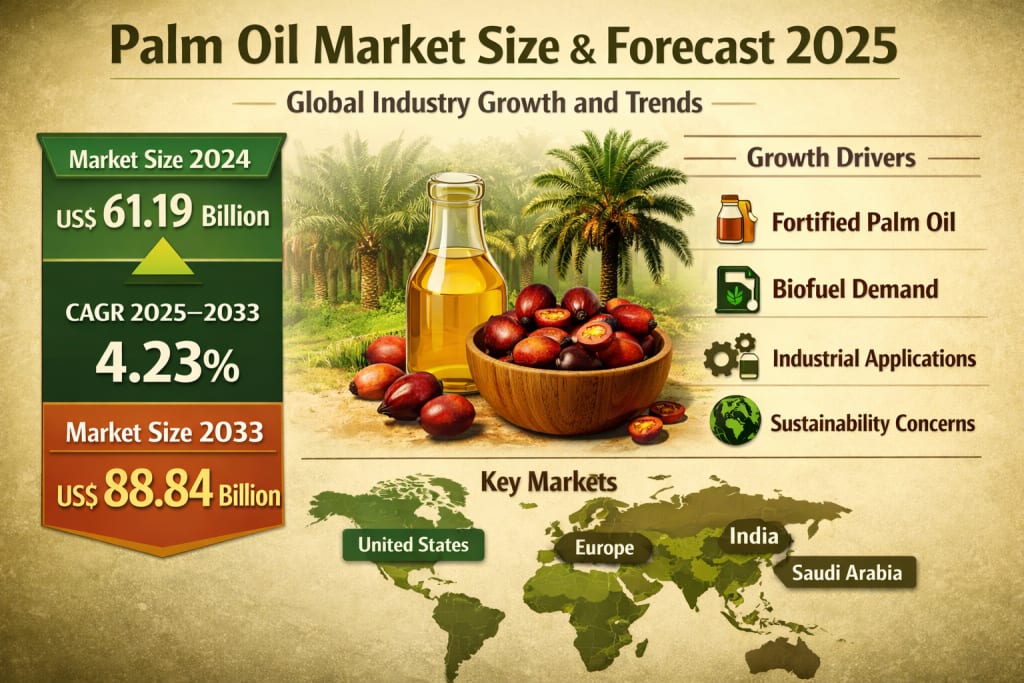
According to Renub Research, the Palm Oil Market is expected to reach US$ 88.84 billion by 2033 from US$ 61.19 billion in 2024, growing at a CAGR of 4.23% from 2025 to 2033. This growth reflects rising global consumption, expanding industrial applications, population growth, and the continued cost advantage of palm oil over alternative vegetable oils.
Geographically, Southeast Asia dominates global production, with Indonesia and Malaysia together accounting for the majority of the world’s palm oil supply. These two countries have built massive plantation and processing ecosystems that feed global demand from food manufacturers, cosmetic brands, and energy producers. Palm oil’s unmatched productivity per hectare has made it the preferred choice for meeting rising global vegetable oil needs, especially in emerging markets where affordability remains a key factor.
At the same time, the industry operates under intense scrutiny. Concerns related to deforestation, biodiversity loss, greenhouse gas emissions, and social issues such as land rights and labor practices have reshaped how governments, companies, and consumers view palm oil. In response, sustainability initiatives like the Roundtable on Sustainable Palm Oil (RSPO) have gained prominence, pushing producers toward more responsible cultivation and traceable supply chains. The future of the palm oil market, therefore, lies in balancing strong economic demand with environmental and social responsibility.
Market Size and Growth Outlook
The global palm oil market’s growth trajectory is supported by a combination of structural and demand-side factors. The steady rise in population, especially in Asia and Africa, continues to increase demand for affordable cooking oils and processed food products. Simultaneously, rapid urbanization and the expansion of the middle class in emerging economies are reshaping dietary habits, driving higher consumption of packaged and convenience foods that rely heavily on palm oil.
From an industrial perspective, palm oil’s role has expanded well beyond the kitchen. Its derivatives are widely used in soaps, detergents, cosmetics, pharmaceuticals, and increasingly in biofuels. This multi-sector demand base provides the market with resilience, helping it grow even during periods of economic uncertainty in specific industries.
Recent industry developments also underline the market’s long-term potential. In May 2024, Dabeeo, a geospatial intelligence AI technology company, launched an AI monitoring project for Indonesian palm oil plantations in partnership with Tunas Sawa Erma Group, one of Indonesia’s largest producers. The project covers 765 square kilometers and highlights how digital technologies are being adopted to improve productivity and sustainability.
In India, May 2024 marked the start of operations at 3F Oil Palm’s first integrated oil palm processing unit in Arunachal Pradesh under the National Mission on Edible Oils–Oil Palm (NMEO-OP). The facility includes a modern processing and refinery unit, a zero-discharge effluent plant, and a power plant based on palm waste, signaling India’s push toward domestic palm oil production. Earlier, in January 2024, M11 Industries and MK Agrotech announced the launch of an oil palm plantation project in Odisha under an MoU with the state government.
These investments indicate that both producing and consuming nations are strengthening their palm oil ecosystems, which supports the positive long-term market outlook.
Growth Drivers for the Palm Oil Market
Increasing Interest in Fortified Palm Oil
One of the key growth drivers shaping the palm oil market is the rising demand for fortified edible oils. Fortified palm oil enriched with vitamins such as vitamin A and vitamin D plays an important role in addressing nutritional deficiencies, particularly in developing countries. Studies suggest that fortified cooking oils can help consumers meet 25% to 30% of their daily vitamin A and D requirements, making them a powerful tool in public health strategies.
Governments across several regions are increasingly promoting food fortification to combat malnutrition. In India, for example, the Food Safety and Standards Authority of India (FSSAI) proposed mandatory fortification of edible oils with vitamins A and D to improve immunity and address micronutrient deficiencies. This regulatory push has encouraged palm oil producers to invest in more nutritious and value-added products.
The private sector is also responding. In October 2023, KTC Edibles, the UK’s largest edible oil supplier, launched “Planet Palm,” a range of certified sustainable and traceable palm oil products for UK food producers. Earlier, in September 2021, BASF West Africa and EDCEL Limited introduced a vitamin A premix for edible oils, supporting the broader fortification trend. These initiatives are steadily expanding the role of palm oil in health-focused food strategies.
Increasing Production of Biofuel
Palm oil has become a crucial feedstock for biodiesel production, positioning it at the center of the global energy transition toward renewable fuels. Biodiesel derived from palm oil offers an alternative to fossil fuels and helps countries diversify their energy mix while improving energy security.
Government policies play a major role in this shift. In India, the National Policy on Biofuels, introduced in 2018 and updated in June 2022, aims to reduce dependence on imported petroleum by encouraging domestic biofuel production. Similar policies exist in other regions, where blending mandates and incentives support biodiesel adoption.
Corporate investments reflect this momentum. In July 2022, Eni Kenya B.V. began producing vegetable oil for bio-refineries after completing an oilseed collection and pressing facility in Makueni, Kenya. With an initial capacity of 15,000 tons and a projected output of 2,500 tons in 2022, the project illustrates how biofuel-focused investments are expanding feedstock supply chains. As more countries commit to climate goals and renewable energy targets, palm oil’s role in biofuels is expected to remain a strong growth engine.
Versatility in Industrial Applications
Few agricultural commodities match palm oil’s versatility. In the personal care and cosmetics industry, palm oil and its derivatives are prized for their moisturizing, emulsifying, and stabilizing properties, making them essential ingredients in soaps, shampoos, lotions, and makeup products. In household and industrial cleaning products, palm-based surfactants are widely used for their effectiveness in removing grease and dirt.
The pharmaceutical industry also relies on palm oil derivatives in the production of tablets, ointments, and capsules, where stability and consistency are critical. Beyond that, palm oil finds applications in candles, lubricants, and industrial greases, as well as in animal feed formulations.
This wide application spectrum not only strengthens overall demand but also reduces the market’s dependence on any single sector. The combination of affordability, functional performance, and scalability makes palm oil a cornerstone ingredient across multiple global industries.
Challenges in the Palm Oil Market
Environmental Impact
The environmental footprint of palm oil production remains the industry’s most controversial and pressing challenge. Large-scale expansion of oil palm plantations, particularly in Indonesia and Malaysia, has led to significant deforestation, threatening biodiversity and destroying habitats of endangered species such as orangutans and tigers. Forest clearing, often involving burning, releases massive amounts of carbon dioxide, contributing to climate change.
These issues have triggered global criticism and led to stricter scrutiny from governments, NGOs, and consumers. Certification schemes like the RSPO aim to promote sustainable practices, but implementation across the entire supply chain remains uneven. While progress has been made, ensuring transparency, traceability, and compliance at scale continues to be a complex task.
Price Volatility
Price volatility is another major concern for the palm oil industry. Prices are influenced by weather conditions, disease outbreaks, geopolitical tensions, and trade policies in major producing countries. Events such as droughts or floods can sharply reduce yields, while export restrictions or changes in import duties can disrupt global trade flows.
For producers, this volatility complicates long-term planning and investment decisions. For consumers and manufacturers, it can lead to sudden increases in input costs, affecting product pricing and margins. Managing this instability is critical for maintaining steady growth and market confidence.
Regional Market Insights
United States Palm Oil Market
In the United States, palm oil demand is driven by food processing, personal care, and biofuel industries. It is commonly used in baked goods, snacks, margarine, and confectionery products due to its low cost and long shelf life. Beyond food, palm oil derivatives are widely used in soaps, detergents, and cleaning products.
Sustainability concerns have gained traction in the U.S. market, leading to increased demand for RSPO-certified sustainable palm oil. While environmental and social issues remain a topic of debate, palm oil’s functional advantages and cost efficiency continue to support steady market growth.
United Kingdom Palm Oil Market
The UK palm oil market is shaped by strong demand from the food, cosmetics, and biofuel sectors. Palm oil is widely used in processed foods and baked goods, but the market is also one of the most vocal in terms of sustainability expectations. Consumer awareness regarding deforestation and biodiversity loss has pushed retailers and manufacturers to prioritize certified sustainable palm oil.
As a result, RSPO certification and traceable supply chains are becoming increasingly important in the UK. Despite sustainability pressures, palm oil remains a critical ingredient across multiple industries.
India Palm Oil Market
India is one of the world’s largest consumers of edible oils, and palm oil plays a central role due to its affordability and wide availability. It is extensively used in cooking oils, snacks, and processed foods. The Indian government is also actively promoting domestic oil palm cultivation under initiatives like NMEO-OP to reduce import dependence.
At the same time, sustainability concerns are gaining attention, and demand for responsibly sourced palm oil is gradually increasing. With rising population, urbanization, and food consumption, India is expected to remain a key growth market for palm oil.
Saudi Arabia Palm Oil Market
Saudi Arabia relies heavily on imports to meet its palm oil demand, which is driven by the food processing, packaged food, and household cooking segments. Palm oil is also used in detergents, cosmetics, and increasingly in biofuel-related applications.
As sustainability concerns grow globally, Saudi Arabia is also witnessing a gradual shift toward certified sustainable palm oil. While price and availability remain important factors, environmental considerations are starting to influence procurement strategies.
Market Segmentation
By Application:
Household Cooking
Food & Beverages
Oleo Chemicals
Personal Care
Animal Feed
Bio-fuel
By Country:
North America: United States, Canada
Europe: France, Germany, Italy, Spain, United Kingdom, Belgium, Netherlands, Turkey
Asia Pacific: China, Japan, India, Australia, South Korea, Thailand, Malaysia, Indonesia, New Zealand
Latin America: Brazil, Mexico, Argentina
Middle East & Africa: South Africa, Saudi Arabia, United Arab Emirates
Company Analysis
The market features several major global and regional players, including:
Archer-Daniels-Midland Company
Boustead Holdings Berhad
IJM Corporation Berhad
IOI Corporation Berhad
Kulim Malaysia Berhad (Johor Corporation)
Sime Darby Plantation Berhad
United Plantations Berhad
Univanich Palm Oil Public Company Ltd.
Wilmar International Ltd.
These companies are evaluated across four key dimensions: Overview, Key Persons, Recent Developments & Strategies, and Financial Insights, reflecting their strategic positioning in the global palm oil landscape.
Final Thoughts
The global palm oil market is on a steady growth path, supported by expanding food consumption, rising industrial applications, and the increasing role of biofuels in the global energy mix. With the market projected to grow from US$ 61.19 billion in 2024 to US$ 88.84 billion by 2033, palm oil will remain a critical commodity in the global economy.
However, the industry’s long-term success will depend on how effectively it addresses environmental and social challenges. Sustainability, traceability, and responsible production practices are no longer optional—they are becoming central to market access and consumer trust. The companies and countries that can balance economic growth with environmental responsibility will shape the future of the global palm oil industry.
About the Creator
Feelings Never Die
It is Valentine's Day again, and it bought back memories that were over fifty years old. It bought me back to 1971, and I woke up and I knew my baby was due today. I was big and pregnant, and I felt like I was about to burst wide open. Imagine my surprise when the doctor told my I had a due date of February 14. I couldn't believe it, and since my baby was due today, I felt I could indulge myself a bit. I had gained a lot of weight, and chocolate was on the no-no list, but I had came to the end of this pregnancy, and I hoped it would be okay, after all I would deliver this baby today. So I walked across the street to the grocery story, and bought myself, a peppermint patty, covered in chocolate, my favorite. Me and my Valentine's baby would enjoy it together.
By Susan Payton6 days ago in Fiction



Comments
There are no comments for this story
Be the first to respond and start the conversation.