
Europe Defibrillator Market Trends & Summary: Life-Saving Technology Driving a New Era of Cardiac Care (2025–2033)
With rising cardiovascular disease, stronger public access programs, and rapid technology innovation, Europe’s defibrillator market is set for steady and transformative growth.

Europe Defibrillator Market Outlook
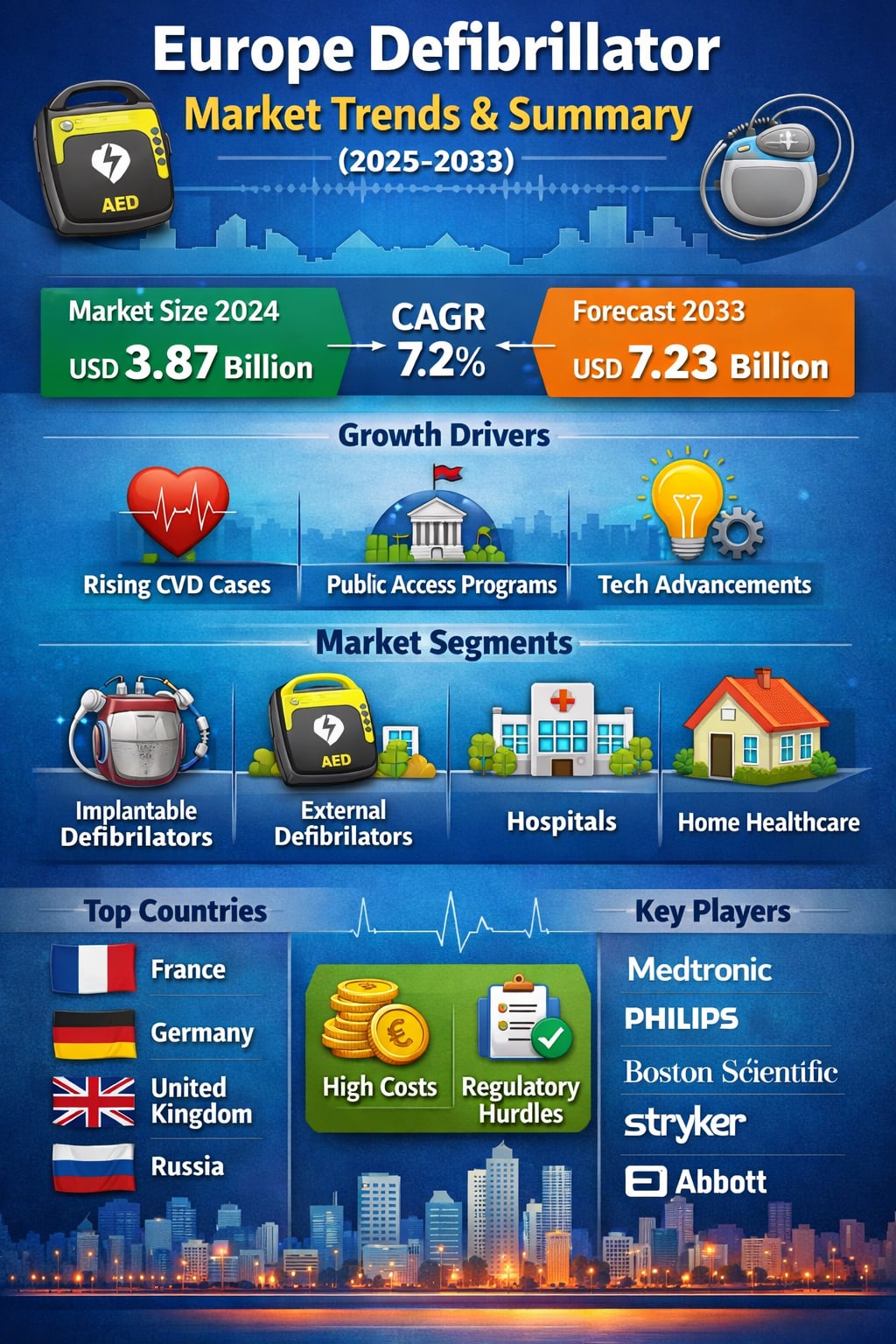
The Europe defibrillator market achieved USD 3.87 billion in 2024 and is expected to expand to USD 7.23 billion by 2033, growing at a CAGR of 7.2% from 2025 to 2033. This strong growth trajectory reflects a combination of medical necessity, policy support, and technological innovation shaping cardiac care across the continent.
A defibrillator is a critical medical device designed to restore a normal heart rhythm by delivering an electric shock or pulse to the heart. It is primarily used in cases of sudden cardiac arrest (SCA), a life-threatening condition where the heart unexpectedly stops beating effectively. Defibrillators are commonly categorized into Automated External Defibrillators (AEDs), Implantable Cardioverter Defibrillators (ICDs), and Wearable Cardioverter Defibrillators (WCDs), each serving specific patient needs and care environments.
Across Europe, demand for defibrillators has increased significantly due to the rising burden of cardiovascular diseases, aging populations, and stronger emphasis on emergency preparedness. Governments and health authorities are actively promoting the placement of AEDs in public spaces such as airports, railway stations, shopping malls, sports stadiums, and schools. At the same time, hospitals are expanding the use of advanced implantable defibrillators to prevent sudden cardiac death in high-risk patients.
Technological advancements have further accelerated adoption. Modern defibrillators are becoming more portable, user-friendly, and connected, making them suitable not only for clinical environments but also for community and home use. As a result, defibrillators are now a core component of Europe’s emergency medical response systems, bridging the gap between professional healthcare and public intervention.
Growth Drivers in the Europe Defibrillator Market
Increasing Incidence of Cardiovascular Diseases
Europe continues to face a significant and growing burden of cardiovascular diseases (CVDs), including arrhythmias and sudden cardiac arrest. CVDs remain the leading cause of death across the region, responsible for more than 42.5% of total annual deaths, equivalent to nearly 10,000 deaths each day. Aging populations, sedentary lifestyles, poor dietary habits, and rising rates of diabetes and obesity are all contributing to this alarming trend.
This growing patient pool is driving demand for defibrillators across hospitals, ambulances, public spaces, and even private homes. Countries with older demographic profiles, such as Germany and Italy, are seeing particularly strong demand for both implantable and external defibrillators. Early intervention using defibrillation significantly improves survival rates, making these devices essential tools in modern cardiac care and emergency response.
Government Initiatives and Public Access Programs
Governments across Europe have implemented comprehensive initiatives to improve access to life-saving equipment, particularly AEDs. Many countries now mandate the installation of defibrillators in public places, sports facilities, transportation hubs, and educational institutions. These policies are often supported by national registries, funding programs, and public awareness campaigns.
France and the United Kingdom, for example, have been at the forefront of Public Access Defibrillation (PAD) programs, aiming to ensure that AEDs are readily available where cardiac arrests are most likely to occur. Training initiatives have also expanded rapidly. In 2023, more than 500,000 people in Europe were trained in CPR and AED use through certified programs, significantly improving community readiness to respond to cardiac emergencies. The European Resuscitation Council has also worked with national health authorities to promote AED training in workplaces and public institutions.
These efforts not only save lives but also create sustained demand for easy-to-use, reliable external defibrillators across the continent.
Technology Developments and Product Innovation
Technological innovation is another major growth driver in the European defibrillator market. Manufacturers are continuously improving device design, focusing on portability, connectivity, battery life, and ease of use. Today’s AEDs often feature voice prompts, visual instructions, and automated analysis, allowing even untrained bystanders to use them confidently during emergencies.
In the implantable segment, advances such as remote monitoring, smaller device sizes, longer battery life, and better integration with hospital information systems are transforming patient management. Connectivity with electronic health records (EHRs) allows clinicians to monitor patients in real time and intervene earlier when risks arise.
In October 2024, ZOLL®, an Asahi Kasei company, announced the approval of the ZOLL AED Plus® under the EU Medical Device Regulation (MDR 2017/745), following the MDR approval of the ZOLL AED 3® in January 2024. These regulatory milestones highlight the ongoing innovation and compliance efforts shaping the European market.
Challenges in the Europe Defibrillator Market
High Cost of Devices and Implant Procedures
Despite strong growth prospects, cost remains a significant barrier, especially for implantable defibrillators. The financial burden includes not only the price of the device but also surgical implantation, post-operative care, follow-up monitoring, and eventual device replacement. These costs can be substantial, particularly in countries with limited healthcare budgets or weaker reimbursement systems.
In parts of Eastern Europe, financial constraints continue to limit access to advanced cardiac devices. Hospitals and healthcare providers may delay investments, especially in rural or under-resourced regions. As a result, while Western Europe sees high adoption rates, disparities in access persist across the broader European landscape.
Regulatory Complexity and Product Recall Risk
Europe’s stringent regulatory environment, especially under the Medical Device Regulation (MDR), ensures high standards of safety and quality but also increases compliance costs and extends time-to-market for new products. For manufacturers, navigating this complex regulatory framework can be both time-consuming and expensive.
Additionally, the defibrillator industry has faced product recalls in the past due to battery failures or software issues. Such incidents can damage brand reputation, reduce clinician and patient confidence, and lead to financial losses. The combination of regulatory pressure and technical risk remains an ongoing challenge for market participants.
Europe Implantable Defibrillator Market
The implantable defibrillator segment in Europe is growing steadily, driven by the rising prevalence of chronic heart conditions such as arrhythmias, heart failure, and cardiomyopathy. Implantable Cardioverter Defibrillators (ICDs) and Cardiac Resynchronization Therapy Defibrillators (CRT-Ds) are widely used to prevent sudden cardiac death in high-risk patients.
Western European countries, particularly Germany, France, and the United Kingdom, lead in adoption due to strong healthcare infrastructure and favorable reimbursement policies. Technological improvements, including miniaturization, enhanced battery life, and remote monitoring capabilities, are making these devices more efficient and patient-friendly, further supporting market growth.
Europe External Defibrillator Market
External defibrillators, especially AEDs, are experiencing robust growth across Europe. This is largely due to expanding public access programs and increasing awareness of sudden cardiac arrest. These portable, easy-to-use devices are now commonly found in offices, schools, airports, shopping centers, and sports venues.
Governments, corporations, and private institutions are increasingly viewing AEDs as essential components of safety infrastructure. While manual and semi-automatic defibrillators remain critical in ambulances and emergency departments, the fastest growth is occurring in the public access segment, particularly in countries like the UK and France.
Europe Hospital Defibrillator Market
Hospitals remain the largest end-users of defibrillators in Europe due to the high volume of cardiac procedures and emergency interventions. Advanced defibrillator systems are integral to emergency rooms, operating theaters, and intensive care units (ICUs).
Both external and implantable defibrillators are widely used in hospital settings, depending on patient needs. The adoption of technologically advanced models with ECG monitoring, data logging, and connectivity features is improving clinical efficiency and patient outcomes. In February 2024, patients at Royal Papworth Hospital NHS Foundation Trust became the first in Europe outside clinical trials to receive a new type of implantable cardioverter-defibrillator, highlighting ongoing innovation in hospital-based cardiac care.
Europe Home Healthcare Defibrillator Market
The home healthcare segment is gaining momentum as Europe’s population ages and healthcare systems shift toward home-based chronic care management. Portable and wearable defibrillators are increasingly used by patients at risk of sudden cardiac arrest who may not be suitable candidates for implantable devices.
The expansion of home care services, particularly in Western Europe, along with better insurance coverage and the integration of telemedicine, is supporting growth in this segment. Home-use defibrillators offer peace of mind to patients and families while reducing the burden on hospitals and emergency services.
Country-Level Insights
France
France has seen strong growth in its defibrillator market due to strict government mandates and extensive public awareness campaigns. AED installations are now compulsory in many public spaces, including stadiums, train stations, and schools. French hospitals are also early adopters of advanced ICD and CRT-D technologies. In April 2024, MicroPort® CRM launched TALENTIA™ and ENERGYA™ devices in Europe, featuring Bluetooth connectivity, reinforcing France’s role as a hub for cardiac device innovation.
Germany
Germany leads the European defibrillator market thanks to its advanced healthcare system, high prevalence of cardiovascular diseases, and strong reimbursement policies. The country has one of the highest implantation rates for ICDs and a large installed base of AEDs in public and private spaces. Continuous investment in innovation and strong collaboration between domestic and international medtech companies further strengthen Germany’s market position.
United Kingdom
The UK market is driven by strong government and charitable support for public access defibrillation. Organizations such as the British Heart Foundation have played a key role in expanding AED availability. The National Health Service (NHS) continues to support widespread deployment in healthcare facilities, while home-based and wearable defibrillators are gaining popularity in community care settings.
Russia
Russia’s defibrillator market is growing gradually, supported by government efforts to improve emergency healthcare infrastructure. While adoption remains lower than in Western Europe, urban areas are seeing increased installation of AEDs and advanced hospital defibrillators. Cost constraints and regional disparities remain challenges, but partnerships between global and local companies are helping improve access and awareness.
Europe Defibrillator Market Segmentation
By Product:
Implantable Defibrillators
External Defibrillators
By End User:
Hospital
Pre-hospital
Public Access
Alternate Care
Home Healthcare
By Country:
France, Germany, Italy, Spain, United Kingdom, Belgium, Netherlands, Russia, Poland, Greece, Norway, Romania, Portugal, Rest of Europe
Companies Covered (4 Viewpoints):
Overview
Key Person
Recent Developments
Revenue
Key Players:
Medtronic Plc., Philips Healthcare, Nihon Kohden Corporation, Boston Scientific Corporation, Stryker Corporation, Asahi Kasei Corporation, LivaNova PLC., Abbott
Final Thoughts
The Europe defibrillator market is entering a decisive growth phase, driven by the rising burden of cardiovascular disease, strong government support for public access programs, and continuous technological innovation. With the market expected to grow from USD 3.87 billion in 2024 to USD 7.23 billion by 2033, defibrillators are set to play an even more critical role in saving lives across hospitals, communities, and homes.
While challenges such as high costs and regulatory complexity remain, the overall outlook is highly positive. As awareness, accessibility, and technology continue to improve, defibrillators will increasingly become a standard part of Europe’s healthcare and public safety infrastructure—turning rapid response into routine practice and giving millions a better chance at survival.
About the Creator
Tom Shane
Tom Shane is a content writer specializing in SEO-driven blogs, product descriptions, and thought leadership. He crafts engaging, research-backed content that connects with audiences and drives results.
Global Dialysis Market Size and Forecast 2025–2033
Introduction The global dialysis market is entering a decisive decade of transformation, driven by a sharp rise in chronic kidney disease (CKD), end-stage renal disease (ESRD), aging populations, and rapid technological innovation in renal care. According to Renub Research, the Dialysis Market is expected to reach US$ 171.61 billion by 2033, up from US$ 116.57 billion in 2024, growing at a compound annual growth rate (CAGR) of 4.39% from 2025 to 2033.
By shibansh kumara day ago in Trader
Artificial Sweetener Market Size and Forecast 2025–2033: The Global Shift Toward Sugar-Free Living
Artificial Sweetener Market Overview The global artificial sweetener market is undergoing a steady and transformative expansion as consumers increasingly move away from traditional sugar and toward healthier, low-calorie alternatives. According to Renub Research, the Artificial Sweetener Market is expected to reach US$ 10.86 billion by 2033, up from US$ 6.97 billion in 2024, growing at a CAGR of 5.05% from 2025 to 2033. This growth reflects a broader global shift in dietary habits, driven by rising health consciousness, increasing prevalence of lifestyle diseases, and strong demand for sugar-free and low-calorie food and beverage products.
By Sakshi Sharma2 days ago in Trader


Comments
There are no comments for this story
Be the first to respond and start the conversation.