
Global Dialysis Market Size and Forecast 2025–2033
Rising Kidney Disease Burden, Home Dialysis Adoption, and Technology Innovation Reshape a US$ 171.61 Billion Market

Introduction
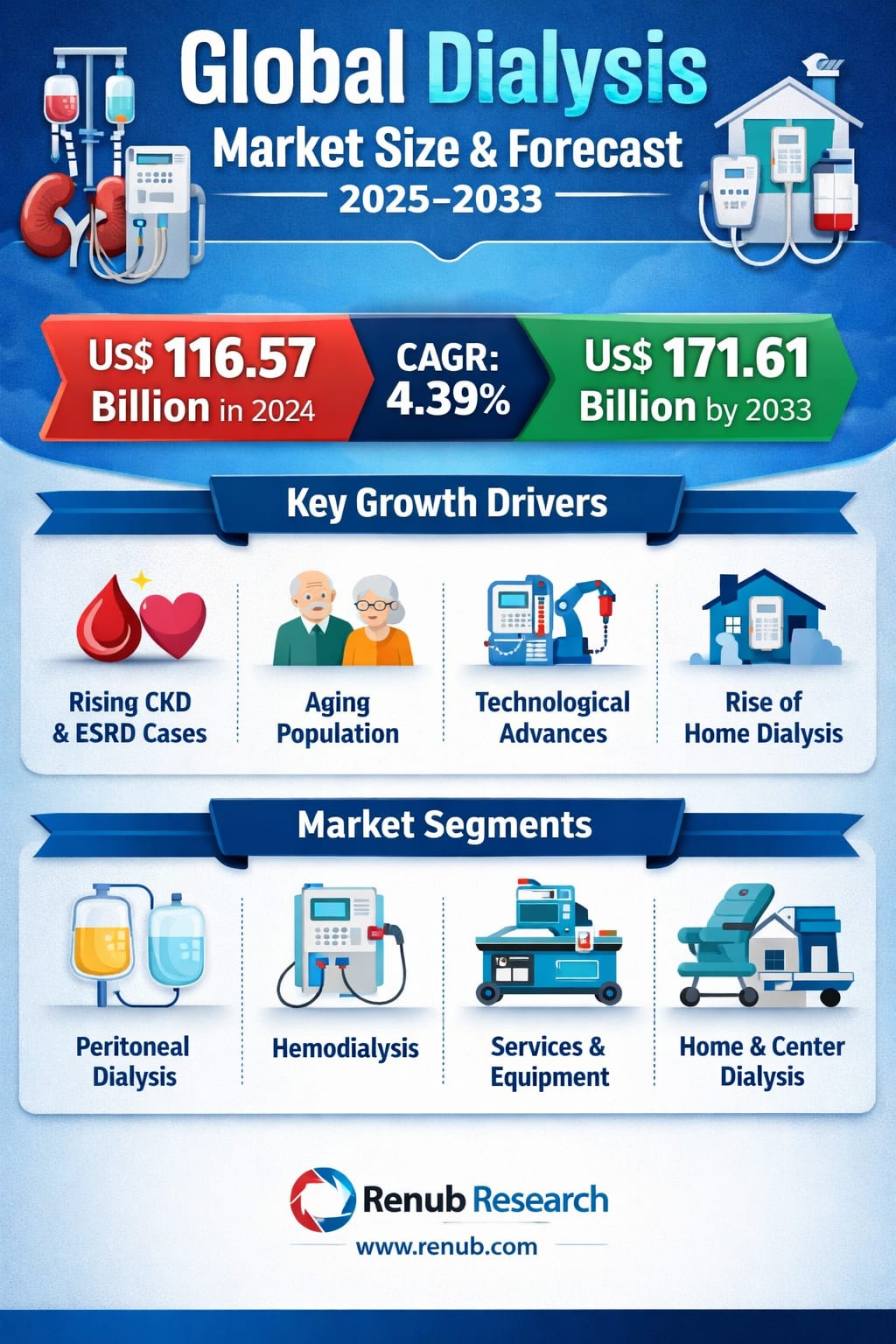
The global dialysis market is entering a decisive decade of transformation, driven by a sharp rise in chronic kidney disease (CKD), end-stage renal disease (ESRD), aging populations, and rapid technological innovation in renal care. According to Renub Research, the Dialysis Market is expected to reach US$ 171.61 billion by 2033, up from US$ 116.57 billion in 2024, growing at a compound annual growth rate (CAGR) of 4.39% from 2025 to 2033.
This growth reflects more than just expanding patient numbers. It also signals a structural shift in how dialysis is delivered—moving beyond traditional in-center treatment models toward home-based dialysis, smarter equipment, better consumables, and more patient-centric care pathways. Governments, healthcare providers, and private players alike are investing heavily in dialysis infrastructure, reimbursement programs, and technology upgrades to meet the surging demand.
At its core, dialysis remains a life-sustaining therapy for patients whose kidneys can no longer adequately filter waste, excess fluids, and toxins from the blood. While it does not cure kidney failure, dialysis plays a critical role in maintaining electrolyte balance, removing metabolic waste, and preserving life until a transplant becomes possible—or as a long-term therapy for millions worldwide.
Understanding Dialysis: A Vital Lifeline
Dialysis replaces key functions of the kidneys when renal failure sets in. The two primary forms are hemodialysis and peritoneal dialysis.
Hemodialysis filters blood outside the body using a machine and a dialyzer, typically performed in hospitals or dialysis centers, though home hemodialysis is also gaining traction.
Peritoneal dialysis uses the lining of the abdomen (the peritoneum) as a natural filter, with a dialysis solution introduced into the abdominal cavity to remove waste products.
Within peritoneal dialysis, Continuous Ambulatory Peritoneal Dialysis (CAPD) and Automated Peritoneal Dialysis (APD) are increasingly popular, especially in home-care settings. These methods offer greater flexibility, reduced hospital visits, and improved quality of life for many patients—factors that are reshaping market demand globally.
Market Size and Growth Outlook
Renub Research projects steady and resilient growth for the global dialysis market over the forecast period. From US$ 116.57 billion in 2024, the market is set to expand to US$ 171.61 billion by 2033, reflecting both rising disease prevalence and expanding treatment access worldwide.
Several structural drivers underpin this growth:
Rising incidence of diabetes and hypertension, the two leading causes of CKD and ESRD
Rapidly aging global population, which is more susceptible to kidney disease
Technological advancements in dialysis equipment, consumables, and monitoring systems
Growing healthcare expenditure in both developed and emerging economies
Expansion of home dialysis solutions
Supportive government policies and reimbursement programs in many regions
Together, these factors are turning dialysis from a purely hospital-based therapy into a broader, more flexible, and more scalable healthcare service industry.
Key Growth Drivers Shaping the Dialysis Market
1. Growing Demand for Advanced Peritoneal Dialysis Methods
One of the most important shifts in the dialysis landscape is the increasing adoption of APD and CAPD, particularly in mature healthcare markets. In the United States, for example, a significant majority of incident peritoneal dialysis patients now use nocturnal APD, reflecting a strong preference for treatments that fit more naturally into daily life.
APD allows automated exchanges during sleep, while CAPD enables patients to manage fluid exchanges manually throughout the day. Both approaches reduce dependence on in-center facilities, improve treatment continuity, and often lead to better patient satisfaction and adherence. As home-based care continues to gain acceptance, demand for these modalities is expected to rise, encouraging further innovation in devices, consumables, and remote monitoring solutions.
2. Expansion of Private Dialysis Facilities and Clinics
The growth of private dialysis centers is another powerful engine behind market expansion, particularly in emerging economies. In countries like India, the private sector already plays a dominant role in dialysis delivery, with hundreds of facilities and thousands of machines concentrated in urban areas—and steadily expanding into smaller cities.
Private clinics often offer shorter wait times, flexible scheduling, and more personalized care, making them attractive to patients who need frequent, long-term treatment. Increased competition among providers is also driving improvements in service quality, technology adoption, and patient experience. Importantly, private facilities help reduce pressure on public healthcare systems, especially in regions where government resources are stretched thin.
3. Lifestyle Changes and the Rising Burden of Renal Disease
Modern lifestyle patterns—sedentary behavior, poor diet, rising obesity rates, and high stress—have significantly increased the global burden of diabetes and hypertension, which in turn are the leading contributors to CKD and ESRD.
Kidney disease now represents one of the highest-cost chronic conditions for healthcare systems worldwide due to the lifelong nature of dialysis treatment. Millions of patients require either continuous renal replacement therapy or kidney transplantation to survive. As the prevalence of ESRD rises, so does the demand for dialysis services, equipment, consumables, and drugs.
At the same time, regulatory approvals for new products and innovations—such as wearable or miniaturized dialysis devices—are opening new frontiers in renal care, further expanding the market’s technological and commercial horizons.
Challenges Facing the Dialysis Market
High Treatment Costs
Despite strong growth prospects, cost remains a major barrier to wider dialysis access, particularly in low- and middle-income countries. Dialysis requires repeated sessions, specialized equipment, trained staff, and continuous supply of consumables—all of which drive up expenses.
In regions with limited insurance coverage or government support, many patients struggle to afford regular treatment, which can restrict market expansion and worsen health outcomes. Even in developed markets, cost containment remains a central policy and operational challenge for providers.
Patient Compliance and Quality of Life
Dialysis is physically and emotionally demanding. Long treatment sessions, strict schedules, dietary restrictions, and potential side effects such as fatigue and infections can take a toll on patients’ mental health and daily routines. These factors can reduce treatment adherence, negatively affecting outcomes and increasing long-term healthcare costs.
Improving patient experience—through home dialysis options, better technology, and integrated care models—has therefore become a strategic priority for both healthcare systems and industry players.
Regional Market Overview
The global dialysis market shows clear regional contrasts in terms of infrastructure, access, and maturity.
North America and Europe lead in advanced technology adoption, reimbursement coverage, and established treatment networks.
Asia-Pacific is the fastest-growing region, driven by large populations, rising CKD prevalence, and improving healthcare infrastructure.
Latin America and the Middle East are expanding steadily, supported by increasing healthcare investment and demand.
Africa continues to face major challenges related to infrastructure, affordability, and access, though gradual progress is being made in select countries.
Country Spotlight
United States
The U.S. represents one of the largest and most sophisticated dialysis markets globally. A high prevalence of CKD and ESRD, combined with an aging population, continues to drive demand. While in-center hemodialysis remains dominant, home-based options such as CAPD and APD are gaining momentum due to convenience and lifestyle benefits. Ongoing innovation and a strong network of private and public providers keep the market on a steady growth path, despite persistent cost pressures.
Germany
Germany’s dialysis market benefits from a strong healthcare system, advanced infrastructure, and comprehensive reimbursement mechanisms. Hemodialysis remains the primary modality, but peritoneal dialysis is steadily gaining acceptance. The key challenges here revolve around rising treatment costs and the need to further expand home-based care to reduce institutional burden.
India
India’s dialysis market is expanding rapidly due to rising CKD prevalence, population aging, and increasing private sector participation. Hemodialysis is the most widely used treatment, though peritoneal dialysis is also growing in popularity. Government initiatives, better infrastructure, and technological adoption are improving access and affordability, supporting long-term market growth.
Saudi Arabia
Saudi Arabia’s dialysis market is supported by a well-developed healthcare system and strong government involvement. Both public and private providers offer hemodialysis and peritoneal dialysis services. With high CKD prevalence and a growing elderly population, demand continues to rise, while home-based dialysis options are becoming increasingly attractive to patients.
Market Segmentation
By Type:
Peritoneal Dialysis
Hemodialysis
By Product & Services:
Services
Equipment
Consumables
Drugs
By End User:
Home Dialysis
In-Center Dialysis
By Region:
North America, Europe, Asia-Pacific, Latin America, Middle East & Africa, with key countries including the United States, Canada, Germany, France, UK, China, Japan, India, South Korea, Brazil, Mexico, Saudi Arabia, UAE, and South Africa.
Competitive Landscape
The dialysis market is highly competitive, with leading players focusing on technology innovation, service expansion, strategic partnerships, and geographic growth. Key companies profiled include:
Asahi Kasei Corporation
B. Braun Melsungen AG
Baxter International Inc.
Becton Dickinson and Company
DaVita Inc.
Fresenius Medical Care AG & Co. KGaA
JMS Co. Ltd.
Medtronic Plc.
These companies are evaluated across multiple dimensions, including company overview, leadership, product portfolio, recent developments and strategies, and revenue performance.
Final Thoughts
The global dialysis market is on a clear and steady growth trajectory, shaped by demographic change, lifestyle-driven disease patterns, and continuous innovation in renal care. With the market projected to reach US$ 171.61 billion by 2033, dialysis is no longer just a hospital service—it is becoming a technology-driven, patient-centric, and globally scalable healthcare ecosystem.
While challenges such as high costs and patient quality-of-life concerns remain, the expansion of home dialysis, private clinics, and smarter treatment solutions offers a promising path forward. For healthcare providers, policymakers, and industry players alike, the coming decade will be defined by one central goal: making life-sustaining renal care more accessible, more efficient, and more humane for millions of patients worldwide.
About the Creator
Keep reading
More stories from shibansh kumar and writers in Trader and other communities.
Europe In-Vitro Diagnostics (IVD) Market Trends & Growth Outlook (2025–2033)
Introduction: Diagnostics at the Heart of Modern European Healthcare The Europe In-Vitro Diagnostics (IVD) market is entering a decisive phase of growth, driven by rising healthcare demands, rapid technological innovation, and a strong policy focus on early disease detection. According to Renub Research, the Europe In-Vitro Diagnostics (IVD) Market was valued at USD 23.35 billion in 2024 and is expected to reach USD 34.47 billion by 2033, expanding at a CAGR of 4.42% from 2025 to 2033.
By shibansh kumara day ago in Trader
LUNA-USDC Crypto Stablecoin Liquidity Alliance Erisprotocol Defi strategy
Alright, let’s talk Terra Liquidity Alliance Erisprotocol I’ve been in this ecosystem since the old days. And if you’re still here, you know the score. You’ve seen the bottom. You understand the risk.
By Bethany Strele2 days ago in Trader


Comments
There are no comments for this story
Be the first to respond and start the conversation.