
Australia Fertilizer Market Size and Forecast 2025–2033
Sustainable Farming, Precision Agriculture, and the Shift Toward Smarter Nutrient Management Are Reshaping Australia’s Fertilizer Industry

Introduction
Australia’s agricultural sector stands at a critical crossroads. As climate variability, soil health concerns, and global food demand continue to rise, fertilizers remain one of the most important pillars supporting farm productivity across the country. From vast wheat fields to high-value horticulture and sugarcane plantations, nutrient management is no longer just about boosting yields—it is about doing so efficiently, sustainably, and responsibly.
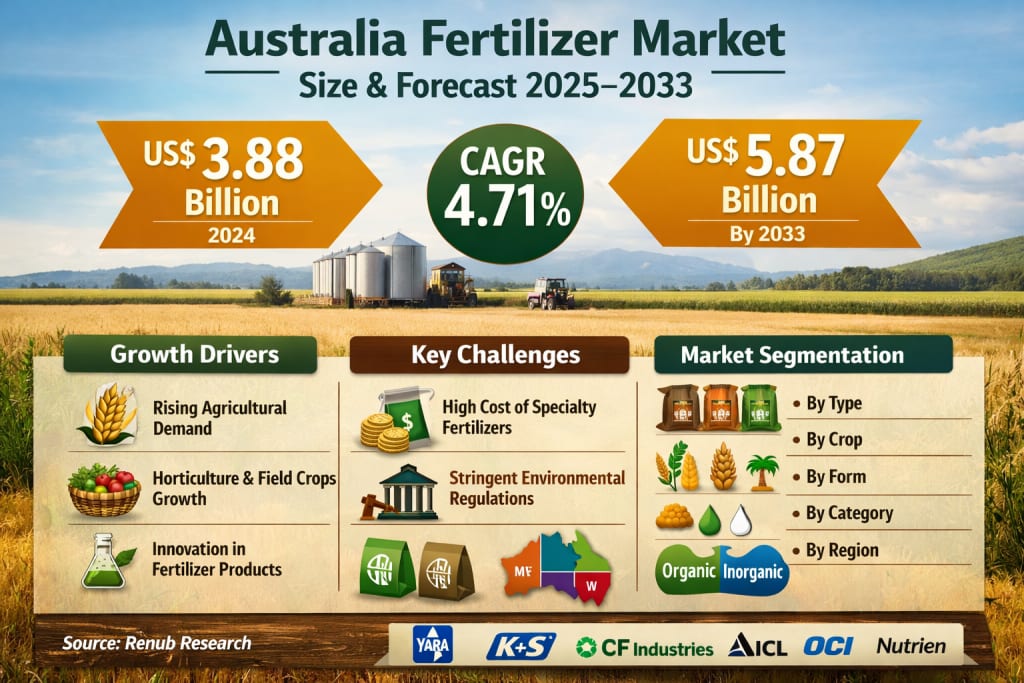
According to Renub Research, the Australia Fertilizer Market is expected to reach US$ 5.87 billion by 2033, up from US$ 3.88 billion in 2024, growing at a compound annual growth rate (CAGR) of 4.71% from 2025 to 2033. This steady expansion reflects a market in transition: one that is increasingly shaped by sustainability goals, precision farming technologies, and a growing preference for organic and bio-based inputs.
While conventional fertilizers continue to dominate volumes, Australian farmers are gradually shifting toward solutions that enhance soil health, reduce environmental impact, and optimize input costs. Supported by government initiatives, infrastructure investments, and innovation in fertilizer formulations, the sector is evolving into a more technology-driven and environmentally conscious industry.
Australia Fertilizer Market Overview
Australia’s fertilizer industry plays a central role in sustaining the nation’s agricultural productivity. The country’s diverse soils—many of which are naturally low in essential nutrients such as nitrogen and phosphorus—make fertilizers a necessity rather than an option for most farming systems. From broadacre crops like wheat and barley to fruits, vegetables, and sugar crops, fertilizers are critical for meeting both yield and quality targets.
The market is served by a mix of domestic production and imports, creating a competitive and well-supplied environment. Strict environmental and quality regulations govern the sector, ensuring that products meet safety standards while minimizing ecological harm. This regulatory framework, while demanding, has encouraged companies to invest in cleaner production processes and more efficient nutrient solutions.
In recent years, innovation and sustainability have become defining themes of the industry. Farmers are increasingly adopting precision agriculture techniques, including soil testing, variable-rate application, and sensor-based nutrient management. These approaches help reduce waste, improve nutrient uptake efficiency, and lower long-term input costs.
Liquid and water-soluble fertilizers are also gaining traction, particularly in regions with advanced irrigation systems. At the same time, government support for sustainable agriculture—through funding, infrastructure development, and risk management programs—continues to strengthen the sector’s long-term outlook.
A notable example of this support is the Australian government’s USD 30 million investment in 2023 aimed at helping grain growers manage risks such as drought and market volatility. This funding has accelerated the adoption of modern irrigation systems and precision farming methods across the country. Today, Australian farms use over 8.1 million megaliters of water annually through various irrigation channels, highlighting the scale and importance of efficient resource management.
Wheat remains the backbone of Australia’s field crop sector, occupying around 50.2% of total field cropland. This dominance significantly influences fertilizer demand patterns. While the adoption of advanced irrigation technologies is still relatively low—only about 9% of farmers use surface drip irrigation and 2% use sub-surface drip systems—the broader shift toward data-driven farming is clearly underway.
Growth Drivers for the Australia Fertilizer Market
1. Rising Agricultural Demand
One of the strongest drivers of fertilizer consumption in Australia is the steady rise in agricultural demand. As both domestic consumption and export markets expand, farmers are under increasing pressure to improve productivity and maintain consistent crop quality. Cereals, fruits, vegetables, and pulses all require balanced and timely nutrient inputs to achieve optimal yields.
Australia’s position as a major exporter of commodities such as wheat, barley, and horticultural produce further strengthens this trend. To remain competitive in global markets, producers must focus on yield optimization, quality improvement, and cost efficiency—objectives that rely heavily on effective fertilizer use. As a result, rising agricultural output continues to translate directly into higher fertilizer demand across the country.
2. Growth in Horticulture and Field Crops
The expansion of horticulture and field crops is another key factor shaping the market. High-value crops such as fruits, vegetables, and specialty grains often require precise nutrient management to meet both yield and quality standards. This has increased the use of customized fertilizer blends designed for specific crops and soil conditions.
In horticulture, the shift toward intensive and, in many cases, year-round production has further boosted fertilizer consumption. Export-oriented producers, in particular, are investing more in soil fertility and plant health to meet strict international quality requirements. At the same time, growing consumer demand—both domestically and globally—for fresh produce and premium grains is reinforcing the importance of fertilizers as a core agricultural input.
3. Innovation in Fertilizer Products
Innovation is rapidly reshaping the future of Australia’s fertilizer market. As sustainability becomes a priority for both policymakers and farmers, there is rising interest in slow-release, water-soluble, and environmentally friendly fertilizers. These products are designed to improve nutrient use efficiency, reduce leaching and runoff, and minimize environmental impact.
Slow-release fertilizers, for example, provide a steady supply of nutrients over time, reducing the need for frequent applications and lowering labor and fuel costs. Water-soluble fertilizers, on the other hand, are well suited to modern irrigation systems and allow for precise, targeted nutrient delivery.
Bio-fertilizers and organic variants are also gaining attention as part of a broader movement toward soil health management and regenerative agriculture. While these products currently represent a smaller share of the market, their role is expected to grow as environmental regulations tighten and sustainability goals become more prominent.
Challenges in the Australia Fertilizer Market
1. High Cost of Specialty Fertilizers
Despite their benefits, specialty fertilizers—such as slow-release and water-soluble formulations—often come with significantly higher price tags than conventional products. For small and medium-sized farmers, these costs can be a major barrier, especially in years when margins are tight or weather conditions are uncertain.
As a result, many producers continue to rely on traditional fertilizers, even though newer alternatives may offer better long-term efficiency and environmental performance. Bridging this affordability gap will likely require a combination of government support, economies of scale, and continued research to reduce production costs.
2. Stringent Environmental Regulations
Australia’s fertilizer industry operates under strict environmental regulations aimed at reducing nutrient runoff, soil degradation, and greenhouse gas emissions. While these rules are essential for protecting ecosystems and promoting sustainable farming, they also increase compliance costs for manufacturers and distributors.
Companies must invest in cleaner technologies, monitoring systems, and reporting processes to meet regulatory standards. These additional costs can limit short-term profitability and, in some cases, slow the introduction of new products. However, in the long run, compliance with environmental norms is increasingly seen as a necessary step to ensure industry credibility, public trust, and sustainable growth.
Regional Insights
Northeast Australia Fertilizer Market
Northeast Australia, particularly North Queensland, plays a vital role in the national fertilizer landscape. The region hosts major production facilities, including Incitec Pivot’s ammonium phosphate plant at Phosphate Hill, which supplies both domestic and export markets.
Agricultural activities in the region—such as sugarcane, cotton, and horticulture—drive strong demand for fertilizers. At the same time, the proximity to the Great Barrier Reef has placed greater emphasis on responsible nutrient management to prevent runoff and protect sensitive marine ecosystems. As a result, sustainable farming practices and strict regulatory compliance are especially important in this part of the country.
Midwest Australia Fertilizer Market
The Midwest, particularly in Western Australia, is witnessing notable growth in fertilizer demand due to its thriving agricultural sector. Grain production, livestock farming, and horticulture form the backbone of the region’s economy, and major suppliers are investing heavily in infrastructure to support this base.
For example, Nutrien Ag Solutions has announced a USD 70 million investment in a new fertilizer distribution center in Rockingham, which will increase bulk granular fertilizer storage capacity by 20%. Similarly, CBH Group is expanding into liquid fertilizers with the construction of a Urea Ammonium Nitrate (UAN) storage facility near the Kwinana grain port. These investments are aimed at improving supply chain efficiency, reducing logistics costs, and ensuring reliable access to fertilizers for farmers across Western Australia.
South Australia Fertilizer Market
South Australia’s fertilizer market is shaped by its diverse farming systems and challenging climate conditions. From horticulture in the Riverland to broadacre grain production on the Eyre Peninsula, the state requires a wide range of fertilizer products tailored to different crops and soil types.
Frequent droughts and variable rainfall patterns have increased the importance of efficient nutrient management and precise application techniques. Local distributors and suppliers play a crucial role in ensuring timely availability of fertilizers, helping farmers adapt to both market and environmental uncertainties. Overall, the region’s fertilizer demand reflects a balance between productivity goals and the need for resource-efficient farming.
Australia Fertilizer Market Segmentation Analysis
By Type (4 viewpoints):
Nitrogen Fertilizers: Urea, Ammonium Nitrate, Ammonium Sulfate, Others
Phosphorus Fertilizers: Superphosphates, MAP, DAP
Potassium Fertilizers: Potash, SOP
Bio-Fertilizers: Microbial, Organic Variants
By Category (2 viewpoints):
Organic
Inorganic
By Form (2 viewpoints):
Dry
Liquid
By Application (4 viewpoints):
Agriculture
Horticulture
Gardening
Others
By Crop (14 viewpoints):
Grassland, Vegetables, Fruits/Treenuts, Roots/Tubers, Sugar Crops, Fibre Crops, Other Oil Crops, Oil Palm, Soybeans, Other Cereals, Maize, Rice, Wheat, Others
By Region (4 viewpoints):
Northeast
Midwest
South
West
Company Analysis
The competitive landscape of the Australia fertilizer market features several major global and regional players, each contributing through product innovation, capacity expansion, and strategic investments. The report covers key companies from four viewpoints—Overview, Key Persons, Recent Developments, and Revenue—including:
Yara International ASA
K+S AG
CF Industries Holdings
Grupa Azoty S.A.
ICL Group
OCI NV
Sociedad Química y Minera de Chile SA
BASF SA
PhosAgro
These companies are increasingly focusing on sustainable product lines, efficient distribution networks, and partnerships with farmers to strengthen their market positions in Australia.
Final Thoughts
The Australia Fertilizer Market is entering a phase of steady, sustainability-driven growth. With the market projected to rise from US$ 3.88 billion in 2024 to US$ 5.87 billion by 2033 at a CAGR of 4.71%, the outlook remains positive, supported by rising agricultural demand, expansion in horticulture and field crops, and continuous innovation in fertilizer products.
While challenges such as high specialty fertilizer costs and stringent environmental regulations persist, they are also pushing the industry toward smarter, cleaner, and more efficient solutions. As precision agriculture, soil health management, and sustainable farming practices become more mainstream, fertilizers will continue to evolve from simple yield boosters into strategic tools for long-term agricultural resilience.
About the Creator
Bitcoin’s Sudden Crash After the Epstein File Release
Bitcoin’s Sudden Crash After the Epstein File Release: Coincidence or Market Psychology? When the long-anticipated Epstein-related documents were released to the public, the world’s attention was captured almost instantly. Media outlets, social platforms, and political commentators erupted with reactions, debates, and speculation. Around the same time, Bitcoin and the broader cryptocurrency market experienced a noticeable decline. This timing led many observers to ask a pressing question: Did the Epstein file release cause Bitcoin to crash?
By Wings of Time 5 days ago in Trader
Bartender
On the heels of grief, pain bears down hard. On the heels of death, pain awakens the quiet place between the end of our own life and now. Feeling anything is like seeing a film and in black and white, slow motion, all sound turned off. Just watching. Gritting teeth, awkward smiles and bloody red eyes move around, scanning the others who are feeling something I don't want to feel, but I do. Escapism is all I have ever known. ~
By ROCK aka Andrea Polla (Simmons)3 days ago in Poets




Comments
There are no comments for this story
Be the first to respond and start the conversation.