
India Furniture Market Size and Forecast 2025–2033: A Decade of Design, Demand, and Digital Disruption
Rising urbanization, e-commerce expansion, and shifting lifestyle preferences push India’s furniture industry toward a US$ 72.11 billion milestone by 2033

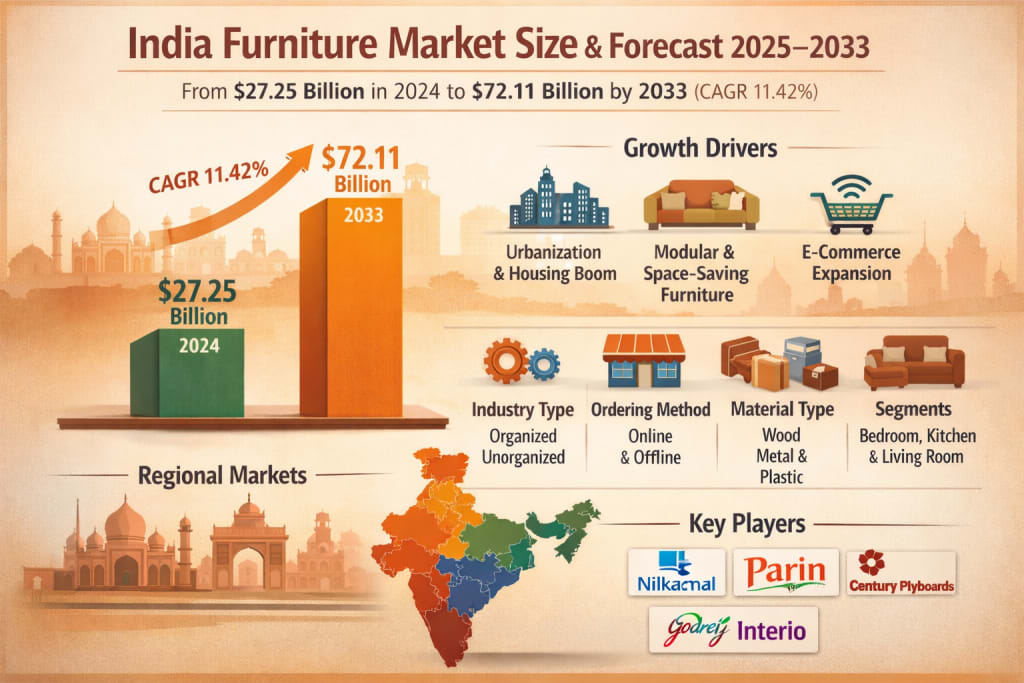
India Furniture Market at a Glance
The India Furniture Market is expected to reach US$ 72.11 billion by 2033, rising from US$ 27.25 billion in 2024, registering a robust CAGR of 11.42% from 2025 to 2033. This impressive growth trajectory reflects not only the rapid transformation of India’s housing and real estate landscape but also deeper shifts in consumer behavior, retail formats, and manufacturing practices.
Government initiatives to strengthen the real estate sector and promote affordable housing, combined with rising demand for modular, space-saving furniture and the explosive growth of e-commerce platforms, are acting as the primary engines of expansion. Furniture in India is no longer seen as a purely functional purchase; it has become a statement of lifestyle, comfort, and personal taste.
The India Furniture Market & Forecast Report 2025–2033 covers the industry by Industry Type (Organized, Unorganized), Ordering Method (Online, Offline), Material Type (Wood, Metal, Plastic, Others), Segment (Bedroom, Kitchen, Living/Dining, Others), Region (North & Central, Southern, Western, Eastern), along with detailed company analysis.
India Furniture Industry Overview
Retail modernization and shifting consumer preferences are driving a major transition in the Indian furniture business. Traditional unorganized merchants are gradually giving way to organized players, while foreign brands are finding more room to operate thanks to policy support such as allowing 51% FDI in multi-brand retail. This shift is especially visible in metropolitan regions, where consumers are increasingly drawn to contemporary designs, modular formats, and ready-to-assemble furniture.
One strong indicator of growing consumer confidence in digital channels is the average basket value of online furniture purchases, which has remained in the range of INR 15,000 to INR 20,000. This suggests that buyers are no longer hesitant to make high-value purchases online, even for products that traditionally required physical inspection.
Retail dynamics are also evolving rapidly as companies adopt omnichannel strategies to improve the customer experience. Leading online furniture platforms such as Pepperfry and Urban Ladder have together attracted investments exceeding USD 300 million. By setting up experience centers, these brands have effectively addressed the long-standing “touch and feel” concern, allowing customers to interact with products physically before completing online purchases. This hybrid model has proven particularly successful in urban markets, boosting trust and accelerating sales.
From a materials perspective, wood continues to dominate, accounting for over 62% of furniture production in India. However, there is a noticeable shift toward engineered wood and modular solutions, especially in cities like Bengaluru, Mumbai, and Delhi, where compact homes and modern lifestyles demand flexible, space-efficient furniture. Urbanization and changing living patterns are clearly reshaping both product design and manufacturing priorities.
Key Growth Drivers of the India Furniture Market
1. Fast Population Growth and Urbanization
India’s rapid urbanization is one of the strongest long-term drivers of furniture demand. As millions of people move from rural to urban areas in search of better jobs and living standards, the need for new homes, offices, and commercial spaces rises sharply. Every new household and workplace creates fresh demand for beds, sofas, wardrobes, kitchen units, and workstations.
Urban consumers also tend to favor stylish, functional, and space-saving furniture, pushing manufacturers to innovate in design and materials. At the same time, population growth continues to create new households, further expanding the customer base. The rise of the middle class in emerging urban centers, with higher purchasing power and aspirational lifestyles, is reinforcing this trend and sustaining long-term market growth.
2. Changing Lifestyles and Consumer Preferences
Today’s Indian consumer is far more design-conscious than in the past. Furniture is increasingly chosen not just for utility, but also for aesthetics, comfort, and brand value. Social media, home décor platforms, and interior design influencers have exposed consumers to global trends, increasing demand for modern, minimalist, and customized furniture.
Another important shift is the growing preference for eco-friendly and sustainable furniture. Environmentally aware buyers are actively looking for products made from recyclable materials, renewable resources, and sustainable manufacturing processes. This has encouraged furniture makers to invest in greener technologies, adopt circular economy practices, and promote responsible sourcing—changes that are reshaping the competitive landscape in a positive way.
3. Rising Disposable Incomes
Rising disposable incomes are playing a crucial role in accelerating the growth of the furniture market in India. As household earnings increase, especially among urban families and young professionals, spending on home improvement and lifestyle upgrades is becoming more common.
Furniture is no longer viewed as a one-time, purely functional purchase. Instead, it is increasingly seen as a reflection of personality, comfort, and social status. Consumers are now more willing to pay for better quality, attractive designs, and customization options. This shift is fueling demand for premium, branded, and designer furniture, and encouraging both domestic and international players to expand their presence in the Indian market.
Challenges Facing the India Furniture Market
1. Limited Penetration in Rural Areas
Despite strong growth in cities, the furniture market’s reach in rural India remains limited. Lower disposable incomes, preference for locally made low-cost products, and limited awareness of modern furniture options continue to restrict demand. In addition, the lack of organized retail stores and weaker e-commerce infrastructure in many rural regions further reduces access to a wide range of products.
Logistical constraints and higher delivery costs also discourage companies from aggressively expanding into remote areas. Bridging this urban-rural gap through better distribution networks, affordable product lines, and targeted awareness campaigns will be essential for truly inclusive market growth.
2. Logistics and Supply Chain Issues
Furniture logistics in India remain complex and costly. The bulky and fragile nature of furniture requires careful handling, specialized transportation, and reliable warehousing, all of which are challenged by infrastructure limitations in many parts of the country.
Poor road conditions, inefficient last-mile delivery, and limited warehousing capacity often lead to delays, higher costs, and product damage. For online retailers, managing reverse logistics for returns and replacements adds another layer of complexity. Addressing these issues through better infrastructure, technology-driven supply chains, and improved delivery networks is critical for enhancing customer satisfaction and operational efficiency.
Regional Outlook: How Different Parts of India Are Shaping the Market
North & Central India Furniture Market
North and Central India are witnessing strong growth driven by urbanization, rising incomes, and expanding real estate activity. Cities such as Delhi, Jaipur, and Chandigarh are seeing increasing demand for both traditional and modern furniture styles. Delhi’s Kirti Nagar market, one of Asia’s largest furniture hubs, continues to attract new showrooms, reflecting sustained business confidence.
Similarly, the growth of residential and commercial projects in areas like Greater Noida has boosted the number of furniture outlets and suppliers. This region plays a crucial role in the national market, offering a diverse mix of mass-market, premium, and customized furniture solutions.
Southern India Furniture Market
Southern India is a major contributor to the Indian furniture industry, combining a strong manufacturing base with a rich tradition of craftsmanship. States like Tamil Nadu and Kerala are particularly important. Tamil Nadu is emerging as a manufacturing hub, supported by international players such as Haworth and initiatives like the International Furniture Park in Tuticorin.
Kerala, on the other hand, is well known for its traditional wooden furniture, especially in clusters like Nellikuzhi. Meanwhile, cities such as Bengaluru, Chennai, and Hyderabad are driving demand for modern, modular, and space-saving furniture, reflecting urban lifestyle changes and higher disposable incomes.
Western India Furniture Market
Western India, including Maharashtra, Gujarat, and Rajasthan, represents a dynamic blend of traditional craftsmanship and modern design. Mumbai and Pune are key demand centers, supported by rapid urbanization and a growing middle class. Mumbai’s furniture markets, such as Chor Bazaar and Oshiwara, offer everything from antiques to contemporary designs.
Events like Design Mumbai highlight the region’s openness to global design trends. Gujarat and Rajasthan continue to contribute through their strong woodworking traditions. With increasing interest in designer, premium, and online furniture purchases, Western India remains one of the most vibrant and diverse regional markets in the country.
India Furniture Market Segmentation
By Industry Type
Organized
Unorganized
By Ordering Method
Online
Offline
By Material Type
Wood
Metal
Plastic
Others
By Segment
Bedroom Furniture
Kitchen Furniture
Living Room / Dining Room Furniture
Others
By Region
North & Central Region
Southern Region
Western Region
Eastern Region
Competitive Landscape and Company Analysis
The Indian furniture market is becoming increasingly competitive as organized players expand and unorganized manufacturers adapt to changing consumer expectations. The report covers key players from four viewpoints: Key Person, Overview, Revenue Analysis, and Recent Development & Strategy.
Key Companies Covered
Nilkamal – A well-known name in plastic and molded furniture, with a strong nationwide distribution network.
Parin Furniture – Focused on modern designs and value-driven offerings for urban consumers.
Century Plyboards India – A major player in wood-based panels and furniture solutions, benefiting from strong brand recognition.
Godrej Industries – Through its furniture and interior solutions businesses, Godrej continues to shape the organized segment with quality, innovation, and trust.
These companies are investing in product innovation, retail expansion, digital platforms, and supply chain improvements to strengthen their market positions and capture the growing demand across India.
Final Thoughts
The India furniture market is entering a golden decade of growth. With the market projected to surge from US$ 27.25 billion in 2024 to US$ 72.11 billion by 2033, the industry stands at the intersection of urbanization, rising incomes, digital transformation, and lifestyle evolution.
While challenges such as logistics constraints and limited rural penetration remain, the long-term outlook is undeniably positive. The shift toward organized retail, the rise of e-commerce and omnichannel models, and growing demand for stylish, sustainable, and space-efficient furniture are reshaping the industry from the ground up.
About the Creator
The Celia Cruz Coin
When the Celia Cruz that I have joined wit coin was issued by the US mint i made it my goal to try to find it on my own i tried to find it by myself and in doing so I did find other interesting coins as well. my cousin did one of the sweetest things anybody could ever do for a person and I just want you to know that I was unexpected but greatly appreciated one day i go and get the mail and I open the mailbox and see an envelope in there I'm thinking she ordered some for her house right and so I just give it to her you know and walk about go about my business and what not and then she comes into the kitchen enhance me this envelope and I'm like what's this so I opened the envelope andIn the envelopeIs the Celia Cruise coinAnd that was a great surprise to meAndI said thank you so much you did not have to do this andShe's like you know because I was starting to be obsessed with finding it andIt was a greatThing that I haven't forgotten and I have itIn a jewelry boxA nice jewelry box I got for ChristmasAlong with the other coinsThat I found in the processPeriodHer grandmother and my honorary grandmother which is the same personAlso was giving me coins and what notWell I was looking for this particular coinPeriodIt's very rareThat ILook for coins and things like thatBut this one particular coinI had to findIt was my mission and my goalAndThe mission has been accomplished.
By Revista Miko:XCI by Rikki La Rougea day ago in Trader
I Don't Need My Phone... Wait, Is That Actually True?
My parents gave me my first cell phone when I was twelve years old. It wasn't a fancy iPhone or anything, not even close. Just a simple black flip phone for when I needed to call or text them after school.
By Madison "Maddy" Newtonabout 13 hours ago in Humans




Comments
There are no comments for this story
Be the first to respond and start the conversation.