
Australia Fertilizer Market — Growth, Forecast & Strategic Outlook 2026–2034
Sustainable farming trends, technological adoption, and soil health optimisation are driving steady expansion in Australia’s fertilizer sector.

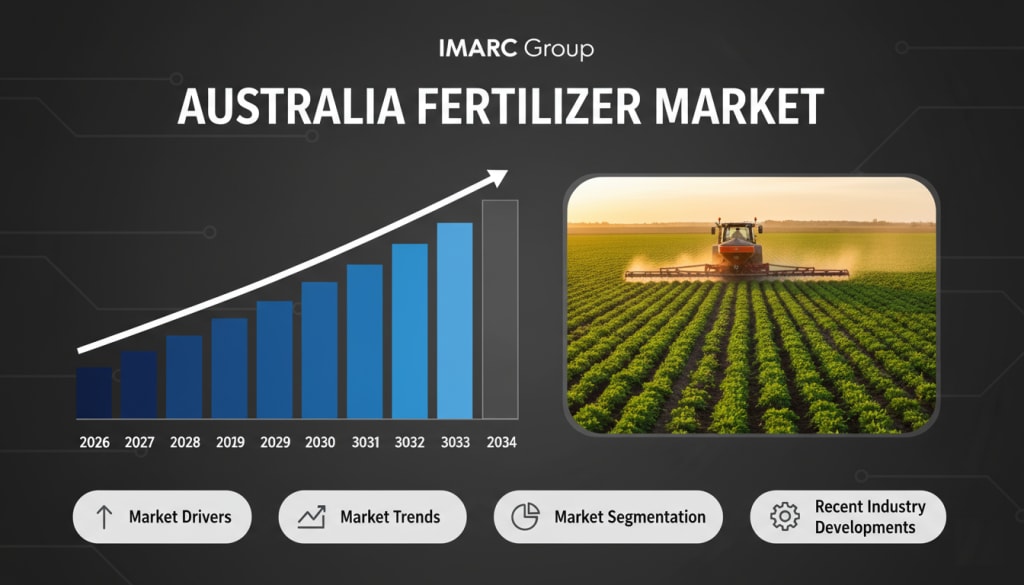
The Australia fertilizer market continues to grow as agricultural producers increasingly adopt nutrient management solutions to boost crop productivity and soil fertility. According to IMARC Group, the market reached USD 2.8 billion in 2025 and is expected to grow to USD 3.9 billion by 2034, exhibiting a compound annual growth rate (CAGR) of 3.43% during 2026–2034.
Fertilizers are essential inputs in Australia’s broad agricultural landscape, where grain, pulses, oilseeds, horticulture, and specialty crops are major contributors to both domestic food supply and export revenues. The market includes traditional chemical fertilizers as well as biofertilizers, and products are available in dry and liquid forms tailored to crop-specific nutrient requirements.
Why the Market Is Growing So Rapidly
1. Increasing Agricultural Production and Crop Diversification
Australia’s agriculture sector remains dynamic, with expansion in broadacre cropping — including wheat, barley, and canola — and diversification into high-value horticulture in regions such as Victoria, Queensland, and New South Wales. This broader crop mix intensifies the need for a range of fertilizers tailored to different nutrient demands, driving consistent uptake.
2. Addressing Soil Health Issues and Nutrient Deficiency
Large expanses of Australian agricultural soils — particularly in Western Australia and parts of the Northern Territory — are naturally low in essential elements like nitrogen, phosphorus, and potassium. Years of intensive farming without balanced replenishment have further accentuated nutrient deficits, compelling farmers to rely on fertilizers to maintain soil fertility and sustain yield levels.
Precision soil testing and agronomic guidance are increasingly guiding fertilizer choices, helping growers apply the right blends at optimal rates to improve outcomes and reduce waste.
3. Shift Toward Sustainable and Organic Fertilizer Solutions
Growing awareness of environmental impacts and the benefits of regenerative farming is encouraging the use of organic and bio-based fertilizers that promote soil structure and microbial health. These products, derived from animal or plant sources, supplement conventional fertilizers by enhancing nutrient availability while aligning with sustainability goals.
Biofertilizers — specialized microbial inoculants and organic amendments — are gaining traction as part of integrated soil health strategies, particularly in regions with established organic farming communities.
4. Emerging Precision Agriculture and Digital Fertilizer Management
Australian farmers are increasingly adopting precision agriculture solutions and digital tools that allow data-driven fertilizer application. Soil sensors, yield mapping, and satellite imagery help optimise nutrient use efficiency, aligning fertilizer input with crop needs more precisely and reducing environmentally harmful over-application.
These technologies not only improve productivity but also support sustainability objectives by minimising nutrient runoff and soil degradation.
5. Government Support and Agricultural Policy Initiatives
Federal and state-level government programs aimed at boosting agricultural productivity and climate resilience are incentivising best practices in fertilization. Through extension services, grants, and education initiatives, growers are encouraged to adopt efficient fertiliser use that enhances crop yields while preserving environmental quality.
What the Opportunities Are
1. Growth in Biofertilizer and Organic Inputs
As demand for sustainable farming intensifies, producers of organic and biofertilizer products can expand their portfolios and capture value in higher-growth segments of the market.
2. Advanced Controlled-Release and Specialty Fertilizers
Controlled-release formulations and specialty nutrient blends that improve efficiency and reduce environmental impact offer attractive opportunities for product innovation and higher margins.
3. Precision Fertilization Services and Digital Platforms
Technology providers offering precision nitrogen management, soil analysis tools, and application recommendation platforms can support growers with data-backed solutions that optimise input use and improve profitability.
4. Training and Agronomy Support Services
Educational and consulting services that help growers interpret soil tests, adopt sustainable fertilization regimes, and implement best practices are valuable additions that can strengthen customer relationships and outcomes.
5. Export Opportunities for Specialty Fertilizer Products
Australia’s reputation for quality agricultural produce opens avenues to export tailored fertilizers and nutrient solutions to markets with similar agronomic challenges in the Asia-Pacific region.
6. Climate-Smart Fertilizer Innovations
Products that enhance water-use efficiency, support drought tolerance, and reduce greenhouse gas emissions will attract growers navigating increasingly variable climatic conditions.
7. Strategic Collaborations Across the Value Chain
Partnerships between manufacturers, agritech firms, research institutions, and governments can accelerate the development and adoption of next-generation fertilizers and sustainable farming practices.
• March 2025: Government Agri-Innovation Funding: The Australian Government expanded funding for climate-smart agriculture, supporting initiatives that improve nutrient use efficiency and soil health through precision fertilizer application, restoration projects, and regenerative practices — helping farmers adopt modern fertilizer technologies seamlessly.
• July 2025: Industry Infrastructure Expansion: Agfert Fertilizers revealed plans to complete a new 20,000-tonne fertilizer storage and distribution facility on the Eyre Peninsula in South Australia ahead of the upcoming crop fertilization season. The expanded capacity will increase regional distribution efficiency and support broader adoption of fertilizer products across southern Australia.
• October 2025: Biofertilizer Market Momentum: Market analyses showed accelerated uptake of biofertilizer products in horticultural and organic farms, with year-on-year growth significantly outpacing traditional inputs as sustainability-oriented growers prioritise soil health and low-impact nutrient solutions.
Why Should You Know About the Australia Fertilizer Market?
The Australia fertilizer market matters because it underpins the productivity, sustainability, and competitiveness of the nation’s agriculture sector. A steady CAGR reflects ongoing demand from diverse cropping systems, from broadacre grains to high-value horticulture, and the interplay between conventional fertilizers and sustainable alternatives. For investors, the sector presents stable growth with opportunities tied to innovation in controlled-release and bio-based products. For agritech firms and service providers, precision agriculture and digital nutrient management represent growth areas. For policy makers, supporting efficient and environmentally responsible fertilization is crucial for food security, rural economic development, and climate resilience.
Understanding this market equips stakeholders with insights into how nutrient inputs, technological adoption, and sustainability trends will shape Australia’s agricultural productivity and environmental outcomes in the years ahead.
About the Creator
Rashi Sharma
I am a market researcher.
Keep reading
More stories from Rashi Sharma and writers in Trader and other communities.
Australia Electric Truck Market — Growth, Forecast & Strategic Outlook 2026–2034
The Australia electric truck market is emerging as a high-growth segment in response to rising sustainability commitments, government initiatives, and technological advancements. According to IMARC Group’s research, the market was valued at USD 21.4 million in 2025 and is projected to reach USD 152.4 million by 2034, expanding at a strong compound annual growth rate (CAGR) of 23.63% during 2026–2034.
By Rashi Sharma2 days ago in Trader
The Saddest Thing - The Billionaires Who Rule America Aren't Even Enjoying Themselves
This single post says more about our ruling class than a thousand policy papers. The saddest thing about today's system is that the men robbing the rest of us - sabotaging our economic prospects, our pensions, our access to affordable healthcare - are not even happy.
By Scott Christenson🌴7 days ago in The Swamp



Comments
There are no comments for this story
Be the first to respond and start the conversation.