
Refrigerated Transport Market Trends & Summary
Cold Chains, Hot Demand: Why Refrigerated Transport Is Becoming the Backbone of Global Trade

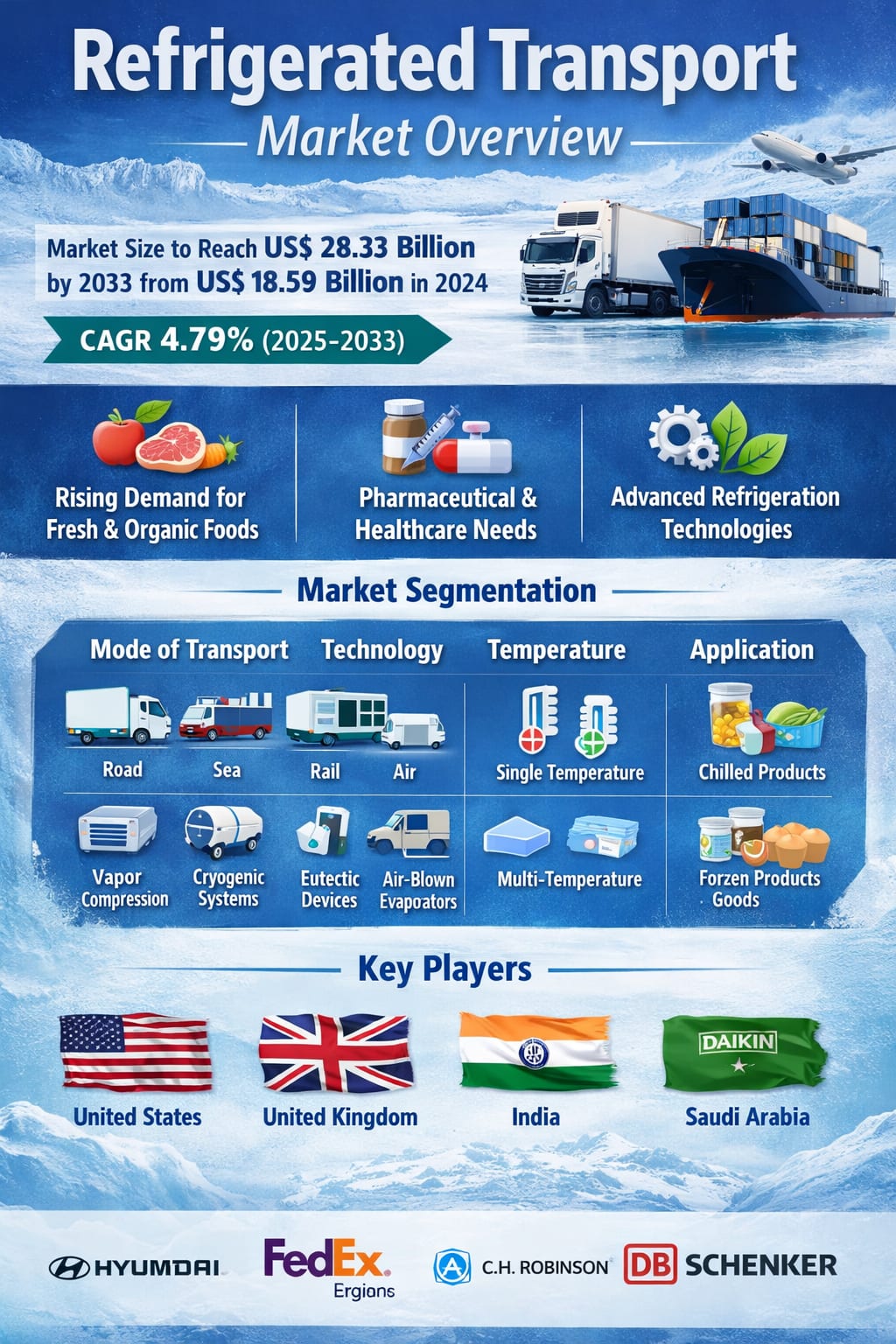
The global refrigerated transport market is entering a decisive growth phase as the world’s appetite for fresh food, frozen products, and temperature-sensitive medicines continues to rise. According to Renub Research, the Refrigerated Transport Market is expected to reach US$ 28.33 billion by 2033, up from US$ 18.59 billion in 2024, growing at a CAGR of 4.79% from 2025 to 2033.
Behind these numbers is a powerful mix of structural changes: consumers demanding fresher and safer food, governments tightening quality regulations, pharmaceutical supply chains becoming more temperature-sensitive, and logistics companies racing to modernize refrigeration technologies. Refrigerated transport—once a niche logistics function—has now become a strategic pillar of global trade.
At its core, refrigerated transport refers to the movement of perishable and temperature-sensitive goods using vehicles and containers equipped with controlled cooling systems. These systems maintain precise temperature ranges to ensure that products such as fruits, vegetables, meat, seafood, dairy products, vaccines, biologics, and specialty chemicals reach their destinations in safe, usable condition. In a globalized economy where products often travel thousands of kilometers before reaching consumers, this capability is no longer optional—it is essential.
The modern supply chain would simply not function without cold chain logistics. Supermarkets depend on it to stock fresh produce year-round. Hospitals rely on it to receive life-saving medicines and vaccines. Food processors and exporters need it to access distant markets without compromising quality. As trade liberalization continues and cross-border commerce in perishables expands, refrigerated transport is increasingly seen not just as a cost center, but as a competitive advantage.
A Market Powered by Food, Health, and Technology
One of the strongest drivers of the refrigerated transport market is the continued expansion of the global food and beverage industry. Population growth, urbanization, and rising disposable incomes—especially in emerging economies—are reshaping consumption patterns. Consumers are buying more fresh produce, more frozen foods, more ready-to-eat meals, and more premium products such as organic vegetables and hormone-free meat. All of these categories depend heavily on reliable temperature-controlled logistics.
At the same time, international food trade is growing. Countries are importing and exporting perishables on an unprecedented scale, making refrigerated road, sea, rail, and air transport indispensable. To meet strict safety and quality standards, logistics providers must invest in advanced refrigeration systems that can maintain consistent temperatures across long distances and complex routes.
Technology is another major force reshaping the market. Advances in refrigeration systems have made it possible to control not just temperature, but also humidity and air circulation with far greater precision. Modern units are also far more energy-efficient than older models, helping companies reduce fuel costs and carbon emissions at the same time.
A notable example of innovation came in February 2023, when researchers at Lawrence Berkeley National Laboratory introduced ionocaloric cooling, a novel refrigeration approach that could offer an alternative to traditional vapor compression systems. By using energy stored or released during phase changes, this method has the potential to reduce dependence on climate-damaging refrigerant gases. While still in development, such breakthroughs highlight how the refrigeration sector is actively searching for cleaner and more sustainable solutions.
Growth Drivers Shaping the Refrigerated Transport Market
Rising Demand from Pharmaceuticals and Healthcare
Beyond food, the pharmaceutical and healthcare sectors are becoming increasingly important customers for refrigerated transport services. The global population is aging, and the prevalence of chronic diseases is rising. This has led to growing demand for temperature-sensitive products such as vaccines, insulin, biologics, and specialty drugs.
The COVID-19 pandemic dramatically underscored the importance of reliable cold chain logistics. The global distribution of vaccines and critical medical supplies showed that even small temperature deviations can render products ineffective. As a result, hospitals, pharmacies, and healthcare distributors are now far more focused on ensuring strict temperature control throughout the transportation process.
This trend is expected to continue. As more advanced biologic drugs and personalized medicines enter the market, the need for precise and dependable refrigerated transport will only intensify, further strengthening long-term demand.
Technological Advancements in Refrigeration Systems
Technology is pushing the refrigerated transport industry to new performance levels. The shift toward electric and solar-powered refrigeration units is helping reduce dependence on diesel-powered systems, cutting both operating costs and environmental impact.
At the same time, smart logistics technologies are transforming how cold chains are managed. Real-time monitoring systems now allow operators to track temperature, humidity, and vehicle location throughout the journey. If something goes wrong, corrective action can be taken immediately, reducing the risk of spoilage or product loss.
Automation, predictive maintenance, and data analytics are also becoming more common. These tools help optimize routes, anticipate equipment failures, and improve overall fleet efficiency. The result is not just better product safety, but also more cost-effective and reliable operations.
Stricter Quality Standards and Regulatory Compliance
Consumer awareness around food safety and drug quality has never been higher. Governments and regulatory authorities around the world have responded by tightening rules on how temperature-sensitive goods are handled, stored, and transported.
Compliance with these regulations is no longer optional—it is a basic requirement for doing business. This has significantly increased demand for high-standard refrigerated transport services equipped with technologies such as GPS tracking, real-time temperature logging, and data reporting systems.
For companies, meeting these standards does more than avoid fines or penalties. It builds trust with customers, protects brand reputation, and reduces losses caused by spoilage or contamination. In this sense, regulatory pressure is not just a challenge—it is also a catalyst for modernization and market growth.
Key Challenges Facing the Industry
Energy Efficiency and Environmental Concerns
Refrigerated transport is energy-intensive by nature, especially when older refrigeration units are still in use. High fuel consumption translates into higher operating costs and greater carbon emissions. As sustainability becomes a central concern for governments, investors, and consumers, the industry is under increasing pressure to adopt greener solutions.
Many companies are now exploring natural refrigerants, electric-powered units, and energy-saving technologies. While these solutions promise long-term benefits, they often require significant upfront investment. Balancing cost, performance, and environmental responsibility remains one of the sector’s biggest strategic challenges.
The Complexity of Maintaining Temperature Control
In cold chain logistics, consistency is everything. Even small temperature fluctuations can damage products, especially in the case of pharmaceuticals or high-value food items. This makes continuous monitoring and precise control absolutely critical.
To manage this risk, companies must invest in advanced sensors, tracking systems, and maintenance programs. They also need well-trained staff and robust operational procedures. Any failure can lead not only to financial losses, but also to regulatory penalties and reputational damage. In a market where trust is paramount, temperature control is both a technical and a strategic priority.
Regional Market Perspectives
United States Refrigerated Transport Market
The United States represents one of the most mature and dynamic refrigerated transport markets in the world. Demand is being driven by the growing consumption of fresh and frozen foods, the expansion of e-commerce grocery delivery, and the steady rise in pharmaceutical shipments.
Technological innovation plays a major role, with companies investing heavily in energy-efficient units and real-time monitoring systems to improve performance and reduce costs. However, challenges such as high energy consumption, environmental concerns, and complex regulatory requirements—particularly around food safety—continue to shape market strategies. Despite these hurdles, the U.S. market is expected to maintain steady growth, supported by strong logistics infrastructure and high demand for temperature-sensitive goods.
United Kingdom Refrigerated Transport Market
In the UK, the refrigerated transport market is growing steadily, driven by consumer preferences for convenience, freshness, and food quality. The rise of online grocery shopping and home delivery services has further increased the need for reliable cold chain logistics.
Companies are increasingly adopting energy-efficient refrigeration systems and advanced temperature monitoring tools to improve both sustainability and reliability. At the same time, strict food safety regulations and environmental targets are pushing the industry toward greener technologies. The UK market is likely to see continued investment in sustainable solutions as companies align with both regulatory requirements and consumer expectations.
India Refrigerated Transport Market
India’s refrigerated transport market is expanding rapidly, supported by rising demand for fresh food, dairy products, meat, and pharmaceuticals. The growth of the middle class and changing consumption habits are creating new opportunities for cold chain logistics across the country.
Government initiatives focused on infrastructure development, including cold storage networks and logistics corridors, are also playing a key role. However, challenges remain, particularly in rural areas where infrastructure gaps and inconsistent temperature control can limit efficiency. Even so, the adoption of energy-efficient systems and real-time tracking technologies is helping improve performance and reliability, setting the stage for long-term growth.
Saudi Arabia Refrigerated Transport Market
Saudi Arabia’s refrigerated transport market is being fueled by expanding retail, foodservice, and e-commerce sectors, along with the country’s strategic role as a regional trade hub. Demand for temperature-controlled logistics is rising for food, pharmaceuticals, and chemicals alike.
The main challenges include high energy costs, equipment maintenance, and the need to maintain stable temperatures over long distances in harsh climatic conditions. Still, ongoing investments in infrastructure and logistics modernization, combined with technological upgrades in refrigeration systems, are supporting steady market expansion.
Market Segmentation Snapshot
According to Renub Research, the Refrigerated Transport Market is segmented as follows:
By Mode of Transportation:
Refrigerated Road Transport
Refrigerated Sea Transport
Refrigerated Rail Transport
Refrigerated Air Transport
By Technology:
Vapor Compression Systems
Air-Blown Evaporators
Eutectic Devices
Cryogenic Systems
By Temperature:
Single Temperature
Multi-Temperature
By Application:
Chilled Food Products
Frozen Food Products
Others
By Country (25 Markets):
North America (United States, Canada)
Europe (France, Germany, Italy, Spain, United Kingdom, Belgium, Netherlands, Turkey)
Asia Pacific (China, Japan, India, Australia, South Korea, Thailand, Malaysia, Indonesia, New Zealand)
Latin America (Brazil, Mexico, Argentina)
Middle East & Africa (South Africa, Saudi Arabia, UAE)
Competitive Landscape and Key Players
Renub Research’s analysis covers leading companies from five viewpoints: overview, key persons, recent developments and strategies, product portfolio, and financial insights. Major players include:
Hyundai Motor Company
Singamas Container Holdings Limited
General Mills Inc.
LAMBERET SAS
United Technologies Corporation
C. H. Robinson Worldwide, Inc.
Daikin Industries Limited
FedEx Corporate Services, Inc.
DB Schenker AG
Ingersoll Rand Inc
Krone Commercial Vehicle Group
These companies are competing not only on scale and network reach, but also on technology, sustainability, and service reliability. Investments in smarter refrigeration systems, cleaner energy solutions, and digital monitoring platforms are becoming key differentiators in an increasingly competitive market.
Final Thoughts
The refrigerated transport market is no longer just a support function within global logistics—it is a strategic enabler of modern trade, healthcare, and food security. With the market projected to grow from US$ 18.59 billion in 2024 to US$ 28.33 billion by 2033, at a CAGR of 4.79%, the direction is clear: cold chains are becoming hotter business than ever.
Driven by rising demand for fresh food, expanding pharmaceutical needs, stricter regulations, and rapid technological innovation, the industry is evolving toward smarter, greener, and more reliable solutions. While challenges around energy use and temperature control remain, they are also pushing the sector toward much-needed modernization.
About the Creator
Cardiac Mapping Market Size to Surpass USD 4.02 Billion by 2033 | At CAGR 8.60%
Overview – Cardiac Mapping Market Cardiac mapping refers to advanced diagnostic techniques used to analyze the electrical activity of the heart to detect arrhythmias and other cardiac abnormalities. These technologies play a critical role in guiding electrophysiology procedures, improving procedural accuracy, and enhancing patient outcomes. The market includes electroanatomical mapping systems, contact and non-contact mapping technologies, and advanced mapping catheters.
By James Smithabout 7 hours ago in Trader
Feelings Never Die
It is Valentine's Day again, and it bought back memories that were over fifty years old. It bought me back to 1971, and I woke up and I knew my baby was due today. I was big and pregnant, and I felt like I was about to burst wide open. Imagine my surprise when the doctor told my I had a due date of February 14. I couldn't believe it, and since my baby was due today, I felt I could indulge myself a bit. I had gained a lot of weight, and chocolate was on the no-no list, but I had came to the end of this pregnancy, and I hoped it would be okay, after all I would deliver this baby today. So I walked across the street to the grocery story, and bought myself, a peppermint patty, covered in chocolate, my favorite. Me and my Valentine's baby would enjoy it together.
By Susan Payton7 days ago in Fiction


Comments
There are no comments for this story
Be the first to respond and start the conversation.