
Asia Pacific Vegetable Seeds Market Size and Forecast 2025–2033
Hybrid adoption, protected cultivation, and food security policies reshape the future of seed innovation across Asia-Pacific

Introduction
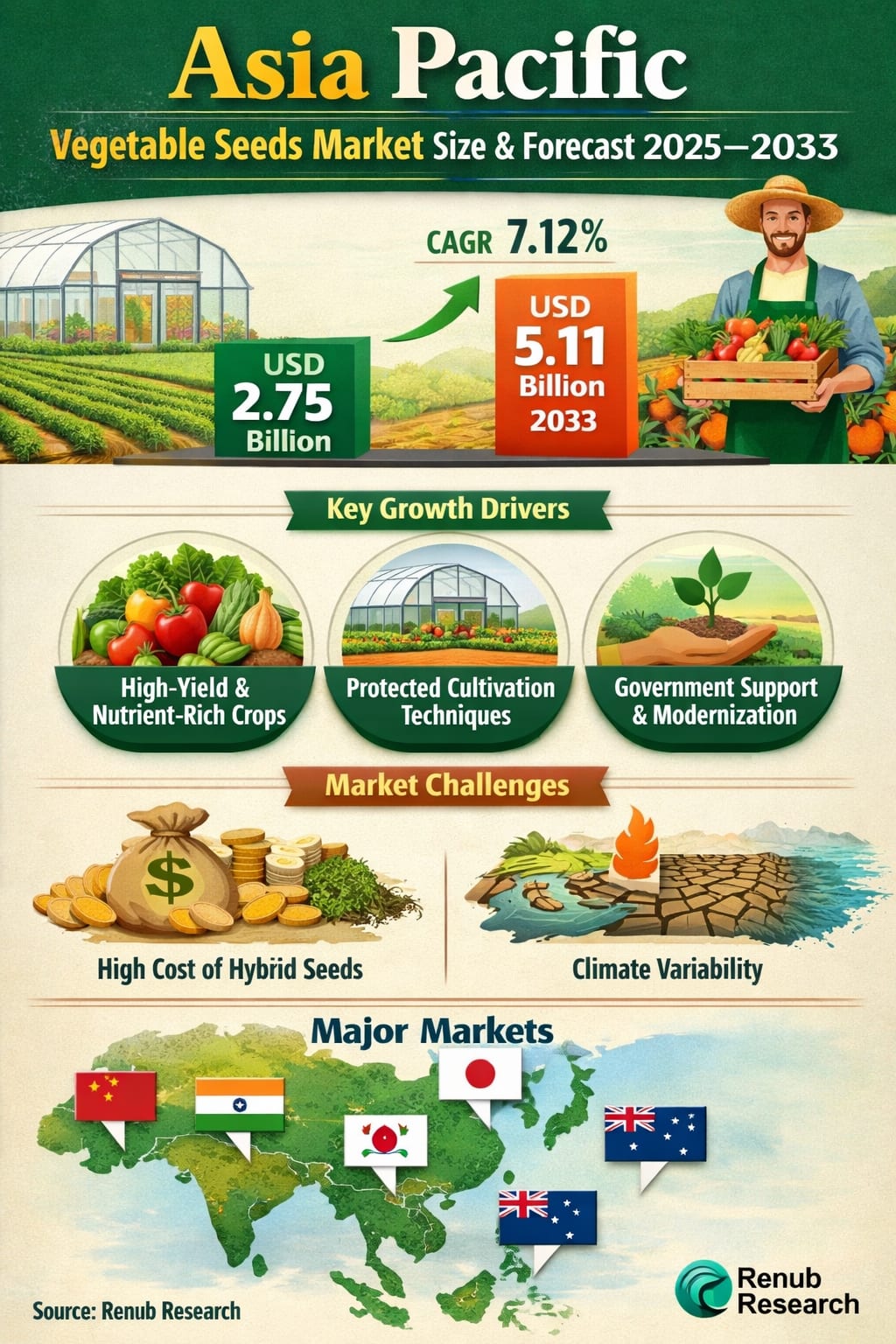
The Asia Pacific vegetable seeds market is entering a decisive growth phase as governments, farmers, and agribusiness companies across the region increasingly focus on productivity, food security, and climate-resilient agriculture. According to Renub Research, the Asia Pacific Vegetable Seeds Market was valued at USD 2.75 billion in 2024 and is projected to reach USD 5.11 billion by 2033, expanding at a CAGR of 7.12% during 2025–2033.
This growth trajectory reflects more than just rising seed sales. It signals a broader transformation in how vegetables are cultivated across the region—from traditional open-field farming to protected cultivation systems, and from saved seeds to high-performance hybrids and improved varieties. The shift is being driven by population growth, rapid urbanization, changing food habits, and strong policy support for modern agriculture in major economies such as China, India, Japan, and Southeast Asian nations.
Vegetable seeds form the backbone of horticulture, enabling the cultivation of essential crops such as tomatoes, cucumbers, peppers, carrots, spinach, and gourds. In Asia Pacific, where vegetables are central to daily diets and smallholder farming remains widespread, the quality, performance, and availability of seeds play a critical role in determining farm incomes, food supply stability, and export competitiveness.
Market Overview: The Backbone of Asia-Pacific Horticulture
Vegetable seeds can broadly be categorized into open-pollinated varieties, hybrids, and genetically improved seeds, each offering different benefits in terms of yield, uniformity, disease resistance, and adaptability to local conditions. While open-pollinated seeds remain important in cost-sensitive markets, hybrid seeds are increasingly gaining ground due to their superior productivity and consistency.
Across the Asia Pacific region, vegetable seeds are essential not only for large-scale commercial farms but also for millions of smallholder and household growers. Rising population levels, increasing urbanization, and growing demand for fresh and processed vegetables are pushing governments and private players to invest heavily in seed quality and distribution systems.
Countries such as China, India, and Vietnam are actively promoting the use of certified and hybrid seeds to improve yields and enhance farmer incomes. At the same time, the rapid expansion of protected cultivation—including greenhouses, polyhouses, and shade-net systems—is creating fresh demand for specialized seed varieties that can perform well in controlled environments. Better logistics, organized retail, and digital agri-platforms are further improving farmers’ access to high-quality seeds, strengthening the overall market ecosystem.
Key Growth Drivers
Rising Demand for High-Yield and Nutrient-Rich Vegetables
Consumer awareness around health, nutrition, and food quality is rising sharply across Asia Pacific, particularly in urban and semi-urban areas. This is translating into higher demand for vegetables that are not only abundant but also rich in nutrients and consistent in quality.
To meet this demand, farmers are increasingly turning to high-yielding and improved seed varieties, especially hybrids, which allow them to produce more output from limited land resources. This is particularly important in densely populated countries where arable land per capita is shrinking. Hybrid seeds help improve farm profitability, stabilize supply, and support regional food security goals.
The growing importance of the seed industry is also reflected in regional collaboration and industry events. In December 2024, the Asia and Pacific Seed Alliance (APSA) and the China National Seed Trade Association (CNSTA) announced the 29th Asian Seed Congress in Sanya, highlighting the region’s increasing focus on innovation, cooperation, and long-term seed sector development.
Expansion of Protected Cultivation Techniques
Protected cultivation is rapidly gaining momentum across countries such as China, India, Vietnam, Japan, and South Korea. Greenhouses, polyhouses, and shade-net structures help farmers reduce weather-related risks, improve crop quality, and achieve year-round production.
These systems require specialized vegetable seed varieties designed for controlled environments, with traits such as compact growth, uniform fruiting, heat tolerance, and disease resistance. As a result, seed companies are increasingly investing in breeding programs tailored specifically for protected cultivation.
The growing importance of modern horticulture technologies is also evident in industry exhibitions and trade fairs. For example, AGRITECHNICA ASIA, scheduled to be held in Vietnam in March 2025 alongside HortEx, is expected to showcase solutions for major crops, including vegetables, reinforcing the region’s push toward technology-driven agriculture.
Government Support and Agricultural Modernization
Governments across Asia Pacific are playing a crucial role in shaping the vegetable seeds market through subsidies, rural development programs, technology transfer initiatives, and support for research and development. Many countries are actively promoting the use of improved and hybrid seeds as part of broader strategies to enhance productivity, reduce import dependence, and strengthen food security.
Public-private partnerships are becoming more common, helping accelerate the development and distribution of better-performing seed varieties. In February 2025, Indonesia signaled a stronger push toward modern agricultural technologies, including genetic engineering, to address food security and climate challenges—an example of how policy direction is increasingly aligned with innovation in the seed sector.
Key Challenges Facing the Market
High Cost of Hybrid and Genetically Improved Seeds
Despite their clear benefits, hybrid and biotech seeds remain expensive, especially for small and marginal farmers in developing economies. Unlike open-pollinated varieties, hybrid seeds generally need to be purchased every season, which increases input costs and limits adoption among resource-constrained growers.
This price sensitivity means that, in many rural areas, farmers continue to rely on traditional or lower-cost seeds, slowing the overall penetration of advanced seed technologies. Addressing affordability through better financing, subsidies, and local production will be essential for sustained market expansion.
Climatic Variability and Crop Vulnerability
Asia Pacific is highly exposed to climate risks, including floods, droughts, heatwaves, and unpredictable rainfall patterns. These factors directly affect crop performance and seed viability, making farm planning more complex and increasing the risk of crop losses.
For seed companies, this creates continuous pressure to invest in climate-resilient and stress-tolerant varieties, which raises research and development costs. While innovation in this area is progressing, climatic uncertainty remains a structural challenge for the region’s vegetable seed industry.
Segment Insights
Hybrid Vegetable Seeds: Driving Productivity Gains
Hybrid seeds are steadily gaining prominence across Asia Pacific due to their higher yields, better disease resistance, and improved adaptability to different growing conditions. Major agricultural economies such as China and India are investing heavily in hybrid technologies to boost domestic production and improve farmer incomes.
These seeds are suitable for both open-field and protected cultivation and support faster crop cycles, making them particularly attractive for commercial vegetable farming. As profitability from hybrid crops increases, adoption rates among progressive farmers continue to rise.
Cucurbit Seeds: Strong Demand for Tropical Staples
Cucurbit crops—including cucumbers, melons, and gourds—are widely grown across the region, especially in China, India, and Thailand. Their natural adaptability to tropical and subtropical climates makes them a priority segment for seed breeders.
Rising consumption of cucurbits in both fresh and processed forms is fueling demand for high-quality, pest-resistant, and disease-tolerant seed varieties, strengthening this segment’s contribution to overall market growth.
Solanaceae Seeds: Core of Asian Diets and Exports
Solanaceae crops such as tomatoes, peppers, and eggplants are staples in Asian cuisine and key export products for several countries. Demand for these seeds is rising alongside urbanization, changing diets, and the expansion of greenhouse farming, particularly for tomatoes and capsicums.
Hybrid and disease-resistant solanaceae seeds are seeing strong uptake, driven by the need for consistent quality, higher yields, and better shelf life in both domestic and export markets.
Protected vs. Open Field Cultivation
The protected cultivation segment is expanding rapidly, supported by investments in greenhouses and controlled-environment farming. Seeds designed for these systems are bred for specific traits such as compact growth, heat tolerance, and efficient nutrient use.
At the same time, open-field cultivation remains the dominant farming method across much of Asia Pacific, particularly in rural areas. Demand here is driven by cost-effective, resilient seed varieties that can withstand climatic stress while delivering stable yields. Both open-pollinated and hybrid seeds continue to play vital roles in this segment.
Country-Level Outlook
China
China is the world’s largest producer and consumer of vegetables, making it a cornerstone of the Asia Pacific vegetable seeds market. Strong government support for seed technology, large-scale greenhouse farming, and a well-developed domestic seed industry are key growth drivers. Hybrid adoption rates are high, and demand for quality seeds continues to rise alongside exports and domestic consumption.
Japan
Japan’s market is highly specialized, shaped by advanced greenhouse farming, limited arable land, and strong consumer demand for premium produce. The country relies on both imports and domestic breeding programs, with a strong focus on high-performance hybrid seeds. Productivity, technology integration, and precision farming are central to market growth.
India
India is one of the fastest-growing vegetable seeds markets in the region. A large agricultural workforce, diverse climatic zones, and rising demand for fresh vegetables are driving seed adoption. The government’s National Mission on High-Yielding Seeds, announced in the 2025–26 Union Budget, aims to boost research and expand access to climate- and pest-resistant varieties, further strengthening the market outlook.
South Korea
South Korea’s market is influenced by advanced farming practices, strong demand for quality produce, and a growing focus on indoor and vertical farming. Leafy greens, peppers, and tomatoes are key crops, and the push for self-reliance in seed production is encouraging investment in domestic breeding programs.
Australia
Australia’s vegetable seed industry is export-oriented and technology-driven, with strong emphasis on disease resistance, drought tolerance, and sustainability. Farmers are increasingly adopting hybrid and organic seed varieties to meet both domestic and international standards, supported by robust R&D and biosecurity frameworks.
Competitive Landscape
The Asia Pacific vegetable seeds market is highly competitive, with both global giants and regional players активно investing in research, breeding, and distribution. Key companies covered in the market include:
Bayer AG
Syngenta AG / Syngenta Group
Groupe Limagrain
Sakata Seed Corporation
Gansu Dunhuang Seed Co. Ltd.
JK Agri Genetics Ltd.
BASF SE
Bejo Zaden BV
Corteva Agriscience
These companies compete on the basis of product innovation, regional adaptability, distribution reach, and farmer support services, with a strong focus on developing climate-resilient and high-yielding varieties.
Final Thoughts
The Asia Pacific vegetable seeds market is clearly on a strong growth path, underpinned by rising food demand, expanding protected cultivation, and supportive government policies. With the market expected to grow from USD 2.75 billion in 2024 to USD 5.11 billion by 2033 at a CAGR of 7.12%, seeds are set to play an even more strategic role in shaping the region’s agricultural future.
While challenges such as high seed costs and climatic uncertainty remain, ongoing innovation, policy support, and increasing farmer awareness are steadily transforming the sector. In the coming decade, vegetable seeds will not just be an agricultural input in Asia Pacific—they will be a critical driver of productivity, sustainability, and food security across one of the world’s most dynamic regions.
About the Creator
Australia Veterinary Market — Growth, Forecast & Strategic Outlook 2026–2034
The Australia veterinary market is experiencing strong growth as animal healthcare and services expand across both companion and production animals. According to IMARC Group, the market reached USD 2.1 billion in 2025 and is projected to grow to USD 4.9 billion by 2034, exhibiting a compound annual growth rate (CAGR) of 9.60% during 2026–2034.
By Amélie Belle3 days ago in Trader




Comments
There are no comments for this story
Be the first to respond and start the conversation.