
Asia Pacific LIDAR Market Size and Forecast 2025–2033
Smart Mobility, Infrastructure Digitization, and Autonomous Systems Power a High-Growth Decade for LIDAR Across Asia Pacific

Asia Pacific LIDAR Market Outlook
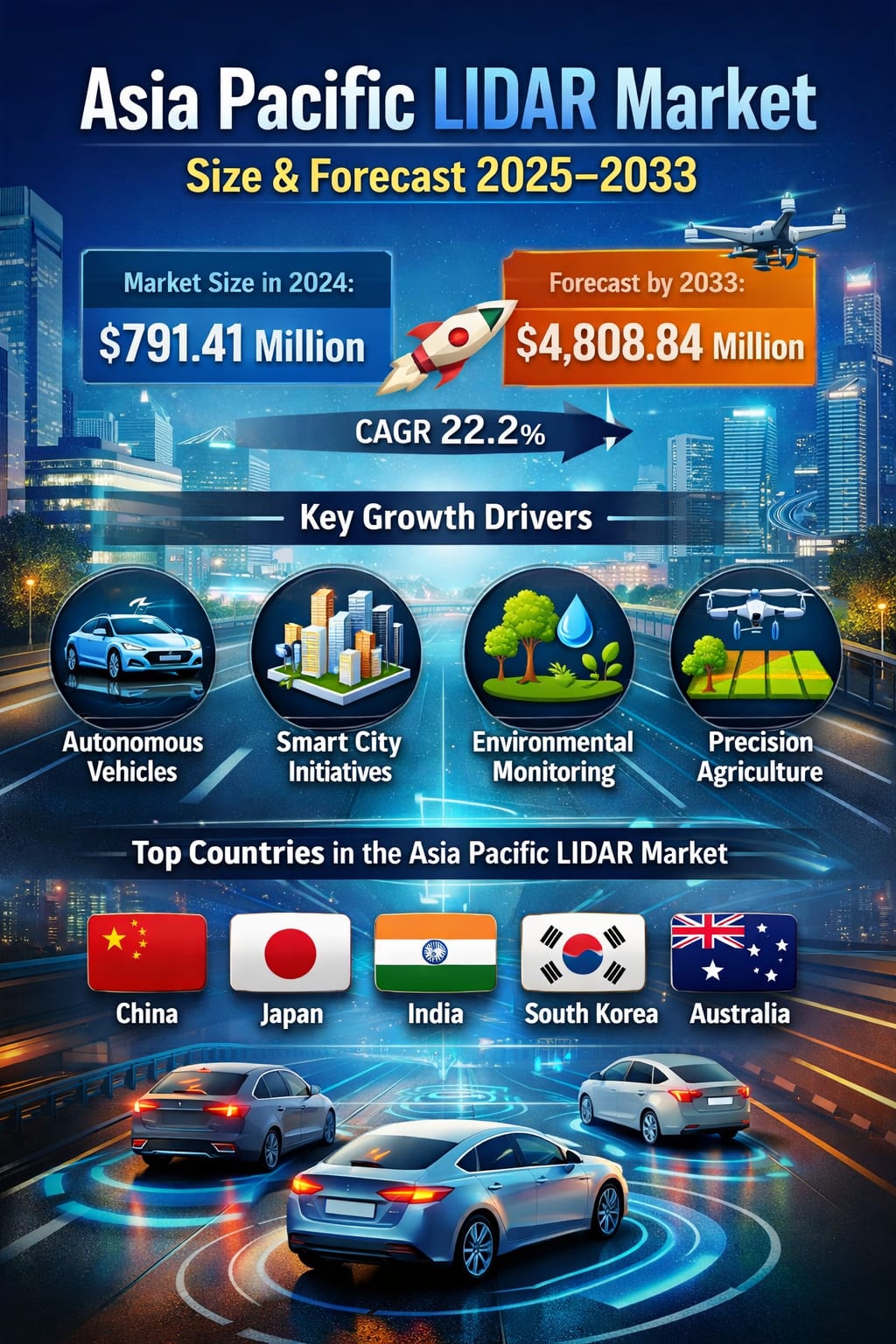
The Asia Pacific LIDAR market is entering a decisive growth phase, driven by rapid advances in autonomous mobility, smart infrastructure, environmental monitoring, and industrial automation. The market size was valued at USD 791.41 million in 2024 and is projected to reach USD 4,808.84 million by 2033, expanding at a robust CAGR of 22.2% from 2025 to 2033.
This surge reflects a broader regional shift toward data-driven planning, intelligent transportation systems, and high-precision mapping technologies. Governments, enterprises, and research institutions across China, Japan, India, South Korea, and Australia are increasingly relying on LIDAR (Light Detection and Ranging) to capture accurate, real-time, three-dimensional spatial data for applications ranging from self-driving vehicles to climate resilience planning.
LIDAR works by emitting laser pulses toward a target and measuring the time it takes for the reflected light to return. This simple principle enables extremely precise distance measurements and the creation of detailed 3D models of terrain, infrastructure, vegetation, and urban environments. Compared with traditional surveying or camera-based systems, LIDAR offers superior accuracy, depth perception, and reliability in complex or low-light conditions—making it a cornerstone technology for next-generation digital ecosystems.
Across Asia Pacific, rising investments in smart cities, transportation modernization, and digital twins are steadily turning LIDAR from a specialized tool into a mainstream technology platform.
Key Growth Drivers in the Asia Pacific LIDAR Market
Rising Adoption of Autonomous and Connected Vehicles
One of the strongest growth engines for the LIDAR market in Asia Pacific is the accelerating adoption of autonomous and semi-autonomous vehicles. LIDAR sensors provide real-time, high-resolution 3D perception, allowing vehicles to detect obstacles, map surroundings, and navigate safely in complex traffic environments.
China, Japan, and South Korea are investing heavily in intelligent mobility ecosystems, supported by policy initiatives, 5G deployment, and AI-driven transport systems. Automakers and technology companies are increasingly integrating LIDAR into advanced driver assistance systems (ADAS) and self-driving prototypes to improve safety, redundancy, and situational awareness.
A notable milestone came in April 2025, when Hesai Technology announced that its LIDAR solution would power WeRide’s autonomous vehicles on Uber’s platform in Dubai under the city’s 2030 smart mobility plan—highlighting the growing global footprint of Asia-based LIDAR suppliers and the strategic importance of this technology in autonomous transportation.
Smart City and Infrastructure Development Initiatives
Smart city development is another major catalyst for LIDAR adoption across the region. Governments are using LIDAR for 3D city modeling, urban planning, traffic management, and infrastructure inspection. Countries such as India, Singapore, China, and Japan are increasingly relying on geospatial intelligence to optimize land use, improve public safety, and enhance infrastructure resilience.
Large-scale projects often combine LIDAR data with GIS platforms and digital twin models, enabling planners to simulate urban growth, assess structural risks, and monitor assets in real time. Public–private partnerships are accelerating the deployment of these systems, making LIDAR a foundational technology for modern urban governance.
In January 2025, China State Construction Engineering Corporation (CSCEC) inaugurated the Advanced Attosecond Laser Infrastructure initiative, including a major facility in Guangdong Province. While focused on high-end laser research, this development underscores the region’s deepening investment in advanced photonics and laser-based technologies, which also supports innovation in the broader LIDAR ecosystem.
Environmental Monitoring and Precision Agriculture
Environmental sustainability and food security are becoming strategic priorities across Asia Pacific, and LIDAR plays a growing role in both. Governments and environmental agencies use LIDAR for flood modeling, forest canopy analysis, coastal monitoring, and disaster risk assessment. Its ability to generate highly accurate elevation and vegetation data makes it invaluable for climate adaptation strategies.
In agriculture, LIDAR supports precision farming by enabling detailed field mapping, crop health assessment, and optimized irrigation planning. Countries such as Australia and China are investing in land-use monitoring and climate data collection, where LIDAR provides unmatched accuracy and consistency.
In September 2023, Terra Drone Corporation strengthened its presence in precision agriculture by acquiring Avirtech, a Southeast Asia-based startup specializing in agricultural drone spraying and mapping—highlighting how LIDAR-enabled drones are becoming central to modern farming practices in the region.
Challenges Facing the Asia Pacific LIDAR Market
High Equipment and Deployment Costs
Despite strong growth potential, LIDAR systems remain relatively expensive due to the cost of key components such as lasers, sensors, inertial navigation systems, and GPS modules. Integration, calibration, and data processing also add to total project costs. For smaller enterprises and budget-constrained public agencies, these expenses can slow adoption, particularly outside the automotive sector.
Although ongoing innovation and manufacturing scale—especially in China—are gradually reducing costs, affordability remains a barrier to mass deployment in several developing markets across the region.
Regulatory and Technical Constraints
Regulatory fragmentation is another challenge. Different countries maintain varying rules on drone operations, data collection, and the use of LIDAR in public spaces, which can delay projects and increase compliance complexity.
On the technical side, adverse weather conditions such as heavy rain, fog, or dust can affect LIDAR performance. In addition, some markets still face shortages of skilled professionals capable of handling large-scale point cloud data processing and analysis, limiting the speed of adoption in advanced applications.
Segment Insights: Where Growth Is Concentrated
Terrestrial LIDAR
Terrestrial LIDAR is gaining strong traction in construction, mining, forestry, and heritage conservation. It is widely used for land surveying, building modeling, tunnel inspection, and archaeological documentation. In countries such as India, Japan, and Malaysia, expanding infrastructure projects and conservation efforts are driving demand for high-resolution, ground-based scanning solutions.
LASER LIDAR Systems
Laser-based LIDAR systems dominate applications in transportation, defense, aerospace, and robotics. Their ability to deliver fast, precise spatial data in dynamic environments makes them ideal for autonomous vehicles, airport security, and advanced surveillance systems. With ongoing miniaturization and AI integration, laser LIDAR is expected to remain at the core of real-time perception technologies.
Corridor Mapping
Corridor mapping is a critical application for highways, railways, pipelines, and power transmission lines. Asia Pacific’s massive investment in connectivity infrastructure—particularly in China, Vietnam, and Southeast Asia—is driving demand for aerial and mobile LIDAR systems that can rapidly survey long, narrow routes with high accuracy, reducing project risks and planning errors.
3D LIDAR
3D LIDAR is transforming urban planning, defense simulation, robotics, and digital twin development. Japan and Singapore are at the forefront, using 3D LIDAR for city modeling and autonomous navigation. As interest in spatial computing, AR/VR, and immersive simulations grows, 3D LIDAR is set to become a cornerstone of the region’s spatial intelligence economy.
Medium-Range LIDAR
Medium-range LIDAR strikes a balance between range and resolution, making it ideal for robotics, drones, industrial automation, and smart logistics. Manufacturing hubs in China and South Korea are increasingly using LIDAR-guided robots for warehouse automation and factory operations, while agriculture and logistics sectors adopt these sensors for navigation and terrain scanning.
Country-Level Market Dynamics
China
China is the largest LIDAR market in Asia Pacific, supported by its booming autonomous vehicle industry, smart city programs, and strong manufacturing base. The country is also a global production hub for LIDAR components, enabling cost advantages and rapid innovation. In March 2025, Leapmotor began pre-selling its B10 SUV—its first model equipped with LIDAR—at a highly competitive price point, signaling the growing commercialization of LIDAR in mass-market vehicles.
Japan
Japan’s LIDAR market is driven by automotive innovation, robotics, and disaster management. Leading automakers and technology firms are integrating LIDAR into next-generation mobility platforms, while government agencies use it for earthquake monitoring and urban resilience planning. In January 2024, Kudan Inc. announced the integration of its Lidar SLAM technology into Terra Lidar Dual, further strengthening Japan’s position in high-precision mapping solutions.
India
India’s LIDAR market is expanding steadily, supported by smart city initiatives, infrastructure modernization, and digital agriculture. Government programs focused on urban planning, forestry management, and flood risk assessment are boosting demand for high-resolution spatial data. In July 2024, ideaForge Technology partnered with Inertial Labs to integrate advanced LIDAR solutions into high-performance drones, pushing the boundaries of UAV-based mapping in India.
South Korea
South Korea is emerging as a key LIDAR hub, driven by its strengths in electronics, automotive technology, and smart manufacturing. The country’s push toward Industry 4.0, intelligent logistics, and autonomous mobility is accelerating LIDAR adoption across industrial and defense applications. In February 2025, Northrop Grumman and Hanwha signed an agreement related to the Airborne Laser Mine Detection System, highlighting LIDAR’s strategic role in defense technologies.
Australia
Australia’s LIDAR market is shaped by environmental monitoring, mining, and geospatial surveying needs. The technology is widely used for coastline management, bushfire risk assessment, and agricultural mapping. In April 2025, Aerometrex Limited secured a LIDAR contract with the Queensland Government to capture high-accuracy airborne data, reflecting the growing importance of LIDAR in public sector planning and resource management.
Competitive Landscape
The Asia Pacific LIDAR market features a mix of global technology leaders and innovative regional players. Key companies include Faro Technologies Inc., Teledyne Technologies Inc., Hexagon AB, Vaisala Oyj, Innoviz Technologies Ltd., Denso Corporation, Hesai Technology, and Benewake. These firms compete on technology performance, cost efficiency, miniaturization, and integration with AI and software platforms, while expanding their footprints across automotive, infrastructure, and industrial applications.
Final Thoughts
The Asia Pacific LIDAR market is entering a high-growth era, fueled by the convergence of autonomous mobility, smart infrastructure, environmental intelligence, and industrial automation. From USD 791.41 million in 2024 to a projected USD 4,808.84 million by 2033, the market’s rapid expansion at a 22.2% CAGR reflects how essential spatial data and real-time perception have become to the region’s digital future.
While challenges around cost, regulation, and technical complexity remain, continuous innovation, government support, and large-scale infrastructure programs are steadily lowering barriers to adoption. As Asia Pacific accelerates toward smarter cities, safer transportation, and more sustainable land management, LIDAR is set to evolve from a specialized sensing tool into a foundational technology powering the region’s next wave of economic and technological transformation.
About the Creator
Philippines Telemedicine Market 2026: Set to Surge to USD 8,240.5 Million by 2034 on Digital Health Expansion
Philippines Telemedicine Market Overview The Philippines telemedicine market size is rapidly transforming healthcare delivery in the archipelago, driven by rising healthcare demand, improved digital infrastructure, and consumer preference for convenient, remote care solutions. According to the latest IMARC Group research, the market reached USD 2,141.8 million in 2025 and is forecast to grow to USD 8,240.5 million by 2034, expanding at a compound annual growth rate (CAGR) of 15.50% during 2026–2034.
By Manisha Dixit3 days ago in Trader
Europe Anticoagulants Market Size and Forecast 2025–2033
Introduction: A Market at the Heart of Modern Cardiovascular Care The Europe anticoagulants market is entering a decisive decade, shaped by demographic change, lifestyle-related disease burdens, and rapid pharmaceutical innovation. Valued at US$ 11.63 billion in 2024, the market is expected to reach US$ 23.68 billion by 2033, expanding at a CAGR of 8.22% from 2025 to 2033. This strong growth reflects not only rising clinical need, but also a fundamental transformation in how blood clotting disorders are treated across the continent.
By Sakshi Sharmaabout 18 hours ago in Trader
Nancy Guthrie: Is a miracle still possible after close to two weeks?
Close to two weeks since Nancy Guthrie's abduction As of February 12, 2026, Nancy Guthrie remains classified as missing for 12 days, but there is no official confirmation that she is deceased. Blood matching Guthrie’s DNA was found on her front porch, indicating she likely suffered an injury during the abduction.
By Cheryl E Preston3 days ago in Geeks



Comments
There are no comments for this story
Be the first to respond and start the conversation.