
Asia Pacific Urinary Tract Infection Treatment Market Size and Forecast 2025–2033
Rising infection rates, better diagnostics, and expanding healthcare access reshape UTI treatment demand across Asia Pacific

Introduction
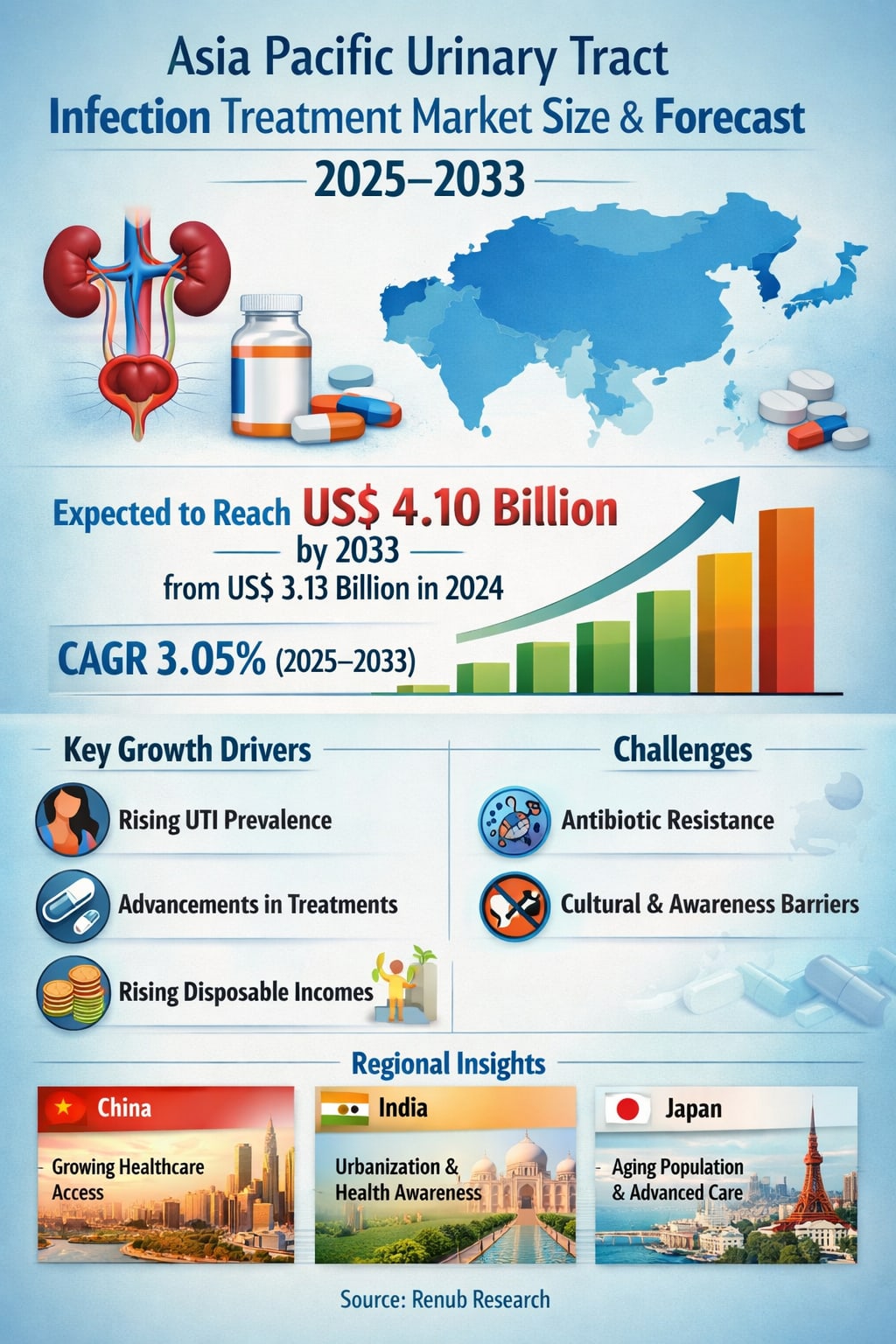
The Asia Pacific Urinary Tract Infection (UTI) Treatment Market is steadily gaining momentum as healthcare systems across the region respond to a growing disease burden, changing demographics, and rising awareness of urinary health. According to Renub Research, the Asia Pacific Urinary Tract Infection Treatment Market is expected to reach US$ 4.10 billion by 2033, up from US$ 3.13 billion in 2024, expanding at a compound annual growth rate (CAGR) of 3.05% from 2025 to 2033.
This growth reflects a convergence of multiple trends: increasing prevalence of UTIs, improved access to healthcare services, better diagnostic capabilities, and continuous innovation in antibiotic and antifungal therapies. UTIs, once considered routine and easily treatable, are now drawing more strategic attention from healthcare providers and policymakers due to concerns around antibiotic resistance, aging populations, and the rising cost of recurrent infections.
Across Asia Pacific, countries such as China, India, and Japan are witnessing structural changes in healthcare delivery. Urbanization, higher disposable incomes, and stronger public health campaigns are encouraging more people to seek early diagnosis and treatment. At the same time, digital health platforms and online pharmacies are making UTI treatments more accessible than ever before, particularly in densely populated and semi-urban areas.
Asia Pacific Urinary Tract Infection Treatment Market Overview
A urinary tract infection (UTI) refers to an infection affecting any part of the urinary system, including the kidneys, bladder, ureters, and urethra. The most common cause is bacterial infection, particularly Escherichia coli (E. coli), although other pathogens can also be responsible. Typical symptoms include frequent and painful urination, cloudy or strong-smelling urine, pelvic discomfort, and, in more severe cases, fever and back pain.
While UTIs can affect individuals of all ages and genders, women are significantly more prone due to anatomical factors such as a shorter urethra. Other high-risk groups include pregnant women, elderly individuals, people with diabetes, and those with weakened immune systems or urinary retention issues. If left untreated, UTIs can progress into more serious kidney infections, making early diagnosis and timely treatment essential.
In the Asia Pacific region, the UTI treatment market is being shaped by improvements in healthcare infrastructure, broader availability of antibiotics and supportive therapies, and rising awareness about personal hygiene and preventive healthcare. The market also benefits from the growing presence of retail pharmacies and online drug stores, which are simplifying access to both prescription and over-the-counter medications.
Market Size and Forecast: A Steady Growth Trajectory
Renub Research estimates show a clear upward trend for the Asia Pacific UTI Treatment Market. From US$ 3.13 billion in 2024, the market is projected to expand to US$ 4.10 billion by 2033, reflecting a CAGR of 3.05% during the 2025–2033 period.
This moderate but stable growth highlights the essential nature of UTI treatments within healthcare systems. Unlike elective therapies, UTI treatments fall into the category of necessary, often urgent medical interventions. As populations grow and age, and as lifestyle-related risk factors such as diabetes become more common, the baseline demand for UTI treatments is expected to remain strong.
Moreover, the market is not only driven by volume but also by value growth, as newer and more advanced therapies enter the market. Combination antibiotics, targeted treatments for resistant strains, and improved diagnostic-linked therapies are gradually increasing the overall spending per patient, especially in urban and developed parts of the region.
Key Growth Drivers
Rising Prevalence of UTIs
One of the most important drivers of the Asia Pacific UTI Treatment Market is the increasing prevalence of urinary tract infections. Rapid urbanization, lifestyle changes, and dietary shifts have contributed to higher infection rates, particularly among women, elderly individuals, and patients with chronic conditions such as diabetes.
In many Asia Pacific countries, aging populations are becoming a major demographic trend. Older adults are more susceptible to UTIs due to weakened immune systems, higher rates of catheter use, and underlying health conditions. This demographic shift alone is expected to sustain long-term demand for UTI treatments.
Additionally, greater awareness and improved diagnostic access mean that more cases are being detected and treated than in the past. This has led to a steady increase in prescriptions for antibiotics, antifungal medications, and supportive therapies, further boosting market growth.
Advancements in Treatment Options
Continuous advancements in antibiotic and antifungal therapies are also playing a crucial role in shaping the market. Pharmaceutical companies are investing in the development of more effective drugs that can address complicated and recurrent UTIs, as well as infections caused by resistant bacteria.
A notable example is the launch of biapenem by BDR Pharma in September 2021. This drug is used to treat complicated urinary tract infections, along with other serious bacterial infections. Such innovations not only improve clinical outcomes but also help address the growing challenge of antibiotic resistance.
As treatment protocols become more refined and targeted, physicians are increasingly able to tailor therapies based on infection severity and patient profile. This trend is supporting both better patient outcomes and sustained market expansion across the region.
Rising Disposable Incomes and Healthcare Spending
Economic growth across much of Asia Pacific has led to rising disposable incomes, which in turn is driving higher healthcare spending. More people can now afford doctor visits, diagnostic tests, and prescription medications, including treatments for UTIs.
In urban areas especially, patients are more proactive about seeking early treatment rather than relying solely on home remedies. This shift toward professional healthcare services is increasing demand for branded and generic UTI medications alike.
At the same time, governments and private investors are continuing to expand healthcare infrastructure, including hospitals, clinics, and pharmacy networks. This broader access to care is making UTI treatments more readily available, even in previously underserved regions.
Challenges Facing the Market
Antibiotic Resistance
One of the most serious challenges in the Asia Pacific UTI Treatment Market is antibiotic resistance. The overuse and misuse of antibiotics have led to the emergence of resistant bacterial strains, making some standard treatments less effective.
This not only increases treatment costs but also prolongs recovery times and raises the risk of complications. In response, healthcare systems are being forced to adopt stronger, often more expensive antibiotics, and to emphasize better antibiotic stewardship. While this creates opportunities for new drug development, it also places pressure on healthcare budgets and treatment protocols.
Cultural and Awareness Barriers
In several parts of Asia Pacific, cultural norms and social stigma can discourage people from seeking timely medical care for UTIs. Because UTIs are associated with personal hygiene and intimate health, some patients may delay treatment or rely on home remedies instead of consulting healthcare professionals.
Misconceptions about the causes and seriousness of UTIs can also hinder early diagnosis and effective prevention. These barriers can slow market growth in certain regions, even as overall awareness is gradually improving.
Country-Level Insights
China
China’s UTI treatment market is expanding steadily, supported by its large population, improving healthcare access, and growing awareness of urinary health. The increasing prevalence of UTIs among women and the elderly is driving demand for effective treatment options.
Government healthcare initiatives, along with advances in diagnostic technologies, are improving early detection and treatment rates. The rapid growth of online pharmacies and telemedicine platforms is also making UTI treatments more accessible across both urban and rural areas. Alongside Western medicine, traditional Chinese medicine continues to play a role, reflecting diverse patient preferences.
India
In India, the UTI treatment market is growing due to urbanization, changing lifestyles, and improving healthcare awareness. Inadequate sanitation in some areas and rising rates of diabetes are contributing to higher UTI incidence, boosting demand for antibiotics and preventive care products.
The availability of affordable generic medicines and the expansion of healthcare infrastructure are supporting market growth. Despite challenges such as antibiotic resistance and limited access in rural regions, public health campaigns and better diagnostics are helping drive steady progress.
Japan
Japan’s UTI treatment market benefits from a strong healthcare system, advanced diagnostics, and a robust pharmaceutical industry. An aging population is a major driver of demand, as older adults are more susceptible to recurrent and complicated UTIs.
The country’s focus on medical research and innovation is helping improve treatment outcomes, even in the face of antibiotic resistance challenges. Preventive care, early detection, and the development of new therapies continue to strengthen the market’s long-term outlook.
Market Segmentation
By Product Type
Penicillin & Combinations
Quinolones
Cephalosporin
Aminoglycoside Antibiotics
Sulphonamides (Sulfamethoxazole + Trimethoprim)
Azoles and Amphotericin B
Tetracycline (Doxycycline)
Nitrofurans (Nitrofurantoin)
Others
By Indication
Complicated UTI
Uncomplicated UTI
By Distribution Channel
Hospitals
Gynecology & Urology Clinics
Drug Stores
Retail Pharmacies
Online Drug Stores
By Country
China
Japan
India
South Korea
Thailand
Malaysia
Indonesia
Australia
New Zealand
Rest of Asia Pacific
Competitive Landscape
The Asia Pacific UTI Treatment Market is moderately competitive, with a mix of global pharmaceutical giants and strong regional players. Key companies include:
AstraZeneca plc
Bayer AG
GlaxoSmithKline PLC
Johnson & Johnson
Novartis AG
Pfizer
Merck & Co. Inc
Dr. Reddy’s Laboratories Ltd
Bristol-Myers Squibb Company
These companies compete across multiple dimensions, including product portfolios, research and development capabilities, geographic presence, and pricing strategies. Most are focusing on expanding their antibiotic and anti-infective pipelines while also strengthening distribution networks across emerging Asia Pacific markets.
Final Thoughts
The Asia Pacific Urinary Tract Infection Treatment Market is on a steady and resilient growth path, driven by rising infection rates, better healthcare access, and continuous improvements in treatment options. With the market projected to grow from US$ 3.13 billion in 2024 to US$ 4.10 billion by 2033, the region represents a stable and strategically important space for pharmaceutical companies and healthcare providers alike.
While challenges such as antibiotic resistance and cultural barriers remain, ongoing innovation, public health initiatives, and expanding healthcare infrastructure are expected to support long-term market development. As awareness of urinary health continues to improve and treatment options become more advanced and accessible, the Asia Pacific UTI treatment market is well-positioned to play a critical role in improving patient outcomes across the region.
About the Creator
Electric Vehicle Battery Swapping Market to Reach USD 1,440.12 Million by 2033: Why This 21.20% CAGR Signals a Major EV Shift
Now, a powerful alternative is gaining traction worldwide. The Electric Vehicle Battery Swapping Market is projected to soar to USD 1,440.12 million by 2033, expanding at an impressive CAGR of 21.20%. As cities push toward zero-emission transportation and EV adoption surges, battery swapping is emerging as a fast, scalable, and cost-efficient solution.
By Adil Ali Khan3 days ago in Trader
The Pride Flag and the Diversion
For nearly a decade, the LGBTQIA Pride Flag rippled in the wind at Christopher Park, a kaleidoscope of color staked into the soil of America’s first national monument to LGBTQIA+ liberation. That flag came down this week. Federal officials, citing new guidance from the Trump Administration, silently lowered the rainbow flag from its pole across the street from the Stonewall Inn. The birthplace of the modern gay rights movement now flies only the United States flag.
By Tim Carmichael2 days ago in Pride




Comments
There are no comments for this story
Be the first to respond and start the conversation.