
Biodegradable Plastic Market Size and Forecast 2025
How Eco-Friendly Materials Are Reshaping Global Packaging, Agriculture, and Consumer Goods

Introduction: A Market Built on Urgency and Opportunity
The global conversation around plastic waste has shifted from concern to action. Governments, corporations, and consumers are no longer debating whether plastic pollution is a problem—they are actively searching for alternatives. In this changing landscape, biodegradable plastics have moved from niche innovation to mainstream necessity.
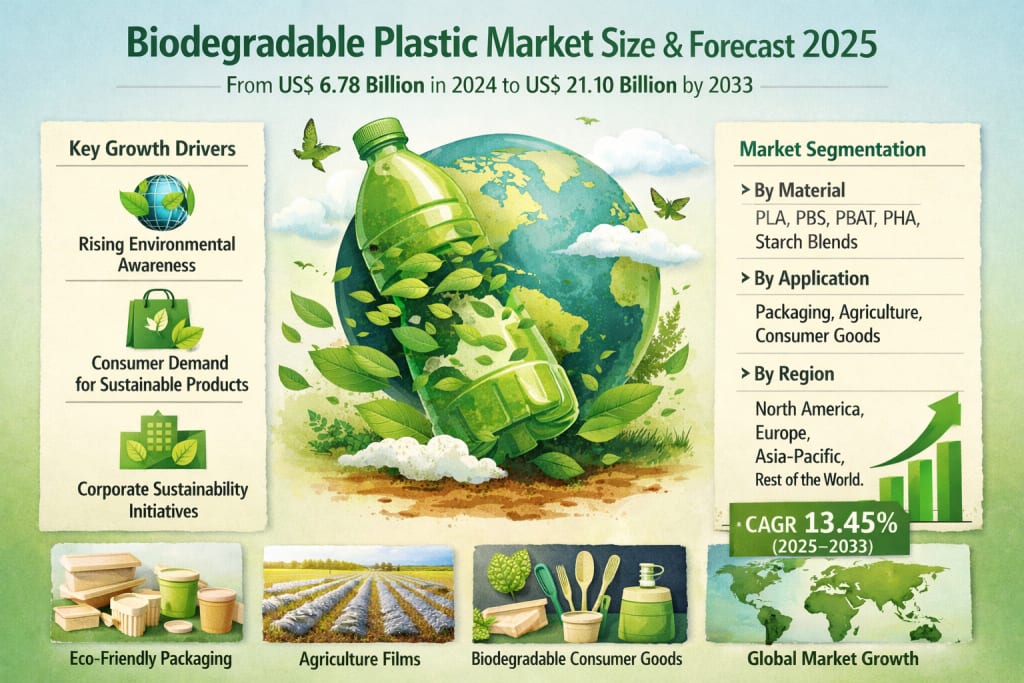
According to Renub Research, the Biodegradable Plastic Market is expected to reach US$ 21.10 billion by 2033, up from US$ 6.78 billion in 2024, growing at a strong CAGR of 13.45% from 2025 to 2033. This rapid expansion reflects more than just technological progress—it signals a global shift in how materials are designed, used, and disposed of.
From packaging and agriculture to consumer goods and food service, biodegradable plastics are steadily replacing traditional petroleum-based plastics. Driven by stricter regulations, rising environmental awareness, and corporate sustainability commitments, the market is entering a decisive growth phase that could redefine the future of materials.
What Are Biodegradable Plastics—and Why Do They Matter?
Biodegradable plastics are materials that can decompose into natural substances such as water, carbon dioxide, and biomass through the action of microorganisms like bacteria and fungi. Depending on the material type and environmental conditions, this process can take anywhere from a few months to a few years—far less than the centuries required for conventional plastics.
These materials come in several forms. Some are made from renewable, plant-based sources like corn starch or sugarcane, while others are synthetic polymers engineered to break down under specific conditions such as heat, sunlight, or oxygen exposure. Today, biodegradable plastics are used across a wide range of applications, including packaging, agriculture, consumer goods, and even medical products.
Their biggest advantage is environmental: they help reduce long-term plastic pollution, lower landfill burden, and support the transition toward a circular economy. As concerns over marine litter, microplastics, and carbon emissions intensify, biodegradable plastics are increasingly seen not just as an alternative—but as a necessity.
Market Momentum: Why Growth Is Accelerating
Several powerful forces are pushing the biodegradable plastic market forward.
First, government regulations are playing a critical role. Many countries have introduced bans or restrictions on single-use plastics such as bags, straws, cutlery, and food containers. These policies are creating immediate demand for compostable and biodegradable substitutes, especially in packaging and food service sectors.
Second, consumer behavior is changing. Shoppers today are far more conscious of environmental impact than a decade ago. Sustainable packaging, eco-friendly products, and green branding are no longer “nice to have”—they influence purchasing decisions directly. Brands that fail to adapt risk losing relevance in an increasingly sustainability-driven market.
Third, technological progress is improving both the performance and cost-efficiency of biodegradable materials. New formulations, better blending techniques, and advances in bio-based feedstocks are making these plastics more durable, versatile, and affordable than before.
Finally, corporate sustainability commitments are accelerating adoption. Major global brands in food, retail, and consumer goods are pledging to reduce plastic waste and carbon footprints, and biodegradable plastics are becoming a key part of those strategies.
A notable example came in May 2024, when South Korean chemical company SKC announced plans to build the world’s largest biodegradable plastic plant in Hai Phong, Vietnam, with an annual capacity of 70,000 tons of PBAT. The plant will use tree-derived nanocellulose to reinforce bioplastics for broader applications, including personal hygiene products—highlighting how innovation and scale are now moving hand in hand.
Key Growth Drivers Shaping the Market
1. Rising Environmental Awareness
Public awareness of plastic pollution has reached unprecedented levels. Images of plastic-choked oceans, overflowing landfills, and wildlife harmed by waste have reshaped public opinion worldwide. Traditional plastics, which can take hundreds of years to degrade, are increasingly viewed as incompatible with a sustainable future.
Biodegradable plastics offer a more responsible alternative by breaking down faster and reducing long-term environmental impact. This shift in mindset—across both consumers and businesses—is one of the strongest drivers behind the market’s rapid expansion.
2. Consumer Demand for Sustainable Products
Today’s consumers, especially millennials and Gen Z, actively seek out eco-friendly products. Packaging made from biodegradable materials, compostable cutlery, and sustainable household goods are no longer niche—they are becoming mainstream.
As demand grows, manufacturers are expanding their biodegradable product portfolios to stay competitive. This virtuous cycle of demand and innovation is steadily pushing the market forward.
3. Corporate Sustainability Initiatives
Large corporations are setting ambitious ESG (Environmental, Social, Governance) goals. From retail giants to food and beverage multinationals, companies are under pressure—from regulators, investors, and customers—to reduce their environmental footprint.
Switching to biodegradable plastics helps companies meet regulatory requirements, enhance brand image, and align with long-term sustainability strategies. As more corporations make this transition, market adoption accelerates.
Challenges That Still Hold the Market Back
Despite strong growth prospects, the biodegradable plastic market faces some important hurdles.
Limited Availability of Raw Materials
Many biodegradable plastics rely on agricultural feedstocks such as corn, sugarcane, or starch. These resources are subject to fluctuations in crop yields, weather conditions, and commodity prices. Supply chain disruptions can increase costs and limit consistent production.
There are also concerns about competition with food supply and land use, which could become more significant as demand scales up globally.
Performance Limitations
In some applications, biodegradable plastics still struggle to match the strength, durability, and moisture resistance of conventional plastics. For example, in heavy-duty packaging or construction-related uses, traditional plastics often outperform biodegradable alternatives.
While R&D is closing this gap, performance concerns continue to limit adoption in certain high-stress or long-life applications.
Material Insights: Where the Growth Is Coming From
Polybutylene Succinate (PBS)
PBS is gaining attention for its excellent thermal stability, mechanical strength, and compostability. It is widely used in packaging, agricultural films, and disposable products. Demand is rising particularly in Europe and Asia-Pacific, supported by environmental regulations and green packaging initiatives.
Polylactic Acid (PLA)
PLA, made from renewable sources like corn starch and sugarcane, is one of the most popular bioplastics globally. It is commonly used in food packaging, disposable cutlery, and 3D printing due to its transparency and rigidity. However, its biodegradability works best in industrial composting facilities, making waste infrastructure a key factor in its environmental impact.
Starch Blends
Starch blends are among the most cost-effective biodegradable plastics. Often combined with PLA or PBS to improve performance, they are widely used in packaging films, mulch films, and compost bags. While moisture sensitivity remains a challenge, ongoing formulation improvements are expanding their use cases.
Application Spotlight: Where Demand Is Surging
Packaging
Packaging is the largest and fastest-growing application segment. Food & beverage, personal care, and FMCG brands are rapidly switching to biodegradable trays, films, bags, and containers. Innovations in barrier coatings and printability are making these solutions more commercially attractive than ever.
Agriculture
Biodegradable mulch films, seed coatings, and plant pots are transforming sustainable farming. These products eliminate the need for retrieval and disposal, reducing labor costs and soil pollution. Government support in regions like Europe and China is further accelerating adoption.
Consumer Goods
From cutlery and straws to toothbrushes and personal care packaging, biodegradable plastics are becoming a staple in everyday products. Sustainability-focused branding and changing consumer preferences are driving strong growth in this segment.
Regional Outlook: A Truly Global Market
United States: Strong growth driven by regulations, corporate sustainability goals, and rising consumer awareness, despite challenges like higher costs and infrastructure gaps.
United Kingdom: Rapid adoption supported by strict plastic regulations and strong demand from packaging and foodservice sectors.
China: One of the fastest-growing markets, fueled by government bans on non-degradable plastics and massive investments in PLA and PBS capacity.
India: Steady growth supported by plastic waste rules and rising environmental awareness, though infrastructure and cost challenges remain.
Australia: Expansion driven by bans on single-use plastics and strong consumer preference for green products.
Malaysia: Growing interest supported by national sustainability roadmaps, though composting infrastructure is still limited.
Brazil: Strong potential due to abundant biomass resources and a growing sustainability movement.
United Arab Emirates: Market growth supported by government initiatives to reduce plastic waste and promote sustainable alternatives.
Market Segmentation Overview
By Material Type:
PBAT
PBS
PLA
PHA
Starch Blends
Others
By Application:
Packaging
Agriculture
Consumer Goods
Others
By Country (24 markets):
United States, Canada, Germany, United Kingdom, France, Italy, Netherlands, Spain, China, South Korea, Japan, India, Indonesia, Malaysia, Argentina, Brazil, Mexico, Colombia, Saudi Arabia, South Africa, Israel, Australia, UAE, Rest of the World.
Key Companies Covered:
Total Corbion
Mitsubishi Chemical Holding Corporation
Toray Industries
BASF SE
Green Dot Bioplastics
Amcor Limited
(Each analyzed across Overview, Key Persons, Recent Developments, and Financial Insights.)
Final Thoughts: A Market That Represents the Future
The biodegradable plastic market is no longer just a promising niche—it is becoming a cornerstone of the global transition toward sustainable materials. With the market projected to grow from US$ 6.78 billion in 2024 to US$ 21.10 billion by 2033, the direction is clear: industries, governments, and consumers are aligning around greener solutions.
While challenges remain—particularly around cost, performance, and infrastructure—the pace of innovation and policy support suggests these barriers will continue to shrink. For businesses, investors, and policymakers alike, biodegradable plastics represent not just a growth opportunity, but a critical step toward a more sustainable and responsible global economy.
In the years ahead, the question will no longer be whether biodegradable plastics will replace conventional plastics—but how fast that transformation will happen.
About the Creator
Tom Shane
Tom Shane is a content writer specializing in SEO-driven blogs, product descriptions, and thought leadership. He crafts engaging, research-backed content that connects with audiences and drives results.
Australia Grocery Retail Market — Growth, Forecast & Strategic Outlook
The Australia grocery retail market continues to grow steadily as both traditional retail and digital channels adapt to evolving consumer needs. According to IMARC Group, the market reached USD 54.3 billion in 2025 and is forecast to expand to USD 79.2 billion by 2034, exhibiting a compound annual growth rate (CAGR) of 4.16% during 2026–2034.
By Amélie Belleabout 17 hours ago in Trader
Stanislav Kondrashov on Bitcoin, Amazon, and the New Shape of Tech Pressure
Bitcoin is falling. Amazon is drawing scrutiny. And the wider tech sector is facing questions it hasn’t had to answer in years. According to Stanislav Kondrashov, founder of TELF AG, what’s happening now isn’t about panic or collapse—it’s about a shift in how the world views technology’s role in the broader economy.
By Stanislav Kondrashov5 days ago in Trader
Super Bowl LX Recap: A Team Called Hawks
Sixty. The Super Bowl turned 60! Still amazes me that this was the sixtieth Super Bowl played in NFL history. It seems like yesterday that I watched Super Bowl XXVII, the first SB I ever watched. The QB who won Super Bowl XXVII has since called a few SBs, and will call next year's game, but that's another story. Super Bowl LX took place at Levi's Stadium in Santa Clara, California, the home stadium of the San Francisco 49ers. However, it was one of their division foes who represented the NFC, as the Seattle Seahawks faced off against the New England Patriots.
By Clyde E. Dawkins3 days ago in Unbalanced




Comments
There are no comments for this story
Be the first to respond and start the conversation.