
European Union Passenger Car Market Size and Forecast 2025–2033
How electric mobility, policy pressure, and technology shifts are reshaping Europe’s auto industry

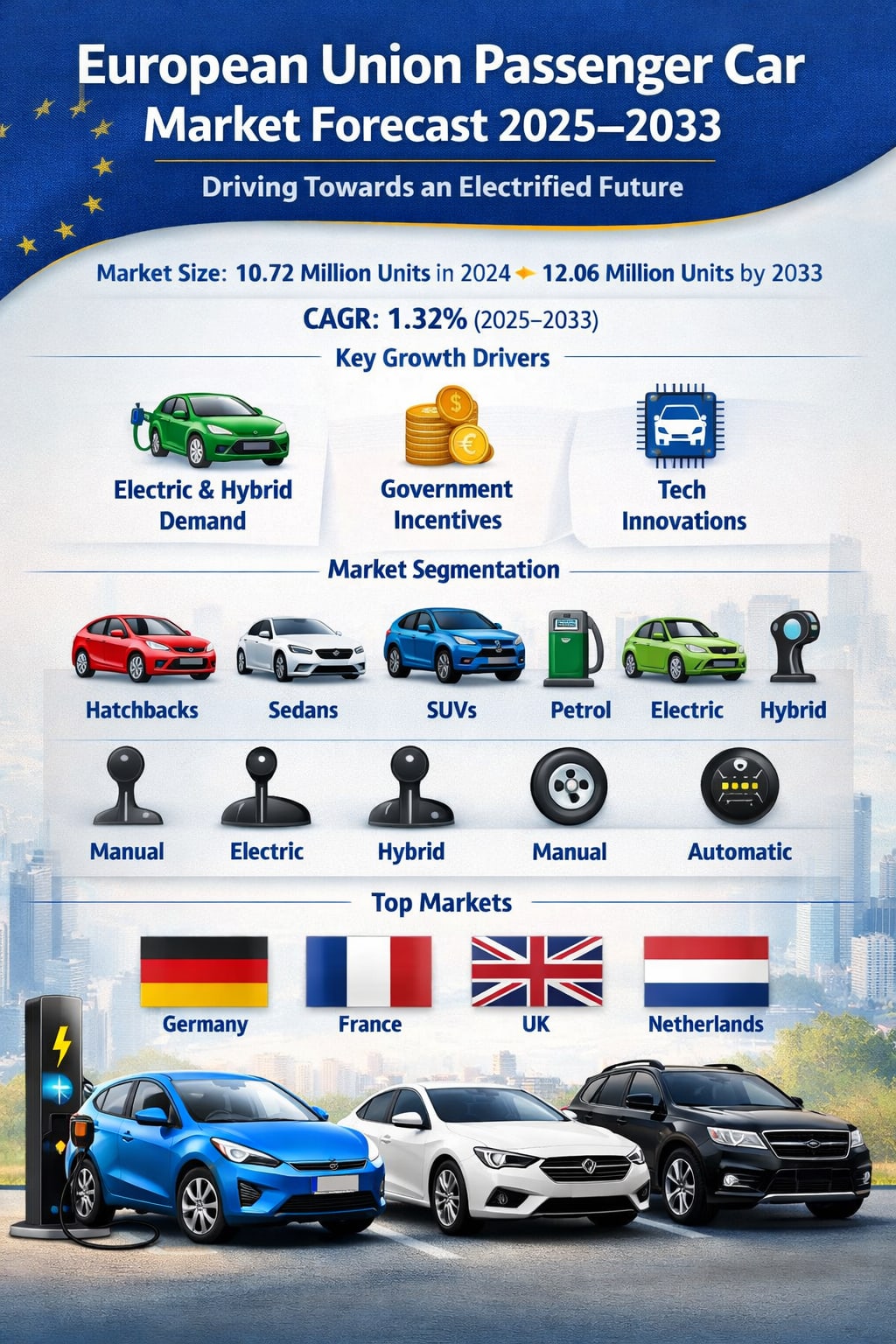
European Union Passenger Car Market Overview
The European Union passenger car market remains one of the most mature, competitive, and technologically advanced automotive landscapes in the world. A passenger vehicle is primarily designed for carrying people rather than goods and typically accommodates up to five occupants. Across Europe, passenger cars form the backbone of everyday mobility, supporting commuting, tourism, logistics for services, and personal travel across both urban and rural regions.
In 2024, the European Union Passenger Car Market stood at 10.72 million units, and it is projected to reach 12.06 million units by 2033, growing at a CAGR of 1.32% from 2025 to 2033. While this growth rate may appear modest compared to emerging markets, it reflects the maturity of the European automotive sector, the gradual replacement cycle of vehicles, and the deep structural transformation underway as the region shifts toward low-emission mobility.
Europe benefits from a dense and well-developed road network, high urbanization levels, and a strong middle-class consumer base. Fuel-efficient and compact models dominate city landscapes, while SUVs and premium sedans maintain strong demand in suburban and highway-driven regions. At the same time, electric and hybrid vehicles are rapidly gaining popularity, driven by strict emission regulations, rising environmental awareness, and expanding charging infrastructure.
The presence of some of the world’s most influential automakers—such as Volkswagen, BMW, Mercedes-Benz, Renault, Stellantis, and Volvo—further strengthens the market. These companies continue to invest heavily in electrification, digitalization, and next-generation vehicle technologies, ensuring that the European Union remains a global reference point for automotive innovation.
Market Size and Growth Outlook
The growth of the European Union passenger car market is being shaped less by volume expansion and more by technological transition and value transformation. While overall unit sales are expected to rise gradually, the real change lies in the composition of the market: electric vehicles, hybrids, and software-defined cars are steadily replacing traditional internal combustion engine models.
From 2025 to 2033, the market’s steady expansion will be supported by:
Rising adoption of electric and hybrid vehicles
Continuous regulatory pressure on emissions
Ongoing innovation in battery, software, and safety systems
Consumer preference for smarter, cleaner, and more connected cars
Rather than a boom-driven cycle, Europe’s passenger car market is entering a strategic upgrade phase, where sustainability, efficiency, and digital features are becoming as important as design and performance.
Growth Drivers in the European Union Passenger Car Market
Government Incentives and Emission Regulations
One of the most powerful forces shaping the EU passenger car market is regulation. European governments are actively promoting low-emission and zero-emission vehicles through a mix of subsidies, tax benefits, and policy mandates. Initiatives such as the EU Green Deal and the Fit for 55 package are pushing both manufacturers and consumers toward cleaner mobility solutions.
Incentives often include purchase rebates, reduced VAT, lower registration fees, and road tax exemptions for electric and hybrid vehicles. At the same time, stricter CO₂ emission limits and low-emission zones in major cities are discouraging the use of older, high-polluting vehicles. The EU Emissions Trading System (ETS) further reinforces this shift by putting a price on carbon and encouraging cost-effective emission reductions across industries.
Together, these measures are not only boosting demand for electric and hybrid cars but also accelerating the development of charging infrastructure and battery supply chains across the region.
Innovation in Electric and Autonomous Technology
Technological progress is redefining what European consumers expect from a passenger car. Rapid advances in battery technology, electric powertrains, and software integration are making electric vehicles more practical, more affordable, and more appealing. New models offer longer driving ranges, faster charging times, and increasingly sophisticated driver-assistance systems.
At the same time, investments in artificial intelligence, sensors, and vehicle-to-vehicle communication are laying the groundwork for autonomous mobility. A notable milestone came in January 2025, when Mercedes-Benz Drive Pilot became the first approved Level 3 autonomous driving system in Germany for production cars at speeds of up to 95 km/h. Such developments signal a future where safety, convenience, and automation become core value propositions in the European car market.
Younger consumers, in particular, are drawn to these innovations, viewing cars not just as transport tools but as connected, intelligent mobility platforms.
Urbanization and Changing Mobility Patterns
Europe’s ongoing urbanization is reshaping demand patterns in the passenger car market. In dense cities, consumers increasingly prefer smaller, low-emission vehicles that are easier to park, cheaper to run, and compliant with urban emission regulations. At the same time, the rise of car-sharing and mobility-as-a-service (MaaS) models is influencing how people think about ownership and usage.
Manufacturers are responding by designing urban-friendly vehicles with digital connectivity, flexible ownership options, and lower environmental impact. In 2023, Hertz partnered with Uber to offer 25,000 electric vehicles to European city drivers by 2025, aligning with Uber’s goal of achieving zero-emission mobility by 2030 in Europe and North America. Such initiatives highlight how traditional car ownership models are gradually blending with shared and fleet-based mobility solutions.
Challenges in the European Union Passenger Car Market
High Cost of Electric Vehicles and Infrastructure Gaps
Despite strong policy support, the upfront cost of electric vehicles remains a major barrier for many European consumers. Batteries, advanced materials, and complex software systems make EVs more expensive than conventional petrol or diesel cars. While total cost of ownership can be lower over time, the initial purchase price still limits mass adoption in price-sensitive segments.
Infrastructure development is another challenge. Although charging networks are expanding rapidly in countries like Germany, the Netherlands, and France, coverage remains uneven in rural and less-developed regions. Until charging becomes as convenient and ubiquitous as traditional refueling, range anxiety and accessibility concerns will continue to slow adoption in certain markets.
Supply Chain Disruptions and Component Shortages
The European automotive industry has faced significant disruptions in recent years due to global supply chain instability. Shortages of critical components—especially semiconductors—have delayed production, reduced vehicle availability, and increased manufacturing costs. Geopolitical tensions and trade dependencies have further exposed vulnerabilities in global sourcing strategies.
These disruptions affect not only manufacturers but also consumers, who face longer waiting times and fewer configuration options. To mitigate these risks, automakers are increasingly investing in regional supply chains, strategic stockpiling, and local production capacity for key components.
Segment Insights
By Vehicle Type: Sedans in a Changing Landscape
Sedans continue to hold an important position in the EU passenger car market, offering a balance of comfort, efficiency, and design. While SUVs and hatchbacks have gained ground, sedans remain popular among urban professionals and corporate fleets, especially in countries like Germany, France, and Italy. The introduction of hybrid and electric sedan models is helping this segment stay relevant in an increasingly sustainability-focused market.
By Fuel Type: Petrol, Electric, and Hybrids
Petrol-powered cars still account for a significant share of the market, particularly in regions with less-developed EV infrastructure. They remain attractive due to lower upfront costs and widespread refueling networks. However, their long-term outlook is constrained by tightening emission regulations.
Battery Electric Vehicles (BEVs) represent the fastest-growing segment, driven by strong policy support and continuous improvements in range and charging speed. The EU’s investments in charging infrastructure and battery production are further strengthening this segment’s growth prospects.
Hybrid vehicles, including HEVs and PHEVs, serve as a transitional solution for consumers who want better fuel efficiency and lower emissions without fully committing to pure electric mobility. They remain especially popular in markets with strict urban emission zones.
By Transmission Type: Manual vs Automatic
Manual transmissions have traditionally dominated the European market due to lower costs and better fuel efficiency. However, their share is gradually declining as automatic transmissions become more affordable and increasingly standard in hybrid and electric vehicles. Still, manual cars remain common in Eastern and Southern Europe, particularly in entry-level and budget segments.
Country-Level Market Highlights
France
France is one of the largest passenger car markets in the EU, supported by strong domestic brands such as Renault, Peugeot, and Citroën. The country активно promotes low-emission vehicles through incentives, scrappage schemes, and urban mobility policies. In 2024, the French new car market declined by 3.17% to 1,718,416 units, with Renault, Peugeot, and Dacia leading sales, and the Renault Clio and Peugeot 208 among the top-selling models. Despite short-term fluctuations, France remains a key driver of Europe’s green mobility transition.
Germany
Germany is the EU’s largest and most influential passenger car market, home to global giants like Volkswagen, BMW, and Mercedes-Benz. It leads in premium manufacturing, automotive R&D, and the shift toward electric and autonomous vehicles. Strong government policies, including EV incentives and CO₂ fleet targets, are accelerating the transition. Germany also serves as a major export hub, shaping automotive trends far beyond its borders.
United Kingdom
Although no longer part of the EU, the UK remains a crucial European car market. Demand is strong for compact cars, hatchbacks, and hybrids, with growing interest in electric vehicles driven by the government’s plan to phase out new petrol and diesel cars by 2035. Despite Brexit-related trade complexities, the UK continues to influence European automotive trends, particularly in EV adoption and regulatory alignment.
Netherlands
The Netherlands stands out as a leader in electric mobility, with one of the highest per-capita EV adoption rates in Europe. Generous incentives, low taxation on EVs, and a dense charging network have made electric cars mainstream. Dutch consumers prioritize efficiency, sustainability, and connectivity, making the country a benchmark for future-oriented mobility in Europe.
Competitive Landscape
The European Union passenger car market is highly competitive and innovation-driven. Major players include:
Volkswagen AG
Stellantis N.V.
Renault S.A.
Hyundai Motor Company
Bayerische Motoren Werke AG (BMW)
Toyota Motor Europe
Daimler Motor Company Limited (Mercedes-Benz)
Ford Motor Company Limited
Volvo Car Corporation
Nissan Motor Co., Ltd.
These companies are competing not only on design and performance but also on battery technology, software platforms, autonomous features, and sustainability credentials. Strategic partnerships, platform sharing, and investments in EV ecosystems are becoming central to long-term competitiveness.
European Union Passenger Car Market Segmentation
By Type:
Hatchbacks, MUVs, Sedans, SUVs
By Fuel Type:
Petrol, Diesel, Battery Electric (BEV), Hybrid, Plug-in Hybrid (PHEV), Hybrid Electric (HEV), Others
By Transmission Type:
Manual, Automatic
By Country:
France, Germany, Italy, Spain, United Kingdom, Belgium, Netherlands, Russia, Poland, Greece, Norway, Romania, Portugal, Rest of Europe
Final Thoughts
The European Union passenger car market is not just growing—it is transforming. Between 2025 and 2033, the industry will continue its steady shift away from traditional combustion engines toward a future defined by electric mobility, digital intelligence, and sustainability. While challenges such as high EV costs and supply chain vulnerabilities remain, strong policy support, technological innovation, and changing consumer preferences are keeping the market on a forward-looking path.
With unit sales expected to rise from 10.72 million in 2024 to 12.06 million by 2033, the real story is not just about volume—it is about what kind of cars Europeans will drive in the next decade: cleaner, smarter, and more connected than ever before.
About the Creator
The Celia Cruz Coin
When the Celia Cruz that I have joined wit coin was issued by the US mint i made it my goal to try to find it on my own i tried to find it by myself and in doing so I did find other interesting coins as well. my cousin did one of the sweetest things anybody could ever do for a person and I just want you to know that I was unexpected but greatly appreciated one day i go and get the mail and I open the mailbox and see an envelope in there I'm thinking she ordered some for her house right and so I just give it to her you know and walk about go about my business and what not and then she comes into the kitchen enhance me this envelope and I'm like what's this so I opened the envelope andIn the envelopeIs the Celia Cruise coinAnd that was a great surprise to meAndI said thank you so much you did not have to do this andShe's like you know because I was starting to be obsessed with finding it andIt was a greatThing that I haven't forgotten and I have itIn a jewelry boxA nice jewelry box I got for ChristmasAlong with the other coinsThat I found in the processPeriodHer grandmother and my honorary grandmother which is the same personAlso was giving me coins and what notWell I was looking for this particular coinPeriodIt's very rareThat ILook for coins and things like thatBut this one particular coinI had to findIt was my mission and my goalAndThe mission has been accomplished.
By Revista Miko:XCI by Rikki La Rougeabout 23 hours ago in Trader
I Don't Need My Phone... Wait, Is That Actually True?
My parents gave me my first cell phone when I was twelve years old. It wasn't a fancy iPhone or anything, not even close. Just a simple black flip phone for when I needed to call or text them after school.
By Madison "Maddy" Newtonabout 12 hours ago in Humans




Comments
There are no comments for this story
Be the first to respond and start the conversation.