
Europe Automotive Actuators Market Size and Forecast 2025–2033
How electrification, automation, and safety innovation are reshaping Europe’s actuator ecosystem

Europe Automotive Actuators Market: A Decade of Smart Motion
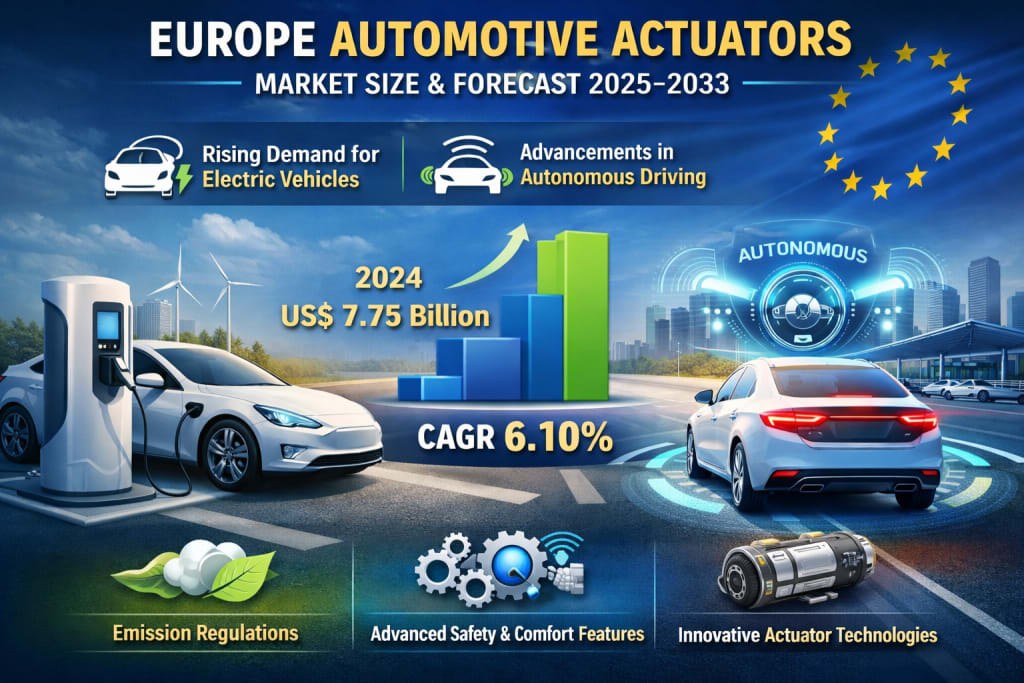
The Europe Automotive Actuators Market is entering a decisive growth phase as the region accelerates toward electrification, automation, and smarter mobility. According to Renub Research, the market is expected to reach US$ 13.20 billion by 2033, up from US$ 7.75 billion in 2024, growing at a CAGR of 6.10% from 2025 to 2033. This steady expansion reflects how deeply actuators have become embedded in the modern vehicle—no longer just mechanical helpers, but intelligent, software-driven components that enable performance, safety, comfort, and efficiency.
Automotive actuators play a critical role in converting electrical, hydraulic, or pneumatic energy into controlled motion. They are the hidden workforce behind many everyday vehicle functions: adjusting seats, opening and closing valves, controlling throttles, managing braking systems, operating climate control flaps, and supporting advanced driver assistance systems (ADAS). As vehicles become more software-defined and electrically powered, the importance of precise, fast, and reliable actuation systems continues to rise.
Europe, with its strong automotive manufacturing base, strict emissions regulations, and fast-growing electric vehicle (EV) ecosystem, is uniquely positioned to drive the next wave of actuator innovation. From Germany’s engineering hubs to France’s electrification push and the UK’s focus on advanced mobility technologies, the region is shaping how actuators evolve from simple motion devices into intelligent mechatronic systems.
Market Overview: Why Actuators Matter More Than Ever
In traditional vehicles, actuators were often mechanical or hydraulic components designed for specific, isolated tasks. Today, they are integral parts of complex electronic control architectures. Modern vehicles use dozens—sometimes hundreds—of actuators working in coordination with sensors and control units to deliver smoother driving, better fuel efficiency, lower emissions, and enhanced safety.
In Europe, the transition toward electric and hybrid vehicles has significantly increased the demand for electric actuators, which offer better energy efficiency, compact design, and easier integration with electronic control systems. At the same time, hydraulic and pneumatic actuators continue to play important roles in heavy-duty and performance-critical applications, particularly in commercial vehicles and certain braking or suspension systems.
Another major factor shaping the market is the rapid adoption of advanced driver assistance systems (ADAS) and the gradual move toward autonomous driving. Features such as adaptive cruise control, lane-keeping assistance, automated braking, and electronic stability control all depend on highly reliable and precise actuators. Any delay, inaccuracy, or failure in actuation can directly impact vehicle safety, making quality and innovation in this segment absolutely critical.
Key Growth Drivers Powering the European Market
1. Rising Demand for Electric Vehicles
The surge in electric vehicle adoption across Europe is one of the strongest growth engines for the automotive actuators market. EVs rely heavily on electric actuation systems for powertrain management, battery thermal control, braking, steering, and auxiliary systems. Compared to internal combustion engine vehicles, EVs require more electronically controlled components, which naturally increases actuator demand.
A strong example of innovation in this space is the Rotor Lock Actuator by Vitesco Technologies, showcased in France in 2024. This advanced actuator integrates multiple functions—park lock, precise rotor position detection, and optional brush systems—into a single compact unit. Such solutions highlight how actuator technology is evolving to reduce system complexity, save space, and improve overall efficiency in electric drivetrains.
As European governments continue to push for zero-emission mobility through subsidies, regulations, and infrastructure investments, the EV fleet is expected to grow rapidly. This directly translates into sustained demand for next-generation actuators optimized for electric platforms.
2. Advancements in Autonomous Driving Technology
Autonomous and semi-autonomous driving systems depend on flawless coordination between sensors, software, and actuators. While sensors “see” the environment and software “decides” what to do, actuators are the components that actually execute those decisions—turning the steering wheel, applying the brakes, or adjusting throttle input.
Europe is investing heavily in this domain. In 2024, the Romanian government approved significant funding for Robert Bosch’s Eurodrives Project, aimed at strengthening production of microelectronics and intelligent actuation systems for electric and advanced vehicles. This initiative underlines how strategic actuator technologies have become for the future of European mobility.
As vehicles move toward higher levels of automation, the number, complexity, and precision requirements of actuators will continue to increase. This trend alone is expected to keep the European automotive actuators market on a strong growth trajectory through 2033.
3. Consumer Demand for Safety and Comfort
European car buyers are increasingly prioritizing safety, comfort, and convenience features. Systems such as automatic emergency braking, adaptive steering, electronic parking brakes, power seats, and advanced climate control are no longer limited to luxury vehicles—they are steadily becoming mainstream.
Each of these features relies on one or more actuators working accurately and quietly in the background. For example:
Seat adjustment actuators improve comfort and ergonomics.
Brake actuators support advanced safety systems and electronic braking.
Throttle actuators enable smoother and more efficient power delivery.
Closer actuators enhance convenience in doors, tailgates, and compartments.
As consumer expectations rise, automakers are responding by integrating more sophisticated actuation systems, which in turn fuels market growth across the region.
Challenges Facing the Europe Automotive Actuators Market
Complexity and System Integration
Modern vehicles are essentially rolling computers, and actuators must integrate seamlessly into complex electronic and mechanical architectures. Designing compact, lightweight, and reliable actuators that can perform multiple functions in tight spaces is a major engineering challenge.
Manufacturers must ensure that actuators work flawlessly with braking systems, steering systems, powertrains, and safety features—all while meeting strict durability and performance standards. This complexity increases development costs and lengthens testing cycles, putting pressure on suppliers to innovate faster without compromising reliability.
Regulatory Compliance
Europe is known for its stringent regulations on safety, emissions, and energy efficiency. While these regulations drive innovation, they also create challenges for actuator manufacturers. Every new design must comply with evolving standards related to vehicle safety, environmental impact, and system reliability.
Meeting these requirements demands continuous investment in research, development, and certification. Smaller suppliers, in particular, may face cost pressures as compliance becomes more complex and resource-intensive.
Country-Level Insights: Where Growth Is Taking Shape
Germany: The Engineering Powerhouse
Germany remains the heart of Europe’s automotive industry and a key driver of actuator innovation. The country’s strong focus on premium vehicles, electric mobility, and advanced driver assistance systems makes it a major market for high-performance actuators.
In 2024, Solero Technologies expanded its European footprint by acquiring a Dutch automotive actuator company, including operations in Germany. This move reflects both the strategic importance of the German market and the growing demand for advanced actuation solutions across Europe.
With its deep supplier ecosystem and strong R&D culture, Germany is expected to remain a central hub for actuator development and production.
France: Electrification and ADAS in Focus
France’s automotive actuator market is being shaped by two major trends: the push for electrification and the rapid adoption of ADAS features. Electric actuators are gaining popularity due to their energy efficiency, compact size, and compatibility with modern electronic control systems.
Government policies aimed at reducing emissions and supporting electric mobility are further accelerating this transition. While supply chain challenges and the need for continuous innovation remain, France is well-positioned to benefit from the broader European shift toward smarter and cleaner vehicles.
United Kingdom: Innovation in Mobility Technologies
The UK automotive actuators market is expected to grow steadily, driven by increasing adoption of hybrid and electric vehicles, as well as rising demand for driver assistance and comfort features.
Actuators play a critical role in systems such as regenerative braking, battery management, throttle control, power windows, adjustable seats, and automatic climate control. Ongoing advances in lightweight materials, compact designs, and energy-efficient motors are helping suppliers meet the evolving needs of UK automakers.
Market Segmentation Snapshot
By Actuator Type:
Hydraulic Actuators
Pneumatic Actuators
Electric Actuators
By Vehicle Type:
Passenger Cars
Light Commercial Vehicles
Heavy Commercial Vehicles
By Application:
Throttle Actuators
Seat Adjustment Actuators
Brake Actuators
Closer Actuators
Others
By Country:
France, Germany, Italy, Spain, United Kingdom, Belgium, Netherlands, Russia, Poland, Greece, Norway, Romania, Portugal, Rest of Europe
Competitive Landscape: Key Players Shaping the Market
The European automotive actuators market is highly competitive, with global and regional players focusing on innovation, strategic partnerships, and expansion to strengthen their positions. Major companies covered in the market include:
Robert Bosch GmbH
Nidec Corporation
Denso Corporation
Johnson Electric Holdings Ltd
Mitsubishi Electric Corp
CTS Corp
Hitachi Ltd
Aptiv PLC
These companies are analyzed across four key dimensions: Overview, Key Persons, Recent Developments, and Financial Insights, along with their Competitive Landscape and Market Share. Their continued investments in R&D, electrification technologies, and intelligent actuation systems are expected to shape the market’s direction through 2033.
The Road Ahead: What the Forecast Really Tells Us
With the market projected to grow from US$ 7.75 billion in 2024 to US$ 13.20 billion by 2033, the Europe automotive actuators sector is clearly on a strong upward path. A 6.10% CAGR may look moderate compared to some high-growth tech sectors, but in the context of the mature automotive industry, it signals healthy, sustainable, and innovation-driven expansion.
This growth is not just about selling more components—it reflects a deeper transformation of vehicles into smarter, safer, and more efficient machines. Actuators are no longer just mechanical parts; they are becoming intelligent, software-integrated systems that sit at the core of modern mobility.
Final Thoughts
The Europe Automotive Actuators Market stands at the intersection of electrification, automation, and digital transformation. As EV adoption accelerates, autonomous features become more common, and consumers demand higher levels of safety and comfort, actuators will continue to grow in both importance and sophistication.
Backed by strong industrial capabilities, supportive regulations, and continuous innovation, Europe is set to remain a global leader in advanced automotive technologies. The journey from US$ 7.75 billion in 2024 to US$ 13.20 billion by 2033 is not just a story of market growth—it’s a story of how motion, once purely mechanical, is becoming smarter, cleaner, and more intelligent with every new generation of vehicles.
About the Creator
Mexico Health and Wellness Market Size, Share, Industry Growth and Forecast 2026-2034
How the Mexico Health and Wellness Market Reflects a Shift Toward Preventive Living Health and wellness in Mexico are no longer niche interests — they are becoming part of everyday lifestyle choices. Across cities and rural communities alike, people are increasingly aware that well-being is shaped not only by medical treatment, but by daily habits, nutrition, mental balance, and physical activity. The Mexico health and wellness market reflects this broader cultural shift toward preventive living.
By Jackson Watson2 days ago in Trader
Australia Renewable Energy Market 2026: Quadruple by 2034 as Policy, Tech & Corporate Demand Surge
Australia Renewable Energy Market Overview The Australia renewable energy market growth is undergoing one of the most rapid energy transformations in the Asia-Pacific region. According to the latest IMARC Group research, the market reached USD 193.3 billion in 2025 and is projected to expand to USD 722.2 billion by 2034, propelled by a robust compound annual growth rate (CAGR) of 15.77% over the forecast period (2026–2034).
By Amyra Singh5 days ago in Trader



Comments
There are no comments for this story
Be the first to respond and start the conversation.