
Asia Air Conditioner (AC) Market Size and Forecast 2025–2033
Rising Heat, Rapid Urbanization, and the Race for Energy-Efficient Cooling Are Redefining Asia’s Cooling Economy

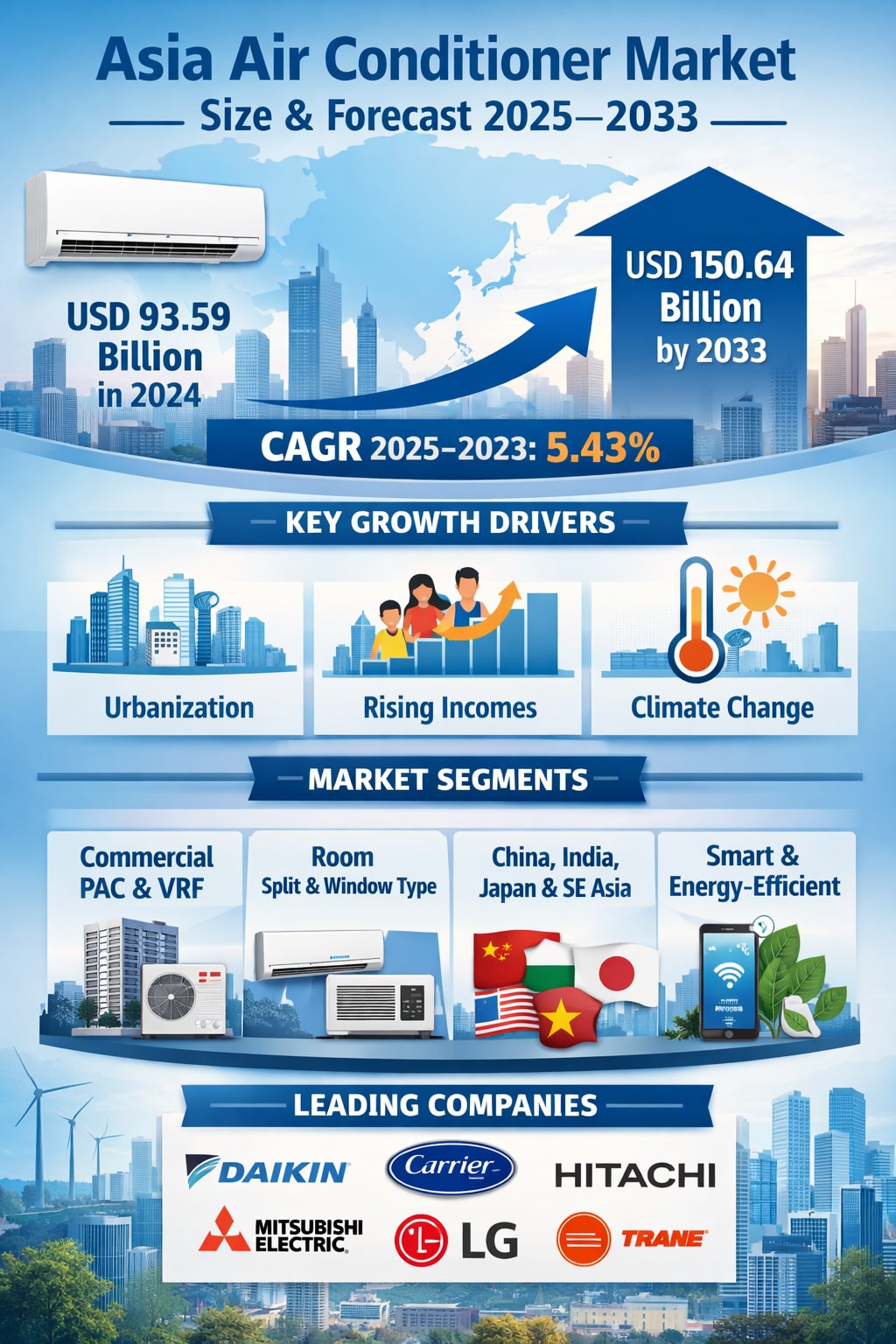
Asia Air Conditioner Market at a Glance
The Asia Air Conditioner (AC) Market was valued at USD 93.59 billion in 2024 and is projected to reach USD 150.64 billion by 2033, growing at a CAGR of 5.43% during 2025–2033. This robust expansion is being fueled by rising temperatures, accelerating urbanization, and the surging demand for energy-efficient cooling systems across residential, commercial, and industrial sectors in major economies such as China, India, Japan, and Southeast Asia.
From compact urban apartments to massive commercial complexes, air conditioning is no longer a luxury in Asia—it is fast becoming a basic necessity. As climate change intensifies heatwaves and cities expand at record pace, cooling infrastructure is turning into one of the region’s most critical consumer and industrial investments.
Asia Air Conditioner Market Overview
An air conditioner (AC) is a device that regulates indoor temperature, humidity, and air quality by extracting heat and circulating cool air within enclosed spaces. Using a refrigeration cycle, modern AC systems often integrate air filtration and smart controls to enhance comfort, efficiency, and health. These systems are widely used across residential homes, offices, shopping malls, hotels, hospitals, factories, and data centers, where precise climate control is essential.
In Asia, the relevance of air conditioning is amplified by the region’s predominantly hot and humid climate. Countries such as India, China, Japan, and those across Southeast Asia experience long, intense summers, often accompanied by high humidity levels. Over the years, air conditioning has shifted from being a premium lifestyle product to an everyday requirement for productivity, comfort, and even public health.
Several structural factors continue to push demand upward. Rising disposable incomes, rapid urban migration, and improving living standards are expanding the consumer base. At the same time, growth in real estate, hospitality, retail, and IT infrastructure is driving large-scale commercial installations. Importantly, governments across the region are also encouraging the adoption of energy-efficient and low-emission cooling systems, aligning HVAC growth with sustainability and climate goals.
Key Growth Drivers in the Asia Air Conditioner Market
1. Urbanization and Infrastructure Expansion
Asia is in the middle of one of the largest urban transitions in human history. Countries like China, India, Vietnam, and Indonesia are witnessing massive investments in housing, transport hubs, offices, shopping centers, and smart cities. Every new apartment block, mall, hospital, or corporate park adds to the demand for reliable cooling solutions.
Urban consumers are increasingly prioritizing indoor comfort and air quality, especially in densely populated cities where heat retention and pollution levels are higher. Large-scale government infrastructure programs and smart city initiatives are further accelerating installations of modern HVAC systems. In addition, continuous rural-to-urban migration is expanding the residential customer base, creating sustained long-term demand for both entry-level and premium AC models.
This shift is not only increasing the volume of units sold but also encouraging the adoption of technologically advanced and energy-efficient models, as cities look to balance comfort with energy management.
2. Growing Middle Class and Rising Disposable Incomes
One of the most powerful engines behind Asia’s AC market growth is the rapid expansion of the middle class. In emerging economies such as India, Indonesia, Vietnam, and the Philippines, millions of households are entering income brackets that allow spending on lifestyle-enhancing appliances.
Air conditioners, once considered aspirational products, are now viewed as essential home upgrades. Easy financing options such as EMIs, buy-now-pay-later schemes, and seasonal discounts have made ACs more accessible than ever. This has led to strong growth not only in entry-level models but also in mid-range and premium segments, including inverter ACs and smart connected systems.
As consumer awareness about energy efficiency and long-term cost savings grows, there is a visible shift toward advanced models that offer better performance with lower electricity consumption—further strengthening market value growth.
3. Climate Change and Intensifying Heatwaves
Asia is among the regions most vulnerable to climate change, with rising average temperatures and more frequent, severe heatwaves. Countries across South and Southeast Asia are experiencing longer and hotter summers, making cooling not just a comfort issue but a public health necessity.
Extreme heat events in recent years have highlighted the risks of heat stress, reduced productivity, and increased health emergencies. As a result, both households and institutions are investing more aggressively in air conditioning and cooling infrastructure. What was once seasonal demand is increasingly becoming near year-round demand in many markets.
Governments and international organizations are also promoting energy-efficient cooling solutions to address the dual challenge of protecting public health while managing the environmental and energy impact of rising AC usage.
Challenges Facing the Asia AC Market
1. High Energy Consumption and Power Grid Stress
Air conditioners are among the most energy-intensive appliances, and their widespread use significantly increases electricity demand, especially during peak summer months. In many developing Asian countries, the power infrastructure is already under strain, leading to outages, voltage fluctuations, and reliability issues.
The continued use of older, less efficient models worsens this challenge. While inverter and energy-efficient ACs offer a solution, their higher upfront cost remains a barrier for price-sensitive consumers. Balancing cooling needs with energy sustainability is therefore one of the region’s most pressing challenges.
2. Affordability and Rural Market Penetration
Despite strong urban demand, affordability remains a major obstacle in rural and low-income segments. The initial cost of purchasing and installing an AC, combined with ongoing electricity expenses, keeps adoption rates low in many areas.
Limited access to financing, lower awareness of energy-efficient technologies, and weaker service infrastructure further restrict penetration. Without targeted policies such as subsidies, low-cost innovations, and rural electrification improvements, a significant portion of Asia’s potential market will remain untapped.
Segment Insights
Asia Commercial PAC Air Conditioner Market
Packaged Air Conditioners (PACs) are widely used in small to mid-sized commercial spaces such as retail stores, clinics, offices, and schools. Their compact design, lower installation complexity, and cost-effectiveness make them ideal for fast-growing urban commercial environments.
The expansion of Asia’s retail sector, SMEs, and public infrastructure projects continues to support PAC demand. At the same time, improvements in energy efficiency and design innovation are helping PAC systems remain competitive against more advanced technologies like VRF in specific applications.
Asia Commercial VRF Air Conditioner Market
Variable Refrigerant Flow (VRF) systems are gaining strong traction in Asia’s commercial segment due to their high energy efficiency, zoning flexibility, and scalability. These systems are especially popular in large office complexes, hotels, hospitals, and IT parks.
Countries such as Japan and South Korea have been early adopters, driven by strict energy standards and green building practices. Although VRF systems require higher initial investment, their lower long-term operating costs and superior performance are accelerating adoption across Southeast Asia and India.
Asia Room Split Air Conditioner Market
Split ACs dominate the residential segment across Asia thanks to their balance of affordability, efficiency, and low noise levels. Urban housing growth in China, India, Vietnam, and Indonesia continues to drive strong demand.
Manufacturers are increasingly differentiating products through inverter technology, smart connectivity, and energy-saving features. Government energy labeling programs and rising consumer awareness about electricity costs are further strengthening this segment’s growth outlook.
Asia Room Window Air Conditioner Market
While facing strong competition from split systems, window ACs still retain a meaningful presence in price-sensitive markets and compact living spaces. Their simple installation and lower upfront cost make them attractive for older buildings, rental homes, and small apartments in countries such as India and the Philippines.
However, concerns over higher noise levels and energy consumption are gradually shifting consumer preferences. Manufacturers are responding with more efficient and quieter models to extend the relevance of this segment.
Country-Level Market Highlights
Japan Air Conditioner Market
Japan’s AC market is one of the most technologically advanced and mature in Asia. Driven by strong domestic brands like Daikin and Mitsubishi Electric, the country leads in inverter and VRF system innovation.
An aging population, high standards for indoor comfort, and strong demand from residential and healthcare sectors ensure steady growth. Japan’s focus on low-carbon technologies, smart homes, and eco-friendly refrigerants continues to shape product development and consumer preferences.
China Air Conditioner Market
China stands as Asia’s largest AC market, supported by massive urbanization, strong manufacturing capabilities, and rising incomes. Residential demand remains robust, with split systems leading the market, while VRF and central systems are gaining popularity in commercial real estate.
Government policies promoting energy efficiency and green buildings are influencing both product design and purchasing decisions. In addition, China’s role as a global manufacturing and export hub makes it a critical player in the worldwide AC industry. Smart, IoT-enabled air conditioners are increasingly appealing to tech-savvy consumers.
India Air Conditioner Market
India’s AC market is among the fastest-growing in Asia, driven by rising temperatures, expanding middle-class incomes, and rapid urban development. While demand is strongest in metro and Tier-1 cities, Tier-2, Tier-3, and even rural markets are beginning to show momentum.
The residential segment—especially split ACs—dominates sales. Government initiatives such as energy labeling and efficiency programs are encouraging the adoption of greener models. E-commerce platforms, seasonal discounts, and easy financing options are further boosting accessibility. Meanwhile, domestic manufacturing under initiatives like “Make in India” is strengthening the long-term growth outlook.
Singapore Air Conditioner Market
Singapore’s market is characterized by high penetration rates due to its year-round hot and humid climate and dense urban environment. The country’s strong emphasis on smart cities and sustainability has driven widespread adoption of inverter ACs and VRF systems.
Strict energy regulations and green building standards play a major role in shaping demand, especially in commercial offices, retail, and hospitality sectors. Compact, low-noise, and smart-integrated systems are particularly popular given space constraints and advanced infrastructure.
Vietnam Air Conditioner Market
Vietnam’s AC market is expanding rapidly, supported by economic growth, urbanization, and rising middle-class consumption. Residential demand, led by split ACs, is surging in major cities such as Ho Chi Minh City and Hanoi, while the commercial sector is increasingly adopting PAC and VRF systems.
Although affordability and power infrastructure remain challenges in rural areas, government support for energy efficiency and continued urban development are expected to sustain long-term growth.
Market Segmentation Snapshot
By Commercial:
PAC
VRF
By Room Type:
Window-Type
Split-Type
By Geography:
China, Japan, India, Indonesia, Vietnam, Thailand, Taiwan, Malaysia, Philippines, Hong Kong, Bangladesh, Myanmar, Singapore, Cambodia, Sri Lanka, Rest of Asia
Company Analysis Covers:
Overview
Key Personnel
Recent Developments
Product Portfolio
Revenue
Key Companies Profiled:
Daikin Industries, Carrier, Electrolux, Emerson Electric Company, Hitachi-Johnson Controls Air Conditioning, Trane Technologies, Mitsubishi Heavy Industries, Ingersoll-Rand
Final Thoughts
The Asia Air Conditioner Market is entering a decisive decade. With market value projected to rise from USD 93.59 billion in 2024 to USD 150.64 billion by 2033, cooling is no longer just a comfort-driven industry—it is becoming a strategic pillar of urban living, public health, and economic infrastructure.
While challenges such as energy consumption, grid pressure, and affordability remain, the push toward energy-efficient, smart, and sustainable cooling solutions is reshaping the competitive landscape. As climate realities intensify and Asia’s cities continue to expand, air conditioning will remain not just a growth market—but a necessity-driven one.
About the Creator
Sakshi Sharma
Content Writer with 7+ years of experience crafting SEO-driven blogs, web copy & research reports. Skilled in creating engaging, audience-focused content across diverse industries.
Keep reading
More stories from Sakshi Sharma and writers in Trader and other communities.
India Cashew Market Size and Forecast 2025–2033
Introduction India’s cashew industry is entering a decisive decade, driven by a blend of changing consumer habits, rising health awareness, and expanding export opportunities. According to Renub Research, the India Cashew Market is expected to reach US$ 3.31 billion by 2033, up from US$ 2.28 billion in 2024, registering a compound annual growth rate (CAGR) of 4.25% from 2025 to 2033. This steady growth reflects not just higher consumption at home, but also India’s continued importance in the global cashew trade.
By Sakshi Sharmaabout 19 hours ago in Trader
Australia E-Commerce Market — Growth, Forecast & Strategic Outlook
The Australia e-commerce market has become one of the most dynamic segments of the nation’s digital economy. According to IMARC Group’s latest research, the Australian e-commerce market reached USD 604.1 billion in 2025 and is projected to expand to USD 1,683.9 billion by 2034, representing a compound annual growth rate (CAGR) of 12.07% during 2026–2034.
By Rashi Sharma3 days ago in Trader
Blessed 33
So I woke up on the morning of February 5, 2026 and guess what and you know what I realized? It’s my 33rd birthday. Do you know what that means? Yes, technically I’m getting old, but what I couldn’t have guessed was this would be one of the best days of my life.
By Joe Patterson6 days ago in Confessions




Comments
There are no comments for this story
Be the first to respond and start the conversation.