
India Cashew Market Size and Forecast 2025–2033
Rising Health Awareness, Expanding Exports, and Product Innovation Reshape India’s Cashew Industry

Introduction
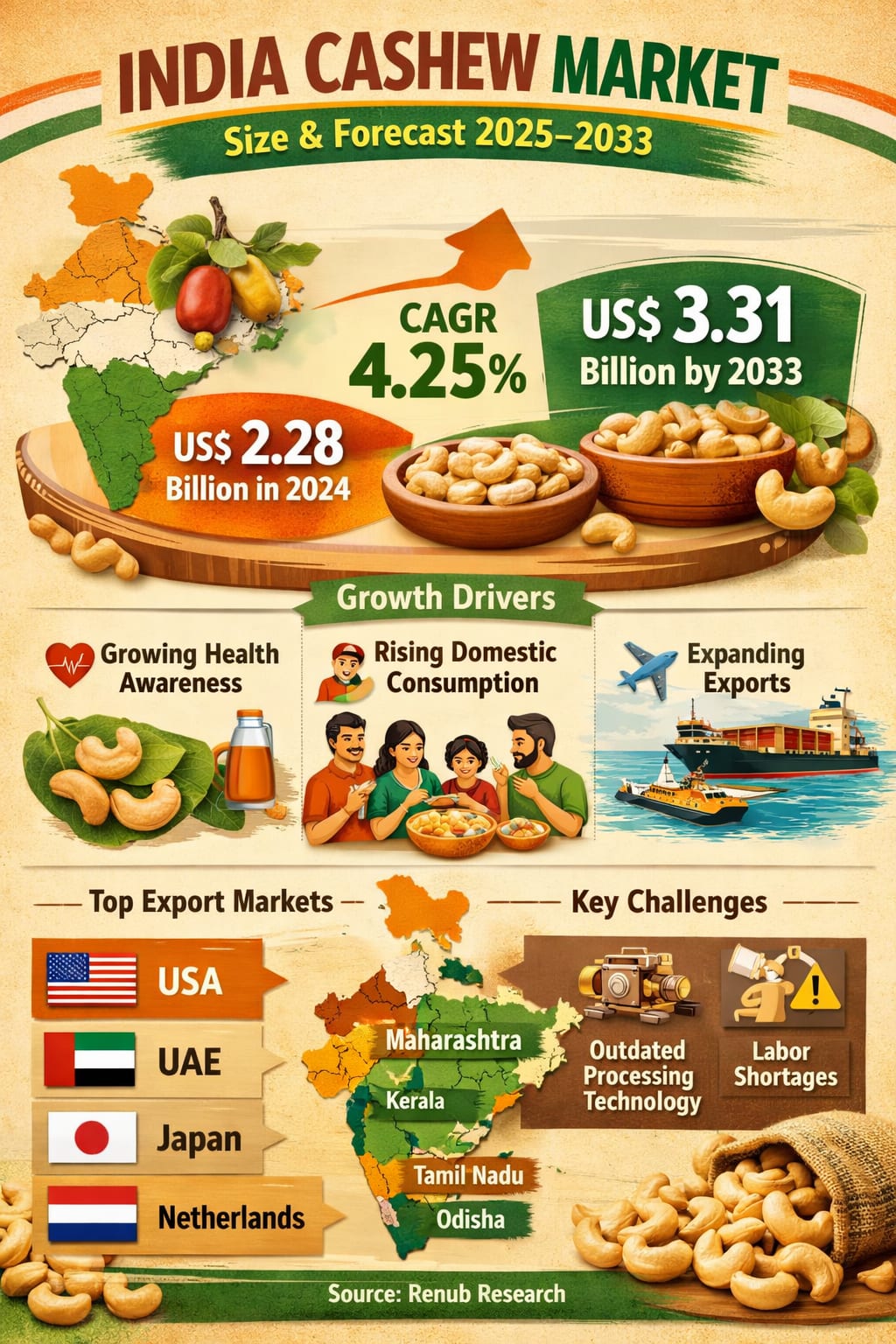
India’s cashew industry is entering a decisive decade, driven by a blend of changing consumer habits, rising health awareness, and expanding export opportunities. According to Renub Research, the India Cashew Market is expected to reach US$ 3.31 billion by 2033, up from US$ 2.28 billion in 2024, registering a compound annual growth rate (CAGR) of 4.25% from 2025 to 2033. This steady growth reflects not just higher consumption at home, but also India’s continued importance in the global cashew trade.
Cashews have long held a special place in Indian households—used in festive sweets, rich gravies, and premium snacks. However, in recent years, they have moved beyond being an occasional indulgence to becoming a regular part of daily diets for many urban and semi-urban consumers. Health-conscious buyers are increasingly turning toward nutrient-dense foods, and cashews, rich in healthy fats, minerals, and vitamins, fit perfectly into this shift.
At the same time, India remains one of the world’s most significant players in cashew processing and exports. The United States, the United Arab Emirates, Japan, and European markets such as the Netherlands continue to be key destinations for Indian cashew kernels. With government support, private investment, and product innovation gaining momentum, the Indian cashew industry is positioning itself not just as a traditional agricultural sector, but as a modern, value-added food industry with global relevance.
India Cashew Market Overview
In terms of both production and exports, India’s cashew sector makes a substantial contribution to the national economy. The country produces over 0.8 million tonnes of cashews annually across approximately 0.7 million hectares of cultivated area. Major producing states include Tamil Nadu, Karnataka, Odisha, Andhra Pradesh, Maharashtra, and Kerala, each playing a vital role in sustaining supply and rural livelihoods.
The industry is also a significant employer, providing livelihoods to around 1.5 million people across farming, processing, and allied activities. Cashew processing, in particular, has historically been labor-intensive, with regions such as Kollam in Kerala emerging as major hubs for shelling, peeling, grading, and packaging.
India exports cashew kernels to more than 60 countries, with the UAE, Japan, the Netherlands, and the United States among the most important markets. Government initiatives such as the Rashtriya Krishi Vikas Yojana (RKVY) and the Mission for Integrated Development of Horticulture (MIDH) aim to boost productivity through better planting material, improved farming practices, and higher-yielding varieties.
From a consumer perspective, the growing focus on nutrition is strengthening long-term demand. A study published in the British Journal of Nutrition suggests that people who consume nuts more than four times a week can significantly reduce their risk of coronary heart disease. This scientific backing is encouraging food manufacturers to incorporate cashews into snack bars, plant-based products, and healthier snack alternatives, replacing high-calorie, low-nutrition options.
The industry is also exploring value addition beyond kernels, including cashew apple products, cashew butter, cashew milk, and even oil extracted from shells. For instance, Sahyadri Farms established one of the largest cashew processing facilities in Nashik in 2023, capable of processing 100 metric tons per day, while also extracting cashew shell oil to enhance overall economic value.
Key Growth Drivers of the India Cashew Market
1. Changing Consumption Patterns
Cashews are no longer limited to festive seasons or special occasions. They are increasingly becoming a regular household staple, especially in urban and semi-urban India. The rapid expansion of supermarkets, hypermarkets, and e-commerce platforms has made cashews more accessible than ever before.
Modern retail has improved product visibility, offered multiple price points, and introduced consumers to a wide range of packaged and branded options. At the same time, changing lifestyles and cooking habits have expanded the use of cashews in everyday recipes—from snacks and breakfast mixes to gravies, desserts, and even plant-based dishes.
Convenience is another major factor. Ready-to-eat, roasted, and flavored cashew packs cater to busy consumers who want healthy snacking options without compromising on taste. These shifts in consumption patterns are steadily pushing domestic demand upward, supporting long-term market growth.
2. Product Innovation and Value Addition
Product innovation is playing a central role in reshaping the Indian cashew market. Brands are increasingly focusing on flavored, organic, and value-added variants to differentiate themselves in a competitive market.
Today’s consumers are drawn to options such as chili-roasted, honey-coated, masala-flavored, and lightly salted cashews, which combine taste with perceived health benefits. Organic cashews, free from synthetic chemicals and pesticides, are also gaining popularity among environmentally and health-conscious buyers.
Beyond traditional snacks, new product categories are emerging. Cashew milk, cashew butter, dairy-free cheese alternatives, and snack bars are becoming especially popular among vegans, lactose-intolerant consumers, and fitness-focused individuals. These innovations not only expand the consumer base but also help companies improve margins through premium pricing and brand positioning.
3. Health and Wellness Trends
The broader shift toward health and wellness is one of the strongest tailwinds for the cashew market. Cashews are rich in heart-healthy monounsaturated fats, along with essential nutrients such as magnesium, copper, zinc, vitamin B6, and vitamin E. These nutrients support heart health, immune function, and overall well-being.
As awareness grows around balanced diets and clean-label foods, consumers are increasingly choosing nuts over processed snacks. Cashews, in particular, benefit from their versatility—they can be eaten raw, roasted, or used as an ingredient in both sweet and savory dishes.
The rise of plant-based diets has further boosted demand for cashew-based alternatives to dairy products. Cashew milk and cashew-based spreads are now widely seen as nutritious, lactose-free options, strengthening both domestic and export demand for value-added cashew products.
Challenges Facing the India Cashew Market
1. Outdated Processing Technology
Despite its global importance, a large part of India’s cashew processing sector still relies on traditional, labor-intensive methods. Shelling, peeling, and grading are often done manually, which reduces productivity and leads to inconsistencies in quality and yield.
In contrast, countries such as Vietnam have invested heavily in automation and modern processing technologies, allowing them to achieve higher efficiency and lower costs. The lack of widespread modernization in India limits scalability and weakens competitiveness in price-sensitive international markets.
Without timely investment in mechanization and technology upgrades, Indian processors may find it increasingly difficult to keep pace with global competitors, especially as export markets demand consistent quality, traceability, and cost efficiency.
2. Labor Shortages and Skill Gaps
The cashew processing industry has historically depended on manual labor, particularly for peeling and shelling. However, labor shortages are becoming a serious concern. Younger workers are increasingly reluctant to take up these physically demanding and sometimes hazardous jobs, especially given the risk of skin and respiratory irritation from handling raw cashews.
As a result, many processing units struggle to find skilled workers, leading to production delays and higher wage costs. This not only raises overall manufacturing expenses but also affects the industry’s ability to scale up operations.
Without focused efforts in skill development, training programs, improved working conditions, and gradual mechanization, the sector risks long-term operational inefficiencies and a further erosion of its global competitiveness.
Regional Spotlight: Maharashtra Cashew Market
Maharashtra contributes nearly one-fourth of India’s cashew production, making it one of the most important states in the sector. The coastal districts of Ratnagiri, Sindhudurg, and Kolhapur provide favorable climatic conditions for large-scale cultivation.
Despite its strong production base, Maharashtra is also one of the largest importers of raw cashew nuts in India. Factors such as pest attacks, climate-related yield fluctuations, and gaps in productivity have made the state dependent on imports to meet processing demand. The processing sector remains largely small-scale and labor-intensive, with limited technological advancement.
To address these challenges, the Maharashtra Cashew Board has announced plans to expand cultivation by 12,000 hectares over three years, focusing on high-density, high-yielding, and organic varieties. The goal is to increase production and reduce raw nut imports by around 25%. Additionally, the promotion of value-added products such as cashew apple juice and cashew wine could boost farm incomes by up to 20%, strengthening the state’s position in both domestic and international markets.
Regional Spotlight: Kerala Cashew Market
Once a global leader in cashew processing, Kerala’s cashew industry is now facing significant challenges. The state currently produces only about 83,000 metric tons of raw cashew nuts, compared to an estimated demand of 600,000 metric tons. It ranks fifth in production and sixth in cultivated area among Indian states, reflecting a long-term decline in productivity and acreage.
The industry remains a crucial source of employment, with around 300,000 workers, nearly 95% of whom are women. However, shortages of raw materials and rising operating costs have forced several processing units, especially in Kollam, to shut down or reduce capacity.
In response, the Kerala State Cashew Development Corporation (KSCDC) has begun sourcing raw cashew nuts from African countries and is gradually introducing partial mechanization. The aim is to improve efficiency and secure raw material supplies while protecting jobs and sustaining livelihoods.
Global Context: Vietnam Cashew Market
Vietnam has emerged as the undisputed leader in the global cashew trade, particularly in processing and exports. The country imports large volumes of raw cashews from producing nations, including India, and has built a highly efficient, technology-driven processing industry.
In 2024, Vietnam exported over 730,000 tons of processed cashews, generating a record US$ 4.37 billion in revenue. The country now processes more than 80% of the world’s cashew supply, giving it immense influence over global prices and trade flows.
While Vietnam faces challenges such as rising shipping costs and limited domestic raw material production, its strong infrastructure, automation, and export-focused strategy continue to set a high benchmark for other cashew-producing and processing nations, including India.
India Cashew Market Segmentation
Cashew Production Market – By States:
Maharashtra
Andhra Pradesh
Orissa
Karnataka
Tamil Nadu
Kerala
Others
Cashew Export Market – By Countries:
UAE
Netherlands
Japan
Saudi Arabia
Vietnam
Others
Company Analysis (Covered from Four Viewpoints):
Key Person
Overview
Revenue Analysis
Recent Development & Strategy
Key Companies Profiled:
Wonderland Foods
Kalbavi Cashews
Britannia Industries Limited
Haldirams
These players are increasingly focusing on branding, product diversification, and distribution expansion to capture both domestic and international growth opportunities.
Final Thoughts
The India Cashew Market stands at an important crossroads. With the market projected to grow from US$ 2.28 billion in 2024 to US$ 3.31 billion by 2033, the industry’s future looks promising, supported by health trends, changing consumption patterns, and rising demand for value-added products.
However, sustaining this growth will require modernization of processing infrastructure, investment in technology, and focused efforts to address labor and skill challenges. At the same time, strengthening farm productivity, promoting high-yield varieties, and expanding value-added product lines can help India protect and enhance its position in the global cashew trade.
If these structural challenges are addressed effectively, India’s cashew industry will not only remain a vital part of the country’s agribusiness landscape but also evolve into a more competitive, innovative, and globally influential sector over the coming decade.
About the Creator
Sakshi Sharma
Content Writer with 7+ years of experience crafting SEO-driven blogs, web copy & research reports. Skilled in creating engaging, audience-focused content across diverse industries.
Keep reading
More stories from Sakshi Sharma and writers in Trader and other communities.
Latin America & Caribbean Automotive Tire Market: Growth, Trends, and Forecast 2025–2033
Introduction The Latin America & Caribbean Automotive Tire Market is steadily gaining momentum, supported by rising vehicle ownership, improving road infrastructure, and expanding mobility needs across both mainland and island economies. According to Renub Research, the market was valued at USD 4.08 billion in 2024 and is projected to reach USD 5.56 billion by 2033, growing at a CAGR of 3.51% from 2025 to 2033.
By Sakshi Sharmaabout 22 hours ago in Trader
Australia Electric Iron Market Poised for Strong Growth on the Back of Urban Lifestyles and Smart Innovation
The Australia electric iron market reached approximately USD 41.8 Million in 2025 and is projected to grow to USD 97.1 Million by 2034, expanding at a CAGR of 9.81% during the forecast period of 2026–2034. This striking growth reflects robust consumer demand for modern, efficient home appliances and an evolving retail environment where convenience and technology are increasingly central to purchase decisions.
By Rashi Sharma4 days ago in Trader




Comments
There are no comments for this story
Be the first to respond and start the conversation.