
Belgium Watch Market Size and Forecast 2025–2033
Luxury Heritage Meets Smart Innovation in a Changing Timepiece Industry

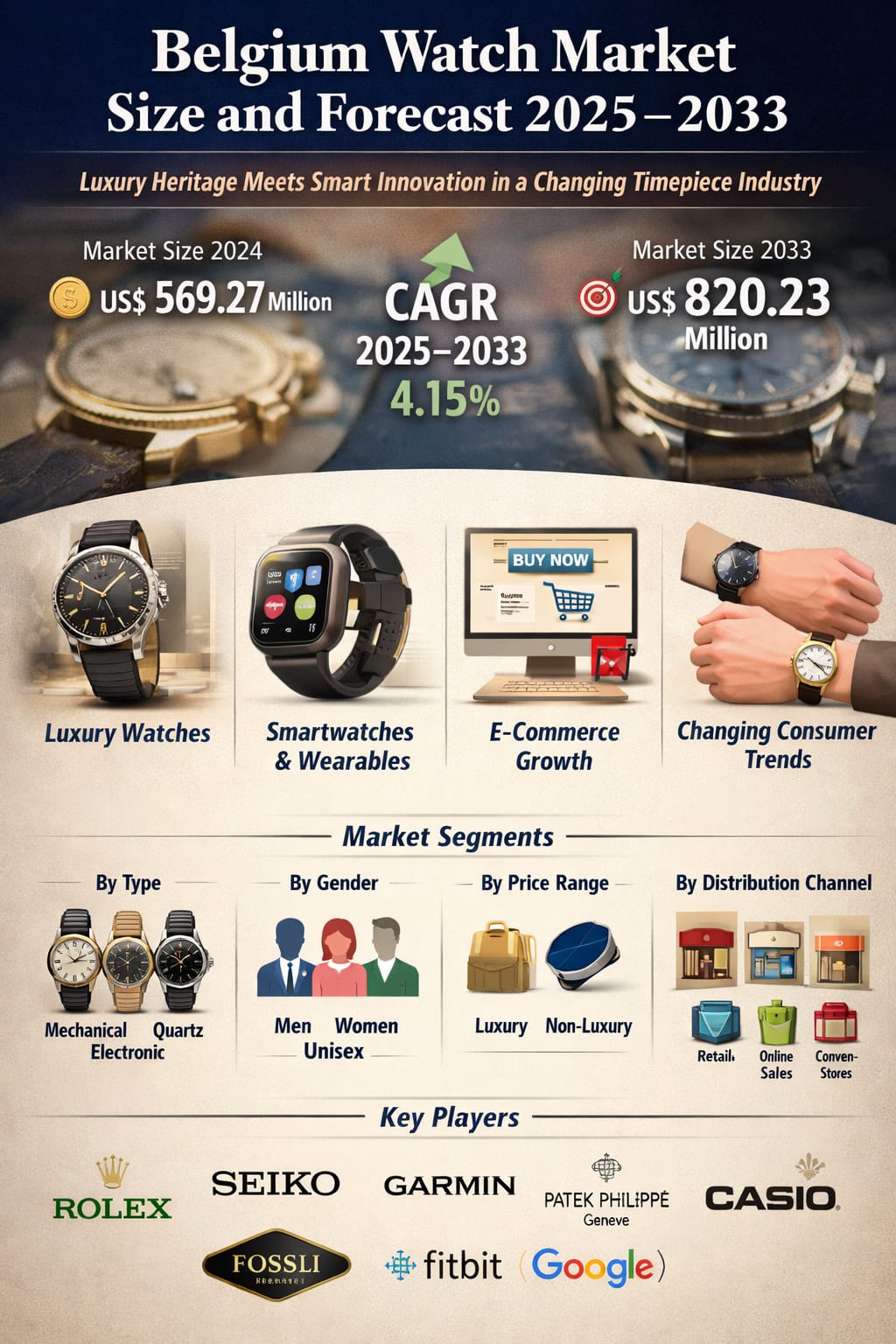
Belgium Watch Market Overview
The Belgian watch market in 2024 was estimated at US$ 569.27 million and is anticipated to grow to US$ 820.23 million by 2033, registering a CAGR of 4.15% during the forecast period from 2025 to 2033. This steady growth reflects a market that is balancing tradition with innovation, where luxury craftsmanship, affordable quartz watches, and feature-rich smartwatches coexist and compete for consumer attention.
A watch is a wrist- or pocket-worn timepiece designed primarily to display time, but modern watches often offer far more than simple timekeeping. Today’s market includes mechanical watches, quartz watches, and electronic or smartwatches, each catering to different consumer needs and price sensitivities. In Belgium, watches serve not only as functional accessories but also as symbols of status, fashion statements, and increasingly, as personal health and fitness companions.
Luxury watches continue to hold a special place in Belgian consumer culture. Premium brands such as Rolex, Omega, and Patek Philippe are widely regarded as markers of success and refined taste, and in many cases, as long-term investment assets. At the same time, smartwatches are gaining rapid traction among tech-savvy and health-conscious consumers who value features like heart-rate monitoring, GPS tracking, sleep analysis, and smartphone connectivity. Meanwhile, quartz watches remain popular due to their affordability, accuracy, and low maintenance requirements, making them a practical choice for everyday use.
The Belgian watch market also benefits from the expansion of both online and offline retail channels. Hypermarkets, convenience stores, brand boutiques, and e-commerce platforms all play a role in making watches widely accessible across different consumer segments. As a result, watches in Belgium are no longer just timekeeping tools—they are lifestyle products that reflect personal identity, technological adoption, and fashion sensibilities.
Key Drivers of Growth in the Belgium Watch Market
Rising Demand for Smartwatches and Wearable Technology
One of the most powerful growth drivers in the Belgian watch market is the increasing adoption of smartwatches and wearable technology. Consumers are becoming more focused on health, fitness, and digital connectivity, and smartwatches offer a convenient way to integrate these priorities into daily life. Features such as step counting, heart-rate monitoring, GPS navigation, sleep tracking, and smartphone notifications have transformed watches into multifunctional personal devices.
Global technology brands like Apple, Samsung, Garmin, and Fitbit continue to introduce new models with improved performance, longer battery life, and more advanced health-tracking capabilities. These innovations make smartwatches increasingly attractive to a broad range of consumers, from fitness enthusiasts and young professionals to older users seeking health-monitoring tools. The integration of smartwatches with mobile apps and digital ecosystems further enhances their appeal, reinforcing their role as essential everyday devices rather than optional accessories.
Growing Appetite for Luxury and Premium Watches
Despite the rise of digital wearables, Belgium maintains a strong and resilient market for luxury watches. Higher disposable incomes, a culture of appreciation for fine craftsmanship, and the perception of luxury watches as investment pieces continue to support demand. Swiss watchmakers such as Rolex, Omega, TAG Heuer, and Patek Philippe enjoy a loyal customer base that values heritage, precision, and exclusivity.
Luxury watches are often purchased to mark important life milestones or as long-term assets that can retain or even increase in value over time. The growing interest in limited-edition models and collectible timepieces further strengthens this segment. For many Belgian consumers, owning a luxury watch is not just about telling time—it is about owning a piece of art, history, and engineering excellence.
Expansion of E-Commerce and Digital Retail
The rapid growth of e-commerce and digital retail platforms has significantly transformed how watches are bought and sold in Belgium. Consumers increasingly prefer online shopping due to convenience, wider product selection, competitive pricing, and easy comparison between brands and models. Major platforms such as Amazon, Bol.com, and specialized watch e-commerce stores offer extensive catalogs that cater to both budget-conscious buyers and luxury shoppers.
Even premium brands are embracing direct-to-consumer (DTC) strategies, launching exclusive online collections and enhancing digital customer experiences through virtual consultations and augmented reality (AR) try-on tools. Secure payment systems, fast delivery options, and flexible return policies have further strengthened consumer confidence in buying watches online. As digital retail continues to evolve, it is expected to remain a key growth engine for the Belgian watch market.
Challenges Facing the Belgium Watch Market
Intensifying Competition from Smart Devices
Traditional watchmakers face growing competition from smartwatches and other wearable devices that offer far more functionality than conventional timepieces. Younger consumers, in particular, often prioritize connectivity, fitness tracking, and app integration over classic design and mechanical craftsmanship. Technology giants such as Apple and Samsung dominate this space, making it difficult for traditional brands to compete purely on features.
To stay relevant, many heritage watch brands are either introducing hybrid models or doubling down on storytelling around craftsmanship, heritage, and exclusivity. However, this shift in consumer preference remains a significant challenge, especially for mid-range mechanical and quartz watch brands.
High Dependence on Imported Watches
Belgium’s watch market relies heavily on imports from Switzerland, Japan, and China. This dependence makes the market vulnerable to supply chain disruptions, currency fluctuations, changes in trade policies, and import duties. Luxury watches, in particular, can become significantly more expensive due to taxes and VAT, potentially limiting demand among price-sensitive consumers.
Moreover, this reliance on foreign manufacturing limits the development of a strong domestic watchmaking industry, making it difficult for local brands to compete with established global players. These factors introduce a degree of uncertainty and price volatility into the Belgian watch market.
Segment Insights
Belgium Electronic Watch Market
The electronic and smartwatch segment is one of the fastest-growing areas in the Belgian watch market. Consumers are drawn to the multifunctional nature of these devices, which combine timekeeping with health monitoring, fitness tracking, navigation, and communication features. Brands such as Apple, Samsung, Garmin, and Fitbit dominate this space, continually pushing technological boundaries.
The integration of AI features, voice assistants, and contactless payment systems further enhances the appeal of electronic watches. As digital lifestyles become more entrenched, this segment is expected to continue expanding, supported by innovation in battery life, design, and user experience.
Belgium Mechanical Watch Market
The mechanical watch segment remains closely associated with luxury, craftsmanship, and heritage. High-end Swiss brands continue to attract collectors and enthusiasts who appreciate the intricate engineering and artistry behind mechanical movements. For many buyers, these watches represent more than just accessories—they are symbols of status and personal achievement.
The growing interest in vintage and pre-owned luxury watches also supports this segment, as mechanical watches often retain or increase their value over time. However, competition from smartwatches means that brands in this segment must emphasize exclusivity, storytelling, and timeless design to maintain their appeal.
Belgium Quartz Watch Market
Quartz watches continue to be popular in Belgium due to their affordability, accuracy, and low maintenance. Brands such as Seiko, Casio, and Tissot offer a wide range of styles, from casual and sporty designs to more formal and elegant options. This segment is particularly attractive to budget-conscious consumers and younger buyers looking for reliable yet stylish timepieces.
However, with the growing popularity of smartwatches, quartz watch manufacturers are under pressure to innovate through improved design, sustainable materials, and added features to remain competitive.
Gender and Price Segment Trends
Belgium Men’s Watch Market
The men’s watch segment in Belgium is highly diverse, ranging from luxury mechanical watches to rugged sports watches and advanced smartwatches. Business professionals often prefer classic analog designs, while younger consumers and fitness enthusiasts lean toward digital and smart models. The demand for durable, feature-rich watches for outdoor and sports activities is also rising, reflecting broader lifestyle trends focused on health and activity.
Belgium Luxury Watch Market
The luxury watch segment remains a cornerstone of the Belgian market. Brands such as Rolex, Audemars Piguet, Cartier, and Patek Philippe continue to attract affluent consumers who view these timepieces as both status symbols and investment assets. Limited editions, exclusive collections, and high-profile collaborations further enhance demand. However, luxury brands must also contend with challenges such as counterfeiting and shifting consumer interest toward smart devices.
Distribution Channel Insights
Belgium Convenience Stores Watch Market
Convenience stores in Belgium typically sell affordable, functional watches, mainly quartz models designed for everyday use. These products cater to value-conscious consumers and impulse buyers who prioritize practicality over brand prestige. While this segment does not drive high revenue growth, it remains stable due to consistent demand for low-cost, reliable timepieces.
Belgium Online Watch Market
The online retail segment is rapidly gaining importance. E-commerce platforms offer consumers access to a wide variety of brands and price points, along with detailed product information, customer reviews, and competitive pricing. Features such as fast delivery, secure payments, and seasonal discounts further boost online sales. As digital shopping habits continue to strengthen, online channels are expected to play an increasingly central role in the Belgian watch market.
Belgium Watch Market Segmentation
By Type:
Quartz Watches
Electronic Watches
Mechanical Watches
By Gender:
Men
Women
Unisex
By Price Range:
Luxury
Non-Luxury
By Distribution Channel:
Hypermarket/Supermarket
Convenience Stores
Online
Key Players Analysis
Major companies operating in the Belgian watch market include:
Seiko Holdings Corporation
Casio Computer Co. Ltd
Timex Group
Rolex SA
Compagnie Financière Richemont S.A
The Swatch Group Ltd
Citizen Watch Co. Ltd.
Fossil Group Inc.
Google LLC (Fitbit Inc.)
These players compete across different price segments and product categories, focusing on innovation, brand positioning, and distribution expansion. Their strategies typically revolve around product launches, technological upgrades, partnerships, and strengthening both physical and digital retail presence.
Final Thoughts
The Belgium watch market is entering a dynamic phase of transformation. With the market expected to grow from US$ 569.27 million in 2024 to US$ 820.23 million by 2033 at a CAGR of 4.15%, the industry is clearly benefiting from a combination of technological innovation, sustained demand for luxury timepieces, and expanding digital retail channels.
While challenges such as competition from smart devices and reliance on imports remain, the market’s ability to cater to diverse consumer preferences—from luxury collectors to fitness-focused smartwatch users—positions it well for long-term growth. In the years ahead, success in the Belgian watch market will likely depend on how effectively brands balance heritage with innovation, craftsmanship with connectivity, and tradition with modern consumer expectations.
About the Creator
Tom Shane
Tom Shane is a content writer specializing in SEO-driven blogs, product descriptions, and thought leadership. He crafts engaging, research-backed content that connects with audiences and drives results.
The People Who Build Wealth and Stay Fit Have the Same 5 Habits
At some point I noticed something strange: the people who were winning at one were usually winning at the other. The disciplined investors I knew were almost always in good shape. The people who stayed fit for decades usually had their finances together. It wasn't random. The same patterns kept showing up.
By Destiny S. Harrisa day ago in Trader
Bitcoin and the Long Road From Internet Idea to Global Asset
Bitcoin did not arrive with a parade. It appeared quietly, almost shyly, during a time when trust in systems was already fragile. At first, it felt like an idea meant only for programmers and online forums. Years passed, and the word bitcoin slowly entered everyday conversations. Some spoke of hope. Others spoke of fear. Many simply felt confused. What makes this digital thing matter so much? Why does it stir such strong emotions across countries and generations? Bitcoin is not just about money. It reflects doubt, belief, patience, and risk. To understand bitcoin is to understand how people respond when old systems feel heavy and new paths appear uncertain. This story is about that tension, and why bitcoin continues to matter.
By Muqadas khan7 days ago in Trader
Our Song
Evening has given way to night. Gently, I settle next to you on the comfortable, old love seat and reach for your hand. You snatch it away, again. It cuts me to the quick, but I hide the pain, understanding that the reaction is but part of your demented state. Since the accident, your presence here in our cozy home has been clouded by a haze I can't see. Nevertheless, I feel the frigidity of your expressions and it serves as an excruciating reminder of the immeasurable distance between us.
By Dana Crandell6 days ago in Fiction


Comments
There are no comments for this story
Be the first to respond and start the conversation.