
Global Cardiac Arrhythmia Monitoring Devices Market Size and Forecast 2025–2033
How Wearables, AI, and Remote Monitoring Are Reshaping the Future of Heart Rhythm Care

Introduction: A Heartbeat Away from a Tech Revolution
The global healthcare industry is in the middle of a quiet but powerful transformation, and few areas show this shift more clearly than cardiac care. Among the most critical innovations driving this change are cardiac arrhythmia monitoring devices—technologies designed to detect, track, and help manage abnormal heart rhythms before they become life-threatening.
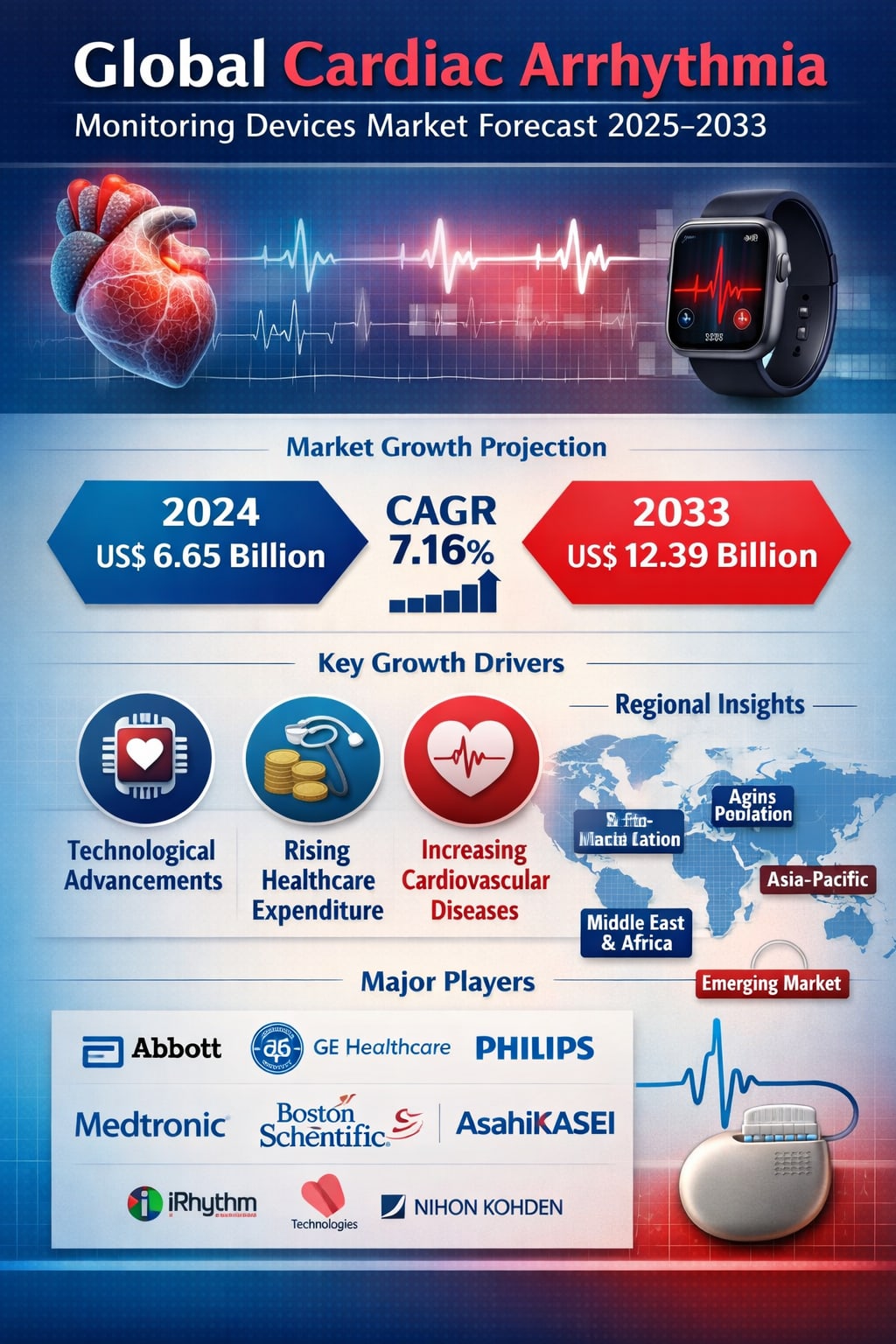
According to Renub Research, the Cardiac Arrhythmia Monitoring Devices Market is expected to grow from US$ 6.65 billion in 2024 to US$ 12.39 billion by 2033, registering a CAGR of 7.16% from 2025 to 2033. This strong growth reflects a world that is aging, increasingly health-conscious, and more open than ever to wearable technology and remote patient monitoring.
From smartwatches that record ECGs to implantable loop recorders that quietly monitor the heart for years, these devices are changing how doctors diagnose, treat, and prevent serious cardiac events. More importantly, they are helping millions of patients live safer, more informed lives—one heartbeat at a time.
Market Overview: What Are Cardiac Arrhythmia Monitoring Devices?
Cardiac arrhythmia monitoring devices are medical tools used to detect, record, and analyze abnormal heart rhythms. These irregular rhythms—known as arrhythmias—can range from harmless palpitations to dangerous conditions like atrial fibrillation or ventricular tachycardia that significantly increase the risk of stroke, heart failure, or sudden cardiac death.
Today’s market includes a wide range of technologies, such as:
Wearable ECG monitors and smartwatches for continuous, real-time tracking
Holter monitors for short-term ambulatory monitoring
Mobile cardiac telemetry (MCT) devices for remote, real-time data transmission
Implantable loop recorders (ILRs) for long-term, high-precision monitoring
Modern devices increasingly use artificial intelligence (AI) and advanced algorithms to improve diagnostic accuracy and detect subtle abnormalities earlier than ever before. Combined with cloud platforms and telemedicine, these tools allow physicians to monitor patients remotely, reduce unnecessary hospital visits, and intervene faster when problems arise.
In short, cardiac arrhythmia monitoring devices have moved from being niche hospital tools to becoming essential components of modern, connected healthcare systems.
Key Growth Drivers Shaping the Market
1. Rapid Technological Advancements
Technology is the single biggest force accelerating this market. The rise of wearable devices, AI-driven analytics, wireless connectivity, and miniaturized sensors has transformed what cardiac monitoring looks like today.
Patients can now wear lightweight patches, smartwatches, or small external devices that continuously track heart rhythms without disrupting daily life. For those with chronic or unexplained symptoms, implantable loop recorders provide long-term monitoring with minimal inconvenience.
AI-powered software further enhances these devices by:
Detecting arrhythmias earlier and more accurately
Reducing false alarms
Helping physicians prioritize high-risk cases
Improving overall clinical decision-making
A strong example of this trend came in July 2024, when Morgan Stanley sponsored a USD 43 million fundraising round for Octagos Health, an AI-powered cardiac device monitoring company. The goal: to use advanced AI to transform patient monitoring and cardiac care delivery. Moves like this highlight how deeply technology and cardiology are now intertwined.
2. Rising Healthcare Expenditure Worldwide
Another major driver is the steady increase in healthcare spending across both developed and emerging economies. Governments and private healthcare providers are investing more in advanced diagnostic tools that can improve outcomes while reducing long-term treatment costs.
Cardiac arrhythmia monitoring devices fit perfectly into this strategy. By enabling early detection and continuous monitoring, these tools can:
Prevent costly complications like strokes and heart failure
Reduce emergency hospital admissions
Support more efficient, outpatient-based care models
Higher healthcare budgets also encourage research and development, leading to more affordable, user-friendly, and accessible monitoring solutions over time—especially important for expanding adoption in developing regions.
3. Growing Burden of Cardiovascular Diseases
The global rise in cardiovascular diseases (CVDs) is perhaps the most powerful demand driver of all. Sedentary lifestyles, aging populations, poor diets, obesity, diabetes, and stress have all contributed to a surge in heart-related conditions worldwide.
In the United States alone, the American Heart Association estimates that more than 130 million Americans could be living with cardiovascular diseases by 2035. A significant portion of these patients are at risk of developing arrhythmias, many of which require continuous or long-term monitoring.
As CVD cases rise, so does the need for:
Wearable ECG devices
Implantable monitoring solutions
Remote patient monitoring platforms
Data-driven cardiac care pathways
This growing patient pool ensures a strong and sustained demand for arrhythmia monitoring technologies well into the next decade.
Challenges Facing the Market
1. High Cost of Devices
Despite their benefits, cost remains a major barrier. Advanced implantable devices and sophisticated wearable systems often come with high upfront prices. Add to that the costs of maintenance, data services, and replacements, and the total expense can become prohibitive—especially in low- and middle-income regions.
For many healthcare systems and patients, these costs limit access, slowing down adoption even when the clinical need is clear.
2. Limited Reimbursement Coverage
Another significant hurdle is inadequate reimbursement. In many countries, insurance providers do not fully cover newer monitoring technologies, particularly implantable loop recorders or advanced wearable ECG devices.
This creates a financial burden for patients and discourages hospitals and clinics from widely prescribing or deploying these solutions. Without stronger reimbursement frameworks, market growth in some regions may remain below its full potential.
Regional Market Insights
North America: The Global Leader
North America, led by the United States, dominates the cardiac arrhythmia monitoring devices market thanks to:
A highly developed healthcare infrastructure
Strong adoption of wearable technology
High awareness of heart health
Supportive regulatory and innovation ecosystems
In the U.S., the rising prevalence of atrial fibrillation (AFib) is a major growth driver. According to the Centers for Disease Control and Prevention (CDC), AFib is expected to affect 12.1 million people in the U.S. by 2030, making it the most common cardiac arrhythmia in the country.
Mobile cardiac outpatient telemetry (MCOT) is also gaining traction, allowing patients to be monitored continuously outside traditional clinical settings. In January 2022, Biotricity received FDA 510(k) clearance for its Biotres Cardiac Monitoring Device, a wearable Holter patch capable of continuous three-channel ECG recording—further expanding innovation in this space.
Europe: Driven by Aging and Awareness
Europe follows closely behind, supported by:
Aging populations
Strong public healthcare systems
Growing awareness of early diagnosis and prevention
Countries like Germany, France, and the UK are seeing increased adoption of implantable and wearable monitoring devices as part of broader digital health and preventive care strategies.
Asia Pacific: The Fastest-Growing Region
The Asia Pacific region is emerging as the fastest-growing market due to:
Large patient populations
Rapid urbanization
Rising healthcare investments
Expanding access to medical technology
India Spotlight
In India, cardiovascular diseases are a major and growing public health concern. Data from the Indian Institute of Public Health Gandhinagar (IIPHG) in August 2024 highlights the rising burden of heart attacks, strokes, diabetes, obesity, hypertension, and high cholesterol.
As awareness improves and telemedicine expands, demand for wearable ECG monitors, Holter devices, and implantable recorders is increasing—especially in underserved and rural areas where remote monitoring can bridge critical healthcare gaps.
Middle East & Africa: Gradual but Steady Growth
In regions like Saudi Arabia, market growth is being supported by:
An aging population
Rising rates of cardiovascular diseases
Government-led healthcare modernization under Vision 2030
Increasing adoption of telemedicine and remote monitoring
While growth is slower compared to North America or Asia Pacific, long-term prospects remain positive as healthcare infrastructure continues to improve.
Market Segmentation Overview
By Type
ECG Monitors
Implantable Monitors
Holter Monitors
Mobile Cardiac Telemetry
Others
By Application
Atrial Fibrillation
Bradycardia
Tachycardia
Ventricular Fibrillation
Premature Contraction
Others
By End User
Hospitals & Clinics
Diagnostic Centers
Others
By Geography
North America: United States, Canada
Europe: France, Germany, Italy, Spain, UK, Belgium, Netherlands, Turkey
Asia Pacific: China, Japan, India, South Korea, Thailand, Malaysia, Indonesia, Australia, New Zealand
Latin America: Brazil, Mexico, Argentina
Middle East & Africa: Saudi Arabia, UAE, South Africa
Rest of the World
Competitive Landscape: Key Players
Major companies shaping the global cardiac arrhythmia monitoring devices market include:
Abbott Laboratories
GE Healthcare
Koninklijke Philips N.V.
Medtronic PLC
Asahi Kasei Corporation
Boston Scientific Corporation
iRhythm Technologies
Nihon Kohden
These players compete across product innovation, technological integration, global expansion, and strategic partnerships, with a strong focus on AI, wearable platforms, and remote monitoring ecosystems.
Final Thoughts: The Future Is Continuous, Connected, and Preventive
The global cardiac arrhythmia monitoring devices market is no longer just about diagnosing heart rhythm problems—it’s about preventing complications, empowering patients, and building smarter healthcare systems.
With the market projected to nearly double from US$ 6.65 billion in 2024 to US$ 12.39 billion by 2033, the momentum is clear. Wearables, AI, telemedicine, and implantable technologies are converging to create a future where heart health is monitored continuously, not just during hospital visits.
Challenges like cost and reimbursement remain, but the long-term direction is unmistakable: cardiac care is becoming more proactive, more personalized, and more connected. For patients, providers, and healthcare systems alike, that’s not just good business—it’s a lifesaving evolution.
About the Creator
S&P/ASX 200 Edges Down 0.07% as Australian Market Closes Lower
The Australian share market ended the session marginally lower, with the S&P/ASX 200 slipping 0.07%, as cautious investor sentiment and mixed global cues weighed on market performance. Despite attempts to stabilize during the trading session, selling pressure in select sectors pushed the benchmark index into negative territory by the close.
By Hammad Nawazabout 24 hours ago in Trader
When True Love Never Questions Your Soul
“And she’s going to learn that this life will hit you, hard, in the face, wait for you to get back up, just so it can kick you in the stomach but getting the wind knocked out of you is the only way to remind your lungs how much they like the taste of air.” — Sarah Kay’s Poem — If I Should Have a Daughter
By Chantal Christie Weiss3 days ago in Humans




Comments
There are no comments for this story
Be the first to respond and start the conversation.