
3I ATLAS Discovery Explained: Why This Interstellar Visitor Is Important for Astronomy?
A rare object from beyond our solar system that is helping scientists unlock the secrets of deep space

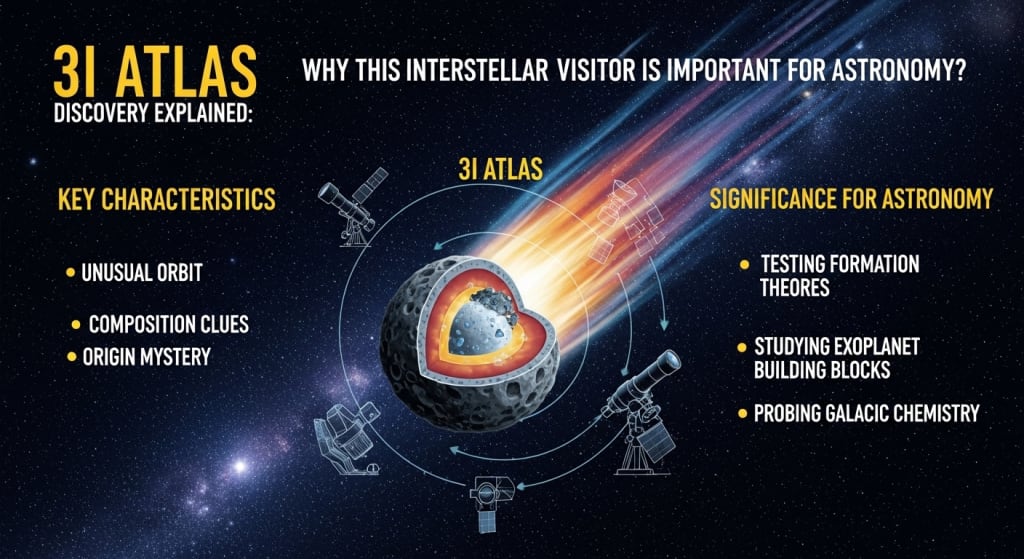
The discovery of the 3I/ATLAS comet has caught the attention of scientists and space lovers around the world. This rare object did not come from our solar system, which makes it special and exciting to study.
In simple words, it is a visitor from another star system. By learning about it, astronomers hope to understand how other solar systems are formed and how space works beyond our own neighborhood.
What Makes This Space Object Special?
This interstellar object is only the third of its kind ever detected. That alone makes it historic.
Unlike common comets, it travels on a path that shows it came from outside our solar system. This unusual movement helped scientists quickly spot that it was different.
How Astronomers Detected It?
The object was first seen by a powerful sky survey telescope. These telescopes scan the sky every night looking for moving objects.
When experts noticed its speed and direction, they realized it could not be from our solar system. Further checks confirmed its interstellar origin.
Why Scientists Got Excited?
Scientists rarely get the chance to study objects from other star systems. This discovery offers a fresh sample of space material.
It is like getting a message in a bottle from far away. Each observation helps answer big questions about the universe.
What the Name Tells Us?
The name may sound technical, but it has meaning. The “3I” means it is the third known interstellar object.
“ATLAS” refers to the telescope system that discovered it. This naming helps track and organize important discoveries in astronomy.
How This Visitor Moves Through Space?
This object moves very fast compared to regular comets. Its path is stretched and open, not circular.
That shape tells scientists it will not return. Once it passes through, it will continue its long journey through space.
What It Is Made Of?
Early studies suggest it is made of ice, dust, and rock. These materials are common in comets, but their mix may be unique.
By studying its light and glow, scientists can guess what it contains. This helps compare it with objects from our own solar system.
How It Helps Us Learn About Other Systems?
Every solar system forms differently. By studying this object, scientists can see how materials form elsewhere.
The 3I/ATLAS comet acts like a sample from another star system. That makes it incredibly valuable for research.
What Makes It Different From Past Discoveries?
Earlier interstellar objects looked more like rocks. This one behaves more like a classic comet.
It shows gas and dust as it warms up. This gives scientists more data to study and compare.
Why Regular People Should Care?
You do not need to be a scientist to find this exciting. Discoveries like this remind us how big and mysterious space is.
They also inspire curiosity and future exploration. Many young students may become scientists because of moments like this.
Key Facts at a Glance
Here are some simple points to remember:
It came from outside our solar system
It is only the third known interstellar object
It was discovered by a sky survey telescope
It will not return after leaving our system
It helps scientists study other star systems
What Scientists Are Still Studying?
Researchers are still watching its movement and brightness. Every day brings new data.
They hope to learn how long it has traveled and where it came from. These answers may take years to fully understand.
The Role of Modern Technology
Advanced telescopes made this discovery possible. Older tools may have missed it.
Better technology means more discoveries in the future. We may soon find more visitors like this one.
Final Thoughts
The discovery of the 3I/ATLAS comet is a reminder that our solar system is not alone. Objects from faraway stars can and do pass through our cosmic backyard.
By paying attention to discoveries like this, we learn more about the universe and our place in it. Stay curious, because space always has more stories to tell.
About the Creator
Australia Sanitary Ware Market 2026: Housing Activity, Design Innovation & Bathroom Renovation Trends
Australia Sanitary Ware Market Overview The Australia sanitary ware market is an essential component of the country’s building materials and home improvement landscape, supplying products that are integral to both residential and commercial bathrooms and washrooms. Sanitary ware includes toilets, washbasins, urinals, bidets, and related ceramic and composite fixtures designed to support hygiene, comfort and aesthetics. Over the past decade, sanitary ware has evolved from purely functional products into design-focused elements that contribute to interior style, water efficiency and overall home value.
By Amyra Singh5 days ago in Trader




Comments
There are no comments for this story
Be the first to respond and start the conversation.