
When There Is No Gray: A Border Patrol Killing With No Plausible Ambiguity
Sometimes the problem isn’t uncertainty—it’s the refusal to admit when there is no gray.

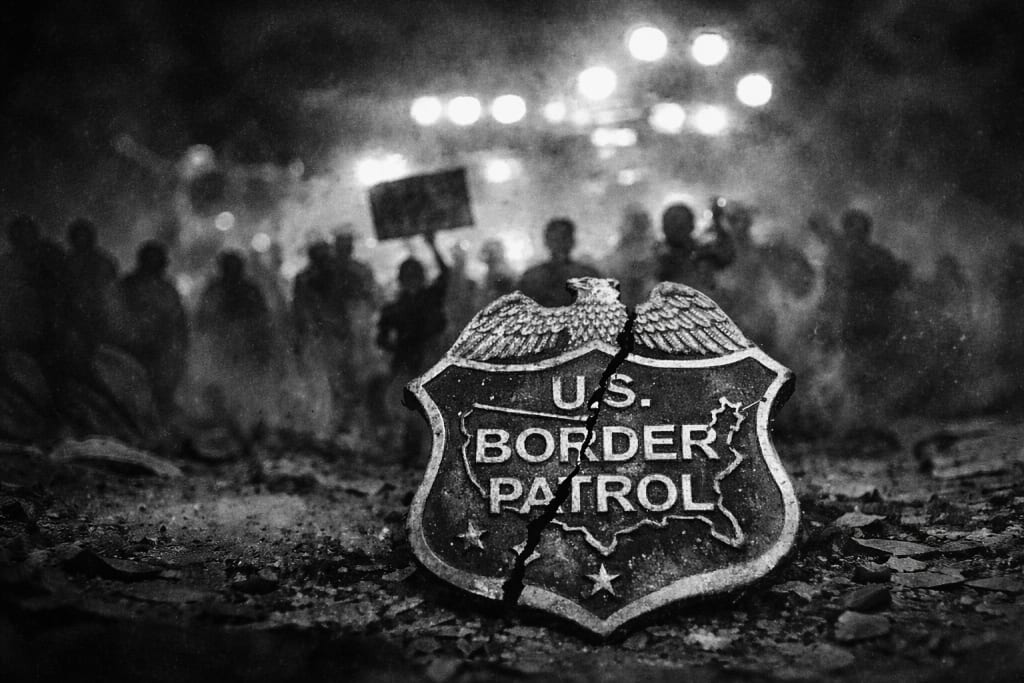
“It's better to die on your feet than to live on your knees”
— By Emiliano Zapata
Rodney King and the Illusion of “Gray”
For decades, the Black community had warned about brutality at the hands of the police, but the videotaped beating of Rodney King on March 3, 1991, forced much of America to confront it. For those willing to see what their fellow Americans were experiencing, that incident finally grabbed their attention. Yet, for too many others, even seeing the violence with their own eyes was not enough. They refused to look beyond the evidence itself and instead insisted on framing the issue in stark black and white, or in today’s terms, red versus blue.
Rodney King was not without fault; he was a parolee who was driving while intoxicated and led police officers on a chase that reached 110 mph. He endangered both the pursuing officers and the general public. Once he finally pulled over, the responding officers claimed he was not compliant, which is consistent with his intoxicated state. If this is true, it may have justified the officers’ initial use of force against King.
Video recorded by a bystander shows officers striking King with their batons at least 50 times. The beating continued after the unarmed suspect was on the ground and not attacking. At this point, their actions moved from possibly justified to criminal. The frustration felt by a community that had hoped the videotape would finally result in accountability erupted into unrest that caused $775 million in damage when that accountability never came.
When Additional Evidence Leaves No Gray
Comparisons can be made to the shooting of Renee Nicole Good in Minnesota based on publicly available video and coverage of autopsy findings. Even though the video shows the mother of three had begun turning her wheels away from the agent, it is conceivable that he may not have recognized this in the seconds he had to decide whether to fire, striking her in the right chest.
However, at least two shots were fired after the car had passed the agent and cannot reasonably be described as defensive. One struck her in the left forearm and the other in the left side of her head, which, according to an independent autopsy commissioned by her family, was likely immediately fatal.
Beyond the shooting, video evidence shows that agents on the scene refused to give a medical doctor access to determine whether aid could be rendered and then delayed an ambulance from entering the area. Cell phone footage recorded by the shooter also shows that he and his fellow agents failed to attempt any de‑escalation, issued conflicting instructions to Good, and that he chose to place himself in front of the car in violation of normal police training. After shooting Good at close range, the agent calls her a "fucking bitch."
The Killing of Alex Pretti: Why “Both Sides” No Longer Applies
Less than two weeks after the shooting of Good, which was not investigated by the FBI, Border Patrol agents killed another protester. This time, there was no gray; the killing was effectively an execution.
While an immigration enforcement action was taking place, Alex Pretti was in no way interfering. As was his legal right, he was filming the scene to document the actions of the masked immigration agents. Pretti was standing in the street with a cell phone in his hand when a woman, who was also documenting the scene, was pushed several feet towards him by a Border Patrol agent. She grabs Pretti by the waist, and that same officer then shoves him. A third observer walks over to the scene and she is then violently shoved to the ground.
It is important to note that none of the three protesters retaliated against the violence that was illegally used against them. Still, the Border Patrol agent sprayed Pretti directly in the face with a chemical irritant. At this point, Pretti and the first woman tried to help the second woman off the ground. None of them was facing the officer, yet he continued to assault them with the chemical irritant.
With Pretti still facing toward the woman he was trying to help, agents grabbed him from behind and threw him to his knees. At least one was seen to throw a punch at him. Another removed a gun from Pretti's concealed holster and turned to walk away from the scene. At least five shots rang out, and the group moved back several feet. At least five more shots were then fired into Pretti as he lay on the ground, motionless and unarmed.
As with Good, a medical doctor was at the scene and was initially blocked from helping the victim. When finally allowed to approach, the doctor said that CPR was not being rendered and that it did not appear anyone was attempting to provide aid. By these indications, it appeared that the agents had no intention of helping him.
Why Accountability Still Fails—Even When the Facts Are Clear
According to the government, the agent involved in the shooting was removed from Minneapolis for "his own safety," but is still working. This is highly unusual, as even in a clean shooting, legitimate police officers are typically removed from duty until they are cleared through psychological evaluation. After all, most non-psychotic people will have some kind of reaction, even if the shooting was justified.
Some of the President’s supporters believe that the killing of Pretti is the line that should not have been crossed. But there are still members of the Trump administration, politicians, and MAGA social media users who are willing to defame Pretti and defend the actions of the agents who brutally executed an innocent man. With them, I can find neither moral nor factual common ground.
_____
Carl Petersen is a former Green Party candidate for the LAUSD School Board and a longtime advocate for public education and special needs families. Now based in Washington State, he writes about politics, culture, and their intersections at TheDifrntDrmr.
About the Creator
Carl J. Petersen
Carl Petersen is a former Green Party candidate for the LAUSD School Board and a longtime advocate for public education and special needs families. Now based in Washington State, he writes about politics, culture, and their intersections.
Keep reading
More stories from Carl J. Petersen and writers in The Swamp and other communities.
The 2026 LAUSD Election Is Shockingly Uncontested — and That Should Worry Parents
“The foundation of every state is the education of its youth.” — Diogenes The 2026 Los Angeles Unified School District (LAUSD) board elections are shaping up to be one of the most consequential — and least competitive — school board races in recent memory. With labor unrest rising, enrollment falling, and school closures looming, voters might expect a crowded field of challengers. Instead, they are getting the opposite: quiet races, thin opposition, and decisions that could reshape public education in Los Angeles for years to come.
By Carl J. Petersen13 days ago in The Swamp
The Saddest Thing - The Billionaires Who Rule America Aren't Even Enjoying Themselves
This single post says more about our ruling class than a thousand policy papers. The saddest thing about today's system is that the men robbing the rest of us - sabotaging our economic prospects, our pensions, our access to affordable healthcare - are not even happy.
By Scott Christenson🌴5 days ago in The Swamp
Teleradiology Market Trends & Summary
Introduction: A New Era for Medical Imaging The global healthcare industry is in the middle of a digital transformation, and few segments reflect this shift more clearly than teleradiology. As hospitals and diagnostic centers face rising patient volumes, staff shortages, and growing pressure to deliver faster and more accurate diagnoses, remote radiology services have emerged as a critical solution.
By Sakshi Sharmaabout 15 hours ago in The Swamp
📢 Raise Your Voice Thread: 02/05/2026
Our “Raise Your Voice Threads” are hosted most alternating Thursdays at 12PM ET to offer creators more avenues to uncover exceptional stories on Vocal. As we are continuously searching for fresh creators and inspiring stories, this thread provides an opportunity to exchange and discuss the stories that have moved and motivated us on Vocal.
By Raise Your Voice by Vocal7 days ago in Resources




Comments
There are no comments for this story
Be the first to respond and start the conversation.