
When Does the Big Beautiful Bill Take Effect?
Your clear, straight-from-the-source guide to Trump’s mega bill, its rollout, and what changes and when for everyday Americans.


What Is the Big Beautiful Bill?⏳
Commonly known as the “One Big Beautiful Bill Act” (OBBBA) or Big Beautiful Bill (BBB), this massive tax-and-spending reconciliation package passed Congress in early July 2025 . It merges tax cuts, assistance program reductions, and major budget reallocations into a sweeping policy.
🗓️ The Signing & Timeline
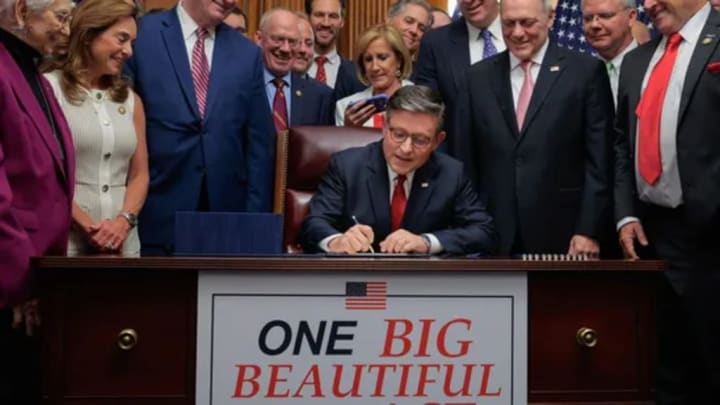
- House approved the final version on July 3, 2025 by a 218–214 vote .
- Senate had previously passed the amended bill on July 1, with VP Vance breaking a 50–50 tie.
- It's expected to be signed into law by President Trump on July 4, in a highly publicized White House ceremony.
🧭 What Takes Effect & When
The Big Beautiful Bill does not launch all at once. Instead, different parts of the bill kick in at different times depending on the area of policy.
- Tax Cuts: Most of the personal tax relief measures, including the tip and overtime exemptions, expanded child tax credit, SALT cap increase, and loan interest deductions, will apply starting from January 1, 2025. That means you'll feel the impact when filing your taxes in early 2026.
- SALT Deduction Cap: The cap is raised to $40,000 immediately upon signing and will be in place for five years. This provides substantial relief for taxpayers in high-tax states.
- Tip and Overtime Exemptions: Starting January 2025, federal taxes will not apply to tips up to $25,000 or overtime earnings up to $160,000, provided your total income is under $150,000.
- Clean-Energy Tax Credit Rollback: Clean-energy incentives, including EV and solar credits, will end 60 days after the bill is signed. Exceptions are made for existing nuclear and hydropower projects already in progress.
- Medicaid and SNAP Reforms: These will not go into effect immediately. Medicaid work requirements and funding changes start after December 31, 2026. SNAP state cost-sharing rules begin in 2028.
- Trump Savings Accounts and Expanded Child Tax Credit: These new financial options begin with the 2025 tax year and are set to expire at the end of 2028 unless extended.
- Military and Border Security Funding: New appropriations for defence, veterans, and border control take effect with the 2026 federal fiscal year.
🔍 Why It’s Staggered
The phased rollout achieves several goals:
- Immediate tax relief before midterms.
- Synchronization with the 2026 fiscal year for spending adjustments.
- Delayed safety-net reforms, softening political blowback.
Some changes, like form updates and new caps kick in at the start of 2025, while others unfold over the following years.
💡 What This Means for You
Filing 2025 Taxes (in 2026)?

- No federal taxes on tips and overtime.
- Increased SALT deductions and a bigger child credit ($2,200, rising to $2,500).
- Loan interest deductions and expanded estate/gift exemptions.
Big Cuts on the Horizon (2026+):
- Medicaid & food assistance work requirements may affect millions.
- Clean-energy credits vanish, impacting those with EVs or solar panels.
- Shifts in remittance and business interest deductions over time.
🌐 Broader Impact
- Families & hourly workers get immediate relief, tens to thousands of dollars back each year.
- Low-income individuals relying on food and healthcare face tougher rules later.
- Energy sector and middle-class savers will lose green incentives, but estates and business owners gain long-term tax sheltering.
Pro & Con Snapshot

✔️ Pros:
- Tangible savings for wage earners and families.
- Stabilizes Trump-era tax settings.
- Boosts working-class buy-in ahead of 2026 midterms.
❌ Cons:
Adds $3.3–4 trillion to deficit over 10 years.
Delays critical safety-net reforms, but lowers support years later.
Wealth transfer critics label it the “largest upward shift to the rich” in U.S. history.
What You Should Do Now✅
Pack up and leave US___ No No..
- Work with your tax advisor to plan form updates and withholdings.
- Budget now for benefit changes coming in 2026–2028.
- Track IRS guidance on bookkeeping for tips, overtime, and new accounts.
- Watch policy moves—state governments may introduce stop-gap relief or stricter enforcement.
Final Take🏁
Yes, the Big Beautiful Bill goes into effect immediately, but not all at once. Most tax relief begins January 2025, while deeper healthcare and budget shifts will unfold over years.
That’s both smart politics and a policy headache.
But for the average working American, the key date is simple:
January 1, 2025—That’s when your next tax filing starts including these mega changes.
If you’re in hourly work or have children, that means real cash savings next year, just don’t ignore the safety-net headwinds on the horizon.
About the Creator
Keep reading
More stories from Bevy Osuos and writers in The Swamp and other communities.
No Taxes on Tips or Overtime? Trump’s Tax Bombshell Just Changed the Game
If you’ve ever stayed late to finish your shift or depended on tips to keep the lights on, this one's for you. Because as of this week, thanks to a massive new tax overhaul just pushed through by Donald Trump, tips and overtime pay may no longer be taxed at the federal level.
By Bevy Osuos8 months ago in The Swamp
The Saddest Thing - The Billionaires Who Rule America Aren't Even Enjoying Themselves
This single post says more about our ruling class than a thousand policy papers. The saddest thing about today's system is that the men robbing the rest of us - sabotaging our economic prospects, our pensions, our access to affordable healthcare - are not even happy.
By Scott Christenson🌴25 days ago in The Swamp
Here Are The 10 Most Powerful Air Forces in the World in 2025 – And France Is Second to Last
As global military technology continues to evolve, the ranking of the world’s most powerful air forces has shifted dramatically in 2025. Military analysts have assessed air forces based on a combination of fleet size, technological sophistication, readiness, operational experience, and strategic reach. The results reveal significant disparities between nations, with some long-standing military powers retaining dominance, while others, including France, surprisingly lag behind despite their historical military reputation. At the top of the list is the United States Air Force (USAF), which continues to maintain an unmatched edge in technology, global reach, and operational readiness. The USAF’s fleet of fifth-generation stealth fighters, including the F-22 Raptor and F-35 Lightning II, along with advanced bomber aircraft such as the B-2 Spirit and the B-21 Raider, provides the United States with unmatched aerial dominance. Coupled with a global network of bases, satellite reconnaissance, and rapid deployment capabilities, the U.S. remains the uncontested leader in air power. Second on the list is China, whose People’s Liberation Army Air Force (PLAAF) has grown rapidly in both size and sophistication. China has invested heavily in stealth fighters, such as the Chengdu J-20, and has expanded its strategic bomber capabilities with aircraft like the Xian H-20, reflecting the nation’s ambitions to project air power regionally and globally. The PLAAF has also developed advanced drone programs, hypersonic weapons, and integrated electronic warfare capabilities, making it a formidable opponent in any potential conflict scenario. Third place is held by Russia, which continues to maintain a strong air force with a focus on both quantity and quality. The Sukhoi Su-57 stealth fighter and modernized versions of the Su-35 provide Russia with a credible air combat capability. Additionally, Russia’s strategic bomber fleet, including the Tu-160 and Tu-95, enhances its long-range strike potential. While Russia faces challenges in logistics and modernization, its operational experience and robust defense industry keep it among the top air powers. Other countries in the top ten include India, Japan, Israel, South Korea, Turkey, and the United Kingdom, each demonstrating a mix of advanced aircraft, operational readiness, and domestic aerospace production capabilities. India and Japan have heavily invested in modern fighters and domestic production programs, while Israel is known for its highly trained pilots and integrated defense networks. South Korea and Turkey balance modern Western aircraft with indigenous upgrades, while the UK leverages its nuclear deterrent and fifth-generation fighter capabilities. Surprisingly, France, traditionally regarded as a military power with one of Europe’s most advanced air forces, ranks second to last in the 2025 assessment. Analysts point to several factors contributing to France’s low ranking. Although France possesses modern aircraft such as the Dassault Rafale, the air force suffers from limited fleet size, aging support systems, and budget constraints that restrict large-scale modernization. Additionally, France’s global deployment capacity is constrained compared to the U.S., China, or Russia, limiting its strategic reach. While operationally competent and technologically advanced, France’s air force cannot match the scale or depth of its global rivals. Several key takeaways emerge from the 2025 ranking. First, technological sophistication alone does not guarantee top ranking; fleet size, maintenance, training, and logistical support play equally important roles. Second, countries investing in domestic aerospace programs, such as China and India, are gaining strategic advantages by reducing reliance on foreign suppliers. Third, nations with limited defense budgets may struggle to maintain parity with more resource-rich powers, regardless of technological competence. Experts suggest that France’s position should not be interpreted as an immediate strategic weakness. Its air force remains capable for regional operations, NATO missions, and nuclear deterrence. However, the ranking highlights the increasing importance of scale, industrial capacity, and integrated technology in defining air power in the 21st century. In conclusion, the 2025 assessment of the world’s most powerful air forces reflects the shifting balance of global military power. While the U.S. continues to dominate, emerging powers such as China and India are rapidly advancing, and traditional European powers, including France, face challenges in maintaining competitive edge. The rankings underscore that in modern warfare, a combination of technological innovation, fleet size, strategic reach, and industrial capability determines the strength of a nation’s air force.
By Fiaz Ahmed 3 days ago in The Swamp
Tatt~Master
— Assembly Line Tatt Machine ~ Impressions to Impress — As I begin to understand more about the Tattoo Phenomenon. I've written silly, yet verbatim, dating site anecdotes in 'Frazzled.' So let me ask you: Would you be More attracted to someone slathered with tattoos, or Less?
By Jay Kantor3 days ago in Humor



Comments
There are no comments for this story
Be the first to respond and start the conversation.