
Web Application Firewall Market Outlook 2025–2033
Rising Cyber Threats, Cloud Adoption, and Compliance Mandates Fuel Explosive Growth


The global digital economy is expanding at breakneck speed — but so are cyberattacks. From data breaches targeting financial institutions to bot-driven attacks overwhelming e-commerce platforms, the threat landscape is becoming more aggressive and sophisticated. Against this backdrop, Web Application Firewalls (WAFs) have emerged as a frontline defense, protecting web applications from malicious traffic, data leaks, and application-level exploits.
According to Renub Research, the international market for Web Application Firewalls was valued at approximately US$ 6.19 billion in 2024. Driven by cloud adoption, regulatory mandates, and rising web-based attacks, the market is projected to grow at a robust CAGR of 14.20% from 2025 to 2033, reaching an estimated US$ 20.44 billion by 2033. This positions WAFs as one of the fastest-growing cybersecurity segments of the decade.
✅ What Is Driving the WAF Market Boom?
1. Escalating Web-Based Attacks
Cybercriminals are increasingly exploiting web applications — the core of modern business operations. Attacks like SQL Injection, Cross-Site Scripting (XSS), Remote File Inclusion, and API exploitation are surging at an alarming rate. With 80%+ enterprise workflows now web-facing, organizations are racing to deploy real-time application-layer defense.
WAFs sit between users and applications, filtering HTTP/S traffic, blocking malicious bots, and preventing data theft — making them indispensable in today’s threat landscape.
2. Cloud Adoption and Digital Transformation
E-commerce, fintech, healthcare, and manufacturing are all shifting operations to cloud-based platforms. This shift creates new attack surfaces, especially across microservices, APIs, and multi-cloud environments.
As companies modernize IT systems, they are prioritizing:
Cloud-native WAF solutions
SaaS-based security services
Hybrid deployment architectures
3. Regulatory Compliance Pressure
Industries are under mounting pressure to meet strict data protection mandates:
GDPR
HIPAA
PCI DSS
Cybersecurity Maturity Model Certification (CMMC)
WAFs play a crucial role in ensuring compliance, providing audit trails, logging, and protection of sensitive data — particularly in banking, government, and healthcare.
4. AI and Machine Learning in Threat Detection
Next-generation WAFs are no longer static. They leverage:
Behavioral analytics
Automated rule generation
Bot fingerprinting
Real-time ML-based anomaly detection
This shift enables proactive prevention rather than reactive mitigation.
5. Remote Work and Mobile Application Growth
The post-pandemic model has decentralized networks. Employees access corporate systems through:
Web apps
APIs
Mobile platforms
This widens the attack surface — increasing WAF adoption across enterprises and SMEs alike.
✅ Key Market Segments
✔ Deployment Model
Cloud-Based WAFs (Fastest Growing)
On-Premises WAFs
Hybrid WAFs
Cloud-native security tools are gaining traction due to scalability, lower maintenance, and pay-as-you-go pricing.
✔ End-User Industries
BFSI (Banking & Finance)
E-Commerce & Retail
Healthcare
Government & Defense
IT & Telecom
Manufacturing
BFSI leads due to high data sensitivity and frequent fraud attempts.
✔ Enterprise Size
Large Enterprises (Major Revenue Share)
SMEs (Fastest Adoption Growth)
SMEs prefer SaaS-based WAFs due to lower upfront costs.
✅ Five Leading Players Shaping the WAF Landscape
1. Akamai Technologies, Inc.
Akamai remains a global leader in cloud security, powering some of the world’s most high-traffic platforms like Adobe, Coca-Cola, FedEx, and Airbnb. Its WAF solutions integrate performance and security, supported by a worldwide edge network that delivers low-latency protection. With a presence across 100+ countries, Akamai is a dominant force in digital application resilience.
2. Qualys Inc
Qualys provides cloud-native security and compliance solutions featuring integrated WAF capabilities. Its strength lies in real-time monitoring, vulnerability assessments, and policy compliance — making it a preferred choice for enterprises seeking unified security dashboards and automation across hybrid networks.
3. F5 Inc
F5’s portfolio — including Distributed Cloud Services, NGINX, and BIG-IP — secures applications across multi-cloud ecosystems. By partnering with VARs, MSPs, and system integrators, F5 ensures global reach across sectors such as finance, education, government, and telecom.
4. Fortinet Inc
Known for its high-performance, AI-driven cybersecurity platforms, Fortinet delivers WAF, network access control, identity management, and application-level protection. Its integration across enterprise and government sectors has positioned it as a top global cybersecurity innovator.
5. NSFOCUS Technologies Group Co. Ltd
NSFOCUS protects mission-critical industries, including four of the top five global financial institutions. With comprehensive DDoS mitigation and application security services, it empowers enterprises and partners to deploy Security-as-a-Service at scale.
✅ SWOT Spotlight: Major Players
Citrix Systems, Inc.
Strength: Strong cloud and virtualization integration, robust ADC platform, advanced threat and bot protection.
Opportunity: Rapid migration to hybrid cloud and AI-powered security analytics.
Amazon Web Services (AWS)
Strength: Market-leading cloud-native WAF with unmatched scalability, ML-driven rules, and global low-latency infrastructure.
Opportunity: Growing multi-cloud adoption and demand for centralized cross-cloud protection.
✅ Sustainability Spotlight: Microsoft Corporation
Microsoft is redefining sustainability in tech, pledging to become:
Carbon Negative by 2030
Water Positive by 2030
Zero Waste Across Key Sites
Through programs like AI for Earth, Microsoft is supporting global environmental innovation — showcasing how cybersecurity and sustainability can coexist responsibly.
✅ Recent Developments in the WAF Market
November 2024: Cloudflare launched its Advanced Certificate Manager with built-in WAF functionality, enhancing security automation.
October 2023: Radware expanded its MSSP program, offering advanced WAF and DDoS services for enterprise clients.
November 2022: Palo Alto Networks acquired Cider Security to strengthen code-to-cloud protection via its Prisma Cloud platform.
These developments underscore a shift toward automation, managed security services, and integrated threat intelligence.
✅ The Road Ahead: What to Expect
1. Surge in API and Microservices Security
As businesses adopt microservices and API-driven architectures, API protection will become a core WAF function.
2. Managed Security Services on the Rise
SMEs are increasingly outsourcing security to MSSPs, accelerating the shift toward subscription-based models.
3. AI-Powered Autonomous Security
Future WAFs will self-learn, self-tune, and auto-mitigate emerging risks.
4. Multi-Cloud Security Consolidation
Organizations will seek unified dashboards to manage security across AWS, Azure, Google Cloud, and on-prem environments.
✅ Final Thoughts
The Web Application Firewall market is entering a decade of unprecedented opportunity. As cyberattacks grow more sophisticated and regulatory pressures mount, WAFs are transforming from optional security tools into mission-critical infrastructure. With a projected market value of US$ 20.44 billion by 2033, the WAF ecosystem is set to become a cornerstone of global digital resilience.
Enterprises that invest early — particularly in AI-driven and cloud-native WAF platforms — will be better equipped to secure applications, maintain compliance, and safeguard customer trust in an increasingly hostile cyber landscape.
About the Creator
Marthan Sir
Educator with 30+ years of teaching experience | Passionate about sharing knowledge, life lessons & insights | Writing to inspire, inform, and empower readers.
Keep reading
More stories from Marthan Sir and writers in The Swamp and other communities.
Electric Kick Scooter Market Companies Analysis (2025–2033)
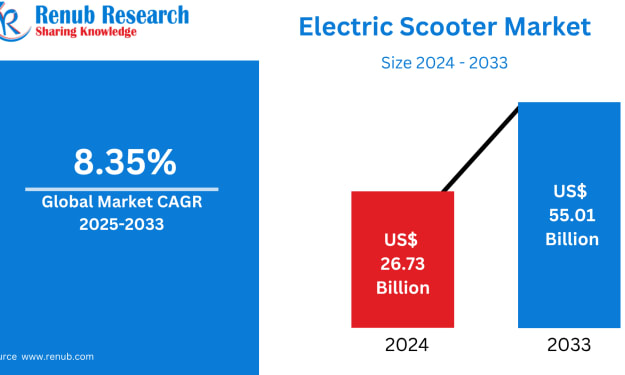
🌍 A Market on the Move The global electric kick scooter market, once a niche curiosity, has now evolved into a powerful force shaping the future of urban transportation. According to Renub Research, the market was valued at US$ 26.73 billion in 2024. Looking forward, it is projected to grow at a CAGR of 8.35% from 2025 to 2033, ultimately reaching an estimated US$ 55.01 billion by 2033.
By Marthan Sir2 months ago in The Swamp
First Flight of 2026 Under UK ‘One In, One Out’ Asylum Scheme Cancelled
The cancellation of the first scheduled flight of 2026 under the United Kingdom’s controversial “one in, one out” asylum scheme has reignited debate over the future of the country’s immigration policy. Planned as a symbolic restart of removals at the beginning of the new year, the flight was intended to demonstrate the government’s continued commitment to managing asylum arrivals through strict controls. Instead, its abrupt cancellation has raised fresh questions about feasibility, legality, and the human consequences of the policy. What Is the ‘One In, One Out’ Scheme? The “one in, one out” scheme is designed to limit the number of asylum seekers remaining in the UK by pairing each new arrival with the removal of another individual. In theory, the policy aims to ease pressure on accommodation systems, reduce backlogs, and deter irregular migration. Supporters argue it brings order to a strained asylum system, while critics contend it treats people as statistics rather than individuals with legal and humanitarian rights. Since its introduction, the scheme has faced logistical challenges and legal scrutiny. Flights arranged to remove asylum seekers often involve complex coordination between government departments, receiving countries, courts, and private contractors. Any disruption along this chain can derail operations, as appears to have happened with the first planned flight of 2026. Why Was the Flight Cancelled? While officials have not released full details, reports suggest the cancellation was caused by a combination of legal challenges and operational difficulties. Last-minute injunctions, incomplete documentation, and concerns over the destination country’s preparedness are all common reasons flights are delayed or grounded. Human rights lawyers have long argued that many individuals scheduled for removal have ongoing asylum claims or unresolved appeals. If even one case is found to breach domestic or international law, entire flights can be postponed. In this case, it appears multiple cases required further review, making it impossible for authorities to proceed as planned. Political Ramifications The cancellation is an embarrassment for the government, particularly as it was positioned as a strong signal of policy continuity in 2026. Immigration remains a politically sensitive issue in the UK, with public opinion sharply divided between calls for tougher enforcement and demands for more humane treatment of asylum seekers. Opposition parties were quick to criticize the cancellation, describing it as evidence that the policy is “unworkable and legally fragile.” They argue that repeated disruptions show the government is prioritizing headlines over sustainable solutions. Meanwhile, ministers have defended the scheme, insisting that delays do not mean abandonment and that further flights will be rescheduled. The Human Impact Beyond politics, the cancellation has real consequences for the individuals involved. Asylum seekers scheduled for removal often endure weeks of uncertainty leading up to a flight. Sudden cancellations can prolong detention or temporary accommodation stays, adding to stress and anxiety. Many asylum seekers have fled conflict, persecution, or economic collapse, and prolonged uncertainty can worsen mental health conditions. Advocacy groups argue that the stop-start nature of removal flights illustrates a system that fails to provide clarity or dignity to those caught within it. Legal and Ethical Concerns The “one in, one out” approach continues to draw criticism from legal experts who question its compatibility with international refugee law. The UK is bound by conventions requiring that asylum claims be assessed individually and fairly. Critics argue that numerical balancing risks undermining this principle, especially if removals are rushed to meet political targets. The cancellation of the first 2026 flight highlights the power of the legal system in acting as a safeguard. Courts play a crucial role in ensuring that removals do not violate human rights, even if this complicates government plans. What Happens Next? Government officials have indicated that the cancelled flight will be reorganized later in the year. However, each delay increases skepticism about whether the scheme can function smoothly. If cancellations continue, pressure may mount for a broader rethink of asylum policy. Some experts argue that long-term solutions lie not in removals but in speeding up asylum decisions, expanding legal migration routes, and working more closely with international partners. Others maintain that deterrence remains essential, even if implementation is difficult. A Policy at a Crossroads The grounding of the first flight of 2026 under the “one in, one out” scheme may seem like a single operational setback, but it reflects deeper structural issues. It exposes the tension between political promises and legal realities, between border control and humanitarian obligations. As the UK moves further into 2026, the fate of the scheme will likely shape broader debates about immigration, human rights, and national identity. For now, the cancelled flight stands as a reminder that managing asylum is not just a logistical challenge, but a moral and legal one—where every decision affects real lives, not just policy statistics.
By Fiazahmedbrohi 5 days ago in The Swamp


Comments
There are no comments for this story
Be the first to respond and start the conversation.