
US Bombers Join Japanese Jets in Major Show of Force After China–Russia Drills, Tokyo Says
Rising Military Posturing Fuels Tensions Across East Asia as the U.S., Japan, China, Russia, South Korea, and Taiwan Respond to Rapid Escalations

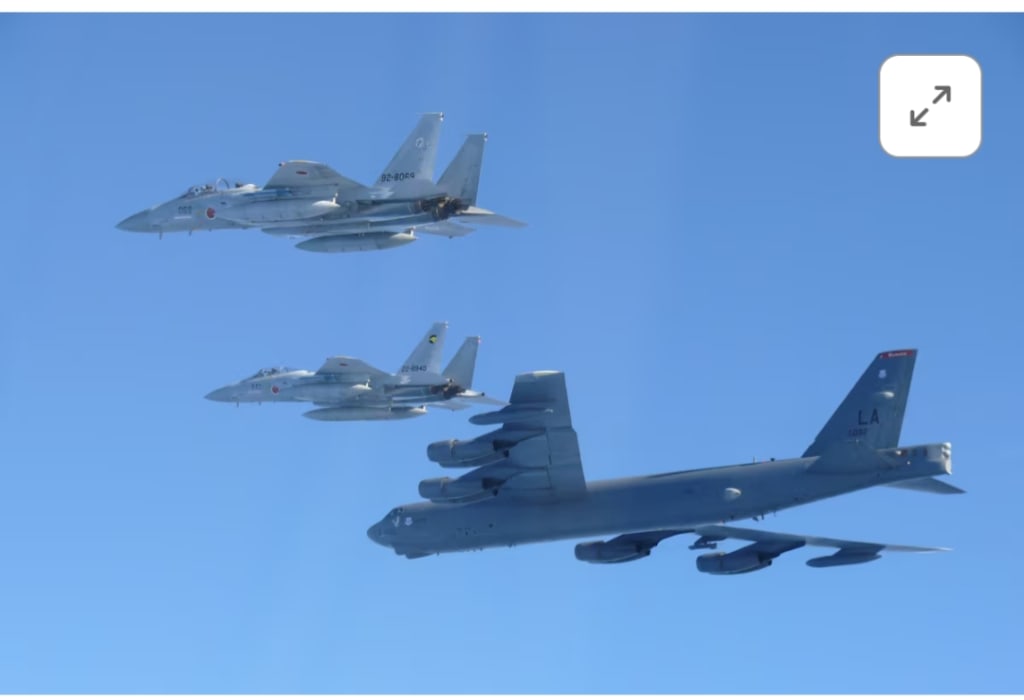
Growing tensions in East Asia surged again this week after the United States deployed nuclear-capable B-52 bombers to fly alongside Japanese fighter jets over the Sea of Japan. Tokyo confirmed the joint drill on Wednesday, stating that the operation was conducted in response to provocative Chinese and Russian military activities in the region. The move marks one of the most visible demonstrations of U.S.–Japan military cooperation in recent months, as both allies attempt to counter what they describe as “unilateral attempts to change the status quo by force.”
The exercise, according to Japan’s Ministry of Defense, involved two U.S. B-52 strategic bombers escorted by three Japanese F-35 stealth fighters and three F-15 air-superiority jets. This was the first U.S. bomber flight in the region since China launched large-scale military exercises last week, intensifying concerns over regional stability.
Japan and U.S. Stand Firm Against Regional Threats
In a strong statement, Japan emphasized that both countries “reaffirmed their strong resolve” to deter aggression and maintain peace. The drill served not only as a show of force but also as a reassurance to Japanese citizens as China continues expanding its military presence in nearby waters and airspace.
For Tokyo, this show of unity with Washington is critical. Japan hosts the largest concentration of U.S. military power outside the American mainland, including an aircraft carrier strike group and major Marine Corps and Air Force units. The joint flight signals to competitors that Japan’s alliance with the United States remains robust and operationally ready.
The Trigger: China and Russia’s Joint Bomber Patrol
The U.S.–Japan operation came just one day after Chinese and Russian strategic bombers carried out a joint patrol across the East China Sea and western Pacific. This collaboration between Beijing and Moscow has become increasingly frequent, raising concerns in Japan, South Korea, and Taiwan.
Japan stated that its jets were even targeted by radar beams from Chinese aircraft during earlier exercises—an accusation Beijing denied, claiming instead that Japanese planes had interfered with its routine operations. Washington swiftly backed Japan’s account, calling China’s behavior “unsafe” and warning it undermines regional peace.
General Hiroaki Uchikura, Japan’s Chief of Staff, declared the China–Russia patrol a clear “show of force” intended to intimidate Japan. Defense Minister Shinjiro Koizumi also briefed NATO Secretary General Mark Rutte about the encounter, signaling Japan’s intent to internationalize concerns about China’s military posture.
China Responds: “No Need to Make a Fuss”
In Beijing, Chinese Foreign Ministry spokesperson Guo Jiakun downplayed Japan’s concerns. He described China–Russia exercises as part of the nations’ annual cooperation plan and insisted they were aimed at maintaining “regional peace and stability.”
Guo criticized Japan for “taking it personally,” suggesting Tokyo was overstating the significance of the drills.
However, regional observers argue that the scale, frequency, and strategic alignment of these China–Russia operations reflect a deliberate effort to challenge U.S. influence and test Japan’s defensive readiness.
Tensions Spread to South Korea and Taiwan
The situation extends far beyond Japanese airspace. South Korea confirmed it scrambled its own fighter jets after detecting both Chinese and Russian aircraft entering its air defense identification zone on Tuesday. Although such zones extend beyond sovereign airspace, their violation is considered a serious security concern.
Meanwhile, Taiwan reported intensified Chinese military activity for the second consecutive day. The island’s defence ministry detected 27 Chinese aircraft—including nuclear-capable H-6K bombers—conducting a “joint combat readiness patrol” around Taiwan. Additional warships and J-16 fighters were also spotted moving near its airspace.
Taipei has repeatedly warned that China’s persistent military pressure is part of a broader strategy to weaken Taiwan’s defenses and intimidate its population.
Japan–China Dispute Reignited by Taiwan Issue
Tensions between Japan and China have worsened since Japanese Prime Minister Sanae Takaichi commented on how Japan might respond if China attacked Taiwan. Beijing accused Tokyo of interfering in its internal affairs, while Japan insists Taiwan’s security is directly linked to its own national safety.
Taiwan sits just over 100 kilometers from Japanese territory, and the sea lanes surrounding the island carry crucial energy supplies for Japan. That proximity makes any conflict in the Taiwan Strait an immediate threat to Japanese interests.
A Region on Edge
With multiple military powers engaged in overlapping exercises, intercepts, and patrols, East Asia is entering a period of heightened risk. Each move invites a counter-response, raising fears of miscalculation or accidental conflict.
The U.S. deployment of B-52 bombers—iconic symbols of American strategic power—signals Washington’s determination to counter China’s growing reach. For Japan, the joint drill sends an equally strong message: its defense partnerships are firm, and it will not be intimidated by China or Russia.
As China, Russia, Japan, South Korea, Taiwan, and the United States continue navigating these rising tensions, the region watches closely, aware that even a single misstep could trigger a chain reaction with global consequences.
About the Creator
Asad Ali
I'm Asad Ali, a passionate blogger with 3 years of experience creating engaging and informative content across various niches. I specialize in crafting SEO-friendly articles that drive traffic and deliver value to readers.
The Forsyth House Fire
Since 1851, Forsyth House has stood on the corner of Union Street and Gordon Street in the heart of Glasgow. Its iconic, or was... because on Sunday 8th of March, 2026, a fire broke out in a small, seemingly un-named shop in the building and tore all that history down. As I write, the rubble is still unsettled and the street is still blocked off. Central Station is quiet on the upper level, and around 30 small businesses have quite literally gone up in smoke.
By S. A. Crawford3 days ago in The Swamp
Hottest in the Office
Dear Rafi, You’re very distracting to work around. For the first second I saw you the other day, I thought you were some type of executive. It took a moment to realize no, you were just the new guy, dressed up for the job he wants. Be still, my heart.
By Gabriel Shames6 days ago in Pride



Comments
There are no comments for this story
Be the first to respond and start the conversation.