
U.S. Officials Meet on Greenland as Congress Challenges Trump’s War Powers
Vance and Rubio hold talks with Denmark and Greenland while lawmakers debate limits on military action in Venezuela

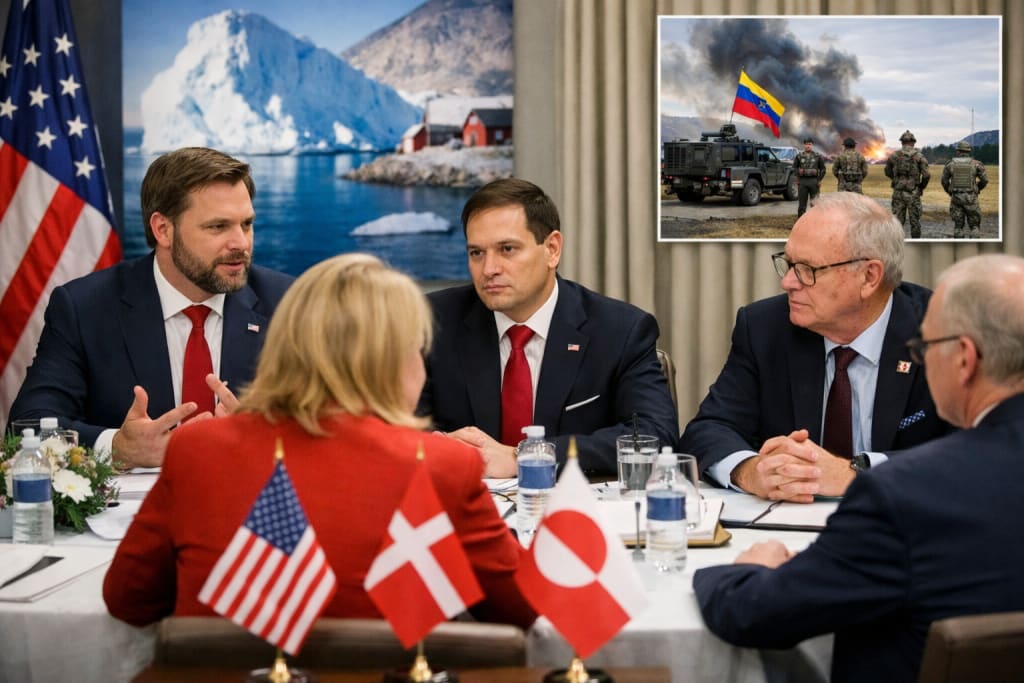
The United States is facing a busy and tense moment in foreign policy. In the same week, top U.S. officials held an important meeting about Greenland, while Congress moved closer to a vote that could limit President Donald Trump’s power to use the military in Venezuela. These two events may seem unrelated, but together they show growing concern at home and abroad about how far U.S. power should go.
This article explains what happened in simple terms, why it matters, and what it could mean for the future.
A High-Level Meeting on Greenland
Vice President J.D. Vance and Secretary of State Marco Rubio recently met with leaders from Denmark and Greenland in Washington. The meeting focused on Greenland, a large Arctic island that is part of the Kingdom of Denmark but has its own local government.
Greenland has become more important in recent years because of its location, natural resources, and growing military value in the Arctic. As ice melts due to climate change, new shipping routes and access to minerals are opening. Major powers like the United States, China, and Russia are all paying close attention to the region.
President Trump has again spoken publicly about Greenland’s importance to U.S. security. In the past, he suggested the U.S. should try to buy the island, a comment that caused anger and disbelief in Denmark and Greenland. While the White House says the current talks are diplomatic, many European leaders remain uneasy.
During the meeting, Danish and Greenlandic officials made their position clear. Greenland is not for sale, and its people have the right to decide their own future. Denmark also stressed that Greenland is part of NATO territory and that any threat to it would affect the entire alliance.
Vance and Rubio reportedly focused on keeping relations calm. They emphasized cooperation on Arctic security, climate research, and economic development rather than ownership or control. Still, the meeting showed that Greenland remains a sensitive issue in U.S.–European relations.
Why Greenland Matters So Much
Greenland sits between North America and Europe, making it strategically valuable. The U.S. already operates a military base there, which plays a role in missile defense and early warning systems.
Beyond security, Greenland may hold rare earth minerals and other resources needed for modern technology. As competition with China grows, the U.S. wants reliable access to these materials through friendly partners.
However, Greenland’s leaders have said they want development that respects their environment and culture. Many people there worry that becoming a pawn in global power struggles could harm their way of life.
At the Same Time: A War Powers Vote on Venezuela
While the Greenland meeting was happening, President Trump faced a serious challenge at home. Members of Congress moved forward with a vote under the War Powers Act, a law passed in 1973 to limit a president’s ability to use military force without approval from lawmakers.
The vote is connected to U.S. military actions in Venezuela. Earlier this month, U.S. forces carried out strikes and operations targeting the Venezuelan government. The Trump administration argued that the actions were necessary to protect U.S. interests and regional stability.
Many lawmakers disagreed. They said the president did not clearly explain the legal basis for the action or seek approval from Congress. As a result, both Democrats and some Republicans supported a resolution that would require Trump to get congressional approval before continuing or expanding military operations in Venezuela.
This kind of vote is rare and politically risky. Even if it passes, the president can veto it. Still, it sends a strong message that Congress wants to reassert its role in decisions about war and peace.
Why These Two Issues Are Connected
On the surface, Greenland and Venezuela are very different issues. One involves diplomacy with allies, and the other involves military action in Latin America. But together, they highlight a larger debate about U.S. power.
Critics say President Trump has taken an aggressive approach to foreign policy, using strong language and military force without enough consultation. Supporters argue that he is protecting U.S. interests and showing strength.
The Greenland talks show how U.S. actions can worry even close allies. The Venezuela vote shows growing concern at home about how military power is used.
Both situations also raise questions about limits. How far can the U.S. go when dealing with other countries? Who gets to decide— the president alone, or the president and Congress together?
What Happens Next?
For Greenland, more talks are likely. The U.S., Denmark, and Greenland will continue to work together on Arctic security and economic cooperation. However, trust may take time to rebuild, especially if strong statements continue from Washington.
For Venezuela, the outcome depends on Congress and the president. If the war powers resolution passes and survives a veto, it could restrict future military action. Even if it fails, it shows that lawmakers are watching closely.
Internationally, both issues will be closely followed. Allies want reassurance that the U.S. respects their sovereignty. At the same time, rivals are watching for signs of division or uncertainty.
A Moment of Testing for U.S. Leadership
This week’s events show the challenges of global leadership in a complex world. The U.S. must balance strength with cooperation, and action with accountability.
The Greenland meeting and the Venezuela war powers vote are reminders that power brings responsibility. How these issues are handled could shape U.S. relationships and its role on the world stage for years to come.
About the Creator
sehzeen fatima
Sehzeeen Fatima is a writer with a Master’s in Science who shares inspiring stories about sports, life, and people. She writes in simple, clear language to connect with readers and spark meaningful thought.
Keep reading
More stories from sehzeen fatima and writers in The Swamp and other communities.
Hypersonic Escalation: Russia’s Missile Strike Signals a Dangerous New Phase in the Ukraine War
n the early hours of January 9, Russia launched one of its most intense aerial assaults on Ukraine in months, deploying a hypersonic missile alongside dozens of conventional missiles and hundreds of drones. The attack marked one of the rare confirmed uses of Russia’s Oreshnik hypersonic missile, a weapon touted by Moscow as nearly impossible to intercept. As explosions rocked Kyiv and other regions, the strike sent a clear message: the war is entering a more dangerous and unpredictable phase.
By sehzeen fatima9 days ago in The Swamp
US Supreme Court Appears Likely to Uphold Restrictions on Transgender Athletes
The US Supreme Court is poised to make a landmark decision that could reshape the landscape of youth and collegiate sports across the country. Reports indicate that the Court appears likely to uphold restrictions on transgender athletes, a move that would reinforce state-level bans preventing transgender girls and women from competing in sports aligned with their gender identity.
By Aarif Lashari4 days ago in The Swamp



Comments
There are no comments for this story
Be the first to respond and start the conversation.