
Trump’s Response to Shooting Shows Intensified Anti-Migrant Stance
The former president uses a national tragedy to reinforce his hardline immigration agenda, reigniting debate over border policies.


When a shooting incident deeply unsettles the nation, the immediate expectation is often a call for unity, healing, and careful examination of the facts. However, former President Donald Trump’s response to the recent shooting shifted the national conversation toward immigration with striking speed and intensity. His remarks not only reignited a familiar political debate but also showcased a sharpened anti-migrant message that is becoming increasingly central to his public rhetoric.
The shooting, which authorities are still investigating, prompted widespread concern about safety, gun violence, and rising social tensions. Yet for Trump, the event became evidence of what he describes as the urgent need for stricter immigration controls. In a public statement, he characterized the tragedy as the outcome of “failed border policies,” suggesting that stronger restrictions would have prevented the incident altogether.
This approach is not new. Trump has long argued that illegal immigration poses major risks to American communities. But his latest remarks indicate a shift toward a more forceful, uncompromising narrative. By emphasizing the incident as a “preventable crime,” Trump portrayed migrants—especially undocumented ones—as security threats, using the moment to reinforce his long-standing promise of tougher enforcement.
Political analysts note that Trump often connects violent events to broader policy failures, aiming to frame the issue in stark and urgent terms. His messaging following this shooting echoed this pattern. He highlighted border security lapses, criticized current administration policies, and repeated his support for measures such as mass deportations, expanded border patrol operations, and tighter entry requirements.
Supporters of the former president argue that his direct, assertive tone reflects justified concern. Many Americans believe the immigration system is overwhelmed and that border-related crime is growing. For these voters, Trump’s response resonates as a call for accountability and stronger action. They see his statements not as political opportunism but as evidence of leadership willing to confront difficult truths.
However, critics strongly disagree. Immigration advocates, human rights organizations, and policy experts were quick to condemn Trump’s remarks, describing them as inflammatory and misleading. Numerous studies consistently show that immigrants—whether documented or undocumented—commit crimes at lower rates than U.S.-born citizens. Advocacy groups argue that linking isolated criminal acts to millions of migrants fuels harmful stereotypes and diverts attention from broader issues like gun violence, mental health, and community safety.
These critics also warn that using a national tragedy to advance political talking points risks further polarizing the country. They contend that Trump’s rhetoric creates an atmosphere of fear and distrust surrounding migrant communities, many of whom contribute significantly to the workforce, economy, and cultural fabric of the United States.
Trump’s response also raises deeper questions about leadership during times of crisis. Public communication following a tragedy typically focuses on compassion, unity, and support for victims. By immediately pivoting to immigration, Trump signaled a strategic decision to frame the event within his policy priorities—particularly as immigration remains a defining issue heading into election periods.
This is not the first time Trump has used high-profile incidents to underscore his argument for strict border control. During his presidency and beyond, he has repeatedly cited violent events to justify building a border wall, intensifying federal enforcement, limiting asylum access, and implementing controversial programs like family separation and “Remain in Mexico.” The recent statement fits squarely within this broader, long-term strategy.
For the general public, Trump’s intensified stance may deepen the divide between those who see immigration primarily through a security lens and those who view it as a humanitarian and economic issue. His remarks also highlight a reality of American politics: tragedies often become catalysts for policy debates, with leaders interpreting events through the lens of their ideological commitments.
As investigations into the shooting continue, many observers caution against drawing conclusions before all facts are known. Law enforcement agencies have not linked the incident to immigration status, nor have they indicated that border policy played a role. Yet political narratives can shape public perception long before official reports are completed.
Looking forward, immigration is expected to remain one of the most contentious issues in U.S. politics. Trump’s response to the shooting suggests that his messaging will become even more hardline, emphasizing border security as a defining component of national safety. Whether this approach unifies or divides voters remains uncertain, but it is clear that the debate will only grow louder as election discussions intensify.
In a nation built by immigrants yet divided by immigration policy, Trump’s remarks fuel a conversation that is both deeply emotional and politically significant. The latest incident—and his interpretation of it—serves as a reminder that tragedies are not only moments of national reflection but also powerful battlegrounds for shaping public priorities.
About the Creator
Asad Ali
I'm Asad Ali, a passionate blogger with 3 years of experience creating engaging and informative content across various niches. I specialize in crafting SEO-friendly articles that drive traffic and deliver value to readers.
Trump Accepts Nobel Medal from Venezuelan Opposition Leader Machado
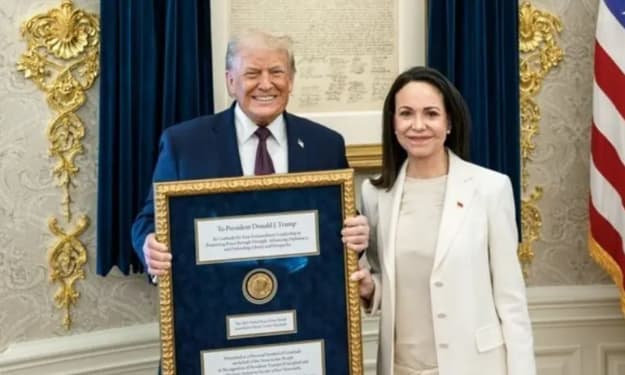
In a moment that made headlines worldwide, Venezuelan opposition leader María Corina Machado presented U.S. President Donald Trump with her Nobel Peace Prize medal at the White House on January 15, 2026. The event, described as both symbolic and political, immediately sparked discussion about the nature of international recognition, diplomatic strategy, and the role of symbolism in politics. Trump accepted the medal, describing it as a “wonderful gesture of mutual respect.” However, experts quickly clarified that the Nobel Peace Prize itself cannot be transferred, and while a physical medal can change hands, the title of Nobel Laureate remains with the original recipient. Despite this, the optics of the event immediately made it a global talking point. A Gesture Packed With Symbolism Machado, who won the 2025 Nobel Peace Prize for her efforts promoting democracy and human rights in Venezuela, explained that giving the medal to Trump was a thank-you for his support of Venezuelan freedom. The medal bore a ceremonial inscription reading: “In Gratitude for Your Extraordinary Leadership in Promoting Peace through Strength, Advancing Diplomacy, and Defending Liberty and Prosperity.” Trump, known for his longstanding desire to win a Nobel Peace Prize, posted on social media praising Machado as “a wonderful woman who has been through so much” and expressed gratitude for the symbolic gesture. The exchange was more than ceremonial—it was a political statement, emphasizing international alliances, shared ideals of governance, and the power of symbolism in modern diplomacy. Why the Medal Matters, But the Prize Doesn’t Transfer It’s important to distinguish between the physical medal and the official Nobel Peace Prize honor. The Norwegian Nobel Institute emphasizes that the title of Nobel Laureate cannot be transferred or shared, even if the medal is handed over to another person. This means that, despite public perception, Trump is not officially recognized as a Nobel Peace Prize winner. Nonetheless, the physical medal carries significant symbolic weight, especially in politics. In this case, the gesture communicated support for democratic principles in Venezuela and acknowledged Trump’s perceived role in influencing international outcomes. Venezuela’s Turbulent Political Context The backdrop of this gesture is crucial. Venezuela has experienced years of political instability under the leadership of Nicolás Maduro, whose administration was accused of corruption, human rights violations, and suppressing democratic institutions. In early January 2026, U.S. forces captured Maduro in a high-profile operation. Machado, a vocal opponent of Maduro, fled Venezuela in December and began lobbying internationally to regain influence. The Trump administration has maintained support for interim leadership under Delcy Rodríguez, a figure with ties to Maduro’s former government. In this context, Machado’s presentation of the medal was both strategic and symbolic, aiming to strengthen her political leverage while reaffirming her commitment to democratic ideals. Trump’s Response and Political Optics Trump’s acceptance of the medal was enthusiastic. He framed it as recognition of his contributions to international diplomacy and freedom movements, praising Machado and highlighting U.S. support for democratic transitions. However, critics argue that the gesture is largely symbolic, with limited direct impact on Venezuelan politics. By linking himself to Machado’s Nobel Peace Prize, Trump reinforced his image as a global influencer, while Machado sought to leverage the moment to draw renewed attention to her leadership ambitions. Global Reactions and Controversy The reaction to the event has been mixed: Some commentators hailed it as a powerful symbolic alignment between the U.S. and democratic movements in Venezuela. Others criticized the move, suggesting it undermined the prestige of the Nobel Peace Prize, using a personal award for political purposes. Observers in Norway, where the Nobel Peace Prize is administered, expressed surprise and concern, emphasizing that the prize is intended to honor peaceful achievements, not political maneuvering. International media coverage highlighted the event as unusual and unprecedented, raising broader questions about the intersection of awards, symbolism, and diplomacy. Symbolism Meets Realpolitik The medal exchange underscores how political symbolism is frequently leveraged to influence perceptions and relationships: The physical medal, while not granting the Nobel title, communicates respect and recognition. For Trump, it reinforced his international profile and provided positive imagery for supporters. For Machado, it was an opportunity to signal alignment with U.S. leadership and maintain relevance on the global stage. Analysts note that such gestures can shape public perception, media narratives, and diplomatic dialogue, even if they don’t directly alter policy outcomes. Implications for U.S.–Venezuela Relations This gesture also reflects the complexity of U.S.–Venezuela relations: The U.S. continues to back interim leadership under Rodríguez, maintaining strategic interests in the region. Symbolically, the medal presentation shows recognition of opposition leaders advocating for democracy, sending a message to both domestic and international audiences. Machado’s alignment with Trump illustrates the delicate balancing act opposition figures face when navigating global alliances while advocating for reform at home. How these symbolic acts translate into real-world political influence remains to be seen, but they are strategically valuable tools in international relations. Cultural and Historical Significance The event also sparks broader discussions about the role of awards and international recognition in politics: Can gestures like this alter public perception of leaders or movements? What is the value of symbolism in shaping global narratives? How do international institutions maintain credibility when political maneuvering intersects with honors like the Nobel Peace Prize? While there are no easy answers, the moment highlights the interplay between politics, recognition, and media attention in today’s globalized world. Final Thoughts Trump’s acceptance of a Nobel Peace Prize medal from María Corina Machado is more than a ceremonial act. It combines political symbolism, personal ambition, and international messaging in a single moment. Although the official Nobel title remains with Machado, the gesture demonstrates the power of visual symbolism in shaping narratives and influencing diplomatic perceptions. For Venezuela, it provides a renewed platform for opposition voices. For Trump, it reinforces his global visibility and reputation as a decisive actor in international politics. As the world watches, the event raises enduring questions about the intersection of recognition, diplomacy, and political strategy, offering a case study in how gestures — even symbolic ones — can resonate far beyond the room in which they occur.Start writing...
By Muhammad Hassan3 days ago in The Swamp


Comments
There are no comments for this story
Be the first to respond and start the conversation.