
Trump Overrides Local Authority, Takes Charge of D.C. Law Enforcement
It was a Tuesday morning in Washington, D.C., but the air carried a different kind of weight.


It was a Tuesday morning in Washington, D.C., but the air carried a different kind of weight. On the surface, everything seemed ordinary: tourists gathered outside the Smithsonian, commuters hurried through Union Station, and street vendors set up carts filled with coffee and bagels. But beneath the city’s everyday rhythm, something extraordinary was unfolding.
The nation’s capital home to the monuments of democracy and the heartbeat of American politics was about to experience a shift in power unlike anything in recent memory.
In a move that stunned residents and sent shockwaves through the political world, President Donald Trump announced that he was overriding local authority and placing the entire Metropolitan Police Department (MPD) under federal control. As part of the same order, he approved the deployment of approximately 800 National Guard troops into the city.
The stated reason? “A matter of safety and national security.”
For Trump’s supporters, this was proof of a leader unafraid to act decisively. For his critics, it was an alarming overreach a show of force in a city that wasn’t asking for it.
The Law That Made It Possible
Washington, D.C., is not like other cities. While it has an elected mayor and a city council, its power is not absolute. Since the Home Rule Act of 1973, local officials have been able to govern most city matters, but the President and Congress retain the authority to step in under certain circumstances.
Trump’s legal justification came from Section 740 of the Home Rule Act, a rarely used provision that allows the President to assume direct control over the MPD during a “public emergency.”
The White House described this as exactly such a moment, pointing to what they called “rising safety concerns” in the city. But according to D.C.’s own crime statistics, violent crime was actually at one of its lowest points in decades.
This raised a pressing question: If the numbers didn’t support the claim of an emergency, what exactly was driving the takeover?
The Announcement That Changed the Tone of the City
The scene in the White House briefing room was tense. Flanked by the Attorney General and the newly appointed federal commander for D.C. policing, Trump stepped to the podium.
- “The safety of our nation’s capital is not up for debate,” he declared. “We will restore order, we will make the streets safe, and we will not allow politics to get in the way of protecting the American people.”
Reporters fired questions about the crime data, the legality of the move, and whether this was about politics more than safety. But Trump didn’t waver.
Within hours, federal officials arrived at the MPD’s headquarters. Chief Pamela Smith was informed that while she would remain in her position, all operational decisions would now be subject to direct oversight from the U.S. Attorney General’s office.

Troops in the Capital
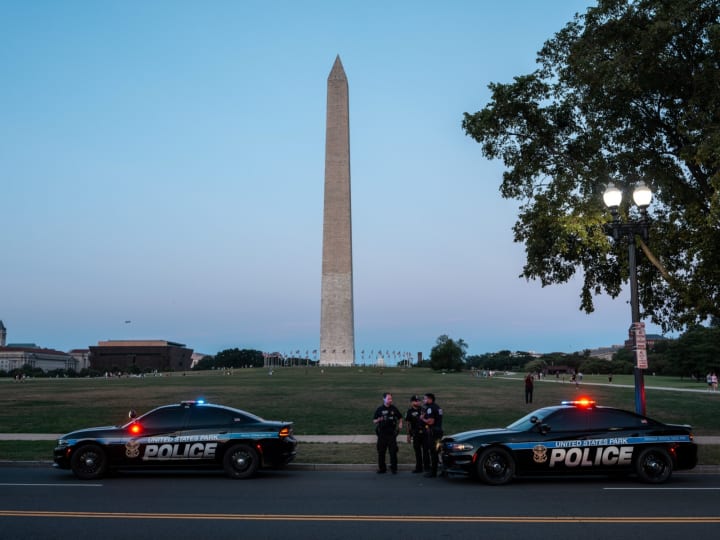
By the evening, Washington looked different. Armored trucks rolled along major boulevards. Guard members in camouflage patrolled near federal buildings and crowded tourist spots. Their presence was visible but controlled no checkpoints, but plenty of watchful eyes.
The last time the National Guard had been deployed in D.C. on this scale was during periods of intense protest. This time, there were no major demonstrations, no riots just an assertion of federal authority.
For some residents, the sight was reassuring. “It feels safer,” said one downtown shop owner. “You see the troops, you think twice before causing trouble.”
For others, it felt unnerving. “This isn’t what a free city should look like,” said a Howard University student. “We’re not at war, so why do we look like we are?”
Why D.C. Is Vulnerable to Federal Takeovers
D.C.’s political status has always been a source of tension. As the seat of federal government, it isn’t part of any state. Its budget, laws, and policies are subject to congressional review, and the President has unique emergency powers over its operations.
In most U.S. cities, a mayor’s authority over local police is absolute. But in D.C., the President can legally seize control of law enforcement a power used sparingly in the past, typically during riots or national security crises.
That’s why this move is so significant: it happened in a period of relative calm.
The Reactions: Praise and Outrage
The response from political leaders was split along predictable lines.
Supporters, including several Republican lawmakers, praised the move as a decisive step to ensure public safety. They argued that local leadership had been too lenient on crime and too slow to act.
Opponents saw it as something far more dangerous. Mayor Muriel Bowser called it “an unprecedented attack on D.C.’s autonomy”, while civil rights groups warned it could lead to civil liberties violations and excessive policing.
One prominent legal scholar described it as “a constitutional stress test”, warning that if this precedent stands, future presidents might use the same power for less defensible reasons.
The Historical Echo
There is precedent for federal takeovers of D.C.’s police, but those moments came during undeniable emergencies. In 1968, after the assassination of Martin Luther King Jr., widespread riots prompted federal intervention. In 1971, anti-war protests brought clashes between police and demonstrators, again leading to federal control.
This time, there was no such flashpoint. And that, historians say, is what makes it remarkable and controversial.
Life Under Federal Command
For now, day-to-day policing hasn’t changed drastically for most residents. The same officers patrol neighborhoods, answer calls, and respond to incidents. But behind the scenes, orders flow from a new command chain, one that bypasses city hall entirely.
Some officers, speaking anonymously, expressed unease at the shift. “It’s strange,” one MPD veteran admitted. “We serve the community, but right now, our orders are coming from people who aren’t from here and don’t know the city like we do.”
Business owners have reported mixed effects. Some downtown retailers have seen a small boost in foot traffic from tourists curious about the situation, while others say customers are avoiding the area entirely.
The Political Stakes
Politically, the takeover is a grenade thrown into an already heated landscape. Democrats in Congress are calling for investigations, while Trump’s allies see the move as a demonstration of strength heading into the next election cycle.
Analysts say this episode could have long-term effects on the statehood debate. Advocates argue it proves why D.C. needs full autonomy. Opponents of statehood say it shows exactly why the federal government must retain oversight.
What Comes Next?
Under the law, this federal control can last no more than 30 days unless extended under another legal provision. Whether Trump plans to push for such an extension is unclear.
If the takeover ends quietly, it may fade from national headlines. But if tensions escalate, protests erupt, or legal challenges succeed, it could become a defining political moment of Trump’s presidency.
Lawsuits are already being drafted, with civil rights attorneys preparing to challenge the definition of “emergency” that justified the move.

The Bigger Question
Beyond the immediate politics lies a bigger, more troubling question: What does this mean for the balance of power between local and federal authority?
In a democracy, local governance is meant to reflect the will of the people who live there. But in D.C., that principle can be set aside with the stroke of a presidential pen.
For residents, it’s a reminder of how fragile their autonomy is. For politicians, it’s a test of how far executive power can stretch without snapping the threads of democratic trust.
Final Thoughts
Washington, D.C., has always been more than just a city. It’s a symbol a living, breathing postcard of American democracy. But symbols are only as strong as the reality behind them.
This takeover, whether seen as bold leadership or dangerous overreach, forces the nation to confront an uncomfortable truth: in the capital of the free world, freedom can be put on hold when the federal government decides it must.
In the weeks ahead, the soldiers may leave, the federal orders may expire, and life may return to normal. But the memory of this moment and the precedent it sets will remain.
And for Washingtonians, the question will linger: If it can happen here, in the heart of democracy, where can’t it happen?
About the Creator
M Ayub Khan
Welcome to my corner of the world! I’m Ayub Khan, a storyteller with a passion for digging deeper into the human experience. Here on Vocal Media, I aim to break the surface and explore the complexities of life that often go unnoticed
Keep reading
More stories from M Ayub Khan and writers in The Swamp and other communities.
Merz Calls Emergency Virtual Summit Ahead of Putin Meeting
German Chancellor Friedrich Merz has called an emergency virtual summit with top U.S., European, and Ukrainian leaders just days before former U.S. President Donald Trump’s planned meeting with Russian President Vladimir Putin. The move underscores the high stakes surrounding Ukraine’s security, Western unity, and the future of peace negotiations in Eastern Europe.
By M Ayub Khan7 months ago in The Swamp
A Gathering of Evil Bosses
“I’m the queen of chin jutting while I smooth my hair, attacking, insulting, and deflecting to protect my appointer.” “Oh, please, Blondi, my hair is curled, highlighted, and longer than yours. I feature television commercials telling immigrants that we will give them a free plane ride home, and if they voluntarily turn themselves in, they will be allowed to legally apply for re-entry. It runs everywhere, and I look good in it! You can’t compete because of your blond hair. Mine is nicer, and my lips are prettier than yours.”
By Andrea Corwin 10 days ago in The Swamp




Comments
There are no comments for this story
Be the first to respond and start the conversation.