
Trump Criticized Rep. Ilhan Omar in Iowa Hours Before a Man Sprayed Substance on Her in Minneapolis
Trump’s Iowa remarks singling out Ilhan Omar came hours before a tense Minneapolis town hall where a man sprayed an unknown substance at her, sparking nationwide debate on rhetoric, safety, and political violence

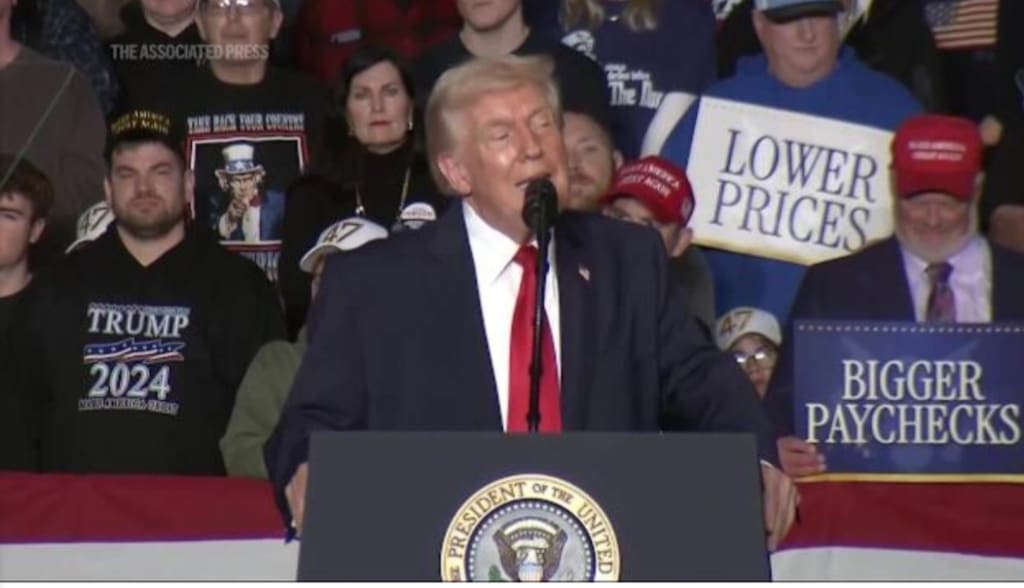
Verbal attacks in political rallies and real‑world violence raise concerns about rhetoric and safety for public officials, as Minnesota lawmaker sprayed with unknown liquid at town hall
Just **hours after former President **Donald Trump publicly criticised Democratic Representative Ilhan Omar at a campaign event in Iowa, a man rushed the stage at a town hall meeting she was hosting in Minneapolis and sprayed an unknown substance toward her, an incident that has reignited national debates about political rhetoric, public safety, and the risk faced by elected officials in the United States.
Trump’s Criticism in Iowa: Rhetoric Amid Campaign Trail
Earlier on the same Tuesday that the Minneapolis incident took place, Donald Trump — campaigning in the battleground state of Iowa — directed sharp criticism at Rep. Ilhan Omar as part of a broader appeal to voters on immigration issues. Speaking to a crowd, Trump stated that his administration would only admit immigrants “who can show that they love our country,” adding that they needed to be “proud, not like Ilhan Omar.” His remarks drew loud boos when her name was mentioned.
Trump also attacked her background, asserting dismissively that she “comes from a country that’s a disaster” — a comment that sparked controversy due to its personal and nationalistic tone. His remarks were part of a broader pattern of public criticism, including past comments at a Cabinet meeting in December when he described Omar as “garbage” and disparaged her associates.
Political analysts note that Trump’s comments reflect efforts to rally his political base by highlighting disagreements with progressive lawmakers and focusing on divisive issues like immigration. However, critics argue such rhetoric can escalate tensions and contribute to an environment where elected officials become targets of hostility rather than debate.
The Minneapolis Town Hall Attack
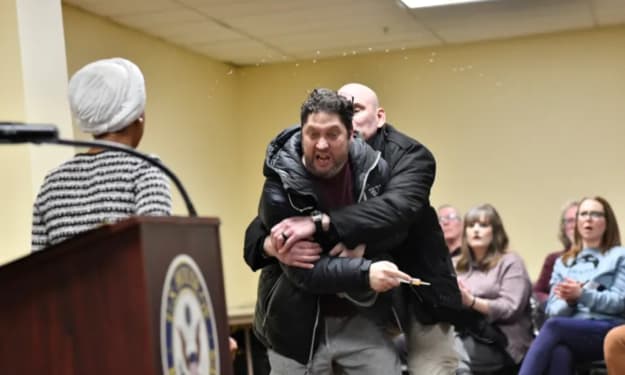
Later that evening, in North Minneapolis, Rep. Ilhan Omar was hosting a town hall meeting attended by local residents and community members when the disruption occurred. As she was discussing federal immigration enforcement policies — including calling for the abolition of U.S. Immigration and Customs Enforcement (ICE) and urging the resignation of Homeland Security Secretary Kristi Noem — a man in the audience suddenly charged toward her and sprayed an unknown substance using a syringe‑like object.
Security personnel and law enforcement quickly intervened, tackling the individual to the ground. Witnesses described the liquid as having a vinegar‑like smell, though authorities have not yet identified the substance. The suspect was arrested on suspicion of third‑degree assault and taken into custody by Minneapolis police.
Despite the startling attack, Omar was not seriously injured and chose to resume her remarks, demonstrating resilience in the face of the confrontation. Video footage from the event shows her continuing the town hall after the man was removed, even as aides urged her to step away and get checked by medical professionals.
National Response and Condemnation
Leaders from both sides of the political spectrum condemned the assault. Republican Representative Nancy Mace took to social media to express alarm at the attack, stating, “No elected official should face physical attacks … This is not who we are,” while also noting her disagreement with Omar’s policies. Minneapolis Mayor Jacob Frey echoed the sentiment, calling the incident “unacceptable” and emphasizing that violence and intimidation have no place in civic engagement.
The incident has also prompted broader reflection on the state of political discourse in the U.S. amid a spate of attacks and threats against public figures. In recent weeks, threats against members of Congress have risen, with related incidents including the arrest of a man in Utah for allegedly assaulting another U.S. representative at a public event.
Context: Tensions in Minneapolis and National Politics
The Minneapolis town hall came at a moment of heightened local and national tension. In Minneapolis, the shooting deaths of two residents — including a **37‑year‑old intensive care nurse — at the hands of federal immigration agents had sparked protests and anger over federal enforcement practices. Omar has been vocal in condemning those actions, intensifying her criticism of federal agencies and calls for accountability.
Nationally, debates over immigration policy, law enforcement authority, and political extremism have intensified as the 2026 election cycle unfolds. Representatives — especially those who speak on contentious issues like immigration reform — often face heated backlash on social media and at public events. The intersection of inflammatory rhetoric from political leaders and volatile public reactions raises concern among experts about the safety of public servants and the health of democratic debate.
Political Rhetoric and Responsibility
Critics of Trump’s Iowa remarks argue that attacks on public figures’ character and patriotism contribute to an atmosphere of polarisation that can embolden fringe individuals. Supporters of the former president counter that strong language reflects legitimate political disagreement and that blame for violence should rest solely with the assailant, not the speaker.
Security analysts note that while political speech is protected and expected in democratic debate, leaders have a responsibility to avoid dehumanizing language that could be misinterpreted or exploited by unstable actors. The distinction between vigorous political disagreement and rhetoric that inflames audiences has become a central point of discussion in the aftermath of the Minneapolis incident.
Omar’s Message After the Incident
In remarks following the event, Omar reiterated her commitment to her constituents and her broader mission. She described herself as a “survivor” and emphasised that intimidation tactics will not deter her work, thanking supporters for rallying around her and affirming her resilience. Her response underscored the symbolic weight of the incident — not only as a physical attack, but as a moment that tested the norms of civic discourse and public safety.
Looking Ahead: Safety and Civic Engagement
The Minneapolis attack and the preceding rhetoric in Iowa have spurred urgent calls for improved security at public political events, particularly town halls that traditionally allow direct engagement between lawmakers and constituents. At the same time, policymakers and civil society groups are debating how to uphold robust political debate without undermining the safety and dignity of participants on all sides of the political divide.
As the nation grapples with these challenges, the incident highlights deep questions about the balance between free expression, political accountability, and the responsibility of leaders to foster a civil, secure public sphere.
About the Creator
Keep reading
More stories from Salaar Jamali and writers in The Swamp and other communities.
Inside Anduril’s Bolt-M Kamikaze Drone Program
How a new generation of autonomous weapons is reshaping modern warfare In recent years, modern warfare has shifted rapidly toward autonomy, speed, and precision. One of the clearest signs of this change is the rise of loitering munitions—often called “kamikaze drones.” Among the newest and most talked-about systems is Anduril Industries’ Bolt-M drone, a compact but powerful weapon designed for fast, flexible combat missions. Anduril, a U.S.-based defense technology company, has built a reputation for blending artificial intelligence with military hardware. The Bolt-M program reflects that approach, combining advanced software, autonomy, and battlefield adaptability into a single system. As conflicts around the world highlight the growing role of drones, Bolt-M offers a glimpse into how future wars may be fought. What Is the Bolt-M Drone? The Bolt-M is a man-portable loitering munition, meaning it can be carried by soldiers and launched quickly in the field. Unlike traditional missiles, loitering munitions can hover over an area before striking a target. This gives operators more time to identify threats and choose the best moment to attack. Bolt-M is designed to strike vehicles, equipment, and fortified positions with high accuracy. Once launched, it can fly autonomously or under human supervision, depending on mission needs. This flexibility makes it suitable for fast-moving battlefields where decisions must be made in seconds. Designed for Modern Battlefields One of the key goals behind the Bolt-M program is adaptability. Traditional weapons often require large support systems, but Bolt-M is meant to be used by small units operating independently. Soldiers can deploy it without heavy infrastructure, making it useful in both urban combat and remote areas. The drone is also built to survive contested environments. Modern battlefields are filled with electronic warfare systems that attempt to jam or disrupt drones. Anduril has focused heavily on resilience, ensuring Bolt-M can continue operating even when communications are limited. The Role of Artificial Intelligence Artificial intelligence sits at the heart of Anduril’s technology. Bolt-M uses AI to help with navigation, target recognition, and decision support. While human operators remain responsible for final engagement decisions, AI allows the system to process large amounts of data quickly. This capability is critical in environments where threats appear suddenly. Instead of relying solely on manual control, Bolt-M can adjust its flight path, avoid obstacles, and maintain stability under challenging conditions. This reduces operator workload and improves mission success rates. Why the U.S. Military Is Paying Attention The U.S. military has been closely watching developments in loitering munitions, especially after seeing their impact in recent conflicts. Systems like Bolt-M offer cost-effective precision, which is increasingly important as defense budgets face pressure. Bolt-M’s modular design also stands out. It can be integrated into broader command-and-control networks, allowing it to share information with other drones, sensors, and units. This fits well with the military’s push toward networked warfare, where systems work together rather than operating alone. Ethical and Strategic Concerns As with any autonomous weapon system, Bolt-M raises important ethical questions. Critics worry about the increasing role of AI in combat and the potential risks if systems malfunction or are misused. Anduril has emphasized that human oversight remains central, with operators maintaining control over lethal decisions. Strategically, the spread of loitering munitions also changes how conflicts are fought. Smaller forces can now threaten larger, better-equipped armies. This shift may deter aggression in some cases but could also lower the barrier to entry for advanced military capabilities. Competing in a Crowded Field Bolt-M enters a market that is becoming increasingly competitive. Several countries and companies are developing similar systems, each trying to improve range, accuracy, and autonomy. Anduril’s advantage lies in its software-first approach, treating hardware as part of a larger digital ecosystem. By constantly updating software, Anduril can improve performance without redesigning the entire drone. This allows Bolt-M to evolve rapidly as battlefield conditions change, a key advantage in modern warfare. What the Future Holds The Bolt-M program is still evolving, but its direction is clear. As militaries look for faster, smarter, and more flexible weapons, systems like Bolt-M are likely to play a larger role. Future versions may offer longer range, improved sensors, and deeper integration with other autonomous platforms. At the same time, governments and international organizations will continue debating how such weapons should be regulated. Balancing military effectiveness with ethical responsibility will be one of the defining challenges of the coming decades. A Glimpse Into Tomorrow’s Warfare Anduril’s Bolt-M is more than just another drone. It represents a shift in how wars are planned and fought—toward autonomy, precision, and networked systems. While questions remain about oversight and long-term impact, there is little doubt that loitering munitions like Bolt-M are shaping the future of global security. As technology continues to advance, the line between software and warfare will only grow thinner. Bolt-M stands at that intersection, offering a powerful example of how innovation is redefining the battlefield.
By Fiaz Ahmed 4 days ago in The Swamp



Comments
There are no comments for this story
Be the first to respond and start the conversation.