
Too Expensive Even for China: The Country Halts Its Ambitious Race With Europe to Build the World’s Largest Particle Accelerator
Rising costs, shifting priorities, and global economic pressure force Beijing to pause one of its boldest scientific ambitions.

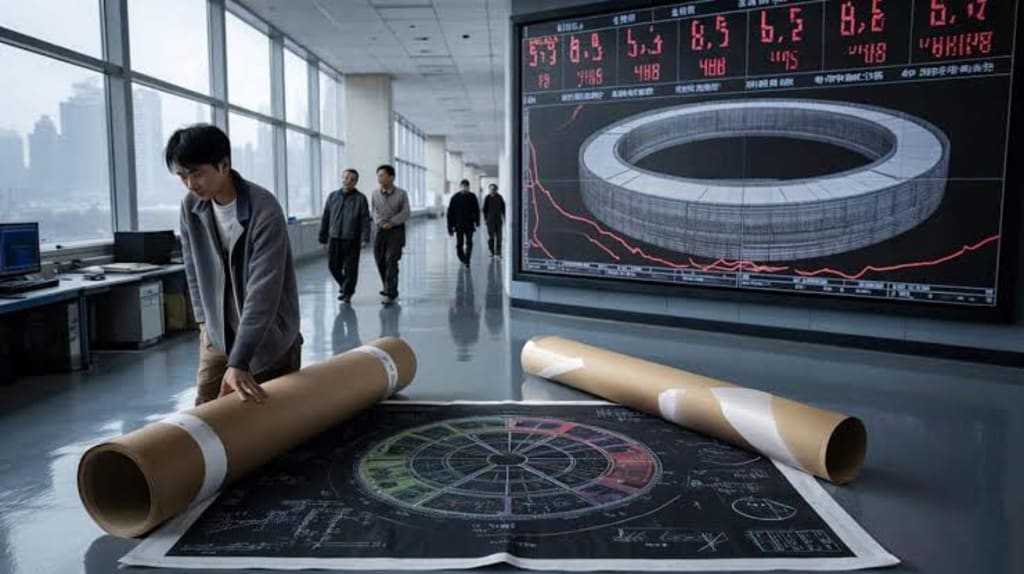
For years, China appeared poised to overtake Europe in one of the most ambitious scientific races of the 21st century: the construction of the world’s largest and most powerful particle accelerator. Designed to surpass CERN’s Large Hadron Collider (LHC), the proposed Chinese machine promised to unlock new mysteries of the universe and redefine global leadership in fundamental physics. But now, in a surprising turn, China has effectively halted the project—citing a reason rarely associated with the world’s second-largest economy: cost.
A Vision Bigger Than CERN
China’s proposed facility, often referred to as the Circular Electron Positron Collider (CEPC), was envisioned as a massive underground ring stretching roughly 100 kilometers—nearly four times the size of CERN’s LHC near Geneva. Scientists hoped it would enable precision studies of the Higgs boson, dark matter, and other unresolved questions that sit at the heart of modern physics.
The project was not merely scientific; it was symbolic. For China, building the world’s largest particle accelerator would signal its arrival as a global leader in basic research, rivaling Europe and the United States not only in applied technologies but in pure scientific discovery.
The Price Tag That Stopped Momentum
Initial estimates placed the cost of the CEPC at around $5–6 billion, but over time, projections ballooned significantly. Infrastructure challenges, advanced superconducting technology, energy demands, and long-term operational costs pushed estimates far higher. When combined with economic headwinds, the price became increasingly difficult to justify.
China’s leadership has shifted priorities toward projects with more immediate economic and strategic returns—such as semiconductor manufacturing, artificial intelligence, renewable energy, and defense technologies. In this context, a decades-long physics experiment with uncertain practical outcomes began to look like a luxury.
As one Chinese science policy analyst reportedly put it, “Fundamental science is important, but timing matters.”
Europe’s Parallel Struggle
China’s pause comes as Europe itself wrestles with similar challenges. CERN has proposed its own next-generation accelerator, the Future Circular Collider (FCC), which would dwarf the LHC in size and capability. However, European governments remain divided over funding, with costs expected to exceed €20 billion.
Public pressure, rising defense budgets, inflation, and climate commitments have made it politically difficult to secure long-term funding for mega-science projects. China’s retreat may embolden critics in Europe who argue that such endeavors are no longer financially realistic.
Science vs. Economic Reality
Particle accelerators are among the most complex machines ever built, requiring unprecedented engineering precision and vast energy resources. While they have delivered transformative discoveries—such as the Higgs boson in 2012—their practical applications are indirect and long-term.
In today’s geopolitical environment, governments are increasingly judged on short-term economic performance and national security. Projects that do not deliver immediate benefits face greater scrutiny, regardless of their potential to reshape human understanding of the universe.
China’s decision reflects this global shift: science is no longer evaluated in isolation from economics and politics.
A Setback, Not a Surrender
Importantly, China has not abandoned particle physics altogether. Research continues at smaller facilities, and Chinese scientists remain deeply involved in international collaborations, including at CERN. The country has also invested heavily in other “big science” fields such as space exploration, fusion energy, and quantum research.
Many experts view the pause as strategic rather than permanent. If economic conditions improve or international partnerships reduce costs, the project could be revived in a scaled-down or collaborative form.
What This Means for Global Science
The halt underscores a sobering reality: even the most powerful nations have limits. Big science increasingly depends on multinational cooperation rather than national prestige projects. The era when a single country could bankroll universe-spanning experiments may be coming to an end.
For young scientists, the decision raises concerns about funding stability and long-term career paths. For policymakers, it forces a reevaluation of how humanity invests in knowledge that may not pay off for generations.
Conclusion
China’s decision to halt its bid to build the world’s largest particle accelerator is more than a budgetary adjustment—it is a sign of changing global priorities. In an age defined by economic uncertainty and geopolitical competition, even the pursuit of fundamental truth must compete with practical necessity.
The universe may still hold its secrets, but for now, the race to uncover them has hit a financial speed bump—one that even China could not afford to ignore.
About the Creator
Fiaz Ahmed Brohi
I am a passionate writer with a love for exploring and creating content on trending topics. Always curious, always sharing stories that engage and inspire.
Keep reading
More stories from Fiaz Ahmed Brohi and writers in The Swamp and other communities.
Europe Won’t Be Blackmailed,” Danish PM Says as NATO Allies Unite Over Trump’s Greenland Threat
Europe’s political leadership has delivered an unusually blunt message after renewed comments from former U.S. President Donald Trump reignited controversy over Greenland: the continent will not be pressured, coerced, or intimidated over its territory. Danish Prime Minister Mette Frederiksen declared that “Europe won’t be blackmailed,” as NATO allies rallied behind Denmark to reaffirm sovereignty, international law, and alliance unity.
By Fiaz Ahmed Brohi2 days ago in The Swamp


Comments
There are no comments for this story
Be the first to respond and start the conversation.