
The Truth Behind Israel’s “Withdrawal”: What’s Really Happening in Gaza and the West Bank
A deep analysis of Israel’s partial withdrawal, territorial control, and the evolving geopolitical reality in Palestine (October 2025)

The Basic Facts About Palestine
Palestinian territories are generally divided into two main parts: the West Bank and the Gaza Strip.
The West Bank includes East Jerusalem (Al-Quds), which remains one of the most disputed areas in the world.
Administratively, the West Bank itself is further divided into about 11 governorates — each with varying degrees of Palestinian Authority presence and Israeli military oversight.
Does “Troop Withdrawal” Mean a Complete Pullout?
When news reports or officials say “Israel has withdrawn from Gaza,” it doesn’t necessarily mean a complete military exit or the end of control.
In many cases, the phrase refers to a reduction in active ground operations or a shift in troop deployment, rather than a total evacuation.
Israel has made several statements claiming to have scaled back or relocated some military units from Gaza.
However, independent sources and observers suggest that Israel still maintains firm control over key zones and critical border points.
For instance, several recent briefings and reports indicate that Israel retains control over much of Gaza’s territory — particularly near major crossings, highways, and key neighborhoods that have been turned into buffer zones or military corridors.
In essence, “withdrawal” here might be a strategic repositioning, not a genuine end to occupation.
Even Israeli defense officials have hinted that long-term military oversight in Gaza, southern Lebanon, and parts of Syria is part of their ongoing security plan.
Thus, the statement “troops have completely withdrawn” can be an exaggeration, as surveillance, air dominance, and ground patrols continue in many areas.
Where Israeli Forces Are Still Present
1. The West Bank
In the West Bank, Israeli forces remain highly active.
Since early 2025, a major military campaign called “Operation Iron Wall” has targeted areas like Jenin, Tulkarm, and Nablus.
The Jenin refugee camp, Nur Shams, and Tulkarm camp have faced ongoing military raids and curfews, with entire neighborhoods brought under heavy surveillance and control.
Reports show an increase in night raids, mass arrests, and expanded checkpoints throughout the West Bank, making daily movement difficult for Palestinians.
Even cities under nominal Palestinian Authority governance are often surrounded or monitored by Israeli forces.
2. The Gaza Strip
In Gaza, while some statements speak of troop withdrawals from central urban zones, the situation on the ground remains far from peaceful.
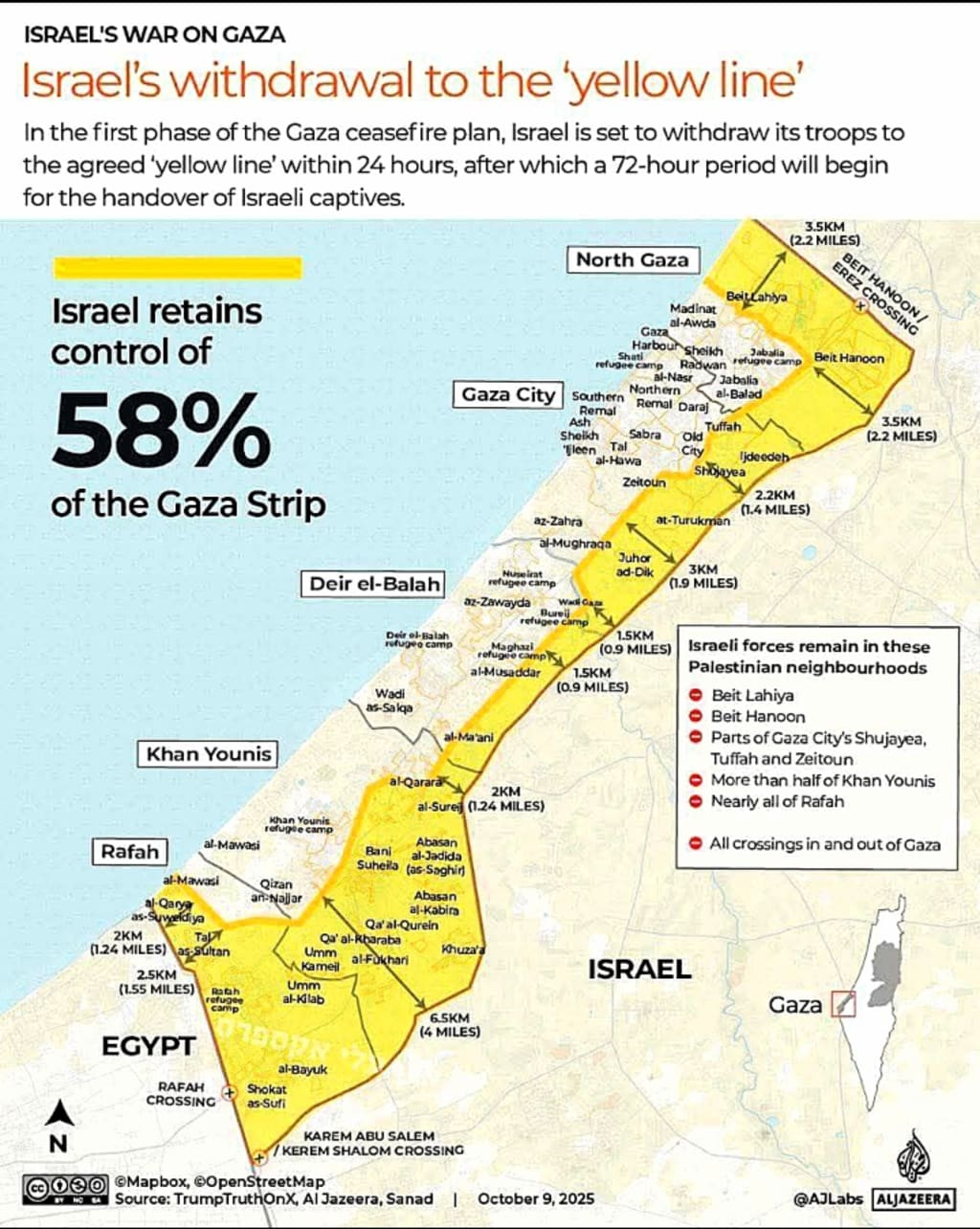
Military analysts suggest that Israel still controls roughly 58–75% of Gaza’s land area — particularly key routes and crossings such as Kerem Shalom, Rafah, and Beit Hanoun (Erez).
The so-called “Yellow Line”, as seen in recent ceasefire maps, marks the line up to which Israeli forces remain stationed.
Within this boundary, Israel continues to maintain checkpoints, drone surveillance, and operational bases.
Many of these zones are labeled “no-go areas”, meaning Palestinians are forbidden to enter or live there.
Humanitarian organizations and the UN report that around 70% of Gaza’s land is now under restricted or conditional access — a situation that continues to worsen living conditions for the displaced population.
The Political and Humanitarian Implications
This partial withdrawal plan, presented as part of a ceasefire, has deeper political implications.
By maintaining military positions up to the “yellow line,” Israel effectively preserves control over Gaza’s key lifelines — including trade, aid routes, and civilian crossings.
For Palestinians, this means that the blockade remains intact, even if the visible troop presence is reduced.
Access to food, medicine, and shelter continues to depend on permissions granted by Israeli authorities.
International observers, including the United Nations Office for the Coordination of Humanitarian Affairs (OCHA), warn that these conditions could amount to “de facto occupation” — where military control persists despite claims of withdrawal.
Moreover, the psychological dimension cannot be ignored.
The image of retreating troops may appear as a sign of de-escalation, but for those living under drones, blocked roads, and constant surveillance, the occupation feels just as present as ever.
Strategic Control and “Security Zones”
In military terms, Israel’s strategy seems focused on maintaining security corridors — thin strips of land that provide fast access for troops and ensure dominance over transportation routes.
These corridors cut across Gaza and the West Bank, linking border areas to major highways, effectively allowing Israel to control movement and logistics without stationing large forces in every city.
Such strategies mirror historical precedents — like the buffer zones established in southern Lebanon during the 1980s and 1990s — where Israel claimed to “withdraw,” yet continued to exert control through proxies and restricted access zones.
The Broader Regional Context
The 2025 situation cannot be seen in isolation.
Tensions along the Lebanon border, sporadic clashes in Syria’s Golan Heights, and political uncertainty in the West Bank all feed into Israel’s broader security calculations.
Meanwhile, regional actors — Egypt, Qatar, and Turkey — are attempting to mediate a more sustainable ceasefire, though each has its own geopolitical interests.
For ordinary Palestinians, however, these diplomatic moves have little immediate effect.
The reality remains that most of Gaza and the West Bank live under varying degrees of siege, surveillance, and military restriction.
Conclusion: The Illusion of Withdrawal
So, has Israel truly withdrawn?
On paper, perhaps partially.
In reality, what’s unfolding is more of a tactical repositioning than a peace-driven retreat.
The 58% control figure highlighted in recent maps paints a sobering picture: most of Gaza remains under effective Israeli authority, and the situation in the West Bank is even more entrenched.
Until border access, sovereignty, and humanitarian freedom are restored, the word “withdrawal” will remain a matter of semantics — not liberation.
About the Creator
Amanullah
✨ “I share mysteries 🔍, stories 📖, and the wonders of the modern world 🌍 — all in a way that keeps you hooked!”


Comments (2)
That's a good news 👍
When the land is still under watch and people still fear to move — can we really call it peace?