
The Stolen Seats: How PTI Was Sidelined
What happened after Pakistan's 2024 elections is not democracy—it’s control.

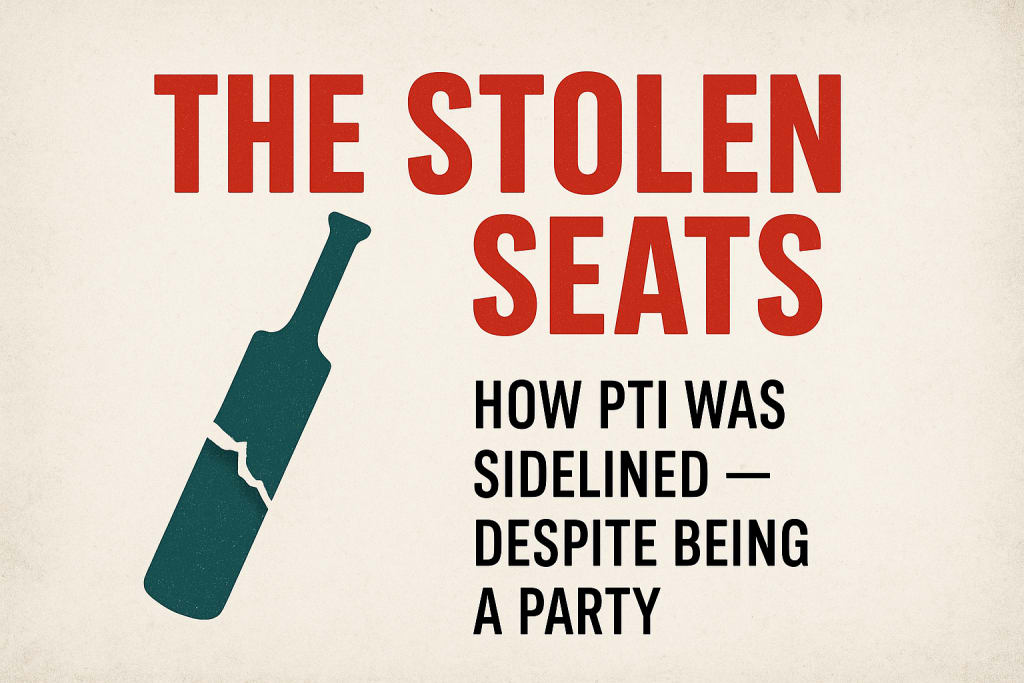
In Pakistan’s February 2024 elections, millions voted for candidates backed by Pakistan Tehreek-e-Insaf (PTI). However, PTI could not use its well-known “cricket bat” election symbol. The Election Commission of Pakistan (ECP) said the party missed the deadline for its internal polls and classified PTI candidates as independents.
Still, PTI supporters knew who to vote for—and PTI-backed independents won the most seats in the National Assembly.
But PTI lost out. Not officially banned, but effectively stripped of reserved seats—special seats for women and minorities awarded based on general election results.
What Happened to PTI Before the Election?
Before the elections, PTI faced a widespread crackdown. Its leaders, activists, and supporters were arrested or harassed. Public rallies were restricted, and media coverage limited.
Most importantly, former Prime Minister Imran Khan, PTI’s most popular leader, was arrested multiple times on cases many saw as politically motivated. His arrest and time in jail created fear and disrupted PTI’s ability to campaign effectively. Yet millions still voted for PTI-backed candidates.
The Size of the Betrayal
Pakistan’s National Assembly consists of:
- General seats: Filled by direct election.
- Reserved seats: Given based on the number of general seats a party wins. These ensure representation for women and minorities.
Because PTI candidates ran as independents, the ECP said they were not eligible for reserved seats. These seats were instead given to other parties—PML-N, PPP, JUI-F, MQM, ANP, PTI (P), and IPP—giving them a two-thirds majority in Parliament.
PTI Says the Documents Were Submitted
PTI insists it followed all legal requirements:
- The party submitted certificates and candidate lists for both general and reserved seats.
- The ECP either concealed these documents or never officially accepted them.
- The decision to deny the “cricket bat” symbol was misread—an error the Supreme Court later acknowledged.
In July 2024, the Supreme Court ruled by an 8–5 majority that PTI was indeed a political party eligible for reserved seats. The Court gave PTI lawmakers 15 days to submit party certificates if they had not done so during nominations.
But Then They Took It Back
However, on June 28, 2025, an 11-member Supreme Court bench reversed that decision. The Court ruled PTI was still ineligible for reserved seats due to procedural faults. This restored an earlier Peshawar High Court verdict and left PTI without those reserved seats.
PTI Is Still a Political Party — Despite All This
Despite setbacks, PTI remains a registered political party. On September 23, 2024, the Supreme Court reaffirmed PTI’s legal status and ruled that the ECP violated voters' rights by denying PTI its symbol and reserved seats. The Court said:
“The constitutional right of a political party to participate in elections is not affected by the absence of an electoral symbol.”
“When election authorities deprive candidates, they not only undermine candidates but also the electorate.”
The Jailed Leadership
PTI’s problems go beyond symbols and seats. Many senior leaders, including Imran Khan, remain behind bars or face ongoing legal challenges. This has weakened the party’s ability to organize and defend itself.
Supporters say this crackdown is part of a wider effort to silence PTI and stop it from effectively challenging the government.
Why This Matters for Democracy
This is more than legal details. It’s about who really chooses Pakistan’s leaders:
- The people, through their vote; or
- Those in power, through legal tricks.
PTI supporters feel cheated, seeing technical rules used to silence the majority’s choice.
If the ECP and courts can block a party that wins the most seats, what hope do voters have? Their votes can be dismissed anytime.
This dangerous pattern involves:
- Denying the party’s symbol.
- Forcing candidates to run as independents.
- Ignoring wins for reserved seats.
- Reversing court rulings supporting the party.
This is not democracy—it’s a managed outcome.
What’s Next?
PTI supporters remain vocal online, sharing evidence and claiming the case is rigged. Despite losing reserved seats, they still have their votes and voices.
Legal experts warn that the Supreme Court’s reversal may shift power but risks damaging public trust. Many ask:
- Should the ECP have hidden documents PTI claims to have submitted?
- Should courts uphold or deny the voters’ will?
Conclusion
The PTI seat saga shows how elections can be stolen—not by force, but by paperwork. PTI wasn’t banned but was stripped step-by-step of symbols, seats, and power. Courts intervened but changed course. Everything was technical, public, and left democracy in doubt.
If winning votes is not enough to win power, what is the point of elections?
Author’s Note:
This is not just about PTI. It’s about Pakistan’s democracy. When a party wins but still loses, when votes count but are not counted—democracy fades.
Sources:
1. Dawn. (2024). PTI barred from using cricket bat symbol for elections.
2. The News International. (2024). PTI’s reserved seats dispute deepens.
3. Al Jazeera. (2023). Pakistan’s PTI faces crackdown ahead of polls.
4. BBC News. (2023). Imran Khan’s multiple arrests ahead of election.
5. Reuters. (2024). Pakistan election dispute and reserved seats controversy.
6. Tribune Pakistan. (2024). Supreme Court rules on PTI’s election symbol eligibility.
7. Supreme Court of Pakistan. (2024). PTI reserved seats ruling (PDF).
8. The Frontier Post. (2025). Supreme Court reverses PTI’s reserved seats decision.
9. Arab News. (2024). SC reaffirms PTI’s right to contest elections without symbol.
10. Dawn. (2024). Ongoing legal challenges for PTI leadership.
About the Creator
Muhammad Adil
Master’s graduate with a curious mind and a passion for storytelling. I write on a wide range of topics—with a keen eye on current affairs, society, and everyday experiences. Always exploring, always questioning.
Keep reading
More stories from Muhammad Adil and writers in The Swamp and other communities.
Imran Khan: Alive but Angry
The heavy fog of uncertainty that had settled over the political landscape of Pakistan has finally lifted. On Tuesday, December 2, 2025, the iron gates of Adiala Jail in Rawalpindi opened just enough to allow a long awaited reunion. Dr. Uzma Khan, the sister of former Prime Minister Imran Khan, was granted permission to meet her brother after weeks of silence. This meeting has brought a wave of relief to millions of his supporters who had been consumed by dark rumors about his safety. While the confirmation of his survival is good news for his party, the details emerging from the meeting paint a grim picture of his life behind bars.
By Muhammad Adil2 months ago in The Swamp
The Climax of Fire
Fire has always been a symbol of transformation. From the first controlled flames used by early humans to modern industrial furnaces and raging wildfires, fire represents creation and destruction, warmth and devastation, survival and loss. “The Climax of Fire” refers to that pivotal moment when flames reach their peak—when energy, intensity, and consequence converge.
By Aarif Lashariabout 18 hours ago in The Swamp


Comments
There are no comments for this story
Be the first to respond and start the conversation.