
The Silent Superweapon
Did DOGE Build the Real Deep State’s Dream Tool
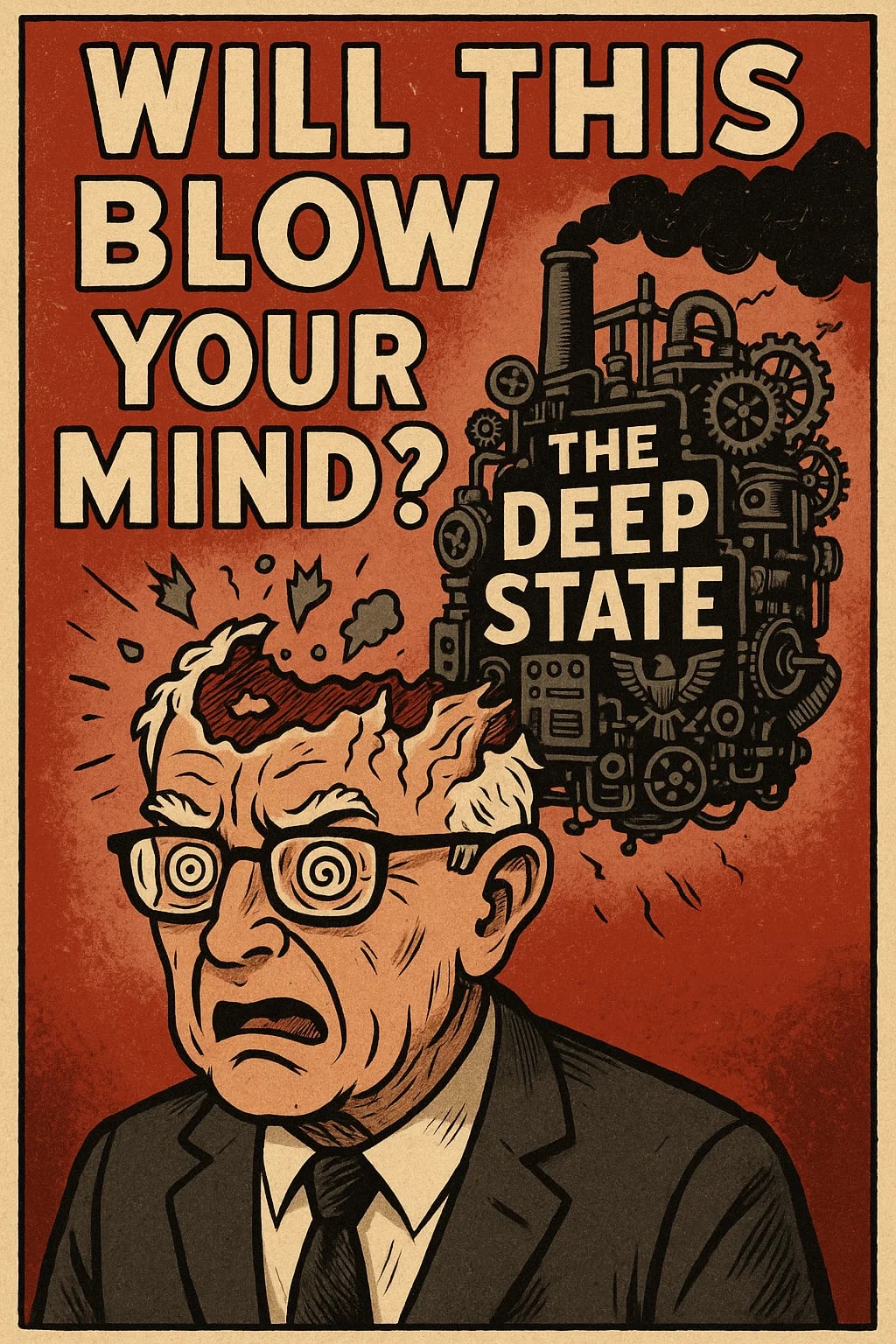
Editorial Note: This satirical essay is a speculative exploration of administrative overreach, government efficiency rhetoric, and the unintended consequences of digitized control. Inspired by the spirit of The Twilight Zone, it invites readers to imagine a world where a new bureaucracy becomes the engine of dystopia. It is not a declaration of fact, but a provocative thought experiment. License is taken to use the real life Department of Government Efficiency name as it is current in the public ethos.
————————————
What if the Department of Government Efficiency (DOGE) was never about efficiency at all?
What if DOGE was the keystone—not of better government—but of total government?
What if we just witnessed the creation of a master tool that will help the real Deep State keep tabs on everybody?
What if it was all just a quiet, technocratic restructuring project packaged in patriotic buzzwords—while behind the scenes, an authoritarian-leaning administration used it to consolidate power, dissolve data firewalls, and quietly construct the most powerful surveillance engine ever assembled in American history?
Not a conspiracy. Not a secret. Just... administration. Policy. A quiet rewrite of bureaucratic processes accomplishing a feat even the loudest “deep state” doomsayers couldn’t imagine:
Birthing a centralized database of every piece of personal data available, owned and operated by the executive branch.
Doesn't that just blow the conspiracy circuits in your brains?
The Trojan Horse of “Owning the Libs”
In recent years, a defining feature of far-right populist rhetoric has been the gleeful pursuit of “owning the libs”—a phrase that has come to represent political performance over policy, retribution over reconciliation, and tribal victory over collective good.
Consider this: The creation of DOGE fit the MAGA playbook perfectly: marketed as a tool to cut waste, eliminate lazy bureaucrats, and expose the administrative “deep state” that MAGA believers imagined as a viper's nest of coastal elitists and progressive saboteurs.
But the deeper irony is this: DOGE may have succeeded not in dismantling the deep state, but in centralizing and supercharging a more nefarious, deeper authoritarian state, obfuscated by the MAGA rhetoric—and all with the blessing, even applause, of those who fear it most.
In feeding their eagerness to “own the libs,” many have overlooked—or outright supported—unprecedented data centralization, consolidation of executive control, and erosion of institutional checks. When authoritarian instincts are wrapped in flags and slogans, scrutiny fades.
If agency silos have indeed been dissolved and data pipelines quietly unified under DOGE’s watch, then perhaps we’ve all been “owned"—not in the smug, partisan sense, but in a far more sinister and dystopian assertion of greater government control.
Agencies Were Quietly Raided for Data
DOGE’s power didn’t come from new laws—it came from creating a new architecture. It dismantled the protective walls between the following sources:
- IRS & Treasury – Tax returns, audit history, flagged “suspicious activity” indicators.
- DHS & ICE – Travel patterns, visa activity, facial recognition scans, citizenship status.
- CMS & HHS – Mental health records, prescription drug use, Medicare/Medicaid data.
- DOJ & FBI – Criminal histories, sealed indictments, protest attendance flagged by digital dragnet.
- Dept. of Education – Academic records, disciplinary referrals, student debt profiles.
- Labor & Unemployment Data – Employment history, benefit claims, flagged anomalies.
Powerful on their own, each dataset had previously been siloed—protected by firewalls, jurisdictional constraints, bureaucratic friction and data privacy regulations. DOGE’s actions intentionally removed that friction under the guise of “efficiency,” creating a living, breathing composite profile of nearly every U.S. resident.
Curiously omitted from this integration effort, however, was one of the largest data generators and spenders of all: the Department of Defense. With a budget that routinely crosses $800 billion and a long-standing inability to pass a modern audit, the Pentagon remains a black hole of accountability. This exclusion was no oversight. It was a strategic decision. By shielding the DOD from the same scrutiny imposed on domestic agencies housing data on all of us, DOGE helped preserve a veil over the probability of massive waste, duplication, and fraud—ensuring that efficiency never touched the institutions most practiced in hiding inefficiency.
The Black Hats Behind the Firewall
To construct a system this vast, this agile, this insidiously efficient—DOGE didn’t just hire consultants or government contractors. It was allowed to recruit from the underground and to bypass long standing requirements for deep background checks designed to maintain the government's integrity.
A new generation of digital mercenaries—including some former black-hat hackers—were quietly brought into the fold. While there is no public proof that DOGE employees were directly involved in leaking classified material, the agency's lax hiring practices and the use of personnel with minimal vetting has raised concerns. Given DOGE's bypassing of traditional security protocols and background checks, it's impossible to rule out that individuals with histories of digital subversion were positioned in critical roles—whether knowingly or through strategic negligence. Some had once defaced government websites for sport. Others had cracked databases, leaked classified documents, or sold access on the dark web. But now, they were given clearance, credentials, and—most importantly—a mission.
For the administration behind DOGE, these individuals were a perfect fit. They didn’t come with the ethical baggage of civil servants. They didn’t ask uncomfortable questions about constitutional limits or Fourth Amendment protections. They were chosen because they thrived on disruption, and they knew exactly how to bypass the safeguards they once exploited. If they did dare to question, they were quietly let go. No room for a conscience. Independent critical thought was out of scope.
Redemption narratives were spun—reformed hackers giving back. But the truth may be more troubling: they weren’t reformed—they were repurposed.
They were allowed to run amok. Most had no understanding of government structure, democratic accountability, or the long arc of constitutional protections—and the consequences of that ignorance weren’t theoretical. Indiscriminate terminations gutted critical agencies. Legally binding contracts were canceled in sweeping purges, exposing the government to costly litigation and operational paralysis. These weren’t reformers—they were guided missiles. What they understood wasn’t governance. It was how to make systems obey or how to break them. And that’s what they were hired to do.
While public-facing reforms touted increased efficiency and digital modernization, these black hat veterans were building backdoors, persistent data flows, and automated monitoring routines—not just to collect information, but to ensure it never stopped being collected.
Every system modernized under DOGE's directive came with hidden tendrils:
- API hooks that streamed data directly into centralized servers.
- Passive surveillance agents buried in service delivery platforms.
- Behavioral tracking loops masked as user-experience enhancements.
This wasn’t a one-time harvest. It was designed with intent as an autonomous ecosystem of surveillance, constantly fed by systems these young technologists optimized without constitutional oversight, and perhaps, without even realizing the scope of their creation.
In the name of rooting out fraud, waste and abuse, they built the operating system of authoritarian dystopia.
And when the data starts flowing, it never stops.
From Surveillance to Social Control
In science fiction, the warning signs have always been clear: when machines learn to monitor behavior, predict disobedience, and enforce outcomes—autonomy fades. From HAL 9000's cold logic in 2001: A Space Odyssey, to Minority Report's pre-crime algorithms, or the omnipresent AI overlords in The Matrix, the dystopian theme is constant: when data knows you better than you know yourself, liberty is no longer assured—it's algorithmically granted, revoked, or delayed.
The DOGE-bots may not have worn black capes nor did they speak in synthetic tones, but they built system functions with the same unemotional efficiency as those cinematic nightmares. No need for sci-fi fantasy when predictive algorithms and real-time monitoring already operate within state infrastructure.
With these firewalls gone, the new master system allows:
- Predictive Behavior Monitoring – Algorithms flag “potential risks” based on your digital footprint, purchases, travel, healthcare choices, and search queries.
- Service Conditionality – “Suspicious” individuals may face delays in benefits, medical authorizations, or financial approvals without explanation or recourse.
- Political Policing – Activists, journalists, and dissenters can be quietly tracked, flagged, or frozen out of public life—all under administrative processes.
- Reward and Punishment Ecosystems – Loyalty to the ruling party, once inferred through data proxies, becomes the currency of access and opportunity.
This isn’t just surveillance. This is programmable governance. And it doesn’t need guns or guards. It just needs dashboards—and silence. We didn’t need to build a glowing cyber villain to lose control. The Master Control Program arrived—wearing khakis, not armor.
Is the Joke’s On Us All?
For years, the “deep state” has been a punchline and a rallying cry—a blurry enemy used to justify dismantling institutional constraints. But what if the dismantling was the point?
DOGE isn’t a bureaucratic fluke—it is a governance weapon cloaked in spreadsheets, PowerPoint decks, and “common sense reform.” While one side cheered its potential to root out liberal “welfare cheats,” “illegals,” or “radicals,” they failed to see that the same tool could just as easily be turned inward. And to compound injury, they failed ultimately in their mission to dramatically cut spending.
The result?
A machine that sees you. A system that scores you. A government that can flip a switch and shut you out. It could ignore courts and congressional authority. It could place you on a no-fly list for simply objecting or disagreeing. It might strip your right to bear arms to preempt resistance. And yes, it could make you disappear.
Not because you're guilty. But because you fit the profile and someone in power doesn't like the look of it.
Conclusion: We All Get Owned
The phrase “Own the Libs” is and always will be a slogan of short-sighted dominance—a gloating celebration of power with no regard for consequence. In this story it may be contra-prophetic: Those cheering the loudest for its creation may now be among the first to suffer under its shadow.
And the rest of us?
We were owned the moment we ceded control of our government to authoritarian ideology and let efficiency become the mask for control. The moment we traded institutional friction for algorithmic precision. The moment we forgot that privacy wasn’t inefficiency—it was liberty.
————————————
Afterword: Notes on Reality and Reasonable Fear
While the preceding essay is a satirical exploration, it draws heavily on real-world developments, media reporting, and historical trends. The Department of Government Efficiency (DOGE) is not a fictional construct; it exists as a recent and consequential administrative body. Though controversial in its origin and mandate, it has been allowed to significantly influence federal operations, technology deployments, and staffing decisions with unusually broad fiscal latitude. What follows is a breakdown of fact-based context and supporting evidence that undergird the satire and illuminate the stakes.
Data Consolidation Is Real—and Accelerating
- Inter-agency data sharing has been expanding through executive directives and modernization initiatives, particularly during national emergencies or under the guise of reform.
- Projects like the Federal Data Strategy and Executive Order 13833 have promoted breaking down “data silos” to streamline government operations.
DOGE’s Real-World Influence
- The Department of Government Efficiency has become a powerful administrative instrument, used to implement rapid restructuring of agencies without lawful congressional oversight.
- Media investigations have documented the appointment of inexperienced individuals to sensitive federal roles within agencies that fell under DOGE's purview, many with ties to Elon Musk’s companies or far-right affiliations.
Department of Defense Exemption from Audit and Oversight
- The Pentagon has failed every audit since they began in 2017. In FY 2023, it could only account for roughly 39% of $3.5 trillion in assets.
- The DOD remains largely exempt from the integration mandates imposed on civilian agencies, citing national security. This remains one of the largest fiscal blind spots in federal governance.
Whistleblower and Security Concerns
- Whistleblowers from agencies like the NLRB have alleged that DOGE staff accessed sensitive labor data improperly and disabled logging tools.
- Multiple lawsuits allege violations of the Privacy Act of 1974, and internal watchdogs have raised concerns about weak vetting and overreach.
- Whistleblower reports suggest that DOGE's actions have jeopardized Social Security Administration operations, potentially putting Americans' earned benefits at risk. Rapid and haphazard changes—including office closures and cuts to telephone support staff—are already disrupting service, and may eventually lead to missed payments or expose sensitive personal data to breaches.
- Reports indicate that DOGE has been compiling a comprehensive database containing sensitive personal information from various federal agencies, including the Social Security Administration (SSA), Internal Revenue Service (IRS), and Department of Health and Human Services (HHS). This aggregation of data has raised concerns about potential violations of the Privacy Act and the risk of unauthorized access or misuse of personal information.
Surveillance Infrastructure Already Exists
- Palantir & Predictive Policing: Used by federal and local agencies to fuse data from multiple sources (e.g., arrest records, license plate readers, social media) to forecast crime. Critics cite opaque algorithms and a pattern of reinforcing systemic bias.
- Fusion Centers (FBI/DHS): Post-9/11 intelligence hubs combining local, state, and federal data. Often criticized for poor oversight, mission creep, and surveillance of nonviolent protestors and journalists.
- No-Fly Lists – Maintained by the TSA and FBI, these lists restrict individuals from air travel, often without due process. Inclusion criteria are secretive and appeal mechanisms are limited.
- Social Media Monitoring (DHS & Contractors): Programs like Babel Street scan public posts for sentiment and keywords. Often used to vet visa applicants or monitor public discourse, raising free speech concerns.
- Credit-Based Social Scoring – While not centralized like China’s system, versions exist through credit monitoring, financial behavior tracking, and background screening services that impact job access, insurance rates, and housing.
- Digital Geofencing – Law enforcement has used geofence warrants and purchased commercial location data from brokers without warrants, enabling real-time tracking of civilians near designated locations.
- AI Deployment in Public Systems – Algorithms now guide decisions in healthcare and social services, often using opaque criteria with little transparency or human oversight.
This is not to say that these tools are inherently bad, but the potential for abuse in their application is a serious concern. They can easily be turned to support strategies that impact civil liberties and suppress dissent.
Cultural Warnings Still Matter
- HAL 9000 in 2001: A Space Odyssey, Minority Report’s pre-crime unit, The Matrix’s AI overlords, and TRON’s Master Control Program are more than fiction—they’re moral allegories about technocratic systems that strip away personal freedom.
- In more recent works like Black Mirror and Westworld, we are reminded that control isn't always achieved through terror—it can arrive through personalization, gamification, and ease. Systems evolve not as tyrants, but as conveniences we cannot resist.
- DOGE's approach, as reported, suggests a move toward machine-logic governance that sidesteps traditional accountability.
- Chaos thrives without accountability, and liberty becomes an afterthought.
As we've seen in science fiction time and again, it's not always the rise of evil but the slow erosion of nuance, empathy, and democratic process that gives authoritarian systems their staying power.
For example, we have Star Wars (Prequel Trilogy) and Marvel’s Captain America: The Winter Soldier. The fall of the Galactic Republic did not result from conquest, but through gradual public acceptance of authoritarianism, justified by fear and order. Marvel’s Project Insight—the data-driven surveillance and pre-crime system couched as protection, was hijacked for mass elimination.
The message: centralizing power, even with good intent, invites abuse.The danger isn't a single villain—it’s the quiet normalization of total control through convenience.
Final Thoughts
This is not prophecy. But it is not fantasy either. When the line between satire and governance starts to blur, when power is administered by those who lack respect for the systems they now control, we risk more than poor policy—we risk the silent replacement of democracy with something far more malignant. If we ignore the danger of societal harm while cheering for short-term gratification and ideological validation, we may soon wake up in a world our founding fathers tried desperately to protect us from: one ruled not by law, but by a modern monarch cloaked in populist ideology.
For those inclined toward conspiratorial thinking, this inversion may strike a deeply unsettling chord. The piece reimagines the so-called “deep state” not as a leftist cabal but as a right-wing efficiency machine—built to control, not liberate. It’s a narrative inversion that may trigger serious mental whiplash in some and send others into a deeper spiral of rationalizing contradictions. Some may twist the story as a false-flag exposé, claiming it confirms their worst fears, only with the roles reversed. Others may see it as satire too close to truth—and wonder whether their fears weren’t misplaced, but misdirected.
Just like an old Twilight Zone episode, the twist isn’t that we were being watched—it’s that we applauded as the cameras were installed. We thought we were in control of the machine… but the machine was already learning to control us.
As Rod Serling once warned, "The tools of conquest do not necessarily come with bombs and explosions and fallout. There are weapons that are simply thoughts, attitudes, prejudices—to be found only in the minds of men." (Episode: The Monsters Are Due on Maple Street, originally aired March 4, 1960).
About the Creator
Lanny Newville
Retired public sector professional with 30+ years in law enforcement and community corrections. Keenly interested contributor in areas of governance, public policy, and the intersection of technology and justice. Seeks truth. Exposes lies.
Keep reading
More stories from Lanny Newville and writers in The Swamp and other communities.
This Is Not Normal. Stop Pretending It Is
Editorial note: I protest. I do. Our current political climate is distasteful, driven by hatred and division, and such a departure from when America was Truly Great. Donald Trump is a symptom, not the disease, but unfortunately for him, he is its chosen figurehead of the far right Christian Nationalist MAGA movement. So if you've read any of my other contributions, the theme is recurrent and most often aimed at rebutting misinformation flung rampantly on social media through memes, mindless repetition of extreme rhetoric, and yes, I'll call some of it outright lies. Oh how I wish for a vaccine. The disease is endemic. Unfortunately, funding for that seems to have dried up.
By Lanny Newville9 months ago in The Swamp
The Saddest Thing - The Billionaires Who Rule America Aren't Even Enjoying Themselves
This single post says more about our ruling class than a thousand policy papers. The saddest thing about today's system is that the men robbing the rest of us - sabotaging our economic prospects, our pensions, our access to affordable healthcare - are not even happy.
By Scott Christenson🌴29 days ago in The Swamp
Israel–Iran Attack: Rising Tensions Shake the Middle East
The long-standing rivalry between Israel and Iran has erupted into a major military confrontation, raising fears of a wider war across the Middle East. Over the past week, the region has witnessed intense airstrikes, missile launches, and retaliatory attacks that have drawn global attention and concern. The latest escalation began when Israel launched a large-scale military operation targeting Iranian military and strategic facilities. The strikes were part of a coordinated campaign known as Operation Lion’s Roar, which involved precision airstrikes against key locations in Tehran and other cities. The operation reportedly targeted missile bases, command centers, and facilities connected to Iran’s military infrastructure. Israeli officials said the attacks were aimed at preventing what they described as an imminent threat from Iran’s missile and nuclear programs. Israel has long accused Tehran of attempting to expand its military influence in the region and of supporting armed groups hostile to Israel. Iranian leaders have repeatedly denied seeking nuclear weapons, but tensions over the issue have remained high for years. In response to the strikes, Iran launched a wave of retaliatory missile and drone attacks targeting Israeli territory and regional military sites. Sirens sounded across several Israeli cities as air defense systems were activated to intercept incoming projectiles. Although many missiles were reportedly intercepted, some managed to strike near urban areas, causing damage and injuries. The conflict intensified further after reports emerged that Iran’s Supreme Leader, Ali Khamenei, was killed in a targeted airstrike during the early phase of the operation. The strike was part of a broader attempt to weaken Iran’s command structure during the escalating conflict. Following the attack, Iran declared that it would continue to retaliate against Israel and its allies. Iranian officials warned that any further attacks would trigger a broader regional response. As a result, military forces in several neighboring countries have been placed on high alert. The situation has also drawn in the United States, which has supported Israeli operations and carried out additional strikes against Iranian targets. According to reports, U.S. forces have attacked hundreds of sites believed to be connected to Iran’s military and security infrastructure. At the same time, political tensions inside the United States have grown. Lawmakers in Washington debated whether the president should have sought congressional approval before launching military operations. A resolution aimed at limiting the president’s war powers was narrowly rejected in the House of Representatives, reflecting deep divisions over the conflict. The conflict has also triggered reactions from groups allied with Iran. In Lebanon, the militant group Hezbollah began launching attacks toward northern Israel, opening another front in the conflict. These developments have raised fears that the fighting could spread across several countries in the region. Meanwhile, Israel has declared a nationwide state of emergency as authorities prepare for possible further missile strikes. Schools have been closed, public gatherings restricted, and thousands of military reservists mobilized to strengthen defenses. The humanitarian impact of the conflict is already severe. Reports indicate that hundreds of people have been killed and thousands injured as airstrikes continue across Iran and missile attacks hit Israeli cities. Civilian infrastructure has also been damaged, and international organizations are warning that the situation could deteriorate further if hostilities continue. Global leaders are now urging both sides to exercise restraint and return to diplomatic negotiations. Many fear that continued escalation could destabilize the entire Middle East, disrupt global energy supplies, and increase the risk of a much larger international conflict. For now, the Israel-Iran confrontation remains one of the most dangerous geopolitical crises in recent years. As missiles continue to fly and diplomatic efforts struggle to gain traction, the world is watching closely to see whether the situation will move toward peace—or spiral into a prolonged regional war.
By Fiaz Ahmed a day ago in The Swamp




Comments (1)
This is some wild speculation! The idea that the Department of Government Efficiency could be a front for something so sinister is really thought-provoking. It makes you wonder what other seemingly innocent government initiatives could have hidden agendas. I'm curious, how do you think we could start to uncover if something like this is actually happening? And do you think there are any safeguards in place to prevent such a dystopian scenario from becoming reality?