


ON THE WAY from Staines to Windsor the road, the A308, runs between the Thames on the right and the fields of Runnymede on the left. In those fields are some big chairs clearly visible from the road. Why were they there? A place for a picnic but if so why? There were no trees for shade. Not there was any on this December day. No hedge lines to shelter from the wind. There they were, in the middle of a field.
My original plan for this day was to visit the JFK Memorial and the Magna Carta Memorial. As these chairs were so close to them, I now had a third objective to see them closely and satisfy my curiosity.
I closed the damp wooden gate that marked the exit from the Magna Carta memorial, took a last look back towards it and once again set foot on England’s green and soggy land. The now familiar squelch of feet on wet ground returned sounding the same as when I made my way to the JFK Memorial. I trudged across the open land to the chairs in the thickening gloom of a late December afternoon. I kept asking myself “Why” and “What” as I got closer to them. Close enough to see there were twelve chairs arranged in two lines of five facing each other and one at each end.
They were slightly bigger than any dining chair found in a home or a restaurant and cast in bronze. Each one was unique. Apart from the rustic pockmarks created during the casting process each one a had a frieze on the two sides of the panel’s sitters could rest their backs against. Impressionist images of moments in time that were inflections for the course of history.
THE TWELVE CHAIRS represent places for members of a jury in the jury room where they can discuss and decide the verdict on a case.
Hew Locke, the artist, is asking the viewer to act as members of a jury passing judgement on each of the events depicted on the twelve chairs in relation to the continuing influence of the Magna Carta.
People refer to these points of inflection as moments when history has been changed. We hear that on the news as the opening line for an article about regime changes or cataclysmic events of any sort. History cannot be changed as it is in the past. Whatever constitutes “history” is indelible. Someone may come along in subsequent years and either rewrite or delete it altogether to conform with their own agendas, but “history” will always be there. There cannot be a future “history” so it has to be asked “How can history be changed?” It cannot. It can only be given a foundation in a moment of time such as 22nd November 1963 (Kennedy assassination) or 15th June 1215 (Signing of the Magna Carta) from which it will set its own course that subsequent generations can then reflect on as “history” as they attempt to link the past to the present or in some cases deny the link ever existed.
The friezes on the fronts and backs of the chairs are based on the themes of the struggle for freedom, rule of law and equal rights; moments of historical inflection that are indelible. Those themes, like the nearby Thames which can trace its source to Lechlade in Oxfordshire, can trace their origins to the Magna Carta. And like the Thames that bends and curves through the English countryside the history made, and the abundance of case law and statutes established since 1215, the progress of those basic principles enshrined in the Magna Carta has not been a straight line.

Chair number twelve portrays the house where Aung San Suu Kyi was incarcerated under house arrest for fifteen years. During that time there was great hope and international support for her to be released unconditionally to partake fully in the politics of her country. This international recognition even included a Nobel Prize. No one, at the time The Jurors was designed, cast and installed could have foreseen what was going to happen to the Rohingya people in Myanmar. How that same community of international recognition were disappointed when after becoming State Counsellor of the country she remained silent over the Rohingya's plight. One of those moments when history has undergone an inflection.

MAYBE THIS INSTALLATION; through some divine collective intervention from King John and the twenty five barons in a rare moment of agreement directed Hew Locke to what could be the very spot the where the Magna Carta was signed to settle a feudal dispute.
Having walked over this ground I certainly would not want to ride one of my own horses here in these conditions let alone be in a charge of mounted knights in all their armour in what would soon become a quagmire.
The brochure for The Jurors does invite people to enjoy the freedom of a picnic sitting on the chairs. He wants visitors to enjoy the freedom of being able to have a conversation with strangers about the subjects portrayed while fending off wasps and flies from the open plastic bowls of food. On the day of my visit there were no wasps and flies and I didn’t have a picnic and there was no one else at the chairs By the time I had walked around the twelve chairs the afternoon gloom was deepening like some of the darkest moments of recent history on both sides of the democrat divides that have become as entrenched as they are vitriolic and toxic, The car park was closing in twenty minutes. That gate, once closed, could be the barrier between me stuck in a cold car park and warm hotel room only fifteen minutes’ drive away.
TIME TO SQUELCH across the land; England's green and pleasant land. A land where history has left indelible marks on the world unlike my footprints. These will be washed away by the next fall of rain or overwritten by the footprints of another visitor who follows my path. Across the ground, not where history was changed, but a place marking where moments in time caused tectonic inflections in its course.
About the Creator
Alan Russell
When you read my words they may not be perfect but I hope they:
1. Engage you
2. Entertain you
3. At least make you smile (Omar's Diaries) or
4. Think about this crazy world we live in and
5. Never accept anything at face value
Keep reading
More stories from Alan Russell and writers in The Swamp and other communities.
Where modern democracy started
“Given by our hand in the meadow that is called Runnymede, between Windsor and Staines, on the 15th day of June in the seventeenth year of our reign (ie 1215) (Extract from the closing paragraph of the English translation of the Magna Carta held at The British Library).
By Alan Russell5 years ago in The Swamp
Greenlanders Say “We Don’t Want to Be Americans” as Trump’s Threats Rekindle Arctic Tensions
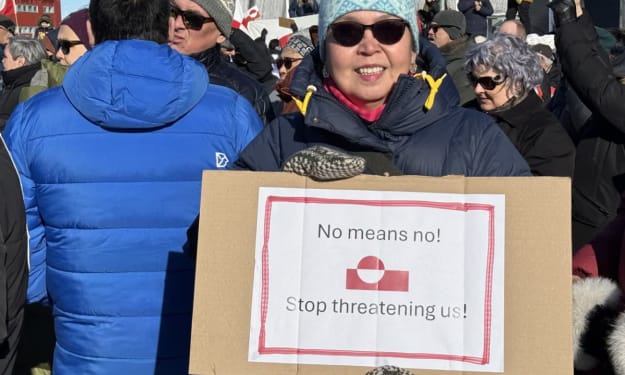
When former U.S. President Donald Trump once again raised the idea of asserting American control over Greenland, the response from the Arctic island was swift, united, and unequivocal. Greenlanders, through their political leaders, made one message clear to the world: they do not want to be Americans. The renewed rhetoric from Trump has not only revived an old controversy but also exposed deeper questions about sovereignty, identity, and the rights of small nations in an era of aggressive geopolitics. Greenland, the world’s largest island, may be sparsely populated, but its strategic importance has grown dramatically in recent years. Melting ice due to climate change has opened new shipping routes and access to vast reserves of rare-earth minerals, oil, and gas. These developments have turned the Arctic into a focal point of global power competition, drawing interest from the United States, China, and Russia alike. Yet for Greenlanders themselves, the conversation is not about global dominance — it is about dignity, autonomy, and the right to decide their own future. A United Political Front in Greenland One of the most striking aspects of the current moment is the rare unity displayed by Greenland’s political leadership. All major parties in the Inatsisartut, Greenland’s parliament, issued a joint statement rejecting any suggestion that Greenland could or should become part of the United States. Their words were firm and symbolic: “We don’t want to be Americans. We don’t want to be Danish. We want to be Greenlanders.” This statement was more than a reaction to Trump’s remarks; it was a declaration of identity. Greenland has spent decades gradually moving away from colonial dependence on Denmark. Since gaining home rule in 1979 and expanded self-government in 2009, the island has taken control of most domestic affairs, while Denmark still manages defense and foreign policy. Many Greenlanders view eventual independence as a long-term goal, but one that must come through democratic choice — not external pressure. Public opinion strongly supports this stance. Surveys consistently show that the overwhelming majority of Greenland’s population opposes becoming part of the United States. The idea of being “bought” or absorbed by another country is widely seen as outdated, disrespectful, and incompatible with modern principles of self-determination. Trump’s Renewed Interest and Strategic Arguments Donald Trump’s fascination with Greenland is not new. During his presidency, he openly floated the idea of purchasing the island, reportedly seeing it as a strategic asset that could strengthen U.S. military positioning in the Arctic and counter rival powers. His latest comments, which hinted that America might take Greenland “one way or another,” reignited fears about coercive diplomacy. From Washington’s perspective, Greenland’s location makes it invaluable. The U.S. already maintains a military presence at Pituffik Space Base (formerly Thule Air Base), a key component of missile defense and space surveillance. Trump and his allies argue that greater U.S. control would enhance security, prevent Chinese investment, and limit Russian influence in the Arctic. However, Greenlandic leaders strongly dispute the notion that their island is vulnerable or incapable of managing foreign partnerships responsibly. They argue that security concerns should be addressed through cooperation with Denmark and NATO, not through threats or unilateral ambitions. To many in Greenland, Trump’s rhetoric feels less like a security strategy and more like a return to 19th-century power politics. Identity, Culture, and the Fear of Losing Control Beyond geopolitics, Greenlanders’ resistance is deeply rooted in cultural and social concerns. Greenland’s population, predominantly Inuit, has a distinct language, traditions, and worldview shaped by Arctic life. The island’s social model prioritizes community welfare, public healthcare, and local decision-making tailored to its harsh environment. Many fear that becoming part of the United States would fundamentally alter these systems. Questions arise about healthcare access, land rights, environmental protection, and the preservation of Indigenous culture. For a society that has already experienced the long-term impacts of colonial rule, the idea of exchanging one external authority for another is deeply unsettling. Local voices have repeatedly emphasized that Greenland is “not for sale.” This sentiment reflects a broader rejection of being treated as a commodity rather than a community. The frustration is not only with Trump personally but with the mindset that assumes powerful nations can redraw borders without the consent of the people who live there. Denmark, NATO, and International Concerns Denmark has firmly backed Greenland’s position, warning that any attempt to force a change in the island’s status would violate international law and strain alliances. Danish leaders have stressed that Greenland’s future can only be decided by Greenlanders themselves, in accordance with existing self-rule agreements. The controversy has also raised concerns within NATO. If a leading alliance member were to threaten the territorial integrity of another member’s realm, it could undermine trust and cooperation at a time when unity is already under pressure from global crises. Allies worry that such disputes weaken the moral authority of democratic nations that claim to uphold international norms. A Defining Moment for Greenland’s Future Ironically, Trump’s threats may have accelerated conversations within Greenland about full independence. While economic challenges remain — including reliance on Danish subsidies — the current situation has strengthened national consciousness and political solidarity. Many Greenlanders now see greater autonomy not just as an aspiration, but as a safeguard against external interference. This moment is a reminder that in the modern world, power should not override principle. Greenland’s leaders are not denying the island’s strategic importance; they are insisting that strategic value does not cancel human agency. Their message resonates far beyond the Arctic, echoing the struggles of small nations everywhere that find themselves caught between competing global powers. Conclusion: Sovereignty Is Not Negotiable As tensions simmer, one truth stands out: Greenlanders are determined to speak for themselves. They reject the idea of becoming Americans not out of hostility, but out of a profound commitment to self-identity and self-rule. In doing so, they challenge a world order that too often prioritizes strategy over sovereignty. Whether Greenland eventually becomes fully independent or continues its partnership with Denmark, its future will be shaped by the will of its people — not by threats, deals, or geopolitical ambition. And in asserting that right so clearly, Greenland has delivered a powerful message: in the 21st century, nations are not possessions, and people are not bargaining chips.
By Muhammad Hassan4 days ago in The Swamp



Comments
There are no comments for this story
Be the first to respond and start the conversation.