
The Impact of Interest Rate Cuts on the United States Dollar, Global Markets, and Bitcoin
The Pros and Cons of Interest Rate Cuts

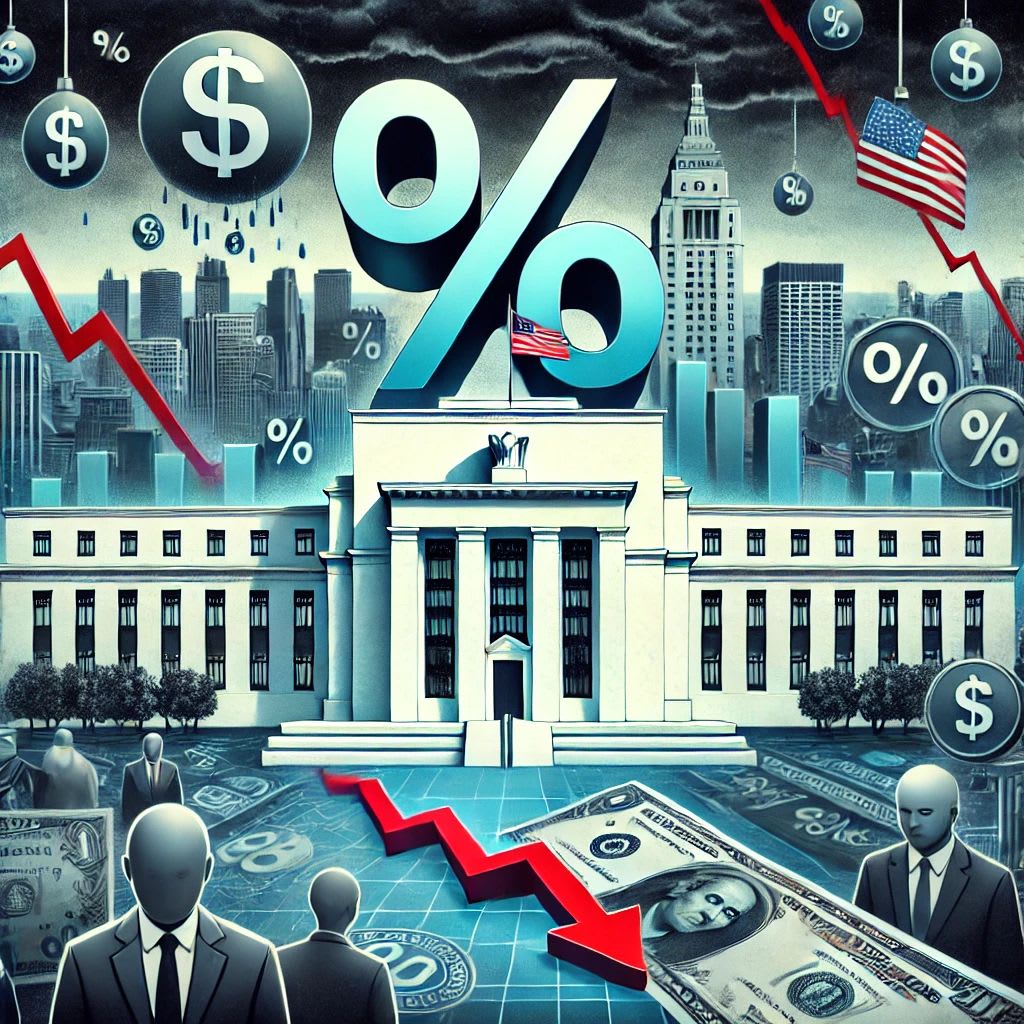
The Federal Reserve has a number of powerful instruments at its disposal, one of the most important of which is the choice to reduce interest rates. During periods of economic unpredictability, cutting interest rates can be an effective way to boost growth by lowering the costs of borrowing money for both consumers and businesses. There are, however, benefits and drawbacks associated with interest rate reductions, and the ramifications extend beyond the borders of the United States, having an effect on markets throughout the world as well as alternative assets such as Bitcoin. In this essay, we will discuss the benefits and drawbacks of lowering interest rates, with a particular emphasis on the ways in which this affects the economy of the United States, stock markets throughout the world, the United States dollar, and Bitcoin.
The Advantages of Reducing Interest Rates For Stimulating the Economy: Bringing down interest rates has a number of direct benefits, one of the most important of which is that it encourages borrowing and investment. Lower interest rates bring down the cost of borrowing money, making it more affordable for consumers and businesses alike to take out loans in order to finance significant purchases like homes and automobiles. This is because firms can use the money to expand their operations. The additional spending helps to promote demand across the economy, which in turn helps to revive growth during times of economic weakness or slowdowns.
Support for the Stock Market: Historically speaking, reductions in interest rates have a tendency to boost stock markets. Lower interest rates make it more affordable for businesses to borrow money, which can result in increased investments in areas such as research and development, infrastructure, and the creation of new jobs. It is possible that this may result in an increase in the profitability of the company, which will be reflected in higher stock prices. Furthermore, a decrease in the interest rates that are offered on savings accounts and bonds might make equity investments more appealing to investors who are looking for larger returns, which further drives up the value of the stock market.
Reduce the burden of debt: Cuts in interest rates reduce the amount of money that is required to be paid back for debt that is already being carried by consumers and businesses. Because of this reduction in interest payments, cash is made available for use in other areas, such as expenditure or reinvestment activities. Having lower interest rates also reduces the cost of servicing the national debt for the government, which is especially essential given the fact that the national debt of the United States continues to increase.
A weaker dollar can be beneficial to exports. Interest rate reduction often result in a weaker dollar for the United States. This is due to the fact that lower rates reduce the returns on dollar-denominated assets, which in turn makes these assets less appealing to investors from other countries. U.S. exporters can reap the benefits of a weakened dollar since it will make their products more competitive in international markets and more affordable. This can assist in the reduction of trade imbalances and the acceleration of economic growth in sectors of the economy that are driven by exports.
These are the drawbacks of lowering interest rates: capital outflows and a depreciation of the dollar: A reduction in interest rates carries with it the possibility of capital flight, particularly to nations that provide higher yields. This is one of the most serious dangers associated with the policy. If the Federal Reserve decides to lower interest rates, investors from across the world may decide to move their money out of the United States in order to pursue higher returns in other markets, such as China or Europe. The outflow of money can have a negative impact on the United States dollar, which can lead to an increase in the cost of imports and contribute to inflationary pressures.
The rapid depreciation of the dollar has the potential to destabilize global financial markets. This is because numerous nations maintain substantial reserves of U.S. dollars and assets denominated in these currencies. A significant drop in the value of the dollar might result in a decrease in trust in the financial markets of the United States. This would lead to foreign investors selling off assets in the United States, which would make the problem of capital outflow even worse.
The volatility of the stock market: Although reductions in interest rates have the potential to immediately stimulate the stock market, they may also result in increased volatility over the longer term. There is a possibility that investors' confidence in the market would deteriorate, which will result in a decline in equity prices, if they believe that rate decreases are an indication of underlying economic weakness. A further point to consider is that if the rate cuts are unsuccessful in preventing a recession, the market may crash as businesses struggle to deal with decreased consumer demand and declining profitability.
The reduction of interest rates leads to a rise in the money supply, which, if it is not well handled, can result in inflationary pressures (inflationary pressures). One of the factors that contributes to higher pricing for products and services in the United States is a weaker currency, which makes imports more expensive. It is possible for inflation to erode purchasing power, particularly for consumers who are on fixed incomes, if it grows at an excessively rapid rate. Additionally, this can have the effect of lowering the real returns on investments, particularly for fixed-income instruments such as bonds.
The United States' interest rate reduction may have limited effectiveness in promoting development in today's interconnected global economy. This is especially true if other major economies, such as China, are following monetary policies that are in direct opposition to those of the United States. For example, if China maintains its low interest rates and continues to attract global capital, the effectiveness of rate cuts implemented by the United States could be decreased. This is because money would move out of the United States and into investments that generate higher returns in other countries. It is possible that the benefits of rate reduction for the domestic economy could be outweighed by this capital flight, which would make it more difficult for the United States to keep the capital that is necessary for growth.
Repercussions for Bitcoin and other online currencies
The influence that interest rate reductions have on Bitcoin and other cryptocurrencies is one of the result that comes as a surprise to the most people. During times of instability in the economy and a decline in the value of the dollar, Bitcoin has become an alternative asset class that has garnered more attention.
As a hedge against the weakening of the dollar, Bitcoin is a pro. Bitcoin has frequently been referred to as "digital gold," which is a defense mechanism against inflation and currency depreciation. The price of Bitcoin may increase as a result of investors using it as a store of wealth when the value of the United States dollar decreases. As a result of institutional investors beginning to allocate portions of their portfolios to cryptocurrencies in order to diversify their holdings and protect themselves against the possibility of market instability, this tendency has become increasingly apparent in recent years.
However, Bitcoin is still a highly speculative asset and continues to be prone to great volatility. A disadvantage of Bitcoin is that it has increased volatility. The reduction of interest rates has the potential to increase the demand for Bitcoin; yet, it also has the potential to result in significant sell-offs if investors choose to liquidate their holdings in order to compensate for losses elsewhere in their portfolios. Furthermore, regulatory uncertainty in major economies such as the United States and China could add to even more volatility, which would make Bitcoin an investment that is dangerous during times of market instability.
The reduction of interest rates is a sword with two edges. On the one hand, they have the potential to supply the United States economy with the much-required necessary stimulus, to raise the stock market, and to ease the burden of debt for both firms and consumers. On the other hand, they run the risk of causing capital outflows, a depreciation of the dollar, volatility in the stock market, and inflationary pressures.
In an economy that is international, the impact of rate cuts implemented by the United States is further hampered by the policies implemented by other major economies such as China. It is also possible that the financial system could see higher volatility as a result of interest rate decreases, which will cause investors to gravitate toward alternative assets such as Bitcoin. This development would make the current economic landscape even more unstable.
Ultimately, in order to successfully navigate a fragile global economy, the Federal Reserve must carefully consider the benefits and drawbacks of performing additional rate decreases. The choices that are made today will have long-term repercussions for markets, currencies, and alternative assets wherever they are found in the world.
About the Creator
Estalontech
Estalontech is an Indie publisher with over 400 Book titles on Amazon KDP. Being a Publisher , it is normal for us to co author and brainstorm on interesting contents for this publication which we will like to share on this platform
Keep reading
More stories from Estalontech and writers in The Swamp and other communities.
Miniature Mind Musings #11:
Are there infinite levels to this lowness, or is there a sale on somewhere? Blink for one minute… Sheesh! I don’t think words like “politics” or “leadership” are gonna be definitions that leave the masses feeling all warm and fuzzy inside anymore for a long time.
By The Dani Writer5 days ago in The Swamp
'20/20'
"Do It Again" the track that would ultimately open the Beach Boys final album on Capitol Records which was released on February 10th 1969 had originally been released as a single in August of 1968. The track was the first of many post-Pet Sounds era throwbacks to the early Beach Boys sound which would become continually more cliched and eventually lead the Beach Boys to the level of self-parody they would eventually succumb to in the 1980s while their closest contemporaries The Beatles nearing the end of their run in 1969 would go on to be viewed as the most influential band of all time. However, the song itself is not bad on its surface, and it opens with a futuristic sounding (for 1969) drumbeat captured by then-Beach Boys engineer Stephen Desper using tape delays on the drums performed by Dennis Wilson and John Guerin. The song has been re-recorded numerous times over the years on various Beach Boys-related projects most notably the 2011 re-recording at Capitol studios featuring the five surviving Beach Boys at the time backed instrumentally by various members of both the Brian Wilson Band and Mike Loves touring "Beach Boys" to promote the then upcoming Beach Boys 50th Anniversary reunion tour in 2012. The hammering and power drill sound at the end of the song was an excerpt from a track called "Workshop" that was to be a part of the uncompleted "SMiLE" album.
By Sean Callaghan6 days ago in Beat


Comments
There are no comments for this story
Be the first to respond and start the conversation.