politics
Politics does not dictate our collective cultural mindset as much as it simply reflects it; We've got to look in the mirror sometimes, and we've got one.
Aboriginal Crisis In Canada Dissected
People who are of First Nation descent have been stuck in an oppressive cycle for decades, yet it seems like the Canadian government only cares when it suits their agendas. There have been attempts of reconciliation over the past few years between the government and First Nation communities, but is that enough? Where is the funding that they have promised? And why haven't they tackled the daily living conditions of those communities? It seems like it takes a state of emergency for officials to take notice of what is really going on in Canada.
By Nat Morrissette8 years ago in The Swamp
Democracy and Regime Changes
Between 1917 and 1991, Russia was a single-party state led by the Bolsheviks, later to be known as the Communist Party of the Soviet Union (CPSU) (Service 2009, 62). From the beginning, the CPSU had authoritarian tendencies that were built into the communist institutions of the Soviet regime. They held a monopoly of political and economic power in the Soviet Union in terms of having a “Leninist party dictatorship, a transformative ideology, central planning, and state ownership of the means of production.” (Bunce 1999, 22). By the time Gorbachev took the office of General Secretary in 1985, the Soviet centralized economy required major reforms in order to increase the quantity and quality of industrial output that would meet the levels of the United States and Western European states (Service 2009, 441). In 1987, Gorbachev introduced two reforms: perestroika (reconstruction) and glasnost (openness). Glasnost opened the space for the airing of grievances, for more information to be available, and for media to be freer. While the Soviet Union was once capable of repressing nationalism, Gorbachev’s social reforms led many ethnic groups of the Soviet Union and the Soviet Bloc into nationalist mobilization (Service 2009, 456-458). On December 26th, 1991, the Belavezha Accords effectively ended the Soviet Union and were signed by the Russian President Yeltsin, Ukrainian president Kravchuk, and Belarusian parliament chairman Shushkevich (Service 2009, 506-507). Following the collapse of the Soviet Union, Russia experienced a triple transition, meaning a political and economic transition and a transition in statehood, in which Russia was recognized as a sole state. While Yeltsin played an essential role in the development of an embryonic Russian democracy, his later years were marked by a partial retreat from the development of a truly democratic political system. The difficulties of the economic transition and the political complications that ensued convoluted the task of creating a solid foundation for a democratic society in the Western sense (Service 2009, 529-534). The results were perverse, as there was a rise in oligarchs, this term “refers to a small group of leaders in the largest financial and industrial structures who are closely tied to the regime” (Zudin 2000, 5).
By Kayla Charles8 years ago in The Swamp
Democrats Are No Longer the Party of FDR and LBJ
The Democratic Party often times reminds voters and republicans that the GOP is no longer the party of Abraham Lincoln, as the Republican Party have begun to use dog whistle racism as a tactic to energize their base. I have no problem with reminding the Republicans of this fact, it's true that if Abraham Lincoln ran today he'd have been called a RINO and would not have had a shot in the primaries. He would've been lucky to win a nomination for a local race, much less the Presidency. But Democrats also need to remember that they are no longer the party of Franklin Roosevelt and Lyndon Johnson.
By Ryan Golden8 years ago in The Swamp
Socialism in the 21st Century
Socialism: some thoughts on its relevance in the 21st century. Socialism is defined as an economic theory or system in which the means of production, distribution and exchange are owned by the community collectively, usually through the state.
By Peter Rose8 years ago in The Swamp
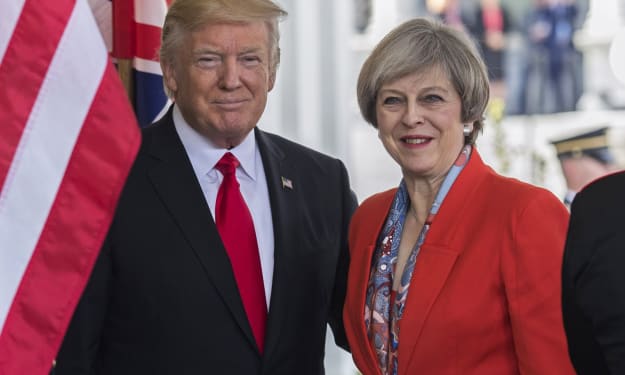
Trump, Brexit and the Politics of Isolationism
This year has been a tumultuous one for British history, defining the final breakaway of the United Kingdom from its somewhat rocky marriage with the European Union. Winston Churchill’s idea of a United States of Europe seems more impossible today than even when it was first proposed.
By Abdullah Masood8 years ago in The Swamp
Allowing Totalitarian Regimes to Take Over
The causes of totalitarian regimes taking power: In Germany, between 1930 to 1940, there was starvation, there was extreme poverty, there was total despair, and no one did anything to help the suffering except one man who came along in the name of the National Socialist Party. He promised salvation, food, strength, power, and pride. What would you do? Assume you have no knowledge of history, you are living in despair, and your children are starving. Would you follow someone who gives hope? You have nothing to lose.
By Peter Rose8 years ago in The Swamp
The Poverty Trap
As of 2013, in Ontario there were a total of 460,100 people on Ontario Works. Of this, 64 percent were adults, with 27 percent being single adults. There were also 427,100 recipients of the Ontario Disability Support Program (ODSP). Ontario may be one of the worst provinces for their social assistance and policies. Welfare creates an everlasting trap for all recipients, keeping their recipients below the poverty line, and trapping them there with their policies. Not only are rates far lower than in previous reports, but they are also much too low for this wage alone to support a family/person. Rates of adults using food banks has increased dramatically because of the inflation and increases in everyday costs. The poverty gap has increased by about 200 percenrt since 1993, leaving many recipients living on incomes 60 percent below the poverty line in Ontario.
By Rion Marks8 years ago in The Swamp
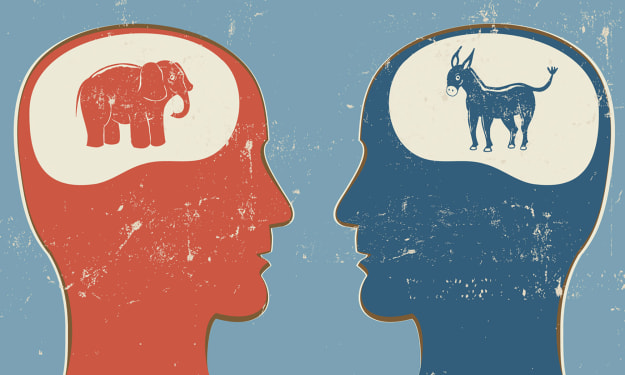
Guide to American Political Parties
Politics. It’s what makes America… America. Even if you're not crazy about politics, or perhaps hate the topic, you hear it almost everywhere you go. It’s one of the main conversation topics that almost always end up becoming an argument, because everyone has a different view on how the country should be. But not everyone is right and not everyone is wrong — that is where politics come in.
By Jacqueline Hanikeh8 years ago in The Swamp
Getting Over It: Brexit & The Mythmaking Saboteurs
Much of the last 2 years in politics has been unpredictable and surprising. Brexit has started the UK on a radical journey that looks to be messy, bumpy, and hard to forecast. But there are a few things we can be relatively sure of. The kind of Brexit we get very much depends on how debates are settled in the UK. Brexit produces the need for a vast number of debates because it will effect every pocket of governance, business and the economy. Sweeping changes with far reaching repercussions are to be introduced; touching on the border arrangements in Northern Ireland, regional funding, devolved powers, regulatory environments and the bodies that maintain them, post-Brexit trade policy, immigration systems & policies and thousands of laws and regulations.
By Dan Dutchison8 years ago in The Swamp