agriculture
Tackling food waste, research and global debates about agricultural sustainability and how to feed our population while still saving some for later.
Neonicotinoids: A Bee’s Death Sentence
For the past couple of years, rising allegations from environmental groups have accused The Environmental Protection Agency (EPA) and the agricultural industry of lackadaisical environmental regulations and poor Agriculture practices, which are triggering a collapse of colonies in the wake of the most recent demising in bees.
By C.R. Pattison6 years ago in The Swamp
Global Warming: Truth or Myth?
In December 2014, fifty scientists and disseminators, members of the Committee for Skeptical Research, published a manifesto asking that those who question the theory of climate change and its anthropocentric origin not be called skeptics.
By creatorsklub6 years ago in The Swamp
Nature Is Engraved into Our Bones
A couple summers ago I went on a trip for one of my classes. We visited two farms; one used organic farming techniques, while the other was a large farming industry that produced cherries. We visited both places in order to see the different perspectives each farmer had on how they viewed money and the industry as a whole, and see what values they stand by and how that influences the way they do business. The organic farmer discussed the hardships of using natural processes and steering away from using pesticides and preservatives.Though it takes a lot more work and he receives less of a profit than his competitors, his respect for the land pushes him to continue utilizing natural methods that are beneficial for the crops and land. On the contrary, the owner of the cherry farm was very driven by keeping his production rates high and making a large profit. He did not find any problems with using pesticides and preservatives for his product, saying that the processes he uses on his farm has no implications on the land. He said that its a necessary means in order to please the consumer and have a better product than your competitor. His mentality was similar to an article I read, "Making Meat," by Boyd W. The article discussed how technology has changed the dynamic of biological processes and humans have found a way to alter things within nature in order to better suit their needs. Nature has become subjected to industrialization and is used and abused for the sole purpose of industries and large corporations to make a profit and spread their business globally. However; trying to fight and go against the structures of nature has implications on its own. As discussed in the article selective breeding reduces genetic diversity, creating genetic monocultures and the excessive use of antibiotics increases the risk of an outbreak of antibiotic resistant bacteria.
By Jasmine Elbekraoui6 years ago in The Swamp
3 Compelling Reasons Why You Should Use Less Plastic (And 7 Simple Ways You Can Do So)
De Beers indoctrinated a generation to believe that “diamonds are forever…" but over time, we’ve learned that it’s plastic that lasts forever. And as it turns out, this has serious implications for our future as a species.
By Aubrey Holt6 years ago in The Swamp
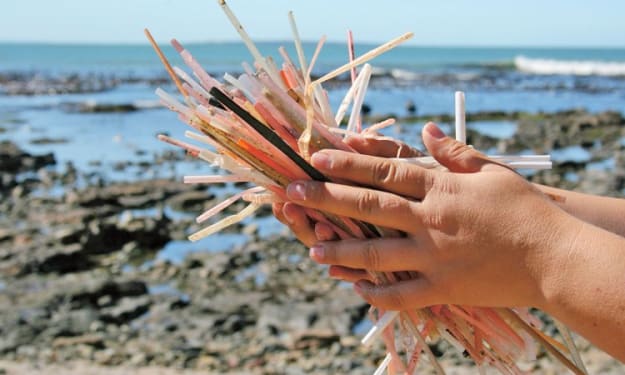
Why We Should Unite in Sensitizing People Against the Unnecessary Use of Plastic Straws
Although some people use straws for good reasons such as feeding the sick and the disabled, the majority use straws for, well, not-so-important purposes such as siphoning carbonated drinks in restaurants or to get ketchup flowing from its bottle. What many don’t understand, however, is that plastic straws are the single biggest threat to environmental conservation.
By Robert Gitau6 years ago in The Swamp
5 Small Changes to Reduce Your Eco Footprint
When it comes to supporting the environment, every individual plays a unique role in reducing their carbon footprint. Overhauling your lifestyle may seem intimidating, but there are some small steps you can take to live a greener life. These steps will add up over time and influence others to do the same.
By Tobias Gillot6 years ago in The Swamp
Take the Plastic-Free Challenge
Plastics in our environment have been trending quite frequently in social media, as well as online lately. I have been seeing the damage that plastics have done, and it hurts me deeply how the planet is suffering, and how it is affecting every single one of us, in one form or another.
By Heidi Zator6 years ago in The Swamp
5 Waste Water Treatment Ideas to Save Nature
Many large cities in India are already grappling with the water crisis, and the treatment of wastewater is necessary to meet the huge demand. But we can always try to save water with some simple practices. You can save water in your daily life by fixing all the leaking taps in your homes and consuming less water for household purposes. Organizations, like Geo India, are trying to make citizens aware of the consequences of the water shortage and the necessity of saving water.
By Kedy Semark7 years ago in The Swamp
Why Transitioning to a Vegan Economy Wouldn't Reduce Greenhouse Gas Emissions
Pretty much every activity humans undertake has an emissions footprint of some description, and animal agriculture is no different. However, when the suggestion arises that since animal agriculture is responsible for quite a large proportion of manmade greenhouse gas emissions and that we can eliminate these emissions immediately through simply getting rid of it, there are major issues that the vegan activist community has failed to address, and which could spell disaster if such a system were to be implemented. What they've as yet failed to establish is what the current system of agriculture is to be replaced with, the timescales involved and whether or not this new paradigm will actually emit less methane and CO2; additionally, they've failed to answer the most important question in all this: whether or not vegan agriculture can actually feed the population. In addition to this, I suspect that animal agriculture isn't the progenitor of the rising levels of atmospheric methane, which started in the 19th century, since this rise followed the Industrial Revolution and the burning of fossil fuels, not the Agricultural Revolution of the 17th century.
By Sam Cottle7 years ago in The Swamp
The Birds and the Bees
It's a summers day, the grass is lush and green and soft beneath my feet. The air is full of butterflies and other insects, and the bees go about their daily task of pollinating the flowers and making honey, something they have done for thousands of years. To my right is a line of ancient oak trees. The soft breeze gently blows through the leaves, creating dappled patterns of light on the forest floor. In the distance, the light dances on the surface of the lake, sparkling like millions of silverfish and I feel peaceful. The year is 1983, and in my naivety, I think this is how it will always be.
By Jean Luc Lafitte7 years ago in The Swamp
Palm Oil: What Is It and How to Avoid It
From the food you eat to the toothpaste used to wash it away, palm oil is found in thousands of everyday products. Harvested from the fruit of oil palms, this edible fat is cheap to produce, versatile, and the most resource efficient source of vegetable oil, making up 45 percent of the supply and employs 6 million worldwide including smallholder farmers.
By The Green Report7 years ago in The Swamp