
Taco Trump: The Tweet, The Controversy, and the Cultural Conversation
How a Simple Taco Bowl Post Sparked a Bigger Debate on Culture and Politics

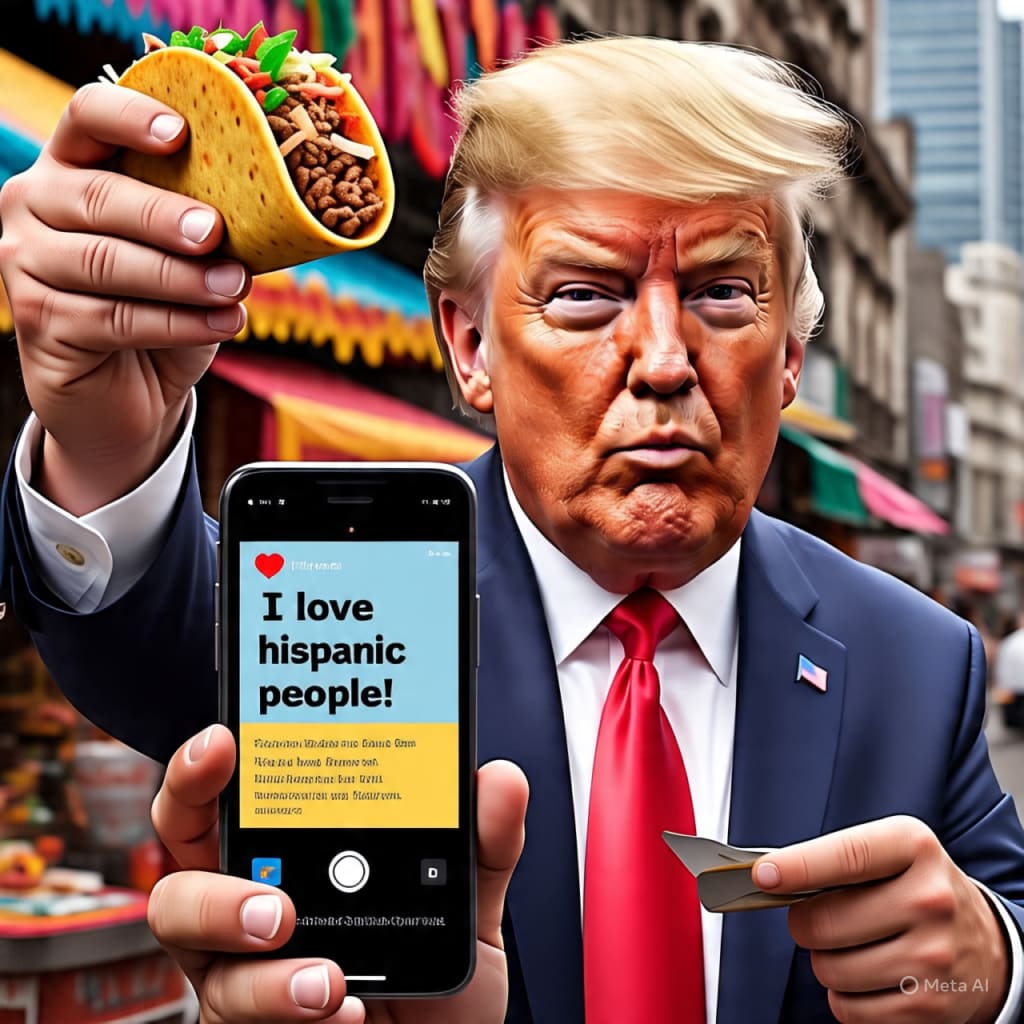
Introduction: When Food Meets Politics
In 2016, then-presidential candidate Donald Trump posted a photo on Twitter eating a taco bowl on Cinco de Mayo, writing, “I love Hispanics!” At first glance, it looked like a light-hearted post. But quickly, it became a topic of national conversation. Many saw it as an attempt to connect with Latino voters, while others found it insensitive and symbolic of a much deeper issue—cultural misunderstanding and political messaging.
Now in 2025, the term “Taco Trump” has become a reference point in discussions about political branding, outreach to minority communities, and how social media plays a role in public perception.
What Happened on Cinco de Mayo
On May 5, 2016, Donald Trump posted a photo of himself at Trump Tower eating a taco bowl. The caption read:
“Happy Cinco de Mayo! The best taco bowls are made in Trump Tower Grill. I love Hispanics!”
The tweet was meant to celebrate Cinco de Mayo, a Mexican holiday often marked with food, music, and parties in the United States. But instead of building goodwill, the post sparked criticism from many directions.
Why Was It Controversial?
To understand the reaction, it’s important to look at what was happening at the time:
Trump had made strong anti-immigration statements, especially about Mexico.
He called for building a wall between the U.S. and Mexico.
He had questioned birthright citizenship and suggested that many immigrants were criminals.
In this context, many people viewed the tweet as tone-deaf. Eating a taco bowl and claiming to “love Hispanics” seemed too simple and disconnected from the real issues affecting Latino communities, such as immigration policy, discrimination, and economic opportunity.
Cultural Representation vs. Stereotyping
Many Latino Americans felt that the tweet reduced their culture to a single food item. While tacos and taco bowls are popular in Mexican cuisine, they do not represent the full diversity of Hispanic or Latino culture.
Key criticism:
Using food to represent an entire group of people, especially when your policies are seen as harmful to that group, can feel more like stereotyping than respect.
How Social Media Amplified the Moment
The tweet quickly went viral. News outlets, comedians, and political commentators reacted. Memes were created. The phrase “Taco Trump” became a nickname used by both critics and internet users to discuss the awkwardness of the moment.
This is a clear example of how one social media post can affect a candidate’s image. Supporters said it was just a fun post. Critics argued it showed a lack of understanding of the communities Trump was trying to reach.
What Was Trump’s Goal?
Many analysts believe the tweet was an attempt at outreach. Trump had been accused of not connecting with minorities, especially Latinos, so the post may have been meant to soften his image.
However, genuine outreach usually requires listening, dialogue, and long-term engagement—not just a single post with a taco bowl.
The Bigger Picture: Food and Politics
This moment opened a broader conversation in the U.S.:
Can politicians use culture to show connection?
When does it become “performative” instead of real?
Is it enough to say you love a culture if your policies don’t support that community?
These are important questions not just for Donald Trump but for all public figures. In today’s world, every post and every message is seen, shared, and judged by millions.
Legacy of “Taco Trump”
Even in 2025, people still talk about the “Taco Trump” moment. It’s used in classrooms, social media debates, and news discussions as an example of how symbolism without substance can backfire.
Politicians are learning that voters want more than catchy posts—they want real actions, real respect, and real results.
Conclusion: A Lesson in Communication
The “Taco Trump” moment teaches an important lesson: intentions matter, but context matters more. In trying to connect with voters, especially from different backgrounds, it’s not enough to just show interest. Leaders must be willing to listen, learn, and support those communities in ways that go beyond food and photos.
In the age of social media, one image can tell a powerful story—but it can also raise serious questions. The legacy of “Taco Trump” is a reminder that real respect is built over time, not in a tweet.
About the Creator
Saad
I’m Saad. I’m a passionate writer who loves exploring trending news topics, sharing insights, and keeping readers updated on what’s happening around the world.
Nvidia Suppliers Halt Work After China Blocks H200 Chip Shipments
The global semiconductor industry is once again caught in the crossfire of geopolitics and technology. This time, the spotlight is on Nvidia’s H200 artificial intelligence chip, as reports confirm that several Nvidia suppliers have halted production after China blocked shipments of the high-performance processor at its borders. What may seem like a routine customs issue is actually far more significant. The decision has disrupted supply chains, unsettled investors, and raised fresh concerns about the future of AI development amid escalating U.S.–China tech tensions. So what exactly happened, and why does it matter so much? What Triggered the Sudden Halt? According to multiple reports, Chinese customs authorities recently informed logistics agents that Nvidia’s H200 chips would not be allowed into the country. This instruction came quietly, without a public policy announcement, but its effects were immediate. Suppliers responsible for producing specialized components used exclusively in the H200 chip responded by pausing operations. These parts are highly customized and cannot easily be repurposed for other products, meaning continued production would risk piling up inventory that cannot be sold or shipped. For suppliers already operating on tight margins, stopping work was the safest financial option—even though it came at a significant cost. Why the Nvidia H200 Chip Is So Important The H200 chip is one of Nvidia’s most advanced AI processors, designed specifically for heavy-duty workloads such as training large language models, data-center AI operations, and advanced cloud computing tasks. It builds on Nvidia’s earlier AI chips and delivers improved memory performance and processing speed, making it especially attractive to companies working at the cutting edge of artificial intelligence. China has been a major market for Nvidia’s AI hardware. Demand for the H200 reportedly surged among Chinese tech giants, research institutions, and cloud service providers eager to stay competitive in the global AI race. Some estimates suggest Chinese orders reached well over one million units, far exceeding initial supply expectations. That demand is exactly why the shipment block has sent shockwaves through the industry. The Role of U.S. Export Controls To understand the bigger picture, it’s important to look at U.S. export restrictions on advanced semiconductors. Earlier this year, U.S. authorities allowed Nvidia to sell the H200 to China under strict licensing conditions. These included safeguards to prevent military use, third-party verification requirements, and limits on shipment volumes. While the approval was narrower than Nvidia had hoped for, it still opened the door for legal exports. However, China’s decision to block the chips suggests that U.S. approval alone is no longer enough. Beijing appears to be asserting its own strategic priorities, regardless of Washington’s licensing decisions. Why China May Be Blocking the Chips China has not issued an official explanation, but several motivations are widely discussed: 1. Reducing Dependence on Foreign AI Hardware China has been investing heavily in domestic semiconductor development. Limiting access to advanced foreign chips could push companies to adopt homegrown alternatives faster. 2. Strategic Leverage Advanced AI chips are now viewed as strategic assets. Controlling their flow gives governments leverage in broader trade and diplomatic negotiations. 3. National Security Concerns Even with export safeguards in place, China may be wary of relying on U.S.-designed technology for critical infrastructure and AI systems. Whatever the reason, the message is clear: AI hardware is no longer just a commercial product—it’s a political tool. Impact on Nvidia’s Supply Chain For Nvidia’s suppliers, the fallout has been immediate and painful. Many of these companies manufacture chip packaging, substrates, and printed circuit boards specifically designed for the H200. These components have little value outside Nvidia’s AI ecosystem, making them difficult to sell elsewhere. By halting production, suppliers are trying to avoid deeper losses—but the pause also highlights how vulnerable global supply chains have become to sudden regulatory decisions. This is not the first time Nvidia has faced such disruption. In the past, China-specific chips designed to comply with export rules were also shelved after regulatory uncertainty made them commercially unviable. Market Reactions and Investor Concerns News of the production halt has unsettled investors, raising concerns about Nvidia’s revenue projections and long-term China strategy. China represents a massive portion of global AI demand, and losing or delaying access to that market could force Nvidia to: Redirect inventory to other regions Adjust pricing strategies Slow future capacity expansion Reevaluate product designs to meet shifting regulations While Nvidia remains dominant in AI chips globally, repeated disruptions could give competitors—both Western and Chinese—an opportunity to gain ground. What This Means for China’s Tech Giants For Chinese companies, the shipment block creates new challenges. Major firms such as Alibaba, Tencent, and ByteDance rely heavily on advanced AI hardware to train models, power cloud services, and develop consumer applications. Without access to the H200, these companies may have to: Rely on older Nvidia chips Explore alternative suppliers Accelerate development of domestic AI processors In the short term, this could slow some AI projects. In the long term, it may strengthen China’s push for technological self-sufficiency. A Bigger Signal in the Global AI Race The Nvidia H200 situation is not an isolated incident—it’s a sign of where the world is headed. Artificial intelligence has become a strategic priority, and the chips that power it are now treated like critical infrastructure. Governments are increasingly willing to intervene, restrict, or block access in pursuit of national goals. As a result, companies operating in this space must now navigate not just market forces, but geopolitical risk at every stage of production and distribution. What Happens Next? At this stage, it’s unclear whether China’s block is temporary or the beginning of a longer-term policy shift. Much will depend on behind-the-scenes negotiations, future export rules, and how aggressively China pushes domestic alternatives. One thing is certain: the pause in Nvidia’s H200 supply chain underscores a new reality—the future of AI will be shaped as much by politics as by innovation. And for companies like Nvidia, adaptability may be just as important as technological leadership.
By Muhammad Hassanabout 10 hours ago in The Swamp


Comments (1)
This whole "Taco Trump" thing is really interesting. It shows how something as simple as a tweet can turn into a huge deal. You made a good point about how it was tone-deaf considering his anti-immigration stance. It makes me wonder how politicians can better understand and respect different cultures when trying to connect. Maybe they should consult with people from those communities before posting something like that. What do you think?